
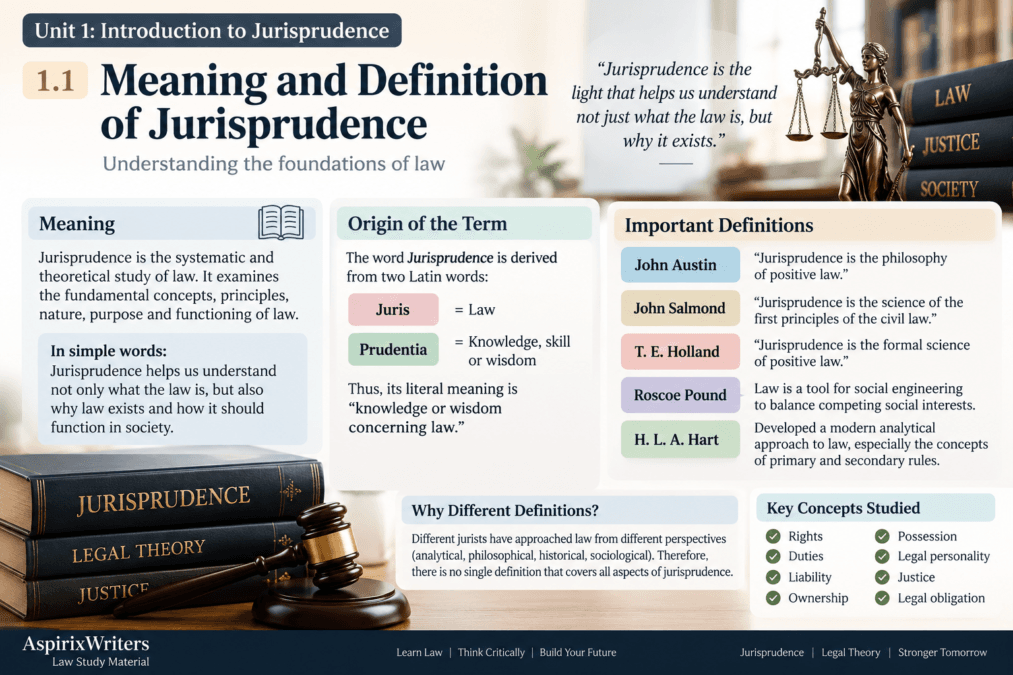
1.1 Meaning and Definition of Jurisprudence
Introduction
Jurisprudence is the systematic and theoretical study of law. It examines the basic concepts, principles, nature, purpose and functioning of law.
In simple words:
Jurisprudence helps us understand not only what the law is, but also why law exists and how it should function in society.
Don’t Miss New Law Opportunities!
Join our WhatsApp community for verified updates on Law Jobs, Internships, Competitions, Scholarships, LLB Notes & more.
Meaning
The word Jurisprudence is derived from two Latin words:
- Juris — Law
- Prudentia — Knowledge, skill or wisdom
Thus, its literal meaning is knowledge or wisdom concerning law.
Important Definitions
John Austin
“Jurisprudence is the philosophy of positive law.”
Austin focused mainly on positive law and its analytical study.
John Salmond
“Jurisprudence is the science of the first principles of the civil law.”
Salmond emphasised the fundamental principles underlying law.
T. E. Holland
“Jurisprudence is the formal science of positive law.”
Holland focused on the form and fundamental concepts of legal relations.
Roscoe Pound
Pound viewed law in relation to society and is closely associated with the concept of social engineering—the use of law to balance competing social interests.
H. L. A. Hart
Hart developed a modern analytical approach to law, particularly through his distinction between primary and secondary rules.
Why Are There Different Definitions?
Different jurists studied law from different perspectives:
| Jurist | Main Emphasis |
|---|---|
| Austin | Positive law |
| Salmond | First principles of civil law |
| Holland | Formal aspects of law |
| Pound | Law and society |
| Hart | Legal rules and legal system |
Therefore, jurisprudence cannot be confined to one narrow definition.
Simple Understanding
Jurisprudence = Law + Legal Concepts + Principles + Purpose + Society
It deals with fundamental concepts such as:
- Rights
- Duties
- Liability
- Ownership
- Possession
- Justice
- Legal obligation
Exam Point
Remember:
Austin → Positive Law
Salmond → First Principles
Holland → Formal Science
Pound → Social Engineering
Hart → Primary & Secondary Rules
Conclusion
Jurisprudence is a broad and evolving study of law. It provides the conceptual foundation for understanding different branches of law and helps students analyse the nature, principles, purpose and social role of law.
Frequently Asked Questions (FAQs)
1. What is Jurisprudence?
Jurisprudence is the systematic and theoretical study of law, including its fundamental concepts, principles, nature and purpose.
2. What is the literal meaning of Jurisprudence?
The word Jurisprudence comes from the Latin words Juris, meaning law, and Prudentia, meaning knowledge, skill or wisdom. It therefore refers to knowledge or wisdom concerning law.
3. Who defined Jurisprudence as the philosophy of positive law?
John Austin defined jurisprudence as the “philosophy of positive law.”
4. What is Salmond’s definition of Jurisprudence?
John Salmond defined jurisprudence as the “science of the first principles of the civil law.”
5. What is Holland’s definition of Jurisprudence?
T. E. Holland defined jurisprudence as the “formal science of positive law.”
6. Who is associated with social engineering in Jurisprudence?
Roscoe Pound is closely associated with the concept of social engineering, which views law as a means of balancing competing social interests.
7. What is the difference between Law and Jurisprudence?
Law primarily consists of legal rules and principles applicable within a legal system, whereas jurisprudence studies the underlying concepts, foundations, principles and theoretical questions concerning law.
8. What are the main concepts studied in Jurisprudence?
Jurisprudence commonly examines concepts such as rights, duties, liability, ownership, possession, legal personality, justice and legal obligation.
Explore
Don’t Miss New Law Opportunities!
Join our WhatsApp community for verified updates on Law Jobs, Internships, Competitions, Scholarships, LLB Notes & more.
About the Author: Dr. Rekha Khandelwal is a Ph.D. in Law and experienced legal educator, researcher, and academic writer specializing in law, legal research, and AI governance. [Read Full Author Profile →]
Explore more –
✔ Professional Writing Services
Classmate Pulse Spiral Notebook ✏️ Need a Spiral Notebook for Everyday Writing? A spiral notebook…

Latest Scholarships & Fellowships 2026–27: Open Opportunities for Upcoming call
Latest Scholarships & Research Fellowships 2026–27 Last Verified: 30 September 2026 Students, researchers, PhD scholars…
Writing & Research Resources: Useful Books, Tools & Essentials for Writers and Researchers
Whether you are an author, content writer, law student, academic researcher, PhD scholar, teacher, or…