
Constitution Of India
Introduction to the Constitution of India — Historical Background and the Union and Its Territory (Articles 1–4)
Subject: Constitutional Law | Module: Constitutional Foundations | Suitable for: 3-Year LL.B. and 5-Year Integrated LL.B. (BA LL.B. / BBA LL.B. / B.Com LL.B.) students
1. Introduction
Every study of Indian Constitutional Law begins with two questions: where did this Constitution come from, and what exactly does it govern? This note answers both. It traces the historical process by which India acquired its Constitution, and then examines Part I of the Constitution (Articles 1 to 4), which defines India as a Union of States and lays down Parliament’s power to alter the internal map of that Union.
Part I is deceptively short — only four Articles — but it is one of the most frequently used parts of the Constitution in practice. Nearly every reorganisation of Indian states, from the linguistic reorganisation of 1956 to the bifurcation of Andhra Pradesh in 2014 to the reorganisation of Jammu and Kashmir in 2019, has been carried out under Article 3. Understanding this topic is therefore essential both for constitutional theory and for tracing later developments in federalism.
2. Historical Background — How India Got Its Constitution
2.1 Constitutional developments before 1950
India’s Constitution did not emerge in isolation. It built upon a series of British-era constitutional statutes:
- Regulating Act, 1773 and subsequent Charter Acts — early administrative framework of Company rule.
- Government of India Act, 1858 — transferred governance from the East India Company to the British Crown.
- Indian Councils Acts (1861, 1892, 1909) — introduced limited legislative participation for Indians.
- Government of India Act, 1919 (Montagu–Chelmsford Reforms) — introduced diarchy in provinces.
- Government of India Act, 1935 — the most significant precursor. It introduced provincial autonomy, a federal scheme (never fully implemented), and supplied the structural skeleton — and a large proportion of the actual text — later adapted by the Constituent Assembly.
2.2 The Constituent Assembly
- The idea of a Constituent Assembly composed of Indians was first demanded by the Indian National Congress in 1934 and accepted in principle through the Cabinet Mission Plan, 1946.
- The Constituent Assembly first met on 9 December 1946, without participation from the Muslim League.
- Dr. Rajendra Prasad was elected President of the Assembly.
- The Assembly functioned through several committees; the most important for drafting was the Drafting Committee, chaired by Dr. B.R. Ambedkar, constituted on 29 August 1947.
- The Objectives Resolution, moved by Jawaharlal Nehru on 13 December 1946, laid down the founding philosophy — sovereignty, republicanism, justice, liberty, equality and fraternity — that later crystallised into the Preamble.
2.3 Adoption and commencement
- The Constitution was adopted and enacted by the Constituent Assembly on 26 November 1949 — commemorated today as Constitution Day / Samvidhan Diwas.
- Most provisions came into force on 26 January 1950, chosen deliberately to mark the anniversary of the 1930 Purna Swaraj (complete independence) resolution of the Indian National Congress. This date is celebrated as Republic Day.
- A limited set of provisions (relating to citizenship, elections and provisional Parliament) came into force earlier, on 26 November 1949 itself.
2.4 Sources of the Constitution
The Constitution is often described as a “borrowed” document, though it is more accurate to say it adapted features from multiple constitutional systems to Indian conditions:
| Feature Borrowed | Source Constitution/Instrument |
| Federal structure, judiciary details, office of Governor, emergency powers (structural core) | Government of India Act, 1935 |
| Fundamental Rights | United States Constitution |
| Directive Principles of State Policy | Irish Constitution |
| Cabinet form of government, parliamentary system | United Kingdom (Westminster model) |
| Concurrent List, freedom of trade and commerce | Australian Constitution |
| Amendment procedure | South Africa |
| Fundamental Duties | Constitution of the erstwhile USSR |
The Constitution of India originally contained 395 Articles at the time of its commencement on 26 January 1950. Through subsequent constitutional amendments, numerous new Articles have been inserted. Today, the Constitution is commonly stated to contain 448 Articles when the inserted lettered provisions (such as Articles 21A, 243A and 371H) are counted separately.
3. Part I of the Constitution — Legal and Statutory Framework
Part I is titled “The Union and its Territory” and contains Articles 1 to 4.
| Article | Subject Matter |
| Article 1 | Name and territory of the Union |
| Article 2 | Admission or establishment of new States |
| Article 3 | Formation of new States and alteration of areas, boundaries or names of existing States |
| Article 4 | Laws made under Articles 2 and 3 to provide for amendment of the First and Fourth Schedules and supplemental, incidental and consequential matters |
4. Essential Elements
4.1 Article 1 — “India, that is Bharat, shall be a Union of States”
- Article 1(1) declares: “India, that is Bharat, shall be a Union of States.”
- Article 1(2) provides that the States and Union Territories shall be as specified in the First Schedule.
- Article 1(3) defines the territory of India as comprising: (a) the territories of the States; (b) the Union Territories specified in the First Schedule; and (c) such other territories as may be acquired.
Why “Union” and not “Federation”: The framers deliberately used the word “Union” rather than “Federation.” Dr. Ambedkar explained in the Constituent Assembly that this was to convey two ideas: first, that the Indian federation is not the result of an agreement among the States (unlike the USA, where sovereign states came together voluntarily); and second, that no State has the right to secede from the Union. The Union is thus described as an “indestructible Union of destructible States” — the Union itself cannot be dissolved, but the individual constituent States can be altered, merged, split or renamed by Parliament under Articles 3 and 4.
4.2 Article 2 — Admission or Establishment of New States
Article 2 empowers Parliament, by law, to:
- admit into the Union new States on such terms and conditions as it thinks fit, or
- establish new States.
This provision deals with territory that is not already part of India — for example, admitting a foreign or newly acquired territory as a State (historically relevant to the integration of Sikkim as a full State in 1975, following its earlier status as an “Associate State” under Article 2A, which was later repealed).
4.3 Article 3 — Formation of New States / Alteration of Existing States
Article 3 is the most frequently invoked provision of Part I. It empowers Parliament, by law, to: (a) form a new State by separation of territory from any State, or by uniting two or more States or parts of States, or by uniting any territory to a part of any State; (b) increase the area of any State; (c) diminish the area of any State; (d) alter the boundaries of any State; (e) alter the name of any State.
Procedural safeguard (proviso to Article 3):
- A Bill under Article 3 can be introduced in Parliament only on the recommendation of the President.
- Where the Bill affects the area, boundaries or name of a State, the President must refer the Bill to the Legislature of that State for expressing its views within a specified period.
- Crucially, this reference is only for obtaining the State Legislature’s views — Parliament is not bound to accept or act upon those views. The final decision rests entirely with Parliament.
4.4 Article 4 — Consequential Amendments Not “Constitutional Amendments”
Article 4 provides that:
- Any law made under Article 2 or Article 3 may contain provisions for the amendment of the First Schedule (names of States/UTs) and the Fourth Schedule (allocation of seats in the Rajya Sabha), and may make supplemental, incidental and consequential provisions.
- Such a law shall not be deemed to be an amendment of the Constitution for the purposes of Article 368, even though it changes the First and Fourth Schedules.
This is a significant drafting choice: it means Parliament can reorganise States and consequently amend these Schedules through an ordinary law passed by simple majority, without following the special/rigid amendment procedure under Article 368.
5. Core Principles
- Plenary and unilateral power of Parliament: The power under Article 3 is wide. Parliament may alter a State’s boundaries, area or name without requiring the consent of the State concerned — only its views need be obtained.
- Indestructible Union, destructible units: The Union of India as a whole is permanent and indivisible, but its constituent States are not; they can be created, merged, divided, or renamed.
- No right of secession: No State has a constitutional right to secede from the Union — reinforcing that India is a Union, not a voluntary federation of sovereign units.
- Territory of India is wider than “States”: Under Article 1(3), the territory of India includes not just States but also Union Territories and any acquired territory — a broader concept than “the States” referred to elsewhere in the Constitution.
6. Important Case Laws
(a) In Re: The Berubari Union and Exchange of Enclaves, AIR 1960 SC 845 — Landmark, Must Know
- Facts/Issue: A Presidential Reference under Article 143 asked whether a 1958 agreement to cede the Berubari Union (part of West Bengal) to Pakistan could be implemented through ordinary legislation under Article 3, or whether it required a constitutional amendment.
- Holding: The Supreme Court held that cession of Indian territory to a foreign country cannot be done under Article 3, because Article 3 deals only with internal adjustment of territory between Indian States/Union Territories — it does not authorise surrender of Indian territory to another sovereign nation. Such cession requires a constitutional amendment under Article 368.
- Significance: Clarified the outer limits of Article 3 — it empowers internal reorganisation, not external cession of Indian territory.
Read in detail In Re: Berubari Union (1960)
(b) Babulal Parate v. State of Bombay, AIR 1960 SC 51 — Important
- Issue: Whether a fresh reference to the State Legislature is required if Parliament makes changes to the Bill after the State Legislature has already given its views.
- Holding: The Court held that a second reference is not necessary merely because the Bill is amended after the State Legislature’s views have been obtained, as long as the amendments do not change the fundamental character of the original proposal referred.
Read in detail Babulal Parate v. State of Bombay (1960)
(c) In Re: Article 370 of the Constitution of India, 2023 INSC 1058 (11 December 2023) — Landmark, Must Know (Contemporary)
- Facts: Following Presidential Orders abrogating the special status of Jammu and Kashmir under Article 370, Parliament enacted the Jammu and Kashmir Reorganisation Act, 2019, bifurcating the State of Jammu and Kashmir into two Union Territories — Jammu & Kashmir and Ladakh — under Article 3.
- Holding: A five-judge Constitution Bench unanimously upheld the abrogation of Article 370 and did not find it necessary to separately rule on the validity of reducing a full State to Union Territory status under Article 3, in view of the Union Government’s submission that statehood would be restored to Jammu and Kashmir. The Court directed restoration of statehood “at the earliest” and directed that Assembly elections be held by 30 September 2024.
- Current status (verified, as of August 2026): Assembly elections were held in Jammu and Kashmir in September–October 2024 and an elected Government (Chief Minister Omar Abdullah) has been in place since October 2024. Statehood itself has not yet been restored — Jammu and Kashmir continues to hold Union Territory status. Pleas seeking implementation of the Court’s directions on statehood restoration remain pending before the Supreme Court, which has continued to hear the matter through 2025–2026, while the Union Government has repeatedly reiterated its intent to restore statehood without committing to a timeline. Students should treat this as a live, developing issue rather than a settled one, and check for the latest position before an examination or publication.
- Significance: This is the most important recent application of Article 3 in practice, and demonstrates that Article 3 continues to be a live, actively litigated provision — not merely historical.
Read in detail In Re: Article 370 of the Constitution (2023)
7. Development of Law
Earlier Position (1950–1956): India initially retained a patchwork of Part A, B, C and D States inherited from British provinces and princely-state unions, without a rational linguistic or administrative basis.
Landmark Development — States Reorganisation Act, 1956: Enacted under Article 3 following the recommendations of the States Reorganisation Commission, this Act reorganised Indian States largely along linguistic lines, replacing the earlier Part A/B/C/D classification with the States and Union Territories structure that (with later modifications) continues today.
Later Developments: Article 3 has since been used repeatedly — for example, in the creation of Nagaland (1963), Haryana and Himachal Pradesh (1966), Punjab reorganisation, the creation of Chhattisgarh, Uttarakhand and Jharkhand (2000), Telangana (2014), and the Jammu & Kashmir Reorganisation (2019).
Current Position: Settled. Parliament’s wide power to reorganise States under Article 3 is well-established and has been repeatedly exercised and judicially upheld, subject to the Berubari limitation that it cannot be used to cede Indian territory to a foreign state.
8. Exceptions and Limitations
- Article 3 cannot be used to cede Indian territory to a foreign country (requires constitutional amendment — Berubari).
- The proviso requiring reference to the State Legislature is a procedural safeguard only; the State Legislature’s views are not binding on Parliament.
- A law under Article 3 must originate on the recommendation of the President — it cannot be introduced as an ordinary private or government Bill without this recommendation.
- Article 4 clarifies that consequential changes to the First and Fourth Schedules made through such laws are not treated as constitutional amendments under Article 368.
9. Practical Example
Suppose Parliament wishes to carve a new State out of an existing large State (as happened with Telangana out of Andhra Pradesh). The process broadly follows this sequence:
- The President recommends introduction of the Reorganisation Bill in Parliament.
- The President refers the Bill to the Legislature of the affected State(s) for its views within a specified time.
- The State Legislature expresses its views (which may be for or against the proposal).
- Parliament considers those views but is not bound by them and may pass the law by simple majority.
- Once passed and assented to, the law takes effect, and consequential changes to the First and Fourth Schedules follow under Article 4 — without requiring the Article 368 amendment procedure.
10. Important Distinctions
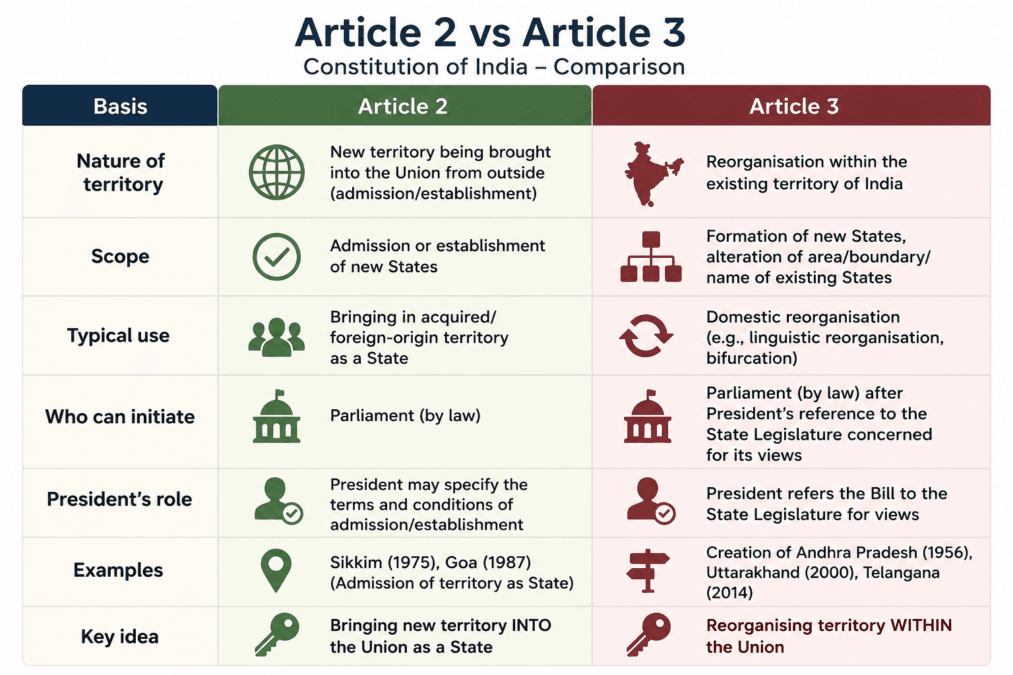
| Basis | Article 2 | Article 3 |
| Nature of territory | New territory being brought into the Union from outside (admission/establishment) | Reorganisation within the existing territory of India |
| Scope | Admission or establishment of new States | Formation of new States, alteration of area/boundary/name of existing States |
| Typical use | Bringing in acquired/foreign-origin territory as a State | Domestic reorganisation (e.g., linguistic reorganisation, bifurcation) |
| Basis | “Federation” (e.g., USA) | “Union” (India) |
| Origin | Formed by agreement among sovereign states | Not the result of agreement among States |
| Right to secede | May exist historically/theoretically | Expressly excluded in India |
| Alteration of constituent units | Generally requires consent of the unit | Parliament may alter unilaterally after obtaining views (not consent) |
11. Current Legal Position
Settled. The scope and validity of Parliament’s power under Articles 1–4 is well-established through more than seven decades of practice and repeated judicial affirmation, subject to the narrow Berubari limitation on cession of territory. The 2023 Article 370 judgment confirms that Article 3 remains actively relevant to contemporary constitutional disputes.
12. Exam Focus
- Text and effect of Article 1(1), (2) and (3).
- Difference between Article 2 and Article 3.
- The proviso to Article 3 — President’s recommendation + reference to State Legislature for views (not consent).
- Why Article 4 excludes such laws from the Article 368 amendment procedure.
- Berubari Union case — cession of territory requires constitutional amendment, not Article 3.
- The phrase “indestructible Union of destructible States.”
- Article 3’s continuing relevance — States Reorganisation Act, 1956; Telangana, 2014; J&K Reorganisation, 2019.
13. Quick Revision Table
| Article | One-Line Summary |
| Article 1 | India is a “Union of States”; defines territory of India |
| Article 2 | Parliament may admit or establish new States (external territory) |
| Article 3 | Parliament may form new States / alter area, boundary, name of existing States (internal reorganisation) |
| Article 4 | Consequential Schedule changes under Article 2/3 laws are not Article 368 amendments |
14. One-Minute Revision
- Part I of the Constitution = Articles 1 to 4 = “The Union and its Territory.”
- India is a “Union of States,” not a federation formed by agreement.
- No State has a right to secede.
- Article 2 = bringing in new territory; Article 3 = reorganising existing territory.
- Article 3 Bills need the President’s prior recommendation.
- State Legislature’s views under Article 3 are consultative, not binding.
- Article 4 changes to Schedule I/IV via ordinary law are not Article 368 amendments.
- Berubari (1960): territory cannot be ceded to a foreign country under Article 3.
- Constitution adopted 26 November 1949; commenced 26 January 1950.
- States Reorganisation Act, 1956, is the major historical application of Article 3.
15. Limited Practice Questions
Short Questions
- What is the significance of the word “Union” in Article 1, as opposed to “Federation”?
- Is the State Legislature’s opinion under the proviso to Article 3 binding on Parliament?
Analytical Question 3. Critically examine whether Article 3 can be used to alter international boundaries or cede Indian territory to a foreign state, with reference to In Re: Berubari Union.
Case/Problem Question 4. Parliament proposes to bifurcate a State without referring the Bill to the concerned State Legislature. Discuss the constitutional validity of such a law.
16. Related Topics
Related Law Notes: Preamble to the Constitution · Salient Features of the Constitution · Citizenship (Articles 5–11) · Federalism and Centre-State Relations · Constitutional Amendment (Article 368) · Basic Structure Doctrine
Related Legal Provisions: Articles 1–4, First Schedule, Fourth Schedule, Article 368
Official Sources
Related Case Laws: Read in Detail
- In Re: Berubari Union (1960)
- Babulal Parate v. State of Bombay (1960)
- In Re: Article 370 of the Constitution (2023)
Note: This is a free conceptual/revision note.For previous-year question bank or exhaustive answer-writing material to get high score Read AspirixWriters Law Success Series Constitutional Law.
1. What is the Constitution of India?
The Constitution of India is the supreme law of the country. It establishes the framework of government, distributes powers among constitutional institutions, and guarantees rights and lays down duties and constitutional principles.
2. When was the Constitution of India adopted and when did it come into force?
The Constituent Assembly adopted, enacted and gave to India its Constitution on 26 November 1949. It came into force on 26 January 1950, which is celebrated as Republic Day.
3. How was the Constitution of India made?
The Constitution was drafted by the Constituent Assembly, which first met on 9 December 1946. The Assembly worked for almost three years, held 11 sessions, and established the Drafting Committee under the chairmanship of Dr. B.R. Ambedkar on 29 August 1947. Its debates and drafting process are preserved in the Parliament Digital Library.
4. How was the Constitution of India made?
The Constitution was drafted by the Constituent Assembly, which first met on 9 December 1946. The Assembly worked for almost three years, held 11 sessions, and established the Drafting Committee under the chairmanship of Dr. B.R. Ambedkar on 29 August 1947. Its debates and drafting process are preserved in the Parliament Digital Library.
5. What were the major stages in the making of the Indian Constitution?
The constitutional development of India progressed through several stages, including the Government of India Act, 1935, the establishment of the Constituent Assembly in 1946, the Assembly’s deliberations and drafting process, the adoption of the Constitution on 26 November 1949, and its commencement on 26 January 1950. The Constituent Assembly’s historical debates are officially available through the Parliament Digital Library.
Classmate Pulse Spiral Notebook ✏️ Need a Spiral Notebook for Everyday Writing? A spiral notebook…

Latest Scholarships & Fellowships 2026–27: Open Opportunities for Upcoming call
Latest Scholarships & Research Fellowships 2026–27 Last Verified: 30 September 2026 Students, researchers, PhD scholars…
Writing & Research Resources: Useful Books, Tools & Essentials for Writers and Researchers
Whether you are an author, content writer, law student, academic researcher, PhD scholar, teacher, or…