
Constitutional Law Complete Notes
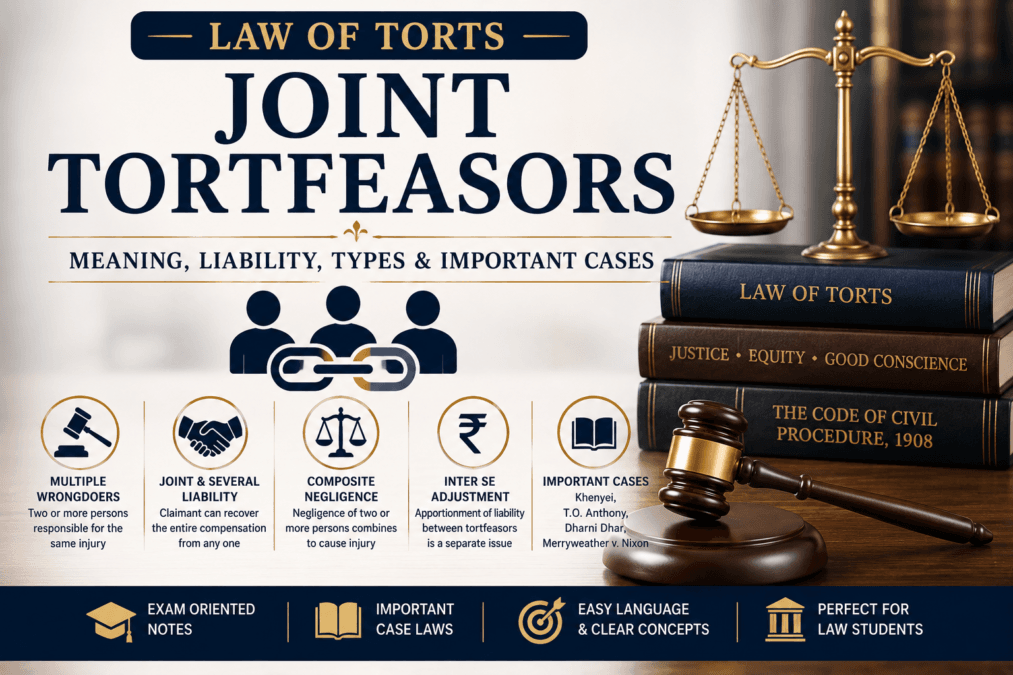
Joint Tortfeasors in Tort Law
Written by Dr. Rekha Khandelwal, Law Educator, Author & Legal Researcher, specializing in clear, student-friendly and exam-oriented legal education.
Introduction
When two or more persons are responsible for the same tortious injury, the law may treat them as joint tortfeasors. The doctrine determines when several wrongdoers can be held responsible for the same damage and what rights the injured person has against them.
Joint tortfeasors are an important topic under the Law of Torts and are expressly included in the University of Rajasthan LL.B. 2025–26 syllabus under Unit I along with extinction/discharge of tortious liability. (University of Rajasthan)
A particularly important principle for Indian law students is that, in cases of composite negligence, the liability towards the claimant can be joint and several. The Supreme Court explained this clearly in Khenyei v. New India Assurance Co. Ltd. (Indian Kanoon)
Don’t Miss New Law Opportunities!
Join our WhatsApp community for verified updates on Law Jobs, Internships, Competitions, Scholarships, LLB Notes & more.
What Are Joint Tortfeasors?
Joint tortfeasors are two or more persons whose wrongful acts are sufficiently connected so that they are responsible for the same tortious injury or damage suffered by the claimant.
Simple Example
Suppose A and B jointly plan and execute an unlawful act that damages C’s property.
Here, A and B may be treated as joint tortfeasors, and C may have a claim against both.
The essential idea is that the law connects the wrongful conduct of the defendants with the same actionable injury.
Definition of Joint Tortfeasors
There is no single statutory definition of “joint tortfeasors” in a general Indian Law of Torts statute because India does not have a comprehensive codified Tort Act.
The concept has therefore developed largely through common-law principles and judicial decisions.
In Khenyei v. New India Assurance Co. Ltd., the Supreme Court dealt with joint tortfeasors in the context of composite negligence and stated that where injury results from the combined wrongful acts of joint tortfeasors, their liability towards the claimant is joint and several. (Indian Kanoon)
Essential Features of Joint Tortfeasors
The following features are important:
1. There must be more than one wrongdoer
The doctrine concerns situations involving two or more persons.
2. Their conduct must result in the same actionable injury
The important question is not merely whether several people acted wrongfully, but whether their conduct is connected with the same damage suffered by the claimant.
3. Their liability may be joint and several
Where the law treats them as jointly liable for the same injury, the claimant may be able to recover the full amount of recoverable compensation from any one liable defendant, subject to the applicable legal rules.
4. The claimant should not be required to recover separately from every wrongdoer
The doctrine protects the injured person from being left without full compensation merely because several persons contributed to the injury.
5. Rights between the tortfeasors are a separate question
The liability of the defendants towards the claimant must be distinguished from the question of contribution or adjustment between the wrongdoers themselves.
How Do Persons Become Joint Tortfeasors?
Joint tortious liability can arise in different circumstances.
1. Common Design or Concerted Action
Where two or more persons act pursuant to a common plan or concerted purpose and their conduct results in the same tort, they may be treated as joint tortfeasors.
Example
A and B jointly enter C’s land and remove C’s property without lawful justification.
Their conduct may make them jointly responsible for the resulting tort.
2. Authorising or Directing a Tort
A person who authorises or directs another person to commit a tort may, depending upon the circumstances, be liable along with the person who actually commits it.
The precise liability depends upon the relationship between the parties and the applicable doctrine.
This should not be confused with vicarious liability, which will be covered separately.
3. Composite Negligence
One of the most practically important situations involving joint tortfeasors arises where the negligence of two or more persons combines to cause injury to a third person.
This is called composite negligence.
Example
A bus driver negligently drives at excessive speed while a truck driver simultaneously drives negligently. The two vehicles collide and injure C, who was not negligent.
The negligence of both drivers may constitute composite negligence as against C.
Joint Tortfeasors and Composite Negligence
These concepts are closely related but should not be treated as identical in every situation.
Joint Tortfeasors
Focuses on the legal relationship and responsibility of multiple wrongdoers for the same tortious injury.
Composite Negligence
Concerns a situation where the negligence of two or more persons combines to cause damage to a person who was not himself negligent.
The Supreme Court’s decision in Khenyei is especially important for this distinction in motor-accident cases. (Indian Kanoon)
Joint and Several Liability
A major consequence of joint tortious liability is the principle of joint and several liability.
This means that, where applicable, each liable tortfeasor can be responsible for the whole recoverable damage as against the injured claimant, rather than the claimant necessarily being restricted to recovering only the percentage of negligence attributed to that defendant.
Supreme Court in Khenyei
In Khenyei v. New India Assurance Co. Ltd., (2015) 9 SCC 273, the Supreme Court held that in a case of composite negligence:
- the liability of the joint tortfeasors towards the claimant is joint and several;
- the claimant can recover the entire compensation from any one of the joint tortfeasors;
- apportionment of compensation between the tortfeasors is not to be used to reduce the claimant’s recovery;
- if all tortfeasors are before the court, their respective shares may be determined for the purpose of inter se adjustment. (Indian Kanoon)
Exam Example
If A and B are both responsible for C’s injury and C is awarded ₹10 lakh:
C may, where the doctrine of joint and several liability applies, recover the recoverable amount from A or B.
The question of how A and B ultimately bear the burden between themselves is a separate inter se issue.
Can the Claimant Sue Only One Joint Tortfeasor?
Yes, where joint and several liability applies.
The Supreme Court in Khenyei recognised the claimant’s right to recover the entire compensation from any one of the joint tortfeasors in a case of composite negligence. (Indian Kanoon)
This is particularly important in motor-vehicle accident cases where more than one vehicle is responsible for the accident.
Why?
The law seeks to protect the injured claimant.
The claimant should not ordinarily have to bear the risk that one of several wrongdoers is unable to pay his share.
Is Apportionment of Negligence Always Necessary?
No.
In Khenyei, the Supreme Court explained that where the case involves composite negligence and joint tortfeasors, determining the percentage of negligence of each tortfeasor is not necessary for determining the claimant’s right to recover the compensation.
However, where all tortfeasors are before the court, their respective degrees of negligence may be determined for purposes of inter se adjustment. (Indian Kanoon)
Therefore:
Apportionment for claimant’s recovery ≠ apportionment for inter se adjustment.
Joint Tortfeasors vs Independent Tortfeasors
This is an important distinction.
| Joint Tortfeasors | Independent Tortfeasors |
| Their liability is connected with the same tortious injury | Each acts independently |
| There may be common design, concerted action or legally recognised joint responsibility | No common design is necessary |
| Liability may be joint and several | Liability depends upon the applicable doctrine |
| Claimant may sue one or more where joint and several liability applies | Each defendant’s liability is examined according to the particular facts |
| Khenyei is important in composite negligence | Independent acts may still combine to cause the same injury |
Important: Independent acts can result in composite negligence, so “independent tortfeasor” should not automatically be treated as meaning “not jointly liable to the claimant.”
Joint Tortfeasors vs Composite Negligence
| Joint Tortfeasors | Composite Negligence |
| A category/concept concerning multiple tortfeasors | A form of negligence involving multiple negligent persons |
| May arise through common action or other legally recognised connections | Usually involves independent negligence combining to cause one injury |
| Can involve intentional torts as well as negligence | Specifically concerns negligence |
| Joint and several liability may arise | Claimant can generally recover full compensation from any liable joint tortfeasor in the relevant case |
| Broader concept | More specific negligence concept |
Joint Tortfeasors vs Contributory Negligence
Joint Tortfeasors
Two or more defendants/wrongdoers are responsible for the claimant’s injury.
Contributory Negligence
The claimant himself has contributed to the damage through his own negligence.
Example
Joint tortfeasors:
A and B negligently injure C.
Contributory negligence:
A and B negligently injure C, but C also acted negligently and contributed to his own injury.
This distinction becomes especially important in motor-vehicle accident cases.
Important Cases:
Khenyei v. New India Assurance Co. Ltd. : (2015) 9 SCC 273
This is one of the most important modern Indian authorities for composite negligence and joint tortfeasor liability.
The case involved an accident involving a bus and a trailer-truck. The Supreme Court held that where the claimant’s injury is caused by composite negligence of joint tortfeasors, the liability towards the claimant is joint and several. (Indian Kanoon)
Principle
The claimant may recover the entire compensation from any one of the joint tortfeasors, while apportionment may be relevant between the tortfeasors themselves.
Exam value: Very High
T.O. Anthony v. Karvarnan: (2008) 3 SCC 748
The Supreme Court discussed the distinction between composite negligence and contributory negligence in a motor-accident context.
The case is particularly useful for understanding that where two or more persons are responsible for an accident and the injured claimant is not himself negligent, the situation is one of composite negligence rather than contributory negligence. (CaseMine)
Exam Point
Composite negligence: negligence of two or more persons causes injury to an innocent claimant.
Contributory negligence: claimant’s own negligence also contributes to the injury.
Dharni Dhar v. Chandra Shekhar : AIR 1951 All 774 (FB)
This Full Bench decision is important for the historical Indian position concerning contribution between joint tortfeasors.
The court examined the old English rule in Merryweather v. Nixon and held that the rule that there could be no contribution between joint tortfeasors did not apply in India. It considered principles of justice, equity and good conscience and recognised contribution in appropriate circumstances. (Indian Kanoon)
Merryweather v. Nixon — Historical Background
Merryweather v. Nixon (1799) is historically associated with the old common-law rule restricting contribution between joint tortfeasors.
However, the historical English rule was subsequently changed by legislation in England.
The Full Bench in Dharni Dhar specifically discussed this development and rejected applying the old rule mechanically to Indian law. (Indian Kanoon)
Contribution Between Joint Tortfeasors
The claimant’s right to recover compensation and the right of one tortfeasor to seek contribution from another are different questions.
First Question
Can the claimant recover compensation?
Where joint and several liability applies, the claimant may recover the full recoverable amount from any one liable tortfeasor.
Second Question
How should the financial burden ultimately be distributed between the tortfeasors?
This is an inter se contribution/adjustment question.
The Indian position has developed through judicial decisions and equitable principles rather than through a single comprehensive general Tort Act.
The Full Bench decision in Dharni Dhar is an important authority on this issue. (Indian Kanoon)
Effect of Full Satisfaction
The claimant is entitled to only one full satisfaction of the same injury, not double recovery merely because several tortfeasors are liable.
Thus, joint and several liability does not mean that a claimant can recover the same loss twice.
The principle is essentially:
One injury → one full compensation, although more than one tortfeasor may be liable for it.
The Supreme Court’s jurisprudence on joint tortfeasors also recognises the importance of satisfaction and the relationship between liability to the claimant and liability among the defendants.
Why Is Joint and Several Liability Important?
The doctrine protects the injured person because:
- there may be multiple wrongdoers;
- one defendant may be financially stronger than another;
- proving the exact percentage of responsibility may be difficult;
- the claimant should not ordinarily bear the risk of insolvency of one wrongdoer;
- the tortfeasors can resolve their respective financial burden separately where the law permits.
Exam-Oriented Example
Problem
A bus driver and truck driver are both negligent. Their negligence causes an accident in which C, a passenger, suffers injuries. C was not negligent.
Answer
The situation may amount to composite negligence.
The bus driver and truck driver may be treated as joint tortfeasors for the purpose of the claimant’s recovery. In accordance with Khenyei, the claimant can, in the relevant circumstances, recover the entire compensation from any one of the liable joint tortfeasors. (Indian Kanoon)
The respective degree of negligence may be relevant for inter se adjustment, but it does not ordinarily reduce the claimant’s right to recover the full compensation from a liable joint tortfeasor.
Key Differences at a Glance
| Concept | Meaning |
| Joint Tortfeasors | Multiple persons legally responsible for the same tortious injury |
| Joint and Several Liability | Each liable tortfeasor may be responsible for the whole recoverable damage to the claimant |
| Composite Negligence | Negligence of two or more persons combines to cause injury to an innocent claimant |
| Contributory Negligence | Claimant’s own negligence contributes to the injury |
| Independent Tortfeasors | Persons whose wrongful acts are independent, although their conduct may sometimes contribute to the same damage |
| Contribution | Adjustment of liability between persons who are liable for the same damage |
Important Cases to Remember
| Case | Principle |
| Khenyei v. New India Assurance Co. Ltd., (2015) 9 SCC 273 | Joint and several liability in composite negligence; claimant may recover entire compensation from any joint tortfeasor |
| T.O. Anthony v. Karvarnan, (2008) 3 SCC 748 | Distinction between composite and contributory negligence |
| Dharni Dhar v. Chandra Shekhar, AIR 1951 All 774 (FB) | Indian position on contribution; old Merryweather rule not mechanically applicable |
| Merryweather v. Nixon, (1799) 8 T.R. 186 | Historical English rule concerning contribution between joint tortfeasors |
| Khushro S. Gandhi v. N.A. Guzder, (1969) 1 SCC 358 | Historical/common-law principles concerning joint tortfeasors, satisfaction and release |
Key Takeaways for LL.B. Students
- Joint tortfeasors are multiple persons responsible for the same tortious injury in a legally recognised sense.
- Their liability towards the claimant may be joint and several.
- Composite negligence is an important situation involving multiple negligent persons.
- Khenyei is a leading Indian Supreme Court authority.
- The claimant can, where the doctrine applies, recover the entire compensation from any one liable joint tortfeasor.
- Inter se apportionment is different from the claimant’s right to recover.
- Do not confuse joint tortfeasors with contributory negligence.
- Merryweather v. Nixon should be treated as a historical English authority, not simply stated as the current Indian rule.
- Dharni Dhar v. Chandra Shekhar is important for the Indian position concerning contribution.
Frequently Asked Questions
1. Who are joint tortfeasors in tort law?
Joint tortfeasors are two or more persons whose wrongful acts make them legally responsible for the same tortious injury or damage.
2. What is the liability of joint tortfeasors?
Where joint and several liability applies, each joint tortfeasor may be liable for the whole recoverable compensation payable to the claimant.
3. Can a plaintiff sue only one joint tortfeasor?
Yes. In cases such as composite negligence where joint and several liability applies, the claimant may recover the entire compensation from any one of the liable joint tortfeasors, as explained by the Supreme Court in Khenyei. (Indian Kanoon)
4. What is the difference between joint tortfeasors and contributory negligence?
Joint tortfeasors are multiple defendants responsible for the claimant’s injury, whereas contributory negligence involves negligence on the part of the claimant himself.
5. What is the rule in Merryweather v. Nixon?
It is an old English common-law rule associated with restricting contribution between joint tortfeasors. It should not be presented as the current general rule in India; Dharni Dhar v. Chandra Shekhar is important in understanding the Indian position. (Indian Kanoon)
Conclusion
The doctrine of joint tortfeasors ensures that an injured person is not unfairly disadvantaged merely because several persons contributed to the same tortious injury.
For Indian LL.B. examinations, the most important combination to remember is:
Joint Tortfeasors → Composite Negligence → Joint & Several Liability → Khenyei.
At the same time, students should keep contributory negligence separate because it concerns the claimant’s own negligence.
The historical rule in Merryweather v. Nixon should also be distinguished from the Indian position, particularly in light of Dharni Dhar v. Chandra Shekhar.
About the Author: Dr. Rekha Khandelwal is a Ph.D. in Law and experienced legal educator, researcher, and academic writer specializing in law, legal research, and AI governance. [Read Full Author Profile →]
Explore more –
✔ Professional Writing Services
Don’t Miss New Law Opportunities!
Join our WhatsApp community for verified updates on Law Jobs, Internships, Competitions, Scholarships, LLB Notes & more.
Classmate Pulse Spiral Notebook ✏️ Need a Spiral Notebook for Everyday Writing? A spiral notebook…

Latest Scholarships & Fellowships 2026–27: Open Opportunities for Upcoming call
Latest Scholarships & Research Fellowships 2026–27 Last Verified: 30 September 2026 Students, researchers, PhD scholars…
Writing & Research Resources: Useful Books, Tools & Essentials for Writers and Researchers
Whether you are an author, content writer, law student, academic researcher, PhD scholar, teacher, or…