
Written by Dr. Rekha Khandelwal, Law Educator, Author & Legal Researcher, specializing in clear, student-friendly and exam-oriented legal education.
Joint and Several Liability in Tort Law:
Introduction
Joint and several liability is an important principle of tort law dealing with situations where two or more tortfeasors are responsible for the same injury.
Under this principle, where the law treats the defendants as jointly and severally liable, the injured claimant may recover the entire recoverable compensation from any one of the liable tortfeasors, rather than being required to recover only a particular percentage from each.
The principle is particularly important in cases of composite negligence. The Supreme Court’s decision in Khenyei v. New India Assurance Co. Ltd., (2015) 9 SCC 273, is a leading Indian authority on the subject. (Indian Kanoon)
Don’t Miss New Law Opportunities!
Join our WhatsApp community for verified updates on Law Jobs, Internships, Competitions, Scholarships, LLB Notes & more.
What Is Joint and Several Liability?
Simple Meaning
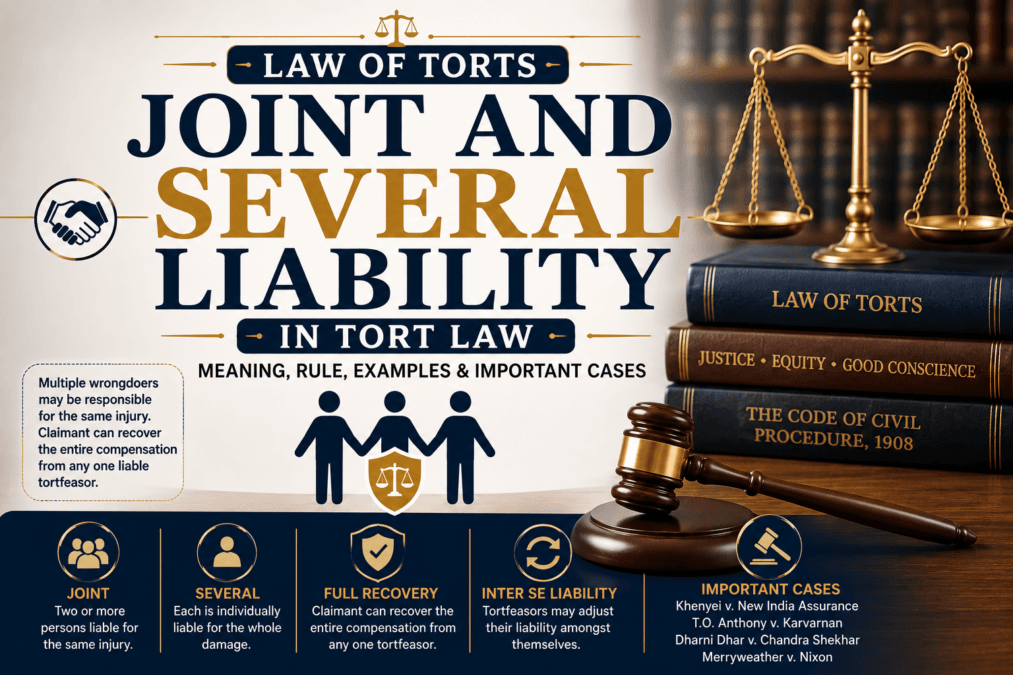
Joint liability means that two or more persons are liable together for the same injury.
Several liability means that each liable person can, subject to the applicable law, be held responsible individually.
When these principles operate together, the liability is called joint and several liability.
Simple Example
Suppose A and B negligently cause an accident in which C suffers damages of ₹10 lakh.
If A and B are joint tortfeasors and their liability is joint and several:
- C may sue A and B together; or
- C may proceed against either A or B; and
- where the doctrine applies, C can recover the full ₹10 lakh from one liable tortfeasor.
The question of how A and B should ultimately share the burden between themselves is a separate inter se question.
Joint Liability vs Several Liability
| Joint Liability | Several Liability |
| Liability is shared by two or more persons | Liability is individual |
| Defendants are connected in relation to the same liability | Each defendant’s liability is considered separately |
| May arise from a common tortious responsibility | May arise from independent legal responsibility |
| The claimant may proceed against the joint wrongdoers according to law | Recovery depends upon the particular defendant’s liability |
Joint and Several Liability
Joint and several liability combines these concepts so that the claimant receives effective protection against multiple liable wrongdoers.
Joint and Several Liability in Composite Negligence
This is the most important application for Indian law students.
What Is Composite Negligence?
Composite negligence occurs when the negligence of two or more persons combines to cause injury to a person who was not himself negligent.
Example
A’s car and B’s truck are both negligently driven. They collide and injure C, an innocent passenger.
C’s injury has resulted from the combined negligence of A and B.
This is a classic example of composite negligence.
The Supreme Court in T.O. Anthony v. Karvarnan, (2008) 3 SCC 748, explained that where injury results from the negligence of two or more wrongdoers, each wrongdoer may be jointly and severally liable to the injured person. (Indian Kanoon)
The Rule in Khenyei v. New India Assurance Co. Ltd.
Case: Khenyei v. New India Assurance Co. Ltd., (2015) 9 SCC 273
This is the leading Indian case that you should remember for joint and several liability in composite negligence.
The Supreme Court considered whether a claimant could recover the entire compensation from one of the joint tortfeasors where the accident resulted from the composite negligence of two vehicles.
The Court held that the liability of joint tortfeasors towards the claimant is joint and several. (Indian Kanoon)
The Supreme Court’s key principles
In a case of composite negligence:
- The claimant may sue both or any one of the joint tortfeasors.
- The claimant may recover the entire compensation from any one liable joint tortfeasor.
- The compensation payable to the claimant should not be apportioned between the tortfeasors merely to reduce the claimant’s recovery.
- If all joint tortfeasors are before the court and sufficient evidence exists, the court may determine their respective degrees of negligence.
- Such determination is for inter se adjustment between the tortfeasors, not for reducing the claimant’s recovery. (Indian Kanoon)
Why Is the Liability Called “Joint and Several”?
Suppose:
- A is 60% responsible;
- B is 40% responsible; and
- C suffers ₹10 lakh damage.
If A and B are jointly and severally liable towards C, C’s right to recover the ₹10 lakh is not reduced to ₹6 lakh against A and ₹4 lakh against B merely because their respective negligence is assessed at 60:40.
C may recover the full recoverable compensation from a liable defendant in accordance with the applicable rule.
The 60:40 division may become relevant between A and B after payment to C.
This distinction is central to Khenyei. (Indian Kanoon)
Claimant’s Recovery vs Inter Se Liability
This is one of the most important concepts in the topic.
1. Liability Towards the Claimant
The claimant’s concern is:
Who can pay my compensation?
Where joint and several liability applies, the claimant can recover the entire recoverable compensation from any one of the liable joint tortfeasors.
2. Liability Between the Tortfeasors
The defendants may subsequently ask:
What proportion should each of us ultimately bear?
This is called inter se liability.
The court may determine the respective degree of negligence for this purpose when the necessary parties and evidence are before it. (Indian Kanoon)
Remember:
Claimant’s recovery ≠ inter se apportionment
Is Apportionment of Compensation Allowed?
Between the Claimant and Joint Tortfeasors
In a case of composite negligence, apportionment should not be used to restrict the claimant’s recovery from the joint tortfeasors.
Between the Tortfeasors
Apportionment may be determined for the purpose of inter se adjustment.
This is exactly the distinction recognised in Khenyei. (Indian Kanoon)
What If One Joint Tortfeasor Is Not a Party?
This is an important practical situation.
Suppose A and B caused the accident, but C, the claimant, sues only A.
If B has not been impleaded, the court should not unnecessarily determine B’s exact percentage of negligence for the purpose of dividing liability between A and B in that proceeding.
The Supreme Court’s principles in Khenyei recognise that determination of inter se negligence requires the relevant parties and evidence. (Indian Kanoon)
The defendant may have an appropriate remedy against the other tortfeasor in separate proceedings, depending upon the circumstances and applicable law.
Joint and Several Liability vs Contributory Negligence
These doctrines must be kept completely separate.
Composite Negligence
Two or more other persons are negligent, and their combined negligence injures the claimant.
Example: A and B negligently injure C.
Contributory Negligence
The claimant himself has contributed to the accident through his own negligence.
Example: A and B are negligent, but C’s own negligent conduct also contributed to his injury.
In T.O. Anthony, the Supreme Court explained that contributory negligence may reduce the claimant’s damages proportionately, whereas in composite negligence the claimant himself has not contributed to the accident. (Indian Kanoon)
Quick Formula
Composite negligence → negligence of multiple wrongdoers → joint/several liability
Contributory negligence → claimant also negligent → damages reduced proportionately
Joint and Several Liability in Motor Accident Claims
The doctrine is especially significant in motor-vehicle accident cases.
For example:
A bus and a truck collide because both drivers were negligent, and a passenger is injured.
If the passenger was not negligent, the accident may constitute composite negligence.
The passenger can seek compensation from the liable joint tortfeasors in accordance with the principle of joint and several liability. Khenyei is particularly important in this context. (Indian Kanoon)
Important Cases:
T.O. Anthony v. Karvarnan Citation: (2008) 3 SCC 748
This case is extremely useful because it explains the distinction between composite negligence and contributory negligence.
The Supreme Court stated that in composite negligence, the injured person may proceed against all or any of the wrongdoers and need not establish each wrongdoer’s exact percentage of responsibility for the purpose of recovering compensation. (Indian Kanoon)
Exam Point
Composite negligence involves negligence of two or more wrongdoers; contributory negligence involves negligence of the injured claimant as well.
Khenyei v. New India Assurance Co. Ltd. : (2015) 9 SCC 273
Principle
In composite negligence, the claimant may sue both or any one of the joint tortfeasors and recover the entire compensation because their liability towards the claimant is joint and several.
If all joint tortfeasors are before the court, their respective negligence may be determined for inter se adjustment. (Indian Kanoon)
Dharni Dhar v. Chandra Shekhar : AIR 1951 All 774
This case is important for understanding contribution between joint tortfeasors.
The Allahabad High Court considered the historical English rule in Merryweather v. Nixon and held that the old rule should not be mechanically applied in India. It relied on principles of justice, equity and good conscience in recognising contribution in the circumstances before it.
Merryweather v. Nixon : (1799) 8 T.R. 186
Merryweather v. Nixon is historically associated with the old English common-law restriction on contribution between joint tortfeasors.
However, the historical rule subsequently ceased to represent the modern English position, and Indian courts have not simply adopted it as a universal current rule.
Therefore, it should be used primarily for historical development in an Indian tort-law article.
Joint and Several Liability: Practical Example
Facts
A and B negligently cause an accident.
C suffers damages of ₹8 lakh.
C is completely innocent.
Situation 1 — Composite Negligence
A and B are joint tortfeasors.
C can seek the full recoverable compensation from either liable tortfeasor where joint and several liability applies.
Situation 2 — C Is Also Negligent
Suppose C’s own negligence contributed to the accident.
Now the issue becomes contributory negligence.
C’s compensation may be reduced according to the extent of his own negligence.
This distinction follows the Supreme Court’s reasoning in T.O. Anthony.
Joint and Several Liability vs Several Liability
| Joint & Several Liability | Several Liability |
| Multiple liable tortfeasors | Each defendant’s liability is separate |
| Claimant may recover full compensation from a liable joint tortfeasor where the doctrine applies | Claimant can recover only the amount for which the particular defendant is legally responsible |
| Commonly important in composite negligence | Depends on the particular legal relationship and cause of action |
| Inter se adjustment may arise | Each person’s liability is independently assessed |
Joint and Several Liability vs Joint Liability
| Joint Liability | Joint & Several Liability |
| Multiple persons are liable together | Multiple persons are liable together, while each may also be individually liable for the whole recoverable amount |
| Focuses on collective responsibility | Provides stronger protection to the claimant |
| May not by itself explain the entire recovery mechanism | Allows recovery from any one liable tortfeasor where the doctrine applies |
Key Principles for LL.B. Exams
Remember these five points:
1. Multiple Wrongdoers
There must be more than one person legally responsible for the injury.
2. Same Injury
The claimant’s injury must be connected to the wrongful conduct of the relevant tortfeasors.
3. Composite Negligence
Where two or more persons negligently cause injury to an innocent claimant, the case may involve composite negligence.
4. Full Recovery
In applicable cases, the claimant can recover the entire compensation from any one joint tortfeasor.
5. Inter Se Adjustment
The respective burden between tortfeasors is a separate matter.
Important Cases at a Glance
| Case | Principle |
| T.O. Anthony v. Karvarnan, (2008) 3 SCC 748 | Composite negligence distinguished from contributory negligence |
| Khenyei v. New India Assurance Co. Ltd., (2015) 9 SCC 273 | Joint and several liability in composite negligence |
| Dharni Dhar v. Chandra Shekhar, AIR 1951 All 774 | Indian approach to contribution between joint tortfeasors |
| Merryweather v. Nixon, (1799) 8 T.R. 186 | Historical English rule on contribution |
Frequently Asked Questions
1. What is joint and several liability in tort law?
It is a form of liability where multiple tortfeasors are responsible for the same injury and, where the doctrine applies, the claimant can recover the entire recoverable compensation from any one of them.
2. What is the leading case on joint and several liability in India?
Khenyei v. New India Assurance Co. Ltd., (2015) 9 SCC 273 is a leading Supreme Court authority, particularly in cases of composite negligence. (Indian Kanoon)
3. Can a plaintiff recover the entire compensation from one tortfeasor?
Yes, in a case where joint and several liability applies, particularly composite negligence, the claimant may recover the entire compensation from any one liable joint tortfeasor. (Indian Kanoon)
4. Is joint and several liability the same as contributory negligence?
No. Joint and several liability concerns multiple liable wrongdoers, whereas contributory negligence concerns negligence by the claimant himself. (Indian Kanoon)
5. What is the difference between composite and contributory negligence?
In composite negligence, two or more wrongdoers cause injury to an innocent claimant. In contributory negligence, the claimant’s own negligence also contributes to the injury. (Indian Kanoon)
Conclusion
Joint and several liability is designed to protect an injured claimant where more than one person is legally responsible for the same injury.
For Indian tort law, the most important chain to remember is:
Composite Negligence → Joint Tortfeasors → Joint & Several Liability → Full Recovery → Inter Se Adjustment
The leading authority is Khenyei v. New India Assurance Co. Ltd., while T.O. Anthony v. Karvarnan is essential for distinguishing composite negligence from contributory negligence. (Indian Kanoon)
About the Author: Dr. Rekha Khandelwal is a Ph.D. in Law and experienced legal educator, researcher, and academic writer specializing in law, legal research, and AI governance. [Read Full Author Profile →]
Explore more –
✔ Professional Writing Services
Don’t Miss New Law Opportunities!
Join our WhatsApp community for verified updates on Law Jobs, Internships, Competitions, Scholarships, LLB Notes & more.
Classmate Pulse Spiral Notebook ✏️ Need a Spiral Notebook for Everyday Writing? A spiral notebook…

Latest Scholarships & Fellowships 2026–27: Open Opportunities for Upcoming call
Latest Scholarships & Research Fellowships 2026–27 Last Verified: 30 September 2026 Students, researchers, PhD scholars…
Writing & Research Resources: Useful Books, Tools & Essentials for Writers and Researchers
Whether you are an author, content writer, law student, academic researcher, PhD scholar, teacher, or…