
AI in sales automation helps teams save time, prioritize leads, and forecast pipelines accurately. Learn how it works, benefits, challenges, and best practices.
Introduction
Sales teams often spend more time updating spreadsheets and chasing unresponsive leads than actually selling. These repetitive tasks reduce productivity and limit meaningful customer interactions.
AI in sales automation addresses this challenge by assisting sales teams with data analysis, follow-ups, and forecasting. Rather than replacing sales professionals, AI in sales automation acts as a decision-support system—helping teams work smarter in today’s data-driven sales environment.
This guide explains how AI in sales automation works in practice, where it delivers value, and what businesses should consider before adopting it.
What Drives AI in Sales Automation
At its core, AI in sales automation uses machine learning and data analytics to support sales workflows—from lead qualification to deal forecasting. These systems analyze customer behavior patterns, past interactions, and engagement signals to suggest next-best actions.
In simple terms, AI functions like a smart assistant that continuously learns from data to help sales teams focus on high-impact opportunities instead of routine manual work.
Market Momentum and Practical Relevance
The growing adoption of AI in sales automation reflects real operational needs rather than hype. As sales data volumes increase and buying journeys become more digital, manual processes struggle to keep up.
Organizations using AI-supported sales tools report:
- Shorter sales cycles due to faster lead prioritization
- Improved pipeline visibility
- More consistent follow-ups across channels
With digital interactions now forming a major share of B2B sales touchpoints, AI-assisted automation is becoming a practical necessity rather than an experimental feature.
How AI in Sales Automation Works (Step-by-Step)
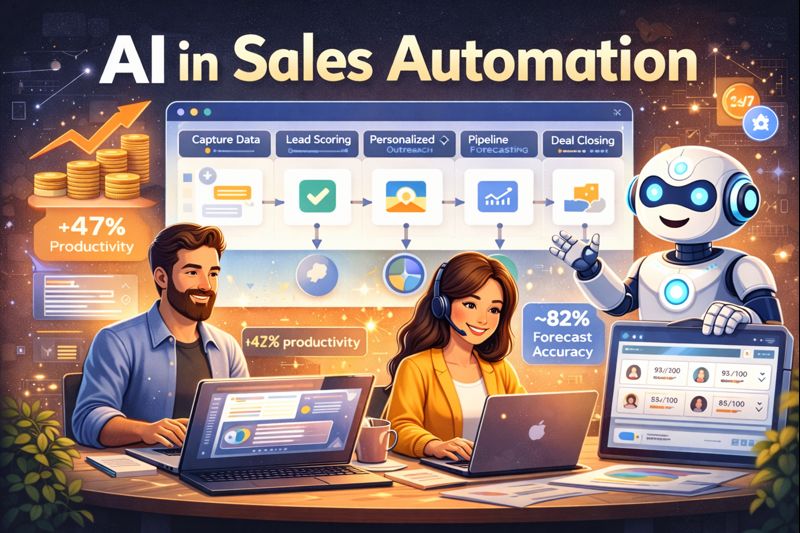
Most AI-powered sales systems follow a structured workflow:
Customer Data Collection
↓
Data Analysis & Enrichment
↓
AI Lead Scoring
↓
Personalized Sales Outreach
↓
Pipeline Monitoring & Forecasting
↓
Sales Decision Support
Core Components Explained
- Data Ingestion: Collects information from CRM systems, emails, website activity, and past deals
- Lead Scoring: Uses behavioral signals to prioritize prospects more likely to convert
- Personalized Outreach: Supports tailored messaging based on engagement history
- Pipeline Forecasting: Identifies deal risks and revenue trends early
- Task Automation: Automates reminders, follow-ups, and reporting
These functions typically integrate with platforms such as Salesforce or Microsoft Dynamics for seamless workflows.
Real-World Applications Across Industries
AI in sales automation is already being applied in multiple sectors:
- B2B technology firms use AI to qualify inbound leads before human engagement
- Consulting companies rely on predictive tools to shorten deal cycles
- Healthcare and pharma organizations use AI insights to align territories and improve quota planning
- Mid-sized enterprises apply AI forecasting to improve revenue planning accuracy
These use cases show that AI in sales automation supports decision-making rather than dictating outcomes.
Key Benefits for Sales Teams
When implemented thoughtfully, AI in sales automation offers clear advantages:
- Improved productivity: Reduces time spent on administrative work
- Better lead prioritization: Helps focus on high-intent prospects
- More accurate forecasting: Supports realistic revenue planning
- Consistent follow-ups: Minimizes missed opportunities
- Scalability: Handles growing data volumes without increasing workload
Importantly, these benefits depend on data quality and human oversight.
Challenges and Limitations to Be Aware Of
AI in sales automation is not without constraints:
- Bias in training data can affect lead scoring outcomes
- Integration with legacy systems may require effort
- Over-automation can reduce personalization if unchecked
- Forecasts are probabilistic, not guarantees
- Data privacy and ethical use require strict governance
Following responsible AI guidelines—such as those outlined by UNESCO and IEEE—helps address these concerns.
Best Practices for Responsible Implementation
To adopt AI in sales automation effectively:
- Start with one clear use case, such as lead scoring or forecasting
- Integrate AI with existing CRM systems for faster adoption
- Regularly audit data to reduce bias and errors
- Train sales teams to interpret AI insights critically
- Use AI recommendations as guidance, not final decisions
- Track metrics like conversion rates, cycle time, and pipeline accuracy
Gradual implementation reduces risk and builds internal confidence.
Frequently Asked Questions
What is AI in sales automation?
AI in sales automation refers to the use of machine learning tools to assist with lead scoring, forecasting, and follow-ups. These systems analyze sales data to support decision-making while reducing repetitive manual tasks for sales teams.
How does AI in sales automation improve forecasting?
AI improves forecasting by analyzing historical deal data, engagement patterns, and pipeline trends. While not perfectly predictive, it offers more consistent insights than manual forecasting when combined with human review.
Which tools support AI in sales automation?
Common platforms include Salesforce Einstein, Microsoft Dynamics 365, Zoho CRM, and HubSpot. Selection depends on business size, existing CRM systems, and data integration needs.
Can AI in sales automation replace sales professionals?
No. AI in sales automation supports sales professionals by handling routine tasks and providing insights. Relationship-building, negotiation, and strategic judgment remain human responsibilities.
What are the main risks of AI in sales automation?
Risks include biased data, privacy concerns, and over-reliance on automated recommendations. Regular audits, transparency, and ethical AI practices help mitigate these issues.
How should ROI be measured?
ROI should be measured using indicators such as reduced sales cycle time, improved conversion rates, forecasting accuracy, and overall productivity—compared before and after implementation.
Conclusion
AI in sales automation helps sales teams operate more efficiently by reducing routine workload and supporting data-informed decisions. When applied responsibly, it enhances productivity without removing the human element that sales relationships depend on.
Businesses that start small, focus on quality data, and maintain ethical oversight are best positioned to gain sustainable value from AI-powered sales tools.
Best AI Tools For Business & Marketing
References
- MarketsandMarkets – AI for Sales & Marketing
https://www.marketsandmarkets.com/Market-Reports/ai-for-sales-and-marketing-market-45678598.html - Microsoft – AI in Sales
https://www.microsoft.com/en-in/ai/use-case/ai-sales-assistant - Salesforce – Sales Automation
https://www.salesforce.com/sales/cloud/ - MIT Sloan – Predictive AI in Sales
https://sloanreview.mit.edu/article/five-ways-predictive-ai-can-improve-sales-performance-management/ - UNESCO – Ethics of Artificial Intelligence
https://www.unesco.org/en/artificial-intelligence
- Academic Writing
- AI Ethics & Future
- AI in Academic Research
- AI in Business & Marketing
- AI in Content Creation
- AI in Design & Development
- AI in Education/Teaching
- AI in Research
- AI Tools & Review
- Indian Laws
- Motivation
- SEO & Digital Marketing
- Writing & Content Creation

AI Chatbots Customer Support: 24/7 Help Guide
Ever lost sales because customer questions came at 2 AM? Many small businesses struggle to…
AI for Small Businesses: Practical Tools & Growth Guide
Running a small business today is both exciting and challenging. You may be managing customers,…
AI in Digital Marketing: Trends Shaping Smarter Marketing
Digital marketing has changed dramatically in recent years, and AI in digital marketing is one…
AI in Email Marketing: Smarter Emails for Better Engagement in 2026
Email marketing remains one of the most reliable digital channels—but only when emails feel relevant….
AI in Market Research: 2026 Trends, Tools & Practical Insights
AI in market research helps businesses analyze data faster, predict trends, and personalize strategies. Learn…
AI in Sales Automation: Practical Guide & Trends
AI in sales automation helps teams save time, prioritize leads, and forecast pipelines accurately. Learn…
Best AI Tools for Business & Marketing 2026
Best AI Tools for Business & Marketing 2026-What if you could run campaigns, write content,…