
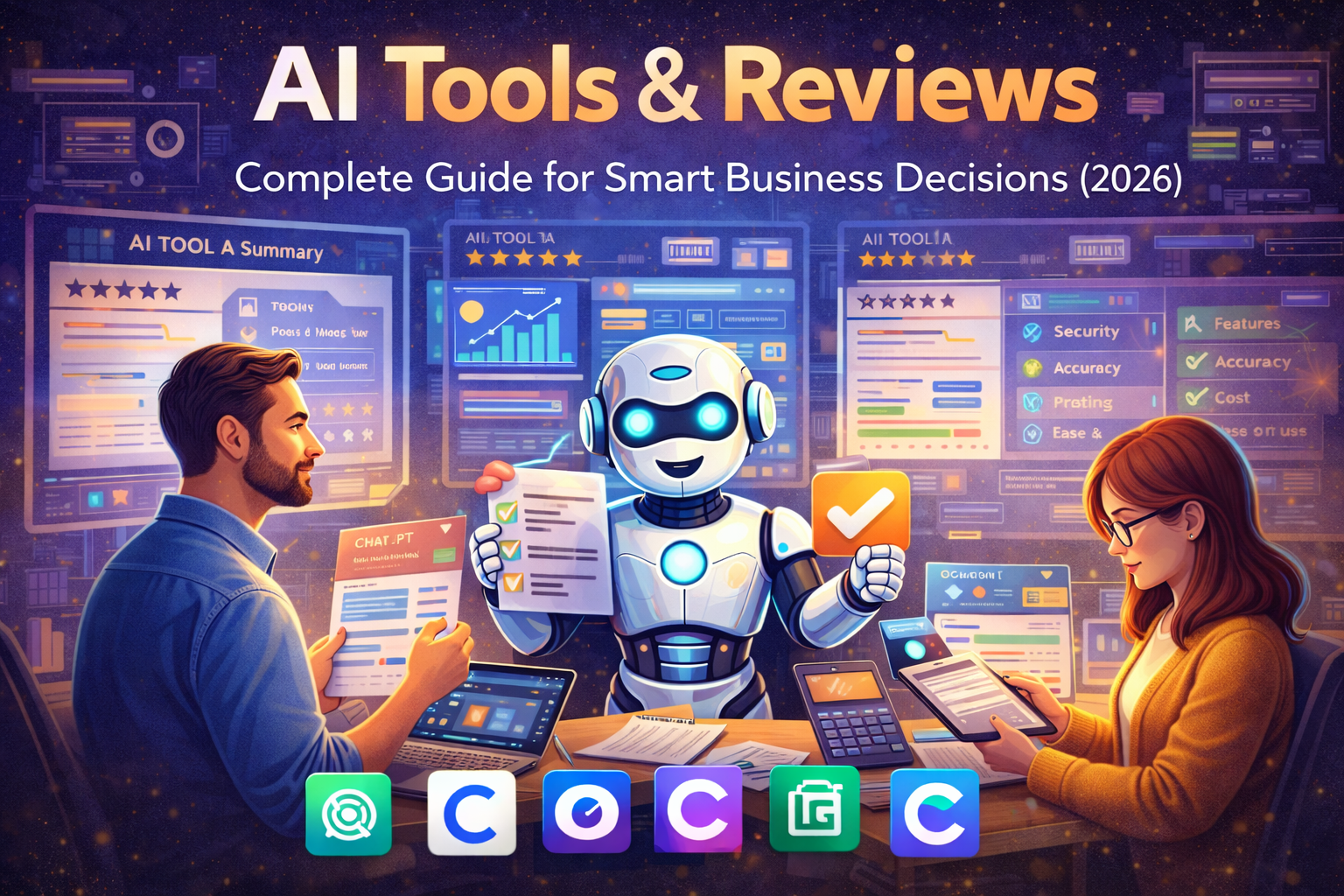
Why Choosing the Right AI Tool Feels So Difficult
From content writing and design to analytics and customer support, hundreds of AI tools promise better productivity. But not all tools deliver real value. Many users waste time and money testing unreliable platforms.
That’s why this AI Tools & Reviews pillar guide focuses on practical evaluation, real use cases, and responsible adoption. Instead of hype, you’ll find clear insights to help you choose tools that actually support your business goals.
What Are AI Tools & Reviews?
AI tools & reviews refer to the systematic evaluation of artificial intelligence software based on performance, reliability, pricing, privacy, and real-world usability. These reviews help users understand how AI platforms work in practice and whether they fit specific business, marketing, or creative needs.
Why AI Tools & Reviews Matter in 2026
As AI adoption grows, so does market saturation. New platforms appear every month, often with similar features. Without trusted reviews, users risk choosing tools that lack support, transparency, or long-term value.
Reliable AI tools & reviews help businesses:
- Avoid poor-quality or unsafe software
- Compare tools objectively
- Invest in scalable solutions
- Maintain data privacy and compliance
- Build sustainable digital workflows
In 2026, informed selection is more important than early adoption.
How AI Tools Are Evaluated (Review Framework)
Professional AI reviews follow a structured process:
Tool Discovery
↓
Feature Testing
↓
Performance Evaluation
↓
Security & Compliance Review
↓
User Experience Analysis
↓
Final Rating & Recommendatio
Core Evaluation Factors
- Functionality – Does it solve real problems?
- Accuracy – Are outputs reliable?
- Usability – Is it easy to learn and use?
- Integration – Does it work with existing systems?
- Ethics & Privacy – Are data practices transparent?
This framework ensures reviews remain practical and unbiased.
Major Categories of AI Tools
AI platforms usually fall into key functional groups:
1. Content & Writing Tools
Used for blogs, emails, scripts, and editing.
2. Marketing & Growth Tools
Support email campaigns, ads, personalization, and analytics.
3. Design & Creative Tools
Generate images, videos, presentations, and branding materials.
4. Research & Analysis Tools
Help with fact-checking, summarization, and market insights.
5. Productivity & Automation Tools
Manage workflows, documents, and internal processes.
Popular AI Tools in Business & Marketing (Overview Table)
| Tool | Primary Use | Best For | Website |
|---|---|---|---|
| ChatGPT | Writing & research | Blogs, planning | https://openai.com |
| Claude | Long-form analysis | Reports, studies | https://www.anthropic.com |
| Perplexity AI | AI search | Fact checking | https://www.perplexity.ai |
| Jasper | Marketing copy | Ads, pages | https://www.jasper.ai |
| Canva AI | Design | Visual content | https://www.canva.com |
| Grammarly | Editing | Proofreading | https://www.grammarly.com |
| HubSpot AI | CRM & automation | Lead management | https://www.hubspot.com |
| Notion AI | Productivity | Planning | https://www.notion.so |
Visual Examples: AI Tools in Real Workflows
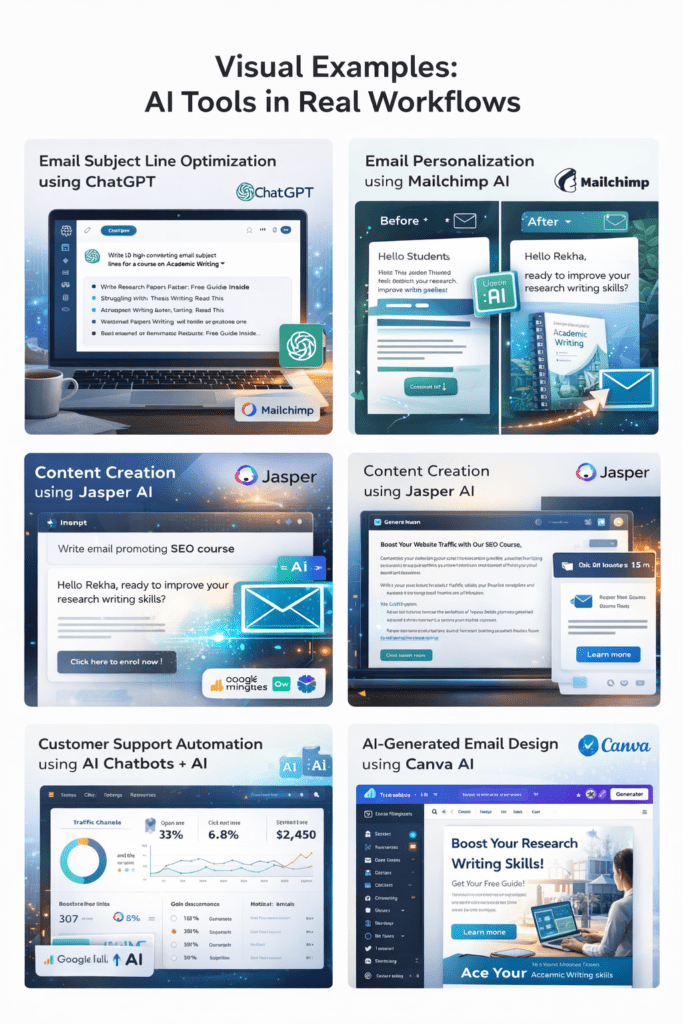
These interfaces show how AI tools present insights, automation, and creative support in real business environments.
Real-World Use Cases of AI Tools
Small Businesses
- Automate email campaigns
- Generate product descriptions
- Analyze customer feedback
Content Creators
- Draft blogs and scripts
- Optimize SEO
- Improve writing quality
Marketing Teams
- Segment audiences
- Predict engagement
- Track campaign performance
Consultants & Educators
- Summarize research
- Prepare presentations
- Manage knowledge bases
AI tools become most effective when aligned with specific workflows.
Benefits of Using Reviewed AI Tools
- Better tool selection decisions
- Reduced experimentation costs
- Improved productivity
- Higher content quality
- Stronger data security awareness
- Long-term platform stability
Trusted AI tools & reviews protect users from unreliable platforms.
Challenges in Reviewing AI Tools
Balanced reviews must address limitations:
- Rapid updates change features frequently
- Free trials may hide long-term costs
- Performance varies by use case
- Privacy policies can be complex
- Marketing claims may exaggerate benefits
This is why continuous, transparent reviews are essential.
Best Practices for Choosing AI Tools
- Define your main objective first
- Compare at least 2–3 tools
- Test free versions when possible
- Read privacy and data policies
- Check customer support quality
- Avoid tool overload
Smart selection improves ROI and reduces frustration.
Frequently Asked Questions (FAQs)
What are AI tools & reviews used for?
AI tools & reviews help users understand how artificial intelligence software performs in real conditions. They evaluate features, reliability, pricing, and ethics so businesses and creators can make informed decisions.
Are AI tool reviews reliable?
Reliable reviews are based on hands-on testing, transparent criteria, and balanced reporting. Users should prefer reviews that mention both advantages and limitations rather than only promotions.
Which AI tools are best for beginners?
Beginners often start with general-purpose platforms for writing, design, and productivity. Tools with clear interfaces, tutorials, and responsive support are ideal for learning.
Can AI tools replace professional expertise?
No. AI tools support professionals by automating routine tasks and offering insights. Strategy, creativity, ethics, and relationship management still require human involvement.
How often should AI tools be reviewed?
Ideally every 6–12 months. Frequent updates, pricing changes, and policy revisions mean that periodic reviews are necessary for accurate recommendations.
Are AI tools safe for business data?
Safety depends on vendor policies and implementation. Businesses should review encryption standards, storage practices, and compliance certifications before adopting any platform.
Conclusion: Building Trust Through Responsible AI Reviews
The AI Tools & Reviews category exists to help users move beyond marketing claims and choose technology wisely. When tools are selected through transparent evaluation and ethical standards, they become reliable partners for growth and innovation.
By combining hands-on testing, human judgment, and verified sources, this pillar supports long-term digital success in an evolving AI ecosystem.
References (Trusted Sources)
- Google – AI & Business Solutions
https://business.google.com - OpenAI – Research & Tools
https://openai.com - IEEE – AI Standards
https://www.ieee.org - UNESCO – AI Ethics
https://www.unesco.org/en/artificial-intelligence
Must Read
- Academic Writing
- AI Ethics & Future
- AI in Academic Research
- AI in Business & Marketing
- AI in Content Creation
- AI in Design & Development
- AI in Education/Teaching
- AI in Research
- AI Tools & Review
- Indian Laws
- Motivation
- SEO & Digital Marketing
- Writing & Content Creation

7 Ways AI Is Revolutionizing Data Analysis in Academic Research
AI is revolutionizing data analysis in academic research by automating data cleaning, accelerating statistical analysis,…
Academic Writing Mastery: The Complete 2026 Guide to Research Papers & Thesis Writing
Academic Writing Mastery Your research deserves to be read. This complete guide transforms your ideas…

AI Chatbots Customer Support: 24/7 Help Guide
Ever lost sales because customer questions came at 2 AM? Many small businesses struggle to…
AI Ethics Checklist for PhD Research: A Practical Guide
A complete AI ethics checklist for PhD research. Learn how to use AI tools ethically,…
AI For Logo and Branding: Best Tools & Workflows 2026
Building a professional brand identity once required hiring designers, waiting weeks for revisions, and investing…
AI for Small Businesses: Practical Tools & Growth Guide
Running a small business today is both exciting and challenging. You may be managing customers,…
AI for UI/UX Design: Tools, Workflows, and Trends
User Interface (UI) and User Experience (UX) design play a critical role in the success…
AI in App Development: Tools, Use Cases & Trends (2026)
App development is no longer limited to experienced programmers or large teams. Today, AI in…
AI in Content Creation: 2026 Guide, Tools & Best Practices
Explore AI in content creation for 2026 — tools, workflows, benefits, real use cases, and…
AI in Design & Development: Tools, Workflows, and Best Practices 2026
Artificial Intelligence is no longer a future concept.AI in Design & Development is already shaping…
AI in Digital Marketing: Trends Shaping Smarter Marketing
Digital marketing has changed dramatically in recent years, and AI in digital marketing is one…

AI in Education: How Artificial Intelligence Is Transforming Teaching and Learning 2026
Education is undergoing one of its most important transformations ever.AI in education is changing how…