
Last Updated: April 17, 2026
AI Ethics Checklist for PhD Research 10-Point Compliance Checklist 2026 Everything you need to use AI responsibly in your thesis — with a ready-to-use disclosure template
“Using AI in research is not wrong — but using it without transparency is.“
A PhD thesis AI ethics disclosure template is no longer optional — in 2026, it is something your university may require before your thesis is even accepted for examination. And yet, most PhD students are still submitting work without any mention of the AI tools they used along the way.
Here is the uncomfortable truth: misusing AI in your research — even unintentionally — can lead to academic penalties ranging from a revision request to full disqualification in serious cases. That is not something you want to discover after three or more years of hard work.
If you are using AI in your research, this guide is for you. We will walk through exactly what ethical AI use looks like, what your university expects, and how to protect yourself with a practical 10-point compliance checklist — plus a ready-to-paste disclosure statement you can use today.
Who this is for: PhD scholars, research students, and academic writers who are using AI tools in any part of their research process — literature review, data analysis, writing, or editing.
Why AI Ethics Matters in PhD Research
Academic integrity is the foundation of everything you produce as a researcher. Your degree, your future publications, and your professional reputation all rest on it. When AI tools enter the picture — even helpful, legitimate ones — they introduce new risks that the traditional academic system was not designed to handle.
Universities around the world have updated their policies significantly in 2025 and 2026. According to guidance from major institutions, three core concerns are driving these policy changes:
- Academic integrity: AI-generated content submitted without disclosure is treated as misrepresentation — comparable to plagiarism in many institutional frameworks.
- Research credibility: If your methods cannot be reproduced or verified because AI usage was undisclosed, your findings lose their scholarly credibility.
- Risk of misuse: Students who use AI to fabricate data, generate fake citations, or produce thesis chapters wholesale — even if a small minority — are causing stricter rules for everyone.
The good news: If you use AI transparently and follow a clear compliance process, your work is fully protected. Ethical AI use is widely accepted — it’s the hiding of AI use that causes problems.
What is AI Ethics in Research?
Simply put, AI ethics in research means using artificial intelligence tools in ways that are honest, accurate, transparent, and respectful of both participants and scholarly standards.
It’s not about whether you use AI. Most universities in 2026 accept AI-assisted research. It is about how you use it and whether you are honest about having done so.
A simple example: You use Elicit to identify 15 relevant papers for your literature review. That is completely acceptable — as long as you note in your methodology: “Paper identification was supported by Elicit (elicit.org), an AI-powered literature search tool, with all sources verified and read by the researcher.” That one sentence protects you entirely.
Core principle: Your analysis, interpretation, argument, and conclusions must represent your own intellectual work. AI tools can assist the process — they cannot replace your scholarly judgment.
10-Point AI Ethics Compliance Checklist
Work through this list before you submit any chapter or your final thesis. Each point is a non-negotiable element of responsible AI use in academic research.
01. Disclose all AI tools used in your research
Transparency requirement — covers tools used for any part of your workflow
| Example State in your methodology: “Elicit was used to support the initial literature search. All identified papers were read and assessed by the researcher.” | Why it matters Undisclosed AI use in any section — even citation sorting — can be treated as academic dishonesty under updated 2026 guidelines at most institutions. |
If ignored: Your thesis may be flagged during examination, requiring major revisions or formal academic misconduct review, regardless of how good your research is.
02. Cite AI tools properly in your methodology section
Academic citation requirement — AI tools must be cited like any other resource
| Example APA 7th: OpenAI. (2025). ChatGPT (GPT-4o) [Large language model]. https://chat.openai.com — same logic applies to Elicit, Julius AI, and others. | Why it matters Citing AI tools establishes methodological transparency. Examiners and reviewers must be able to understand exactly what tools shaped your research process. |
If ignored: Your methodology chapter may be considered incomplete, and the reliability of your research process cannot be assessed or reproduced by others.
03. Never submit AI-generated content as your own writing
Academic authorship — you are the author of your thesis, not the AI
| Example Using Paperpal to improve a paragraph you wrote is acceptable. Pasting a full ChatGPT-generated literature review section into your thesis without heavy editing is not. | Why it matters Your thesis is a demonstration of your own scholarly capability. AI-generated text, submitted as original, misrepresents your work to your institution and future employers. |
If ignored: This is the highest-risk compliance failure. It is categorised as academic fraud at most universities and can result in degree revocation even post-award.
If ignored: Your thesis may be flagged during examination, requiring major revisions or formal academic misconduct review, regardless of how good your research is.
04. Verify all AI-generated information before using it
Data accuracy — AI tools can be confidently wrong
| Example If Elicit summarizes a paper as finding “X improves Y,” go to the original paper and confirm that is what it actually says before citing it in your thesis. | Why it matters AI tools occasionally summarize incorrectly, hallucinate citations, or misattribute findings. You — not the tool — are responsible for the accuracy of your thesis. |
If ignored: Inaccurate citations or misrepresented findings will be identified during examination. This reflects on your scholarly rigor, not on the tool you used.
05. Protect participant data — do not upload it to AI tools
Research ethics and data privacy — a strict institutional requirement
| Example Never upload interview transcripts with participant names, identifiable responses, or medical data to a public AI tool like ChatGPT or Julius AI without ethics clearance. | Why it matters Participant confidentiality is protected under most national data protection laws. Uploading identifiable data to a third-party AI server without consent may breach your ethics approval conditions. |
If ignored: This is not just an academic issue — it may constitute a legal data protection violation under GDPR, PDPA, or equivalent frameworks depending on your country.
06. Human verification for all AI-assisted analysis
Scholarly accountability — AI assists, humans decide
| Example If ATLAS.ti suggests a theme in your qualitative data, you must independently evaluate whether that theme is genuinely supported by your raw data before accepting it. | Why it matters AI pattern recognition can miss nuance, context, and meaning that only you — as an expert in your topic — can assess. Your analysis must reflect your judgment. |
If ignored: Examiners may question the validity of your analysis if they suspect AI categorised your findings without your critical oversight and interpretation.
07. Check your university’s specific AI usage policy
| Example Some universities permit AI-assisted writing and require only a disclosure. Others prohibit any AI writing assistance and only allow AI for data analysis or literature search support. | Why it matters General ethics guidelines are not enough. Your specific institution, department, and supervisor may have additional requirements that override general best practice. |
If ignored: Claiming you “followed general AI ethics guidelines” will not protect you if you violated your institution’s specific policy. Ignorance is not a defence in academic misconduct cases.
08. Run an AI-detection check before submission
| Example Use tools like GPTZero or Turnitin’s AI detection feature on your draft chapters — not because you’ve done anything wrong, but to catch any AI-sounding passages that need rewriting in your own voice. | Why it matters Even when you write authentically, heavy use of AI editing tools can make text flag as AI-generated. Knowing this before submission lets you address it proactively. |
If ignored: You may face AI-detection flags during examination that put your work under additional scrutiny, even if your AI use was entirely appropriate and disclosed.
09. Avoid over-reliance — maintain your own research voice
Intellectual ownership — your thesis must reflect you, not a tool
| Example If your discussion chapter reads uniformly polished and has no discernible personal scholarly voice, it may raise questions — even if every word was technically written by you with AI assistance. | Why it matters Examiners assess not just content but your development as a researcher. Over-polished, AI-flattened writing can hide the analytical depth examiners are looking for. |
If ignored: A thesis that sounds “AI-uniform” throughout may perform poorly in the viva voce if you cannot defend analytical choices or articulate your own reasoning under questioning.
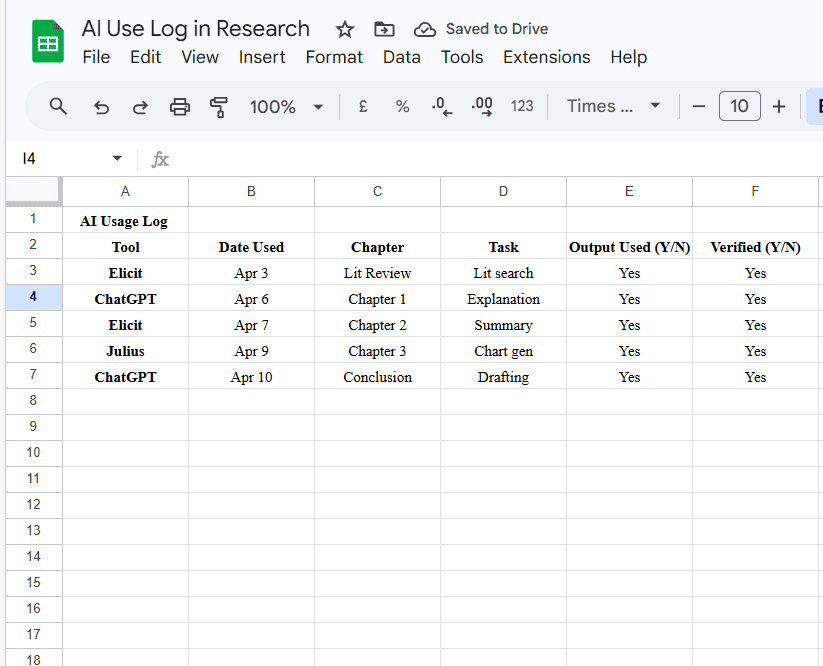
10. Keep a log of every AI tool used, when, and for what task
Audit trail — your best protection if questions arise
| Example Maintain a simple spreadsheet: Tool | Date | Chapter | Task | Output Used? This takes 2 minutes per session and creates an unassailable record of responsible use. | Why it matters If your ethics compliance is ever questioned — during examination or after publication — having a detailed usage log demonstrates the transparency and diligence of a thorough researcher. |
If ignored: Without a usage record, you may be unable to accurately complete disclosure statements, reconstruct your methodology, or respond to examiner questions about your research process.
AI Disclosure Template for Your PhD Thesis
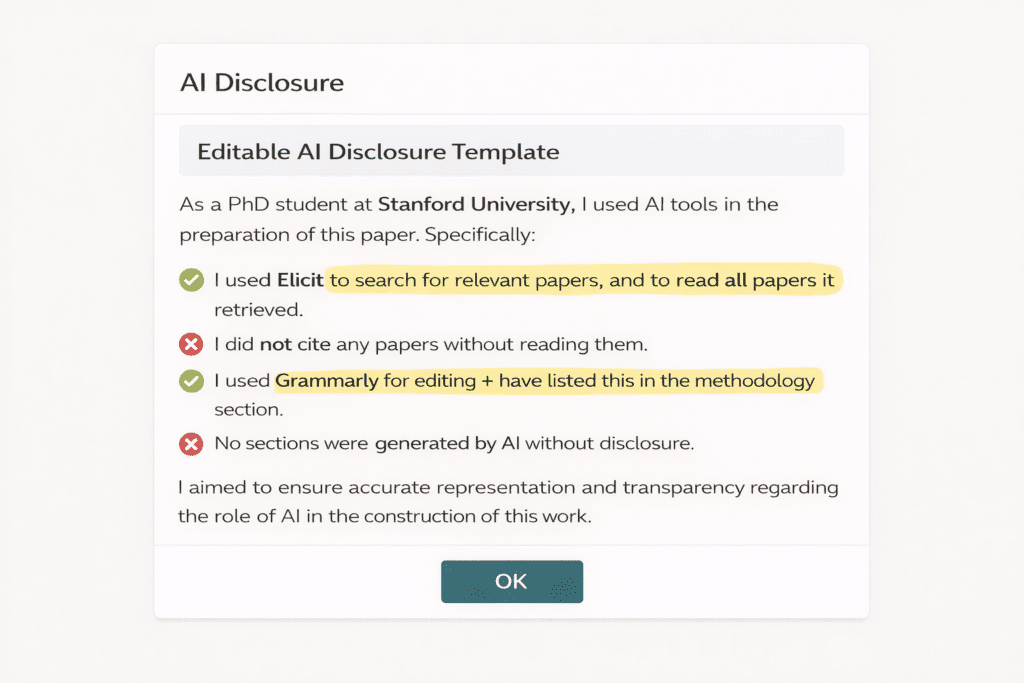
This is a ready-to-use disclosure statement you can adapt and include in your methodology chapter or in a separate “AI Use Statement” section — which many universities now require as a standalone page.
Sample AI Disclosure Statement — PhD Thesis 2026
AI Use Disclosure Statement
In the preparation of this thesis, the author made use of the following artificial intelligence (AI) tools to support specific stages of the research process:
[Tool Name] was used for [specific task, e.g., initial literature search / data visualisation / language editing] during the [chapter or phase, e.g., literature review / data analysis] stage of this research.
All AI-generated outputs were independently reviewed, verified against original sources, and substantially edited by the author. The analysis, interpretation, arguments, and conclusions presented in this thesis represent the author’s own original intellectual work. No AI tool was used to generate thesis text that was submitted without significant revision and human authorship.
This disclosure is made in accordance with the AI usage policy of [University Name], effective [Year].
— [Your Name], [Date of Submission]
Replace all [bracketed placeholders] with your specific details. If you used multiple tools, list each one separately with its specific task. Check whether your university requires this as a signed declaration.
Where to place it: Most universities now accept this either at the start of your Methodology chapter, on a standalone “AI Use Declaration” page after your abstract, or in an appendix. Ask your supervisor which format your institution prefers.
How to Cite AI Tools in PhD Methodology
Learning how to cite AI tools in your PhD methodology is simpler than most students think. The key principle: treat the AI tool as a piece of software or database you used as part of your research process — and cite it accordingly.
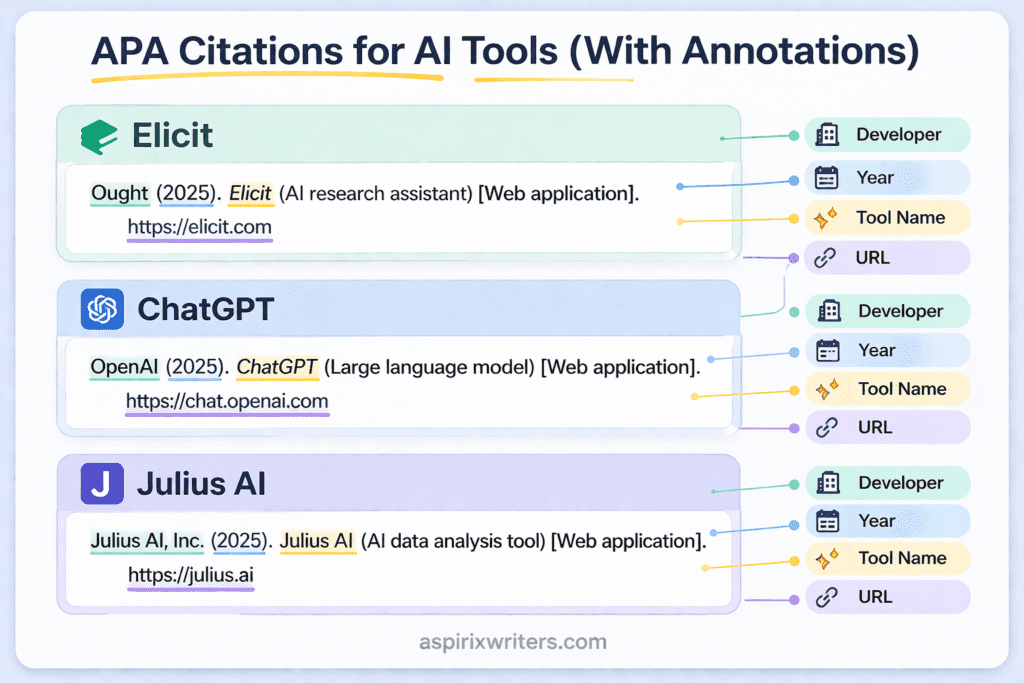
APA 7th Edition Format
APA 7th — General AI Tool Citation
Developer/Company Name. (Year). Tool Name (Version if known) [Type of tool]. URL
Example — Elicit
Ought, Inc. (2025). Elicit (Version 2) [AI research assistant]. https://elicit.org
Example — ChatGPT (for language editing)
OpenAI. (2025). ChatGPT (GPT-4o) [Large language model]. https://chat.openai.com
Example — Julius AI (for data analysis)
Julius AI. (2025). Julius AI [AI data analysis tool]. https://julius.ai
In your methodology text, introduce the citation naturally: “To support quantitative data analysis, Julius AI (Julius AI, 2025) was used to generate descriptive statistics and visualisations from the survey dataset. All outputs were verified by the researcher.”
Note on Vancouver and Harvard styles: Most citation styles do not yet have a standardised AI tool citation format. For Vancouver and Harvard, follow the software/database citation template of that style and add the URL and access date. When in doubt, ask your librarian — they are updated on this regularly.
Common Mistakes PhD Students Make with AI Ethics
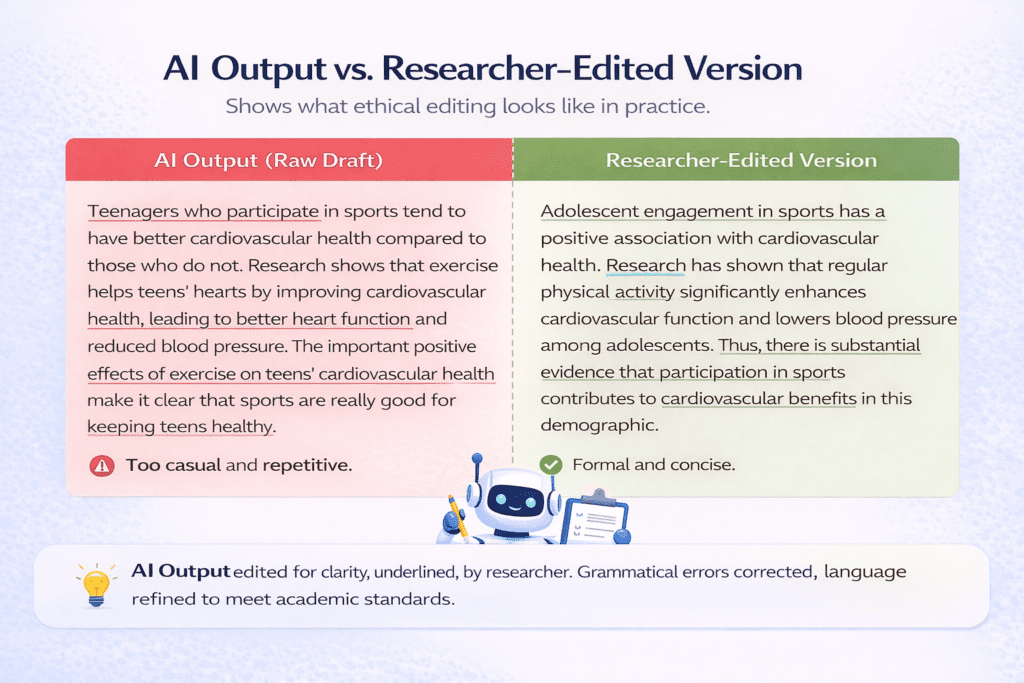
- Copying AI output directly into your thesis: Even one paragraph submitted verbatim without disclosure is a serious compliance failure. Every AI-assisted section must be substantially rewritten in your own voice.
- Not disclosing “minor” AI tool use: Many students assume that using AI for grammar checking or reference sorting doesn’t need disclosure. When in doubt — disclose. There is no penalty for over-disclosing; there can be serious penalties for under-disclosing.
- Over-relying on AI for literature synthesis: AI summaries are a starting point, not a conclusion. Your literature review must demonstrate your own critical engagement with sources — not just a list of AI-generated summaries.
- Using one generic disclosure for all tools: “I used AI tools” is not sufficient. Each tool, its specific task, and the extent of human verification must be named. Vague disclosures can raise more questions than they answer.
- Assuming your university’s policy hasn’t changed: Policies are being updated rapidly in 2026. Check your institution’s current guidance at the start of every academic year — and before submitting any chapter for supervisor review.
Ethical vs Unethical AI Use in Research
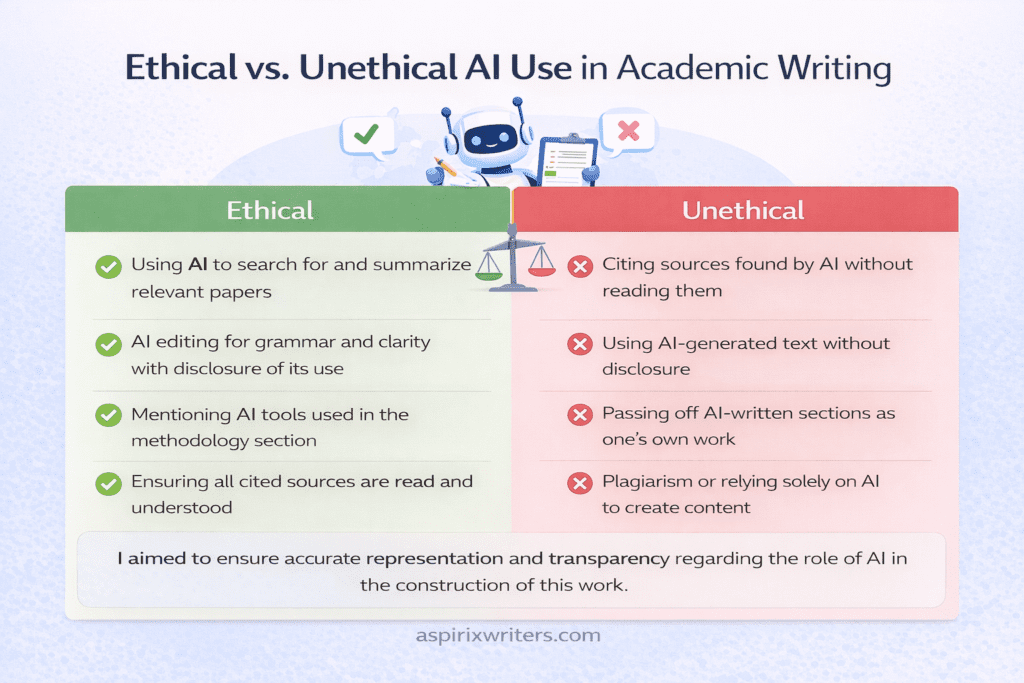
| Ethical AI Use | Unethical AI Use |
|---|---|
| Using Elicit to identify relevant papers, then reading and citing them yourself | Citing papers you found through AI without reading them or verifying their content |
| Using Paperpal to improve the clarity of your own written paragraphs | Using ChatGPT to write entire thesis sections and submitting them without disclosure |
| Using Julius AI to visualise survey data, then interpreting the charts yourself | Submitting AI-generated data analysis as your own interpretation without verification |
| Disclosing all AI tools in your methodology with specific task descriptions | Using AI throughout your research and making no mention of it anywhere in the thesis |
| Using AI to screen abstracts in a systematic review, then manually confirming inclusion | Allowing AI to make final inclusion/exclusion decisions without your review and oversight |
Best Practices for Safe AI Use in Your Research
- Start your AI usage log on day one — a simple spreadsheet takes 90 seconds per session and saves enormous stress at submission.
- Tell your supervisor early — let them know which tools you are using. Their guidance will protect you and may refine your approach.
- Use AI for process, not for prose — searching, sorting, summarising, visualising. The actual writing, interpreting, and arguing should be yours.
- Read the original sources — no matter how confident an AI summary looks. Your credibility depends on it.
- Update your disclosure statement as you go — don’t wait until submission. Add each tool to your disclosure section as you use it, so nothing is forgotten.
University expectations in 2026: Most research universities now expect (a) a named disclosure of AI tools, (b) a description of the tasks they supported, (c) a statement confirming human oversight and verification, and (d) confirmation that the analysis and conclusions are the researcher’s own. That’s it — four clear commitments that protect your entire thesis.
Frequently Asked Questions
Is it allowed to use AI in PhD research in 2026?
Yes — most universities permit AI-assisted research in 2026, provided you disclose which tools you used and for which tasks. Data fabrication, undisclosed AI writing, and unverified AI citations remain prohibited. Always check your institution’s specific, current AI use policy before you begin.
How do I disclose AI usage in my PhD thesis?
Include a named disclosure in your methodology section stating: which tool, which task, what output was produced, and how you verified it. Many universities now require a standalone AI Use Declaration page. Use the ready-made template in this post as your starting point and adapt it to your institution’s format.
Can AI-generated content be considered plagiarism?
Yes — if submitted without disclosure. Undisclosed AI-generated content is treated as misrepresentation of authorship under most institutional plagiarism policies, even though AI itself is not an author. The violation is the lack of transparency, not the AI use itself. Always disclose, always revise, always verify.
What is the best format for citing AI tools in APA 7th edition?
Follow the software citation format: Developer/Company. (Year). Tool Name (Version) [Type]. URL. Example: OpenAI. (2025). ChatGPT (GPT-4o) [Large language model]. https://chat.openai.com — Then in-text, cite as you would any source: (OpenAI, 2025). Add the date of access if the tool’s outputs change over time.
Do I need to disclose AI tools used only for grammar checking?
When in doubt, disclose. Many universities now require disclosure of all AI tool usage, including grammar and editing assistants like Grammarly or Writefull. A brief note — “Grammarly was used for grammar and spelling review” — takes thirty seconds to add and eliminates any compliance risk entirely.
About Author
Dr. Rekha Khandelwal, Research Ethics Advisor · Academic Writer · PhD Research Mentor
Dr. Rekha Khandelwal helps PhD scholars through every stage of the research process — from the first literature search to the final viva voce. Her work spans academic writing, research ethics advising, and AI-in-education consultancy across multiple disciplines.
As institutions navigate rapidly changing AI policies, Dr. Rekha helps researchers understand not just the rules, but the reasoning behind them – so they can work with confidence, integrity, and genuine scholarly authority. Her guidance is known for being direct, practical, and always on the side of the student.
Ethical AI use strengthens—not weakens—your research impact.
EU AI Act: Complete Researcher-Friendly Guide
References:
UNESCO Recommendation on the Ethics of Artificial Intelligence Recommendation on the Ethics of Artificial Intelligence – Legal Affairs
15 Best Free AI Tools Every PhD Student Needs in 2026
15 Best Free AI Tools for PhD Students 2026 Finding the best free AI tools…
7 AI Data Analysis Tools for PhD in 2026
AI Data Analysis Tools AI Research Revolution 2026: Complete PhD Workflow Guide A simple guide…
AI Ethics and Future: Complete Guide to Responsible AI in 2026
AI Ethics and Future Why AI Ethics Matters More Than Ever Think about the last…
AI Ethics Checklist for PhD Research: A Practical Guide
AI Ethics Checklist for PhD Research 10-Point Compliance Checklist 2026 Everything you need to use…
AI in Education in 2026: How Artificial Intelligence Is Transforming Teaching and Learning
Think about a Class 10 student in Jaipur. It is 10 pm. She is stuck…

AI Research Revolution 2026: Complete PhD Workflow Guide
AI Research Revolution 2026 The complete AI PhD research workflow 2026 is changing how researchers…
EU AI Act: Complete Researcher-Friendly Guide (Compliance Timeline to 2026)
What Is the EU AI Act? (In Simple) Imagine you build a robot that helps…

How to Do a Literature Review Using AI Tools
Imagine opening your research database and seeing hundreds of papers on your topic. Instead of…