
Cluster Post 4 | Module 2: The Academic Writing Process
From Concept to Submission Series | 2026
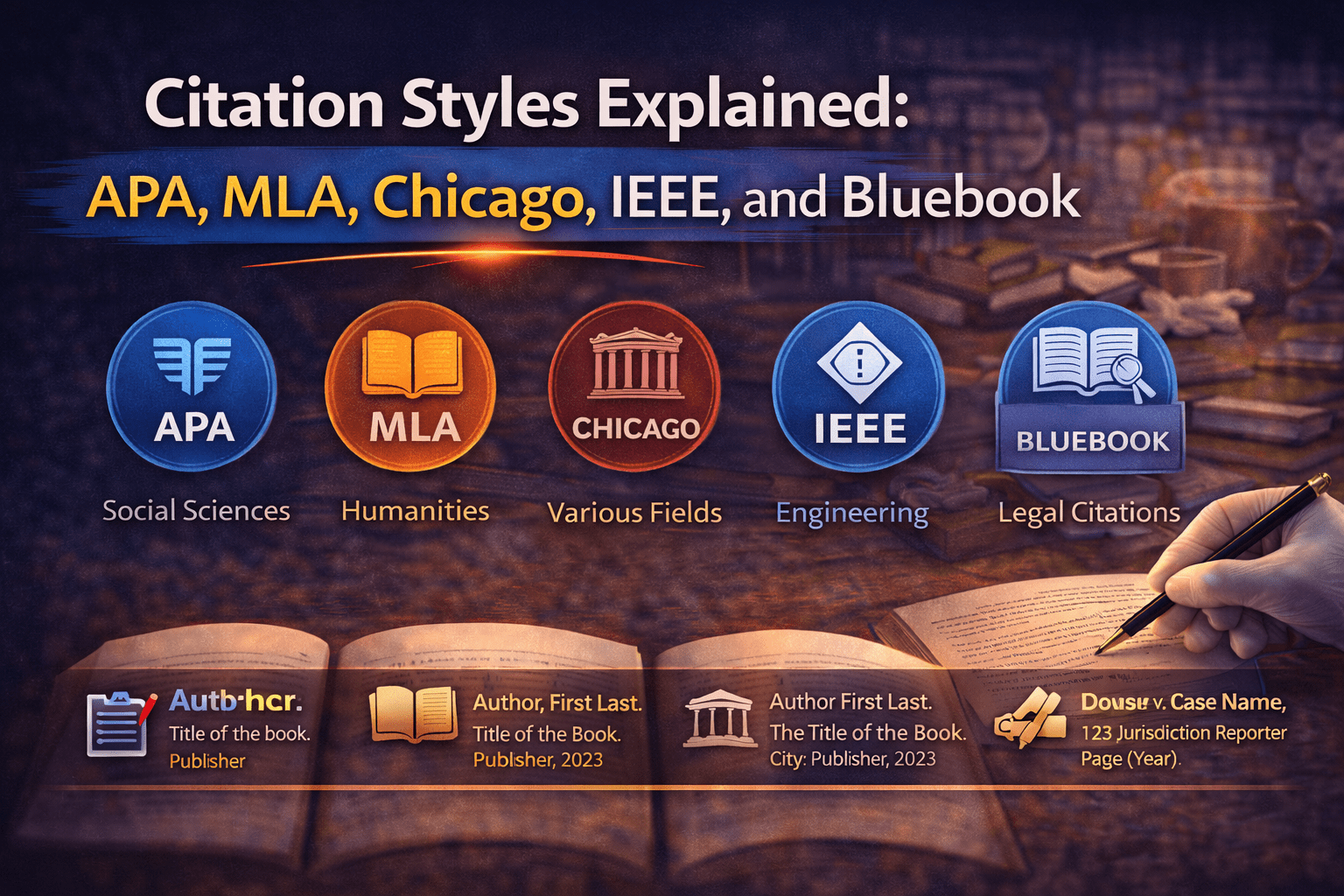
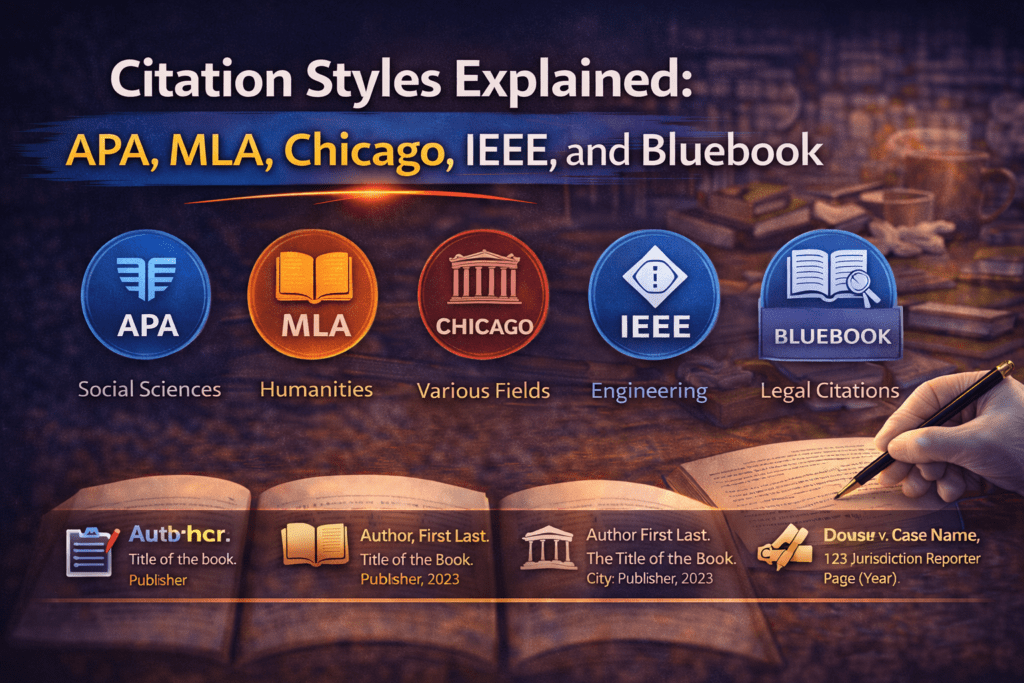
Citation Styles Explained: APA, MLA, Chicago, IEEE, and Bluebook
The module overview introduced the major citation styles. This post goes deeper: why each style exists, what its in-text and reference list formats look like with real examples, the most common mistakes in each, and a decision guide for choosing the right style — including what Indian universities typically require and what happens when your institution’s requirements conflict with your target journal.
Why Citation Styles Exist — and Why They Differ
Citation styles are not arbitrary bureaucratic conventions. Each one was designed to serve the specific needs of the field it originated in, and understanding those needs makes the rules feel logical rather than random.
In social sciences, readers need to quickly assess how recent a source is — a 2024 finding about AI bias matters more than a 2004 one. So APA puts the year immediately after the author name: (Smith, 2024). In humanities, the page number matters more than the date — you are often analysing a specific passage, and knowing that the argument appears on page 47 of a classic text tells a reader more than knowing it was published in 1985. So MLA puts the page number in the parenthesis: (Smith 47). In law, readers need to verify sources precisely and immediately — a case citation must identify not just the case but the exact volume, reporter, and page. So Bluebook developed a highly structured format that looks nothing like APA or MLA, because it is solving a completely different problem.
When you understand the logic behind a style, you make fewer errors — because you understand what information matters most and why it goes where it does.
APA 7th Edition
APA is the dominant style in psychology, education, most social sciences, and increasingly in Indian university social science programmes. If you are writing about education, sociology, public policy, or economics, you are almost certainly using APA.
In-text citations
APA uses author-date citations in parentheses. The year follows the author name because recency matters in empirical research.
One author, paraphrase: (Smith, 2024) One author, direct quote: (Smith, 2024, p. 47) Two authors: (Smith & Jones, 2024) Three or more authors: (Smith et al., 2024) Author named in sentence: Smith (2024) found that… Two works, same parenthesis: (Jones, 2022; Smith, 2024) [alphabetical order]
Reference list format
The reference list is titled References (not Bibliography). Entries are alphabetised by first author’s last name, with a hanging indent — first line flush left, subsequent lines indented 0.5 inches.
Journal article: Smith, J. D., & Jones, A. B. (2024). Peer mentoring and first-year retention. Journal of Higher Education, 95(3), 112–134. https://doi.org/10.xxxx Book: Creswell, J. W., & Creswell, J. D. (2022). Research design: Qualitative, quantitative, and mixed methods approaches (6th ed.). Sage. Chapter in edited book: Patel, R. (2023). Retention in Indian government colleges. In A. Kumar (Ed.), Higher education equity in India (pp. 45–72). Oxford University Press.
Most common APA mistakes
- Using “&” in running text instead of “and” — APA uses “and” in text, “&” only in parentheses and reference lists.
- Missing DOI — APA 7th edition requires DOIs for journal articles whenever available. Many researchers leave them out.
- Wrong capitalisation in reference list — APA uses sentence case for article and book titles (only first word and proper nouns capitalised), but title case for journal names.
- Using 6th edition rules — APA changed significantly in 2020. Running head is no longer required for student papers. DOI format changed. Check which edition your institution requires.
MLA 9th Edition
MLA is standard in literature, languages, film studies, and most humanities disciplines. If you are analysing texts — literary, historical, or cultural — you are almost certainly using MLA.
In-text citations
MLA uses author-page citations, because in humanities analysis the specific location of a passage matters more than its date.
One author, paraphrase: (Smith 47) One author, direct quote: (Smith 47) [same format] Two authors: (Smith and Jones 47) Three or more authors: (Smith et al. 47) Author named in sentence: Smith argues that privacy is… (47) No author: Use shortened title: (“Privacy Rights” 12)
Works Cited format
MLA’s reference list is titled Works Cited. The most distinctive feature of MLA 9th edition is the container system — sources are described in terms of the container they appear in (a journal, an anthology, a website). This makes MLA unusually flexible for citing digital and non-traditional sources.
Journal article: Smith, John D. “Peer Mentoring and Retention.” Journal of Higher Education, vol. 95, no. 3, 2024, pp. 112–134. Book: Creswell, John W., and J. David Creswell. Research Design: Qualitative, Quantitative, and Mixed Methods Approaches. 6th ed., Sage, 2022. Website: Patel, Rohit. “Retention in Government Colleges.” Higher Education India, 15 Mar. 2024, www.higheredIndia.org/retention.
Most common MLA mistakes
- Using parenthetical dates — MLA does not put dates in parenthetical citations. The date appears only in Works Cited.
- Forgetting the period inside the parenthesis — In MLA, the citation comes before the final period: …in higher education (Smith 47). Not: …in higher education. (Smith 47)
- Title case confusion — MLA uses title case for titles (most major words capitalised), unlike APA’s sentence case.
Chicago 18th Edition
Chicago is standard in history, theology, and some social sciences. It offers two systems: notes-bibliography (used by historians) and author-date (similar to APA, used by some social scientists). If you are in history or a humanities field using footnotes, you are using notes-bibliography.
Notes-bibliography: in-text and footnotes
Instead of parenthetical citations, notes-bibliography uses superscript numbers in the text that correspond to footnotes at the bottom of the page or endnotes at the end of the document. The first citation of a source is a full note; subsequent citations use a shortened form.
First citation footnote: ¹ John D. Smith, Peer Mentoring in Higher Education (Academic Press, 2024), 47. Subsequent citation (shortened): ² Smith, Peer Mentoring, 52. Bibliography entry (slightly different format from footnote): Smith, John D. Peer Mentoring in Higher Education. Academic Press, 2024.
The bibliography entry and the footnote entry for the same source are formatted differently — author name is inverted in the bibliography (Smith, John D.) but not in the footnote (John D. Smith). This trips up many researchers.
Most common Chicago mistakes
- Confusing footnote and bibliography format — the author name order differs. In footnotes: First Last. In bibliography: Last, First.
- Using “ibid.” incorrectly — Chicago 18th edition discourages “ibid.” Use the shortened citation form instead.
- Missing publisher location — older Chicago editions required city of publication. Chicago 18th edition has relaxed this for well-known publishers but check your institution’s preference.
IEEE Style
IEEE is standard in engineering, computer science, electronics, and related technical fields. It is radically different from the other styles — numbered rather than author-based.
In-text citations
Sources are cited by number in square brackets. Numbers are assigned in the order sources first appear in the text — the first source cited is [1], the second is [2], and so on. If you cite source [1] again later, it is still [1].
Single citation: Peer mentoring significantly improves retention [1]. Multiple citations: Several studies confirm this effect [1], [3], [7]. Contiguous range: This is well established in the literature [1]–[5].
Reference list format
The reference list is numbered in citation order, not alphabetised. This means the first source cited in the paper is [1] regardless of the author’s name.
[1] J. D. Smith and A. B. Jones, “Peer mentoring and first-year retention,” J. Higher Educ., vol. 95, no. 3, pp. 112–134, Mar. 2024, doi: 10.xxxx. [2] J. W. Creswell and J. D. Creswell, Research Design: Qualitative, Quantitative, and Mixed Methods Approaches, 6th ed. Thousand Oaks, CA: Sage, 2022.
Most common IEEE mistakes
- Alphabetising the reference list — IEEE references are numbered in citation order, not alphabetised. This is the most common IEEE error from researchers who are used to APA or MLA.
- Using full journal name — IEEE abbreviates journal names using standard IEEE abbreviations. “Journal of Higher Education” becomes “J. Higher Educ.”
- Wrong author initial format — IEEE uses initials only for first and middle names: J. D. Smith, not John Smith.
Bluebook and OSCOLA: Legal Citation
Legal citation is different in kind from academic citation. Its purpose is not just attribution but precise identification — a legal citation must enable a reader to find the exact case, statute, or provision in a law library or legal database with no ambiguity. The complexity of legal citation reflects the complexity of legal source materials.
Bluebook (US and international)
The Bluebook is the standard for US legal writing and is widely used internationally, including in many Indian law journals. It has two systems: Bluepages for court documents and Whitepages for academic legal writing. The formats differ.
Case (academic Whitepages format): K.S. Puttaswamy v. Union of India, 10 SCC 1 (2017). Statute: Indian Penal Code § 302 (1860). Journal article: Gautam Bhatia, The Transformative Constitution, 42 Delhi L. Rev. 1, 15 (2019). Constitutional provision: India Const. art. 21.
OSCOLA (UK and many Indian law journals)
OSCOLA — Oxford Standard for the Citation of Legal Authorities — is used by many Indian law journals including NLSIU Law Review and journals following UK conventions. It uses footnotes, not in-text parenthetical citations, and has a distinctive format for cases and legislation.
Case: K S Puttaswamy v Union of India (2017) 10 SCC 1. [Note: OSCOLA does not use full stops in abbreviations or after case names] Journal article: Gautam Bhatia, ‘The Transformative Constitution’ (2019) 42 Delhi Law Review 1. Book: Upendra Baxi, The Future of Human Rights (3rd edn, OUP 2008).
Indian legal citation conventions
Indian law journals are not uniform — each has its own house style. The most important rule is to check the specific journal’s author guidelines before submitting. The four most common formats in Indian journals are Bluebook, OSCOLA, a hybrid of the two, or the journal’s own in-house style.
| Indian law journal | Citation style |
| Journal of the Indian Law Institute (JILI) | Footnote citations, JILI house style — check guidelines |
| NLSIU Law Review (Bangalore) | OSCOLA 4th edition |
| NUJS Law Review (Kolkata) | Bluebook 22nd edition |
| Delhi Law Review | OSCOLA |
| Indian Journal of Constitutional Law | Footnote citations, check guidelines |
How to Choose the Right Style
The decision is almost never yours to make — it is determined by your institution, your supervisor, or your target journal. Check in this order:
- Journal submission: Read the author guidelines on the journal’s website. The required style is always specified. If it is not, email the editorial office and ask.
- Thesis: Check your university’s thesis handbook or ask your supervisor. Most Indian universities specify APA for social sciences, Chicago or MLA for humanities, and Bluebook or OSCOLA for law.
- Course assignment: Check the assignment brief or syllabus. If not specified, ask your instructor. Do not guess.
Never mix styles — APA in-text citations with MLA Works Cited entries, or Bluebook case citations with APA journal references. Choose one style and apply it consistently throughout. Using a reference manager (covered in Cluster Post 5) eliminates most formatting errors by generating citations automatically in whatever style you specify.
🔱 For Law Students: A Note on In-Text vs. Footnote Citation
The most fundamental difference between legal citation and other academic citation is structural, not just formatting. Legal citation uses footnotes; most academic citation uses in-text parenthetical references. This matters because it changes how you integrate sources into your argument.
In APA or MLA, the citation appears in the text itself — the reader sees the source name while reading the argument. In legal writing, the citation sits below the line in a footnote — the reader can follow the argument without interruption, and look down only if they want to verify the source. This separation is deliberate: legal argument should be able to stand on its own logical merits, with sources as verification rather than as the substance of the argument.
A consequence of this is that in legal academic writing, you should not rely on footnotes to carry argumentative content. If the argument only makes sense when you read the footnote, the argument belongs in the main text. Footnotes are for citations, for brief qualifications, and for cross-references — not for substantive points that did not fit in the paragraph above.
Many Indian law students use footnotes as a place to deposit material they could not fit in the main text. Examiners and reviewers notice this immediately. If a point is important enough to make, put it in the main text. If it is not, cut it.
References
- American Psychological Association. (2020). Publication Manual of the APA (7th ed.).
- Modern Language Association. (2021). MLA Handbook (9th ed.).
- University of Chicago Press. (2024). The Chicago Manual of Style (18th ed.).
- Harvard Law Review Association et al. (2025). The Bluebook: A Uniform System of Citation (22nd ed.).
- Oxford Standard for the Citation of Legal Authorities (OSCOLA) – Referencing | UWE Bristol
- Institute of Electrical and Electronics Engineers. IEEE Editorial Style Manual.
- Lipson, C. (2018). Cite Right: A Quick Guide to Citation Styles (3rd ed.). University of Chicago Press.
Next: Cluster Post 5 — Reference Management: Zotero and Mendeley from Setup to Submission

The Complete Guide to Research Paper Structure: IMRAD Format, Thesis Organization & Academic Writing (2026)
From Concept to Submission: A Complete Guide to Research Paper and Thesis Writing Module 1:…
The IMRAD Framework: Why It Exists, How It Really Works, and Where It Breaks Down
Cluster Post 1 | Module 1: Understanding the Structure of Research Papers and Theses From…

How to Write a Research Introduction That Reviewers Cannot Ignore
Cluster Post 2 | Module 1: Understanding the Structure of Research Papers and Theses From…

How to Write a Methods Section That Reviewers Will Trust
Cluster Post 3 | Module 1: Understanding the Structure of Research Papers and Theses From…
The Results Section: How to Present Findings Without Letting Interpretation Slip In
Cluster Post 4 | Module 1: Understanding the Structure of Research Papers and Theses From…

The Discussion Section: How to Turn Findings Into Knowledge
Cluster Post 5 | Module 1: Understanding the Structure of Research Papers and Theses From…
Complete Thesis Structure: A Chapter-by-Chapter Guide
Cluster Post 6 | Module 1: Understanding the Structure of Research Papers and Theses From…
10 Structural Mistakes That Get Research Papers Rejected — And How to Fix Every One
Cluster Post 7 | Module 1: Understanding the Structure of Research Papers and Theses From…

The Academic Writing Process: Complete Guide from First Draft to Submission (2026)
From Concept to Submission: A Complete Guide to Research Paper and Thesis Writing Module 2,…
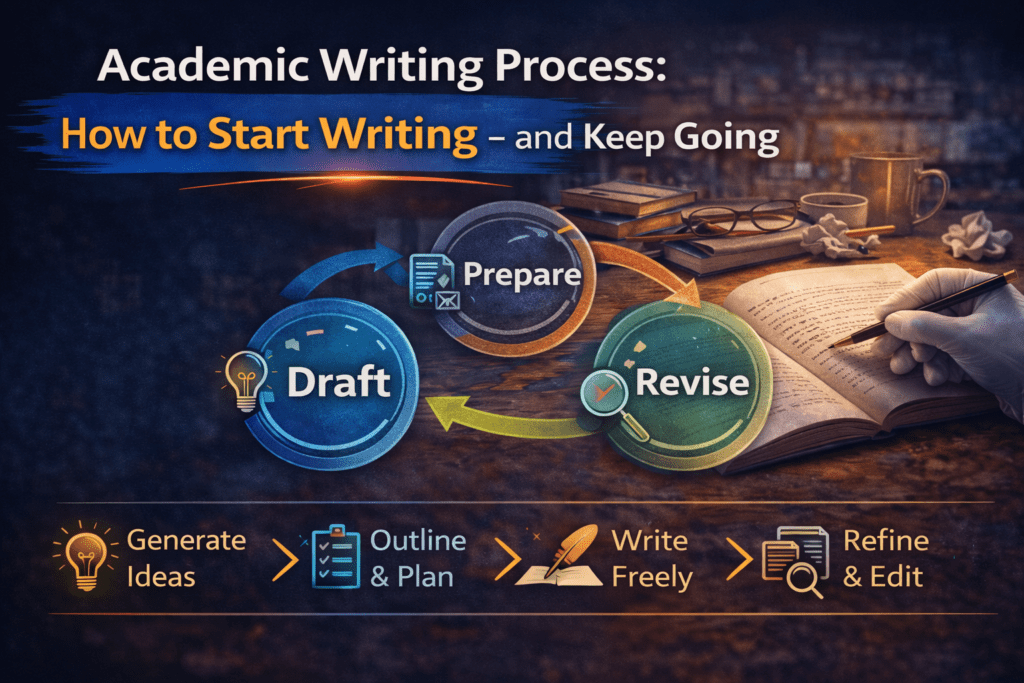
How to Start Writing — and Keep Going
Cluster Post 1 | Module 2: The Academic Writing Process From Concept to Submission Series …

How to Write Clear Engaging Academic Prose
Cluster Post 2 | Module 2: The Academic Writing Process From Concept to Submission Series …
The Revision Process: How to Turn a Draft Into a Submission
Cluster Post 3 | Module 2: The Academic Writing Process From Concept to Submission Series …
Citation Styles Explained: APA, MLA, Chicago, IEEE, and Bluebook
Cluster Post 4 | Module 2: The Academic Writing Process From Concept to Submission Series …
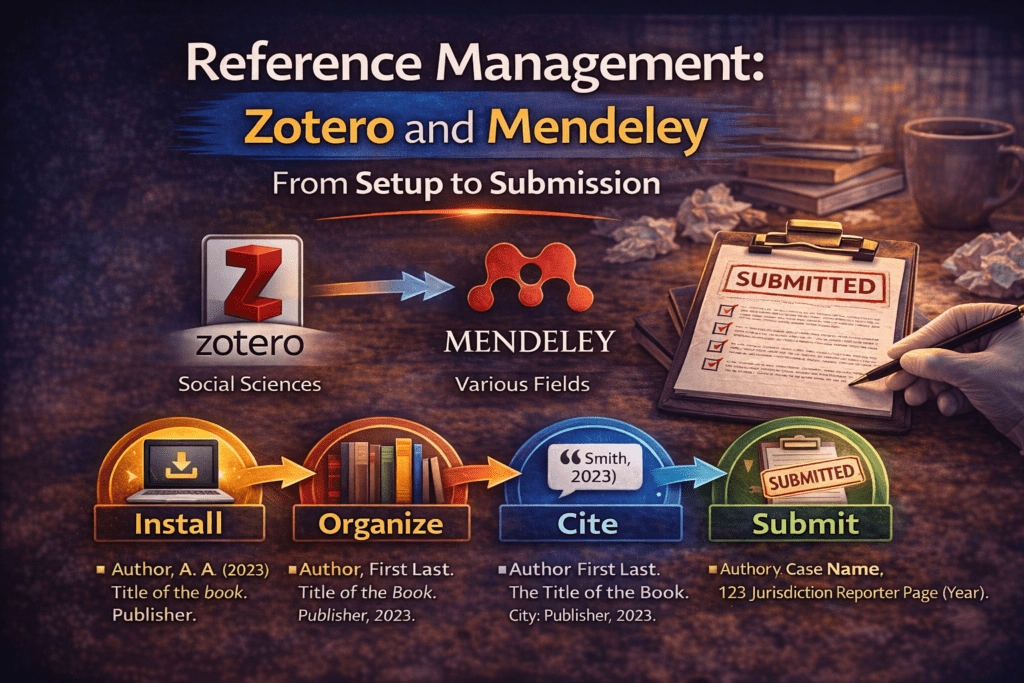
Reference Management: Zotero and Mendeley from Setup to Submission
Cluster Post 5 | Module 2: The Academic Writing Process From Concept to Submission Series …
Research Methodologies: Complete Guide to Quantitative, Qualitative, Mixed Methods & Legal Research (2026)
Why Methodology Determines Research Quality Here’s what thesis examiners focus on first: your methodology section…