
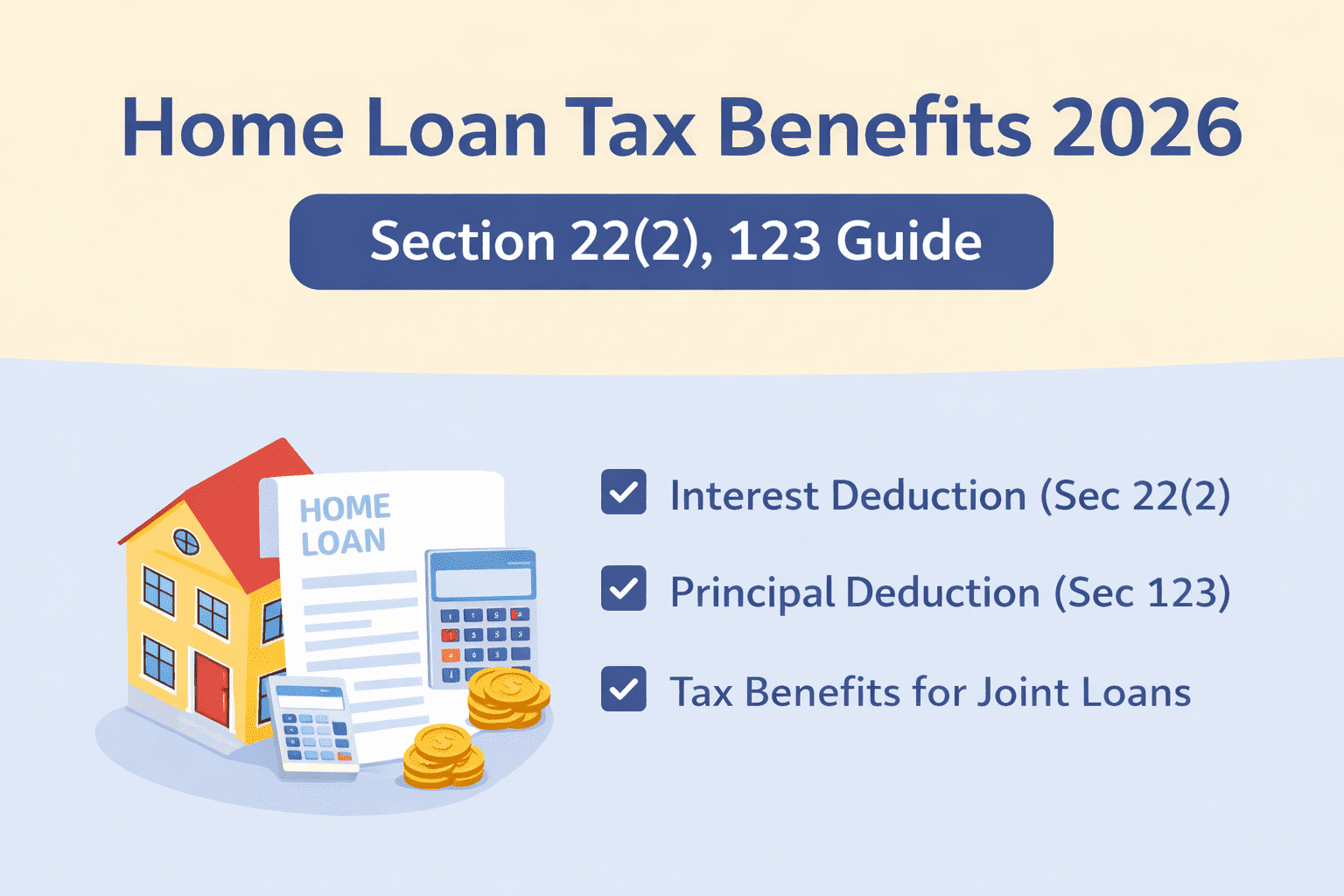
Home Loan Tax Benefits 2026
Section 22(2) Interest Rs 2L, 123 Principal Rs 1.5L — Old Regime Complete Guide
Part of the Income Tax India 2026 : Income Tax India 2026 : A Complete Guide
Arjun and his wife Priya took a joint home loan of Rs 60 lakh in 2023. Their combined EMI is Rs 52,000 per month. Of this, approximately Rs 36,000 is interest in the first few years.
Most people in their position know they can claim Section 22(2) interest deduction. What many do not know: because they are joint owners AND joint borrowers, both Arjun and Priya can each claim Rs 2 lakh interest deduction separately — a combined Rs 4 lakh deduction on interest alone.
Add Section 123 principal deduction (Rs 1.5 lakh each) and the combined tax benefit reaches Rs 7 lakh per year. At 30% bracket each, that saves them Rs 2.18 lakh in tax annually.
This article covers every home loan tax benefit available in 2026 : Section 22(2) interest deduction, Section 123 principal, joint loan benefits, pre-construction interest, let-out property rules, and why home loan holders almost always benefit more from the old tax regime.
| Rs 2 Lakh Max interest deduction — Section 22(2) per taxpayer per year | Rs 1.5 Lakh Principal repayment — Section 123 (within combined limit) | Old Regime All home loan deductions for self-occupied: old regime only | Rs 4 Lakh Joint loan: both owners can claim Rs 2L each on interest |
1. All Home Loan Deductions Table
| Section | What is Deductible | Maximum Limit | Conditions | Regime |
| Section 22(2) | Interest paid on home loan | Rs 2,00,000/year (self-occupied). No limit (let-out). | Loan for purchase or construction (for repair limit is Rs. 30000). Construction must complete within 5 years of loan year-end. | Old regime (self-occupied). BOTH regimes (let-out). |
| Section 123 | Principal repayment + stamp duty + registration charges | Up to Rs 1,50,000/year (within combined 123 ceiling) | Property not to be sold within 5 years of possession. Not for under-construction property. | Old regime only |
| Section 131 | Additional interest deduction for first-time buyers (affordable housing) | Rs 1,50,000 additional (over 22(2) limit) — only for loans sanctioned April 1, 2019 to March 31, 2022 | Stamp value of property up to Rs 45L. Taxpayer should not own any residential house on loan sanction date. | Old regime only |
| Pre-construction interest under Section 22(2) | Interest paid before property possession/completion | Claimed in 5 equal instalments from year of possession. Subject to overall Rs 2L ceiling. | Only for purchase or construction loans. Not for repair or renovation. | Old regime (self-occupied). Both (let-out). |
2. Section 22(2) — Interest Deduction in Detail
Section 22(2) of the Income Tax Act (Section 21 of IT Act 2025) allows deduction of interest paid on a loan taken for purchase, construction, repair, renewal, or reconstruction of house property. The rules differ for self-occupied vs let-out property.
| Property Type | Interest Deduction Limit | Available in New Regime? | Key Condition |
| Self-occupied property | Up to Rs 2,00,000 per year | NOT available | Loan must be for purchase or construction only. Completed within 5 years of loan year-end. |
| Let-out (rented) property | No upper limit — full interest deductible against rental income | Technically available in new regime but losses cannot be set off against salary | Excess interest over rental income creates “house property loss” — set off against other income capped at Rs 2L in old regime only |
| Deemed let-out (second house) | Full interest deductible against notional rent | Loss set-off against salary capped at Rs 2L — old regime only | If you own two self-occupied houses, one is deemed let-out and taxed on notional rent |
| Under-construction property | NIL during construction — no deduction allowed while under construction | N/A | Pre-construction interest can be claimed in 5 instalments after possession under 22(2) |
Pre-Construction Interest — 5-Year Rule
Interest paid on a home loan from the date of borrowing until March 31 of the year before the property is acquired or constructed is called pre-construction period interest. This cannot be claimed in the year it is paid. Instead, it is aggregated and claimed in 5 equal annual instalments from the year in which possession is taken, subject to the overall Rs 2 lakh per year ceiling.
Example: If you paid Rs 3 lakh in pre-construction interest before possession, you can claim Rs 60,000 per year for 5 years (Rs 3L divided by 5), in addition to the current year’s interest — but total cannot exceed Rs 2 lakh per year.
3. Section 123 : Principal Repayment Deduction
The principal component of home loan EMI qualifies for Section 123 deduction up to Rs 1,50,000 per year (within the combined 123 ceiling) under old regime. Two additional items also qualify under 123 for a home: stamp duty and property registration charges — both claimable in the year of payment. [3]
| Component | Eligible Under 123? | Limit | Conditions |
| Principal repayment in EMI | Yes | Within Rs 1.5L Sec.123 ceiling | Property not to be sold within 5 years of possession. If sold earlier, deductions claimed are reversed. |
| Stamp duty paid on purchase | Yes — one-time benefit | Within Rs 1.5L Sec. 123 ceiling | Claimable only in the year of payment. Cannot carry forward. |
| Property registration charges | Yes — one-time benefit | Within Rs 1.5L Sec. 123 ceiling | Claimable only in the year of payment. |
| Home loan principal — repair/renovation loan | No | Not eligible | Only purchase or construction loans qualify. Repair/renovation loans excluded from 123. |
4. Joint Home Loan — How Both Owners Can Double the Benefit
Taking a home loan jointly with a spouse, parent, or sibling is one of the most powerful tax planning strategies available. When both co-applicants are also co-owners, each can claim the full deduction limits independently.
| Deduction | Single Applicant | Joint Loan (Both Co-Owners) | Tax Saved (30% bracket, both) |
| Section 22(2) Interest | Rs 2,00,000/year | Rs 2,00,000 each = Rs 4,00,000 combined | Rs 1,24,800 combined (Rs 4L x 30% + 4% cess) |
| Section 123 Principal | Rs 1,50,000/year | Rs 1,50,000 each = Rs 3,00,000 combined | Rs 93,600 combined (Rs 3L x 30% + 4% cess) |
| Total Annual Deduction | Rs 3,50,000 | Rs 7,00,000 | Rs 2,18,400 combined annual tax saving |
Two critical conditions for joint loan tax benefits: (1) Both must be co-owners of the property — being only a co-borrower without ownership does not give the right to claim deduction. (2) Both must actually be paying the EMI from their own income. Simply being on the loan agreement is not sufficient. Source: incometaxindia.gov.in FAQs on Income from House Property.
Practical tip: to maximise both deductions, structure the joint loan so both partners are co-owners in the property registration document and both contribute to EMI from their respective bank accounts. Keep bank transfer records as proof.
5. New vs Old Regime — Home Loan Comparison
Under the new tax regime, Section 22(2) interest deduction is NOT available for self-occupied properties. Section 123 principal deduction is also not available. This is one of the main reasons home loan holders typically benefit more from the old regime.
| Deduction | Old Tax Regime | New Tax Regime | Impact |
| Section 22(2) interest — self-occupied | Up to Rs 2,00,000 | NOT available | Loss of Rs 62,400 tax saving per taxpayer at 30% bracket |
| Section 123 — principal repayment | Up to Rs 1,50,000 (within 123) | NOT available | Loss of Rs 46,800 tax saving at 30% bracket |
| Section 22(2) interest — let-out property | Full interest against rental income + Rs 2L loss set-off | Technically available but loss set-off against other income not allowed | Complex — consult CA for let-out property in new regime |
For the complete regime comparison with breakeven calculator : New Tax Regime Vs Old Tax Regime 2026
Must read Mutual Funds India 2026: Complete Beginner’s Guide
6. Frequently Asked Questions
Q1: What is the maximum home loan interest deduction in 2026?
The maximum deduction for home loan interest under Section 22(2) for a self-occupied property is Rs 2,00,000 per year per taxpayer in the old tax regime. For a let-out (rented out) property, there is no upper limit on the interest that can be claimed against rental income. For joint home loans where both applicants are co-owners, each can independently claim Rs 2,00,000 — making the combined deduction Rs 4,00,000.
Q2: Is home loan interest deduction available in the new tax regime?
No — for self-occupied properties. Under the new tax regime, deduction for home loan interest under Section 22(2) is NOT available for self-occupied properties. For let-out properties, interest can technically be deducted against rental income, but the loss from house property cannot be set off against salary or other income in the new regime. Section 123 principal deduction is also not available in the new regime.
Q3: Can both husband and wife claim Section 22(2) on a joint home loan?
Yes — if both are co-owners of the property AND co-borrowers on the loan. Both can independently claim up to Rs 2,00,000 each on interest under Section 22(2) and up to Rs 1,50,000 each on principal under Section 123. Combined annual deduction: Rs 7,00,000. Both must actually be contributing to EMI from their own bank accounts. Being only a co-borrower without co-ownership does not entitle a person to claim these deductions.
Q4: What is pre-construction interest and how is it claimed?
Pre-construction interest is the home loan interest paid from the date of borrowing until March 31 of the year before the property is acquired or possession is taken. It cannot be claimed in the year it is paid. After possession, the total pre-construction interest is divided into 5 equal parts and claimed over 5 consecutive years under Section 22(2), subject to the overall Rs 2 lakh annual ceiling. For example, if pre-construction interest is Rs 5 lakh, you can claim Rs 1 lakh per year for 5 years after possession.
Q5: What happens to my home loan tax deductions if I sell the property within 5 years?
If you sell the property within 5 years of possession, all Section 123 deductions claimed on principal repayment in previous years are reversed and added back to your income in the year of sale. They become taxable at your applicable slab rate in the year of sale. There is no reversal of Section 22(2) interest deductions claimed in previous years — those remain valid. This is a critical condition to remember when selling.
Q6: Can I claim home loan interest deduction if the loan is taken from friends or relatives?
Yes — interest on a loan taken from friends, relatives, or any private lender for the purpose of purchase, construction, repair, renewal, or reconstruction of a house property can be claimed as a deduction under Section 22(2), up to Rs 2 lakh per year. The lender does not need to be a bank or financial institution. However, the lender must provide a certificate confirming the interest payable and the purpose of the loan. Personal loans not used for property purposes are not eligible.
Q8: What is Section 80EEA/ 131 and is it still available in 2026?
Section 80EEA of Income Tax Act, 1961 (Section 131 of Income Tax Act, 2025) provided an additional Rs 1,50,000 interest deduction for first-time homebuyers on loans sanctioned between April 1, 2019 and March 31, 2022 for affordable housing (stamp value up to Rs 45 lakh). This section is no longer active for new loan sanctions as the sunset date was March 31, 2022. If your loan was sanctioned before March 31, 2022 and you meet the conditions, you can continue claiming 80EEA/131 for the loan tenure. New home loans sanctioned after March 31, 2022 do not qualify for 80EEA/131. Old regime only.
Conclusion
A home loan in the old tax regime generates some of the largest tax deductions available to individual taxpayers:
- Section 22(2): Rs 2,00,000 interest deduction per person per year. Joint loan doubles this to Rs 4,00,000.
- Section 123: Rs 1,50,000 principal + stamp duty + registration. Joint loan doubles to Rs 3,00,000.
- Combined old regime benefit: Single person Rs 3.5L, joint loan up to Rs 7L per year in deductions.
- New regime: No Section 22(2) for self-occupied, no Section 123.
For how to choose between old and new regime if you have a home loan: New Tax Regime Vs Old Tax Regime 2026
For all deductions beyond home loan: How To Save Income Tax India 2026: 15 Legal Ways
Author –
CA Ajay Khandelwal is a Chartered Accountant and financial expert with over 21 years of experience in taxation, compliance, and business advisory. As a key expert at AspirixWriters, he provides practical insights on income tax, financial planning, and regulatory matters, helping readers make informed financial decisions.
Author Profile CA. Ajay Khandelwal
Disclaimer
This article is for educational and informational purposes only. It is not personal tax advice. Home loan tax rules are based on the Income Tax Act 2025, IT Rules 2026, and incometaxindia.gov.in. Individual tax benefit depends on loan amount, interest paid, property type, ownership structure, and chosen tax regime. Please consult your Chartered Accountant before making tax decisions based on home loan deductions.
References
[1] Income Tax Department — FAQs on Income from House Property | Section 22(2) interest limits | Self-occupied vs let-out | Pre-construction interest | Joint loan deductions | Loan from relatives | incometaxindia.gov.in/Pages/faqs.aspx
[3] Income Tax Department — Deductions allowable to taxpayer | Section 123 — principal repayment | Stamp duty and registration charges | 5-year lock-in on sold property | 80EEA sunset | incometaxindia.gov.in
[2] Income Tax Act 2025 (Act 30 of 2025), egazette.gov.in | Section 21 — Income from House Property | Deductions allowed | Self-occupied property | Let-out property provisions — https://egazette.gov.in
Tax Exemption on Sale of Residential House
Section 123 Deductions 2026: Complete List of All Options
Section 123 Deductions 2026 Part of the Income Tax India 2026 : Income Tax India…

PPF Interest Rate, Limit,Withdrawal & EEE Benefits 2026
PPF Interest Rate, Limit,Withdrawal & EEE Benefits Part of the Income Tax India 2026: Income…
NPS Tax Benefit 2026
NPS Tax Benefit 2026: Section124 Rs 50K & Employer NPS Section 124 Extra Rs 50,000…
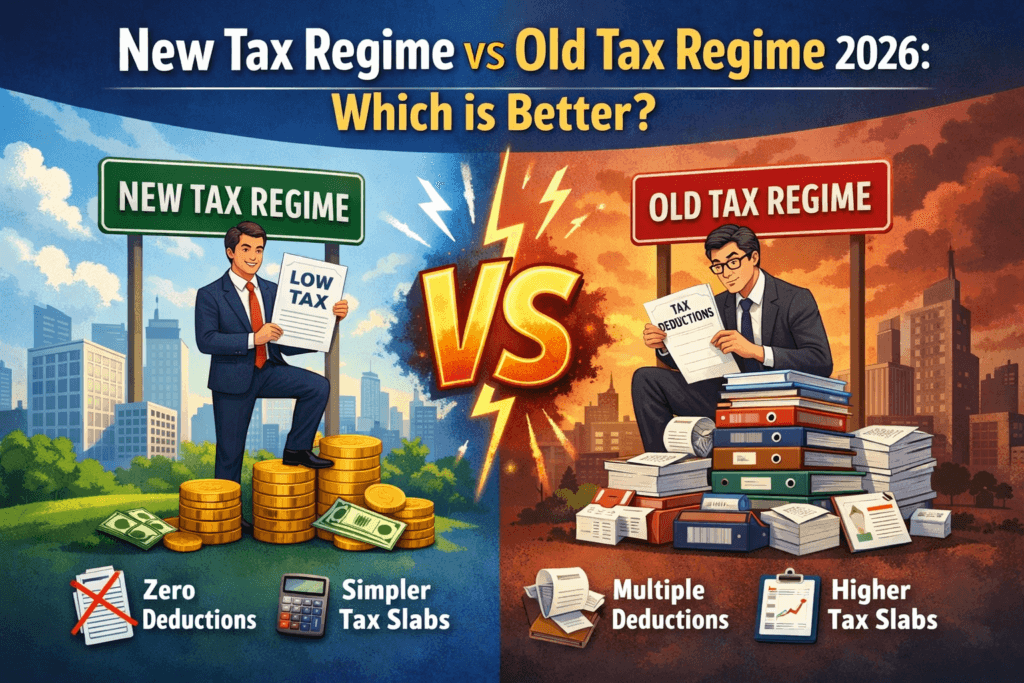
New Tax Regime vs Old Tax Regime 2026
New Tax Regime vs Old Tax Regime 2026 : Which is Better Every year between…