
Income Tax New Provisions 2026 :12 Key Changes from April 1, 2026 Every Taxpayer Must Know
Income Tax India 2026 : A Complete Guide
Meena has been filing her ITR every year without fail. Same process. Same checklist. Same CA. This year her CA called her and said: “Madam, there have been some changes in Income Tax. From April 1, new Income Tax Act, 2025 has become effective. ITR form numbers have changed. Due date are different. Some of the terms have also been changed.”
Meena is not alone. India’s Income Tax Act 1961 — which has governed every rupee of tax since before the Moon landing — has been replaced by the Income Tax Act 2025, effective April 1, 2026. The good news: tax rates are unchanged. This is not a tax hike. The new Act is a structural simplification — 819 sections reduced to 536, 511 rules reduced to 333, 399 forms reduced to 190. The goal was simpler language, easier compliance, less litigation. The practical impact: several deadlines, forms, terminology, and penalties have changed. If you file your taxes the old way in 2026, you risk late fees, wrong form selection, or missed opportunities.
Here are the 12 changes that matter most — after the effect of Finance Bill 2026 (Bill No. 3 of 2026) and the Income Tax Act 2025.
The 12 Changes — At a Glance
There are following changes under Income Tax New Provisions 2026. All changes sourced directly from Finance Bill 2026 (Bill No. 3 of 2026) and Income Tax Act 2025 (Act 30 of 2025).
| No. | What Changed | Before April 1, 2026 | From April 1, 2026 | Affects |
| 1 | Act Name | Income Tax Act, 1961 | Income Tax Act, 2025 | All taxpayers |
| 2 | “Tax Year” replaces FY + AY | Financial Year + Assessment Year (two terms) | Tax Year — single unified term | All taxpayers |
| 3 | Sections and Rules simplified | 819 sections, 511 rules, 399 forms | 536 sections, 333 rules, 190 forms | Tax professionals |
| 4 | ITR-3 / ITR-4 due date | July 31 | August 31 | Self-employed, freelancers, business |
| 5 | New Section 234-I: Revised return fee | No fee for revised return | Fee if revised after 9 months — Rs 5,000 or Rs 1,000 | Anyone filing revised ITR |
| 6 | Revised return window extended | 3 months before end of AY | Until end of Tax Year (March 31) | All ITR filers |
| 7 | New Section 147A: Faceless AO clarified | Ambiguity on who issues reassessment notices | Only regular AO — not Faceless Centre | Taxpayers under reassessment |
| 8 | TDS default decriminalised below Rs 10L | Rigorous imprisonment 3 months to 7 years | Fine only if default below Rs 10 lakh | Businesses deducting TDS |
| 9 | 276C willful evasion — graded punishment | Mandatory rigorous imprisonment 6 months to 7 years | Simple imprisonment up to 2 years or fine or both – graded | Tax evasion cases |
| 10 | Buyback proceeds — capital gains | Buyback treated as dividend income | Buyback treated as capital gains in shareholders hands | Investors receiving buyback |
| 11 | Foreign Assets Disclosure Scheme 2026 | No such scheme | One-time voluntary disclosure — pay tax + 100% penalty, get immunity from further tax, penalty or prosecution | Residents with undisclosed foreign assets |
| 12 | MAT rate reduced | Minimum Alternate Tax 15% | MAT reduced to 14% | Companies |
Changes Explained in Detail
Change 1 and 2 — “Tax Year” Replaces Financial Year and Assessment Year
Under the new IT Act 2025, the old two-year notation is gone. “Financial Year 2025-26” and “Assessment Year 2026-27” are now combined into one: “Tax Year 2026-27.” Tax Year 2026-27 = April 1, 2026 to March 31, 2027. This is the year in which you earn income AND the year you file the return for. Your Form 16, bank interest certificates, and mutual fund statements will all now use “Tax Year 2026-27” instead of the old two-year notation.
Change 3 — Act Simplified: 819 Sections to 536
The 1961 Act had accumulated 65 years of amendments, provisos, explanations, and cross-references. The new Act removes redundant provisions, simplifies language, and restructures the entire law. 819 sections become 536. 511 rules become 333. 399 forms become 190. Revenue neutral – no new taxes, no removed exemptions.
Change 4 — ITR-3 and ITR-4 Due Date: Now August 31
Finance Bill 2026, Clause 5 extends the ITR filing deadline for non-audit business and professional income filers from July 31 to August 31.
| ITR Form | Taxpayer | New Due Date | Changed? |
| ITR-1 (SAHAJ) | Salaried up to Rs 50L, no capital gains | July 31 | No change |
| ITR-2 | Capital gains, multiple house property | July 31 | No change |
| ITR-3 | Business / professional (non-audit) | August 31 | Extended by 1 month |
| ITR-4 (SUGAM) | Presumptive business income (Sec. 58) | August 31 | Extended by 1 month |
| ITR-3 (Audit cases) | Business / professional (tax audit) | October 31 | No change |
Change 5 and 6 — New Section 234-I: Revised Return Fee + Extended Window
Finance Bill 2026, Clause 12 inserts new Section 234-I. Two things change simultaneously:
- Revised return window EXTENDED — you can now revise your ITR until March 31 of the Tax Year (not just 3 months before end of Assessment Year as before)
- New fee if you revise AFTER 9 months from year end : Rs 5,000 if income above Rs 5 lakh, Rs 1,000 if income upto Rs 5 lakh
- Revising within 9 months from year end: still FREE — no fee
- Effective retrospectively from March 1, 2026
Practical example: For Tax Year 2025-26, the previous year ends March 31, 2026. Nine months = December 31, 2026. Revise by December 31 — free. Revise January to March 31, 2027 — pay Rs 5,000 (if income above Rs 5L).
Change 7 — Section 147A: Only Regular AO Can Issue Reassessment Notices
Finance Bill 2026, Clause 8 inserts new Section 147A. It clarifies that reassessment notices under Sections 147 and 148 can only be issued by a regular Assessing Officer — NOT by the National Faceless Assessment Centre (NFAC) or any Assessment Unit under Section 144B. This amendment is retrospective from April 1, 2021. If you received a reassessment notice from the Faceless Centre (not a regular AO) between April 2021 and now, that notice may be challengeable. Consult your CA immediately if this applies to you.
Change 8 and 9 — TDS Default and Tax Evasion: Decriminalised for Smaller Amounts
Finance Bill 2026, Clause 20 rewrites Sections 276B, 276BB, and 276C. “Rigorous imprisonment” is completely removed. The new system is graded and proportionate.
| Offence Type | Amount | Old Punishment | New Punishment |
| TDS/TCS default (276B/276BB) | Below Rs 10 lakh | Rigorous imprisonment 3 months to 7 years + fine | Fine only — no imprisonment |
| TDS/TCS default (276B/276BB) | Rs 10L to Rs 50L | Rigorous imprisonment 3 months to 7 years + fine | Simple imprisonment up to 6 months or fine or both |
| TDS/TCS default (276B/276BB) | Above Rs 50L | Rigorous imprisonment + fine | Simple imprisonment up to 2 years or fine or both |
| Wilful tax evasion (276C) | Below Rs 10 lakh | Mandatory rigorous imprisonment | Fine only |
| Wilful tax evasion (276C) | Rs 10L to Rs 50L | Rigorous imprisonment 3 months to 7 years + fine | Simple imprisonment up to 6 months or fine or both |
| Wilful tax evasion (276C) | Above Rs 50L | Rigorous imprisonment 6 months to 7 years | Simple imprisonment up to 2 years or fine or both |
Change 10 — Buyback Proceeds Now Taxed as Capital Gains
From the Finance Act 2024 (confirmed in Finance Bill 2026): when a company buys back its own shares, the proceeds are now taxed as capital gains in the hands of the shareholder — not as dividend income. The holding period determines whether it is LTCG (above 12 months at 12.5%) or STCG (12 months or less at 20%). Previously, buyback proceeds were treated as dividend and taxed differently. Investors who receive buyback proceeds should confirm the applicable rate with their CA based on their holding period and total income.
Change 11 — Foreign Assets of Small Taxpayers Disclosure Scheme 2026
Finance Bill 2026, Clauses 114 to 128 create a brand-new Chapter IV — the Foreign Assets of Small Taxpayers Disclosure Scheme, 2026. This is a one-time voluntary disclosure window for resident Indians who hold undisclosed foreign assets.
- Pay tax on undisclosed foreign asset + 100% penalty = full immunity from prosecution, any other tax or penalty
- Non-immovable foreign assets below Rs 20 lakh: only a fine, no prosecution
- Declaration does not affect completed assessments for other years
- Commencement date: to be notified separately by Central Government
Frequently Asked Questions
What is the Income Tax Act 2025 and how is it different from the 1961 Act?
The Income Tax Act 2025 (Act 30 of 2025) replaces the Income Tax Act 1961 from April 1, 2026. It is a structural simplification — 819 sections reduced to 536, 511 rules to 333, 399 forms to 190. Tax rates are unchanged. The biggest visible changes are the unified “Tax Year” concept (replacing Financial Year + Assessment Year) and simplified language throughout.
Q2: What is “Tax Year” in the new Income Tax Act 2025?
“Tax Year” is the new unified term that replaces both “Financial Year” and “Assessment Year.” Tax Year 2026-27 = April 1, 2026 to March 31, 2027. Your Form 16, bank interest certificates, and mutual fund statements will now show Tax Year 2026-27 instead of the old FY 2025-26 / AY 2026-27 notation. It is a terminology change only — no impact on tax calculation.
Q3: What is the new ITR filing deadline for self-employed and freelancers in 2026?
For non-audit business income filers (ITR-3) and presumptive income filers (ITR-4), the due date is now August 31 — extended from July 31 by Finance Bill 2026, Clause 5. Salaried employees filing ITR-1 or ITR-2 still have July 31 as their deadline. Tax audit cases retain the October 31 deadline.
Q4: What is the new fee for filing a revised ITR under Section 234-I?
Section 234-I (inserted by Finance Bill 2026, Clause 12, effective March 1, 2026) levies a fee if you revise your ITR after 9 months from the end of the previous year: Rs 5,000 if your total income exceeds Rs 5 lakh, or Rs 1,000 if your income is upto Rs 5 lakh. Revising within 9 months is still free. In return, the window to file a revised return has been extended to the full end of the Tax Year (March 31).
Q5: What does decriminalisation of TDS default mean for small businesses?
Finance Bill 2026, Clause 20 removes “rigorous imprisonment” from TDS default offences under Section 276B or 276BB. For failure to deposit TDS or TCS below Rs 10 lakh, only a fine applies — no imprisonment. For defaults between Rs 10 lakh and Rs 50 lakh, simple imprisonment up to 6 months or a fine or both. Above Rs 50 lakh, up to 2 years simple imprisonment or fine or both. This is a significant relief for small businesses that may have missed TDS payments for smaller amounts.
Q6: What is the Foreign Assets Disclosure Scheme 2026?
The Foreign Assets of Small Taxpayers Disclosure Scheme 2026 (Finance Bill 2026, Clauses 114-128) is a one-time voluntary disclosure window for resident Indians who hold undisclosed foreign assets. If you declare such assets, pay the applicable tax plus a 100% penalty, you receive immunity from prosecution under the Black Money (Undisclosed Foreign Income and Assets) Act. Non-immovable foreign assets below Rs 20 lakh attract only a fine, not prosecution. The exact start date will be notified separately by the Central Government.
Q7: Do I need to file ITR differently because of the new Income Tax Act 2025?
The ITR form numbers and the basic filing process remain similar. The key changes that affect most taxpayers: ITR-3 and ITR-4 filers now have August 31 (not July 31) as their deadline. The new Section 234-I fee applies if you revise your return after 9 months. Your Form 16 will show “Tax Year 2026-27” instead of the old notation — do not be confused by this. The e-filing portal at incometaxindia.gov.in will be updated for the new Act.
Q8: Are the income tax rates and slabs changed under the new Income Tax Act 2025?
No. The Income Tax Act 2025 is a revenue-neutral reform. Tax rates, slabs, and exemption limits are exactly the same as under the old 1961 Act. The new regime slabs (0%, 5%, 10%, 15%, 20%, 25%, 30%) and old regime slabs (0%, 5%, 20%, 30%) are unchanged for Tax Year 2026-27. The Section 87A rebate limits (Rs 12L new regime, Rs 5L old regime) are also unchanged.
Conclusion
The Income Tax New Provisions 2026 don’t reflect a tax hike. Your tax rates are the same. But the rules around deadlines, forms, penalties, and terminology have changed significantly. The four changes by Income Tax New Provisions 2026 that affect most individual taxpayers:
- Tax Year replaces FY/AY — update your mental model of how to refer to tax periods
- August 31 deadline for ITR-3/ITR-4 — business owners get one extra month
- Section 234-I fee — file your revised return within 9 months of year end to avoid paying Rs 5,000
- TDS default below Rs 10L — only fine, no imprisonment — significant relief for small businesses
For the complete income tax guide covering slabs, regime comparison, deductions, and ITR filing, read our Income Tax India 2026: Complete Guide
Author –
CA Ajay Khandelwal is a Chartered Accountant and financial expert with over 21 years of experience in taxation, compliance, and business advisory. As a key expert at AspirixWriters, he provides practical insights on income tax, financial planning, and regulatory matters, helping readers make informed financial decisions.
Author Profile CA. Ajay Khandelwal
References
Income Tax Act 2025 (Act 30 of 2025), notified in the Official Gazette of India on August 21, 2025. Effective April 1, 2026. Replaces Income Tax Act 1961. 536 sections, 333 rules, 190 forms. — https://egazette.gov.in
Finance Bill 2026, Bill No. 3 of 2026, as introduced in Lok Sabha on February 1, 2026. Clause 3 (MAT), Clause 5 (ITR due dates), Clause 8 (Section 147A), Clause 12 (Section 234-I), Clause 20 (Sections 276B/276BB/276C), Clauses 114-128 (Foreign Assets Scheme). — https://indiabudget.gov.in
Income Tax Department — Note on Draft Income Tax Rules 2026 and IT Act 2025 overview. 511 rules to 333, 399 forms to 190. — https://incometaxindia.gov.in
Disclaimer
This article is for educational and informational purposes only based on Finance Bill, 2026 which is yet to be passed. It is not personal tax advice. All data is sourced from official government documents. Every taxpayer’s situation is unique — please consult your Chartered Accountant before making any tax decisions based on the changes described above
Mutual Funds India 2026: Complete Beginner’s Guide
Advance Tax 2026: Due Dates, Calculation & 424/425 Guide
Advance Tax 2026 Who Pays, How to Calculate, 4 Due Dates and Section 424/425 Interest…

Home Loan Tax Benefits 2026: Section 22(2), 123 Guide
Home Loan Tax Benefits 2026 Section 22(2) Interest Rs 2L, 123 Principal Rs 1.5L —…

Housing Loan Tax Benefits under New Regime
Housing Loan Tax Benefits Basics of Rental Income & Housing Loan Tax Benefits Rental Income…
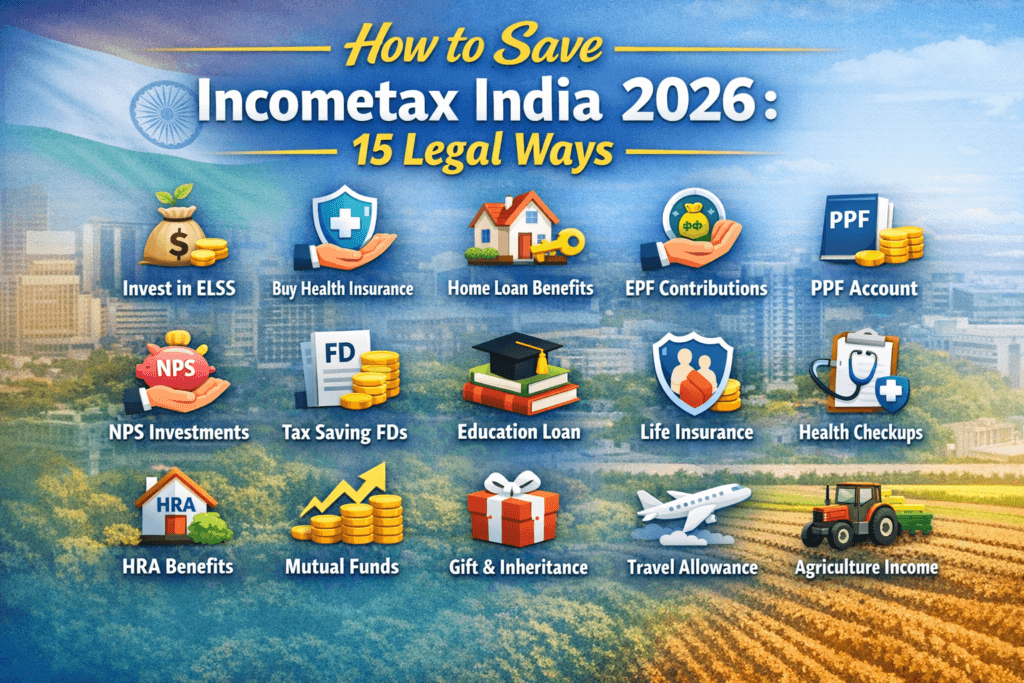
How to Save Income Tax India 2026: 15 Legal Ways
How to Save Income Tax India 2026 15 Legal Ways with Section Numbers, Limits and…
HRA Exemption 2026: Formula, 8 Cities & Claim Guide
HRA Exemption 2026 Calculation Formula, 8 Cities at 50% and Complete Claim Guide (IT Rules…
Income Tax Calculator 2026: New vs Old Regime Guide
Income Tax Calculator 2026 New vs Old Regime — Step-by-Step Calculation at 5 Income Levels…