
Law of Torts — Meaning and Definition of Tort
1. Introduction
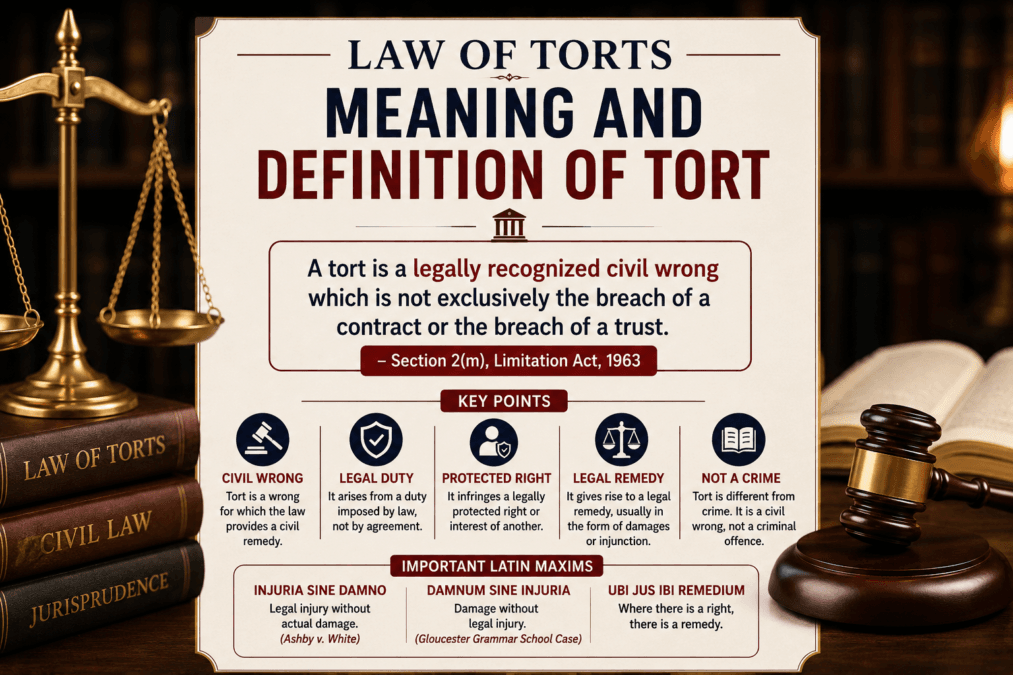
The Law of Torts is an important branch of civil law. Law of Torts is civil substantive Law, It deals with civil wrongs for which the law provides remedies.
A person may suffer injury to his:
- body,
- property,
- reputation,
- personal liberty, or
- another legally protected interest.
When such an interest is wrongfully interfered with, the injured person may, depending upon the nature of the wrong and the applicable law, seek a legal remedy.
In one line: A tort is a civil wrong recognised by law, generally independent of contractual obligations, for which an appropriate legal remedy may be available.
Example :
Imagine that A is driving a car carelessly and injures B.
B never entered into a contract with A. A nevertheless owed B a legal duty to take reasonable care while driving.
Now consider another situation.
A publishes a false statement about B that damages B’s reputation.
Again, there may be no contract between A and B. The legal duty arises from the law itself.
These are typical situations in which the Law of Torts becomes relevant.
Tort law deals with civil wrongs and provides legal remedies for recognised infringements of legally protected interests.
2. Origin and Meaning of the Word “Tort”
The word tort is generally traced to the Latin tortum, meaning “wrong” or “twisted.” In other words “tort” comes from the French word tort, meaning a wrong, It passed into Old French as tort and subsequently entered English legal terminology.
The basic idea is therefore associated with a wrongful or twisted course of conduct.
In simple words
Tort = Wrong
But remember:
Every wrong is not a tort.
For a wrong to constitute a tort, it must fall within a legally recognised basis of tortious liability.
The important idea is this:
Tort law protects legally recognised interests by imposing duties recognised by law and providing appropriate remedies when those duties are violated.
For example, the law may require a driver to take reasonable care towards other road users.
If the driver breaches that duty and causes legally recoverable harm, the injured person may have a claim in negligence.
3. Statutory Definition under the Limitation Act, 1963
India does not have one comprehensive statute that codifies the entire law of torts.
Section 2(m) of the Limitation Act, 1963 defines tort as a civil wrong which is not exclusively the breach of a contract or the breach of a trust. (India Code)
Indian tort law, however, is not comprehensively codified in a single statute and has developed through common-law principles, judicial decisions and legislation.
5. Definitions Given by Jurists
Several leading jurists have attempted to define tort.
The most important definitions for LL.B. students are those of Salmond, Winfield, Pollock and Fraser, along with the statutory formulation under the Limitation Act.
5.1 Salmond’s Definition
According to Salmond:
“A tort is a civil wrong for which the remedy is a common law action for unliquidated damages and which is not exclusively the breach of a contract or the breach of a trust or other merely equitable obligation.”
The Supreme Court of India has quoted and discussed Salmond’s definition in its judgments.
Explanation
Salmond’s definition highlights:
- Tort is a civil wrong.
- It is traditionally remedied through an action for unliquidated damages.
- It is distinct from an exclusive breach of contract.
- It is distinct from an exclusive breach of trust.
What are unliquidated damages?
Unliquidated damages are damages whose amount is not fixed in advance.
The amount is determined by the court according to the facts and circumstances of the case.
Example
If A negligently injures B, the amount of compensation may depend upon:
- medical expenses,
- loss of income,
- pain and suffering,
- future consequences,
- other legally recoverable losses.
The amount is therefore not necessarily predetermined by the parties.
Exam Point
Salmond emphasises the civil nature of tort and its traditional remedy of unliquidated damages.
5.2 Winfield’s Definition
Professor P. H. Winfield defined tortious liability as:
“Tortious liability arises from the breach of a duty primarily fixed by law; this duty is towards persons generally and its breach is redressible by an action for unliquidated damages.”
Winfield’s definition contains three important ideas:
- Duty primarily fixed by law — The duty in tort is generally imposed by law, rather than being created solely by an agreement between the parties.
- Duty towards persons generally — The duty is not ordinarily limited to a particular contractual party; it may be owed to persons falling within the class protected by the relevant tort.
- Remedy through unliquidated damages — Traditionally, breach of such a duty is redressible through an action for damages whose amount is determined by the court rather than fixed in advance.
In tort:
The duty is primarily fixed by law.
It is not necessarily created by an agreement between the parties.
What does Winfield emphasise?
The key idea is:
Duty → Fixed by law → Breach → Legal liability
This distinguishes tort from contract.
Example
A drives a car on a public road.
A has not entered into a contract with every pedestrian.
Nevertheless, the law requires A to exercise reasonable care towards other road users.
If A breaches that duty and causes legally recognised damage, A may be liable for negligence.
Exam Point
Winfield = Duty primarily fixed by law.
This is one of the easiest ways to remember the definition.
5.3 Pollock’s Definition
Sir Frederick Pollock approached tort from a broader perspective.
Pollock explained tort through acts or omissions connected with harm suffered by a determinate person, including interference with an absolute right even where measurable damage may not exist. His formulation is discussed in Indian legal materials and has been reproduced in tort-law texts.
What does Pollock’s approach show?
It shows that tort law consists of different forms of civil liability rather than one single type of wrong.
It can deal with:
- physical injury,
- property interference,
- reputation,
- personal liberty,
- nuisance,
- negligence,
- trespass,
- and other legally recognised interests.
Exam Point
Pollock’s approach helps us understand the diverse nature of tortious liability.
5.4 Fraser’s Definition
Fraser described tort in terms of the infringement of a right in rem of a private individual, giving rise to a claim for compensation.
What is a right in rem?
A right in rem is generally a right enforceable against persons generally, rather than merely against one specific person.
For example, legal rights concerning:
- personal security,
- property,
- reputation, and
- personal liberty
may operate against others generally.
Exam Point
Fraser focuses on infringement of a legally protected right.
6. Comparison of Definitions
| Jurist/Source | Main Idea | Easy Memory |
| Limitation Act, 1963, s. 2(m) | Civil wrong excluding exclusive breach of contract/trust | Civil wrong |
| Salmond | Civil wrong + unliquidated damages | Civil wrong + remedy |
| Winfield | Breach of duty primarily fixed by law | Duty imposed by law |
| Pollock | Different forms of civil liability connected with harm/interference with rights | Diverse liability |
| Fraser | Infringement of a right in rem | Legal right |
After studying the definitions of different jurists, we can understand tort in the following way:
A tort is a legally recognised civil wrong, generally arising from breach of a duty imposed by law, which infringes a legally protected interest and may give rise to an appropriate legal remedy.
9. Essential Characteristics of a Tort
Although the precise requirements differ from one tort to another, the following characteristics are useful for understanding the subject.
1. Tort is generally a civil wrong
The primary legal consequence is ordinarily civil liability.
2. Duty is generally imposed by law
The duty does not necessarily arise from an agreement.
3. There must be a legally recognised basis of liability
Not every harmful or unpleasant act is a tort.
4. A legally protected interest may be involved
Examples include:
- bodily security,
- property,
- reputation,
- liberty.
5. Legal remedy may follow
Depending on the cause of action, remedies may include:
- damages,
- injunction,
- restoration or other appropriate civil relief.
6. The requirements differ between torts
The elements of negligence are not identical to the elements of defamation, nuisance or trespass.
9. Tort and Crime — Are They the Same?
No.
Tort and crime are different branches of law.
| Basis | Tort | Crime |
| Nature | Generally a civil wrong | Criminal offence |
| Primary concern | Protection of legally recognised private interests and civil remedies | Protection of public order and punishment of offences |
| Typical proceeding | Claimant vs defendant | State/prosecution vs accused |
| Main remedy | Damages and other civil remedies | Punishment prescribed by criminal law |
| Standard of proof | Generally balance of probabilities in civil proceedings | Generally beyond reasonable doubt in criminal proceedings |
Can the same conduct be both?
Yes.
A single act can sometimes produce both civil and criminal consequences.
For example, conduct causing physical injury may potentially result in:
- a civil claim for compensation; and
- criminal liability, if the conduct also satisfies the requirements of an offence.
Therefore:
Tort and crime are distinct, but the same facts may sometimes give rise to both.
10. Tort and Contract
| Basis | Tort | Contract |
| Source of duty | Generally imposed by law | Created by agreement |
| Prior agreement | Not necessarily required | Normally required |
| Nature of obligation | Duty recognised by law | Contractual obligation |
| Example | Negligent driving injuring a pedestrian | Failure to perform an agreed service |
| Parties | May have no prior relationship | Parties are connected by the contract |
Easy memory rule
Contract begins with an agreement. Tort does not necessarily require one.
But be careful: the same facts can sometimes involve both contractual and tortious obligations.
Is it Law of Tort or Law of Torts
FAQs
1. What is a tort?
A tort is a legally recognised civil wrong for which the law may provide an appropriate civil remedy.
2. What is the meaning and origin of the word “tort”?
The word “tort” is generally derived from the Latin tortum, meaning “wrong” or “twisted,” and entered English legal terminology through French tort.
3. How is tort defined under Indian law?
Section 2(m) of the Limitation Act, 1963 defines a tort as a civil wrong which is not exclusively the breach of a contract or the breach of a trust.
4. What is Salmond’s definition of tort?
According to Salmond, a tort is a civil wrong for which the traditional remedy is an action for unliquidated damages, and which is distinct from an exclusive breach of contract or trust.
5. What is Winfield’s definition of tort?
“Tortious liability arises from the breach of a duty primarily fixed by law; this duty is towards persons generally and its breach is redressible by an action for unliquidated damages.”
More
- Latest Legal Opportunities
- Internships →
- Judiciary →
- Scholarships
- Fellowships →
- Call for Papers →
- Resume & Interview Preparation →
- Freelancing →
- Law Study Material →
- AI Hub →
Classmate Pulse Spiral Notebook ✏️ Need a Spiral Notebook for Everyday Writing? A spiral notebook…

Latest Scholarships & Fellowships 2026–27: Open Opportunities for Upcoming call
Latest Scholarships & Research Fellowships 2026–27 Last Verified: 30 September 2026 Students, researchers, PhD scholars…
Writing & Research Resources: Useful Books, Tools & Essentials for Writers and Researchers
Whether you are an author, content writer, law student, academic researcher, PhD scholar, teacher, or…
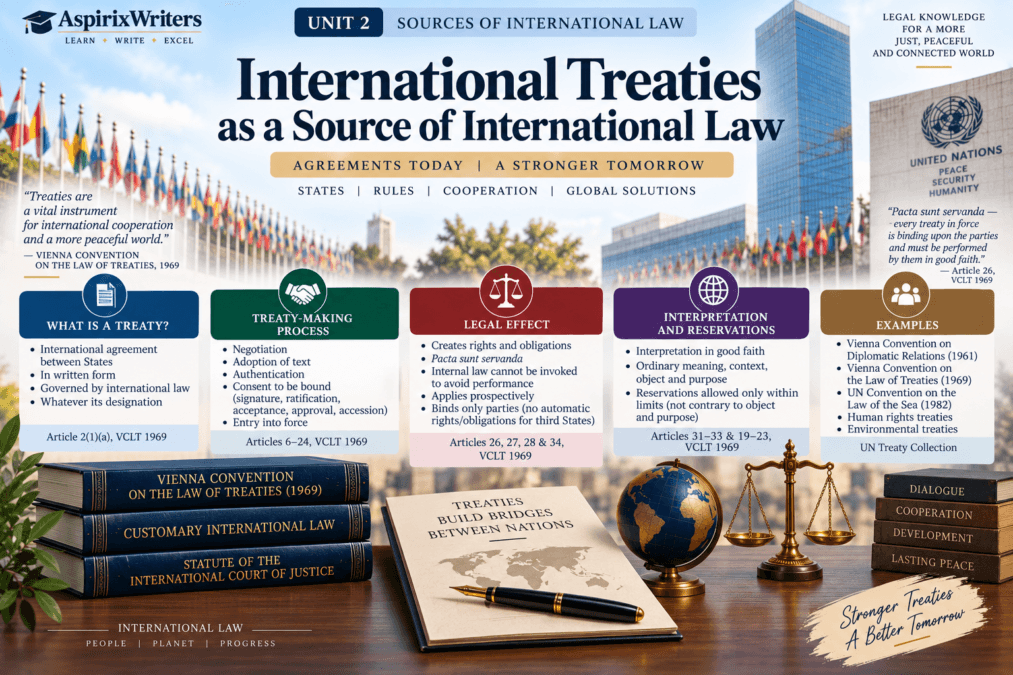
International Treaties as a Source of International Law | LL.B. Notes
International Treaties as a Source of International Law Introduction International treaties are one of the…

The Ultimate Guide to Organizing LLB Notes for Exam Success
LLB Notes for Exam Success Studying law is not simply about reading hundreds of pages….
What Is the Best AI Tool for Legal Research in 2026? A Practical Guide for Lawyers, Law Students and Researchers
What Is the Best AI Tool for Legal Research in 2026? Last updated: September 2026…