
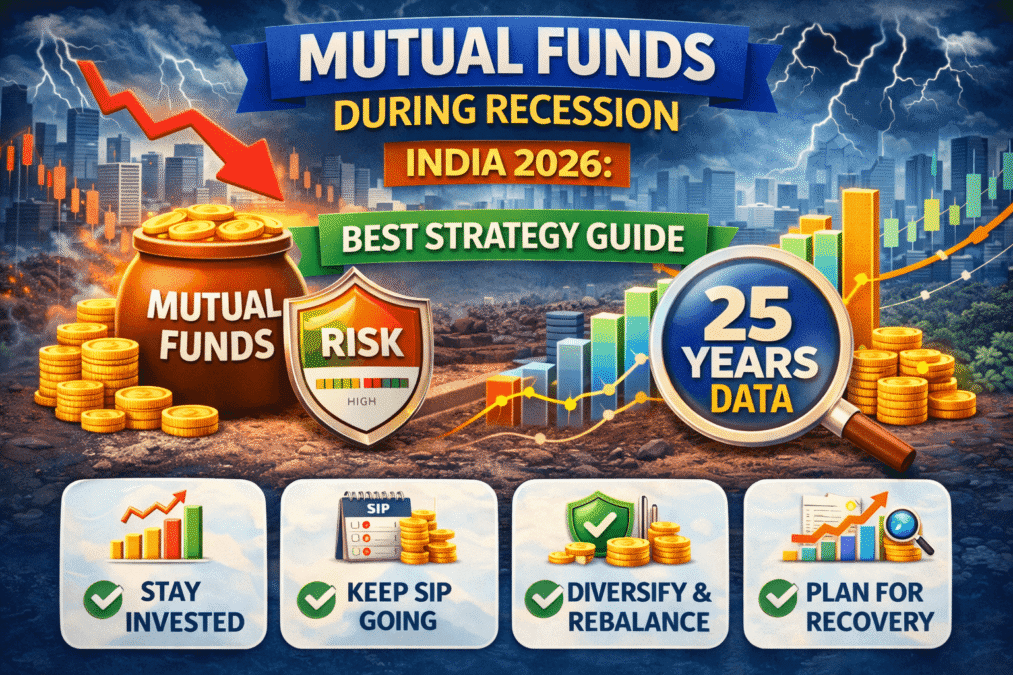
Last Updated: May 26, 2026
The Recession Headlines Are Loud. The Indian Data Tells a Different Story.
Every market correction creates two kinds of investors — those who panic, and those who quietly build future wealth. Which one you become in 2026 depends less on what markets do and more on what you understand about them.
US tariffs of 36% on Indian goods. China slowing. Europe stagnating. FPIs pulling $19 billion out of Indian equities in 2025 — the highest outflow in 15 years. Crude oil spiking. The rupee under pressure.
Every headline in 2026 sounds like a warning. And yet:
- India’s GDP grew 8.2% in Q2 FY 2025-26
- Goldman Sachs forecasts 6.9% growth for India in 2026
- IMF projects 6.6%
- India’s CPI inflation fell to a 26-year low of 0.3% in October 2025
- The RBI cut rates by 125 basis points in 2025 and injected ₹6.3 trillion in liquidity
India is not in recession. It is not heading into one. It is the fastest-growing major economy in the world — even in the most challenging global environment in years.
But a global slowdown still affects India through specific channels. Some sectors suffer. Some funds are better positioned than others. And having the right defensive strategy now can meaningfully protect — and even grow — your wealth through this period.
This guide tells you exactly what to do.
GDP growth projections are from external institutions and may not be realised. All portfolio suggestions are illustrative. Mutual fund investments are subject to market risks. Consult a SEBI-registered Investment Advisor before making changes.
Is India Actually Heading Into a Recession?
A recession is technically defined as two consecutive quarters of negative GDP growth. India has not had a true recession since COVID-19 in FY 2020-21 — and even that was a single-year contraction, not a prolonged structural decline.
| Institution | India GDP Forecast FY26 | India GDP Forecast FY27 |
| Goldman Sachs (Feb 2026) | 6.9% | 6.8% |
| IMF | 6.6% | 6.2% |
| RBI MPC | 6.5% | 6.6% (Q1 FY27) |
| World Bank | 6.5% | Growth sustained |
Sources: IMF India Country Report 2025, RBI Monetary Policy Statement
The global slowdown is real. US tariff risks are real. FPI outflows are real. But India’s domestic consumption story — driven by 1.4 billion people, rising rural incomes, and RBI rate cuts — is largely insulated from a US or Chinese recession. The same domestic demand that protected India in 2008 and 2020 is protecting it in 2026.
Bottom line: India is in a global growth headwind, not a domestic recession. That changes your fund strategy — but does not require panic.
How a Global Slowdown Reaches Your Mutual Fund Portfolio
Even with strong domestic growth, a global slowdown affects Indian markets through specific channels:
| Channel | Impact on India | Funds Most Affected |
| US tariffs (36%, reduced to 18% post-deal) | Export sectors hit — IT, pharma, auto components face slower revenue growth | IT and export-theme sector funds |
| China slowdown | Chinese goods flood global markets at lower prices — Indian manufacturers face competition | Industrial, small cap funds |
| FPI outflows ($19B in 2025) | Market pressure, rupee depreciation, Nifty valuation compression | Large cap equity — short-term pressure |
| Crude oil spike | Higher import bill, input cost pressure on corporates | Diversified equity funds — short-term |
| RBI rate cuts (125 bps in 2025) | Positive for debt funds; lower borrowing costs boost domestic consumption | Debt funds, banking, BAFs — benefit |
| Low inflation (0.3% Oct 2025) | Higher real incomes, strong consumer spending | FMCG, banking, infrastructure funds |
The key insight: A global slowdown hurts export-facing sectors but helps domestic consumption sectors through lower inflation and RBI rate cuts. In 2026, sector positioning matters more than usual.
Which Fund Categories Hold Up Best During a Slowdown
| Fund Category | Recession Positioning | Why | Risk Level |
| Balanced Advantage Fund | Excellent | Dynamically shifts equity/debt based on valuations. Historically lowest drawdown in volatile phases. | Low–Medium |
| Large Cap Fund | Good | Blue chip companies have strong balance sheets and pricing power. Less volatile than mid/small cap. | Medium |
| Quality-focused Flexi Cap | Good | Skilled managers shift to defensive large caps during slowdowns automatically. | Medium |
| Short Duration Debt Fund | Excellent | Benefits from RBI rate cuts. Stable NAV. Low credit risk. | Low |
| Dynamic Bond Fund | Good | Captures maximum gains from falling interest rates. | Low–Medium |
| Gold ETF | Good hedge | Rises during uncertainty. Geopolitical risk and USD strength both support gold. | Medium |
| Mid Cap Fund | Caution | Volatile during global slowdown. Best maintained, not increased, until clarity improves. | High |
| Small Cap Fund | Avoid increasing | Most vulnerable to credit tightening, FPI outflows, and export demand fall. | Very High |
The Defensive Mutual Fund Strategy — Sectors That Protect You
Sectors to Hold or Increase (Defensive)
- FMCG — Non-discretionary spending. People buy soap and cooking oil regardless of the economy. Low inflation in 2026 boosts real rural incomes, supporting demand further.
- Pharmaceuticals and Healthcare — Non-cyclical demand. Domestic generics market remains strong.
- Banking (quality lenders) — Direct beneficiary of RBI rate cuts. Low inflation supports asset quality. Credit growth continues from domestic consumption.
- Infrastructure — Government capex at 3.4% of GDP. Union Budget 2025-26 committed ₹11.11 lakh crore in infrastructure spending — a structural support regardless of global cycle.
Sectors to Reduce During Global Slowdown
- IT (export-focused) — Revenue growth tied to US enterprise spending. US slowdown directly reduces IT budgets.
- Auto (export component) — Global auto demand soft. Export uncertainty adds pressure.
- Small Cap (export-oriented) — FPI outflows hit small cap liquidity disproportionately.
What to Do With Your SIP Right Now
For a full explanation of how SIP works and why Rupee Cost Averaging is most powerful during volatile markets, see our SIP guide for 2026.
| Your Situation | What to Do | Why |
| SIP in Flexi Cap or Large Cap | Continue without change | Rupee Cost Averaging works best during volatility — every lower NAV buys cheaper units |
| SIP in Mid Cap or Small Cap | Continue if horizon is 7–10 years; pause only if goal is under 3 years | Mid and small caps recover most after a slowdown — long-term holders benefit from cheap accumulation |
| Lump sum ready to deploy | Use STP — park in Liquid Fund, transfer ₹5,000–10,000/month into equity over 6–12 months | Avoids investing everything at a market peak; gets exposure gradually as clarity improves |
| Goal within 2 years | Shift this portion to Short Duration Debt Fund now | Goal-linked money must not be in equity during high volatility |
| Retired and on SWP | Continue SWP from Balanced Advantage Fund | BAF automatically reduces equity in volatile markets — protection is built in |
| Want to add to investments | Top up SIP or add lump sum into BAF or quality Large Cap | Market corrections are buying opportunities for long-term investors |
“The next bull market is usually built during the period most investors are afraid to invest.”
Building a Recession-Resilient Portfolio — 3 Frameworks
These are illustrative frameworks. Actual allocation must match your goals, timeline, and risk tolerance. Consult a SEBI-registered Investment Advisor.
Conservative — Capital protection with inflation-beating returns
| Fund Type | Allocation | Purpose |
| Balanced Advantage Fund | 50% | Dynamic equity-debt anchor. Lowest drawdown in uncertainty. |
| Short Duration Debt Fund | 30% | Captures RBI rate cut gains. Better than FD post-tax. |
| Gold ETF | 10% | Geopolitical insurance. Gold rose ~26% globally in 2025. |
| Nifty 50 Index Fund | 10% | Low-cost equity exposure for domestic consumption recovery. |
Moderate — Wealth creation with manageable risk
| Fund Type | Allocation | Purpose |
| Flexi Cap Fund (quality-focused) | 40% | Core growth engine. Manager shifts defensively during slowdowns. |
| Balanced Advantage Fund | 25% | Volatility stabiliser. |
| Short/Medium Duration Debt Fund | 20% | Rate cut benefit. Capital gains as RBI continues easing. |
| Gold ETF or Multi Asset Fund | 15% | Inflation and geopolitical hedge. |
Aggressive — Long-term growth (10+ year horizon)
| Fund Type | Allocation | Purpose |
| Flexi Cap Fund | 45% | Core equity. Flexible across market caps. |
| Mid Cap Fund (quality) | 25% | Cheap valuations now. Maximum upside when recovery accelerates. |
| Nifty 50 Index Fund | 20% | Stable, low-cost anchor. |
| Gold ETF | 10% | Geopolitical risk hedge. |
Key Takeaways
- India is not in recession — it is in a global growth headwind. Domestic fundamentals remain strong. Adjust strategy, do not exit.
- Balanced Advantage Funds are the best all-weather category for uncertain markets — dynamic equity-debt allocation with historically low drawdowns.
- Short Duration Debt Funds directly benefit from RBI rate cuts — excellent recession-period addition to any portfolio.
- Do not stop your SIP — Rupee Cost Averaging turns market falls into cheaper unit purchases. Investors who stopped SIPs during 2008 and 2020 significantly underperformed those who continued.
- Defensive sectors — FMCG, pharma, banking (quality lenders), and infrastructure — hold up better in slowdowns and benefit from India’s domestic consumption strength.
- Reduce, do not exit mid and small caps. Maintain existing positions if your horizon is 7–10 years.
- A Gold ETF allocation of 10–15% provides meaningful geopolitical risk protection in the current environment.
Frequently Asked Questions
Q1: Should I invest in mutual funds during a recession?
Yes — with the right fund selection. Recessions create better entry prices. Balanced Advantage Funds and debt funds are particularly well-suited. For equity, continue SIPs — Rupee Cost Averaging means lower NAVs produce cheaper units that drive future returns.
Q2: Which mutual fund is best during a recession in India?
Balanced Advantage Funds (BAFs) are widely regarded as the most recession-resistant category — they automatically reduce equity when markets fall. Short Duration Debt Funds also perform well as they capture gains from RBI rate cuts. HDFC BAF and ICICI Pru BAF are often cited for their consistent drawdown management. Verify current data at amfiindia.com.
Q3: Is India heading into a recession in 2026?
No. India’s GDP is projected at 6.5–6.9% for FY26 by IMF, Goldman Sachs, and RBI. Inflation is at a 26-year low. Rate cuts are stimulating domestic demand. India faces global headwinds, not a domestic recession.
Q4: Should I stop my SIP during an economic slowdown?
No. Every major Indian slowdown was followed by a recovery — and SIP investors who stayed invested always earned more than those who stopped. Lower NAVs mean your fixed SIP amount buys more units. Those units generate the majority of your future returns when recovery comes.
Q5: What is the best defensive mutual fund strategy in 2026?
Shift some allocation toward Balanced Advantage Funds, add a Short Duration Debt Fund for the rate-cut benefit, and consider a 10–15% Gold ETF allocation for geopolitical protection. Do not increase mid cap or small cap allocation until global clarity improves. Maintain equity SIPs and let Rupee Cost Averaging work.
Conclusion
The fear surrounding a global slowdown in 2026 is understandable. The headlines are genuinely concerning. But for Indian mutual fund investors, the headline fear and the ground reality are two different things.
India is growing. Inflation is low. The RBI is easing. Government infrastructure spending is at a record. Domestic consumption — the engine of India’s economy — is intact.
The right response to a global slowdown is not to exit equity mutual funds. It is to position them correctly: more defensive categories, more domestic consumption exposure, a debt fund buffer to capture rate cut benefits, and a Gold ETF for geopolitical risk.
Continue your SIP. Tilt toward Balanced Advantage Funds and quality large caps. Add a short duration debt fund. Stay invested.
The next bull cycle is built on the units you accumulate during this one.
Official References
- IMF — India Country Report 2025
- RBI — Monetary Policy Committee Statements FY26
- SEBI (Mutual Funds) Regulations, 1996
Continue reading: This article is part of our Mutual Funds India 2026 content hub at aspirixwriters.com/mutual-funds/
Mutual Funds India 2026: Complete Beginner’s Guide
- Top 10 Benefits Of Mutual Funds For Beginners In India 2026
- SIP In Mutual Funds 2026: How It Works, Calculator & Best Plans
- Mutual Funds Vs Fixed Deposits 2026: Which Is Better For You?
Defence Mutual Funds India 2026: Should I Invest Now?
Author
CA Ajay Khandelwal is a Chartered Accountant and financial expert with over 21 years of experience in taxation, compliance, and business advisory. As a key expert at AspirixWriters, he provides practical insights on income tax, financial planning, and regulatory matters, helping readers make informed financial decisions.
Author profile CA. Ajay Khandelwal
Disclaimer
This article is for educational and informational purposes only. It does not constitute personal financial advice, investment advice, or a recommendation to buy or sell any specific mutual fund scheme.
Mutual fund investments are subject to market risks. GDP growth projections are from external institutions and may not be realised. All portfolio suggestions are illustrative. Actual allocation must be personalised based on your financial goals, risk profile, and investment horizon. Please consult a SEBI-registered Investment Advisor before making any portfolio changes.
Find a SEBI-registered investment advisor at: sebi.gov.in

My SIP Is in Loss. Should I Stop Investing?
SIP in loss – Riya is a 28-year-old software engineer in Bengaluru. She started a…

Mutual Fund Vs FD? Which Is Better In 2026 for Salaried Employees
One Gives Stability. The Other Builds Long-Term Wealth. Most Salaried Employees Need Both. If you…

Mutual Funds India Complete Beginner’s Guide 2026
Mutual Funds India 2026 Complete Beginner’s Guide to Benefits, SIP, Types & SEBI New Rules…
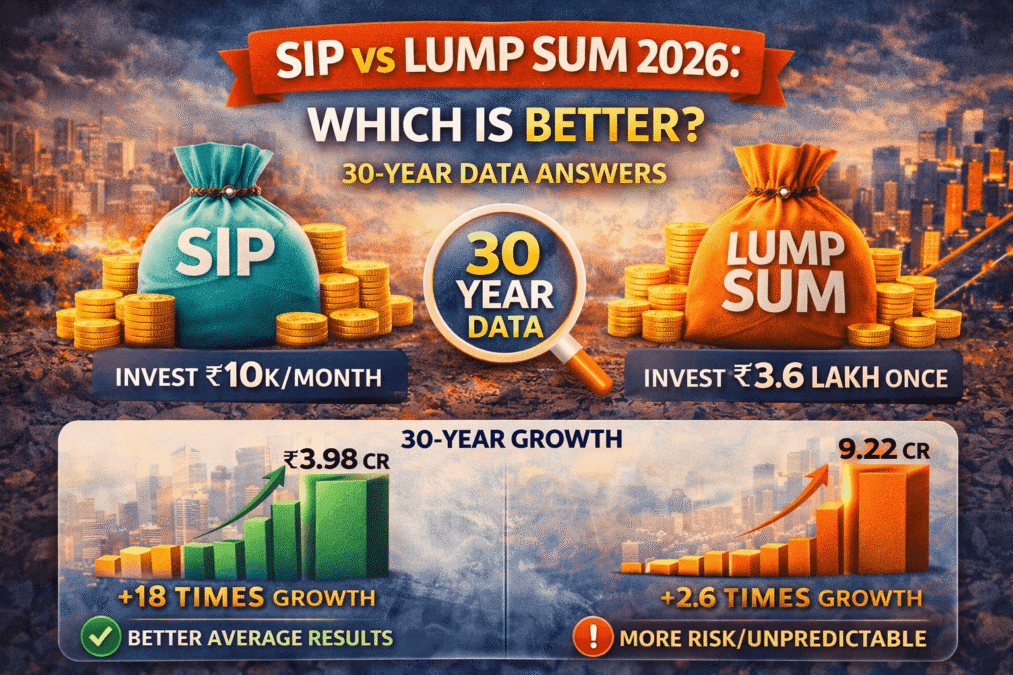
SIP vs Lump Sum 2026: Which Is Better?
SIP VS LUMP SUM 2026 SIP vs Lump Sum in Mutual Funds 2026: Which Is…
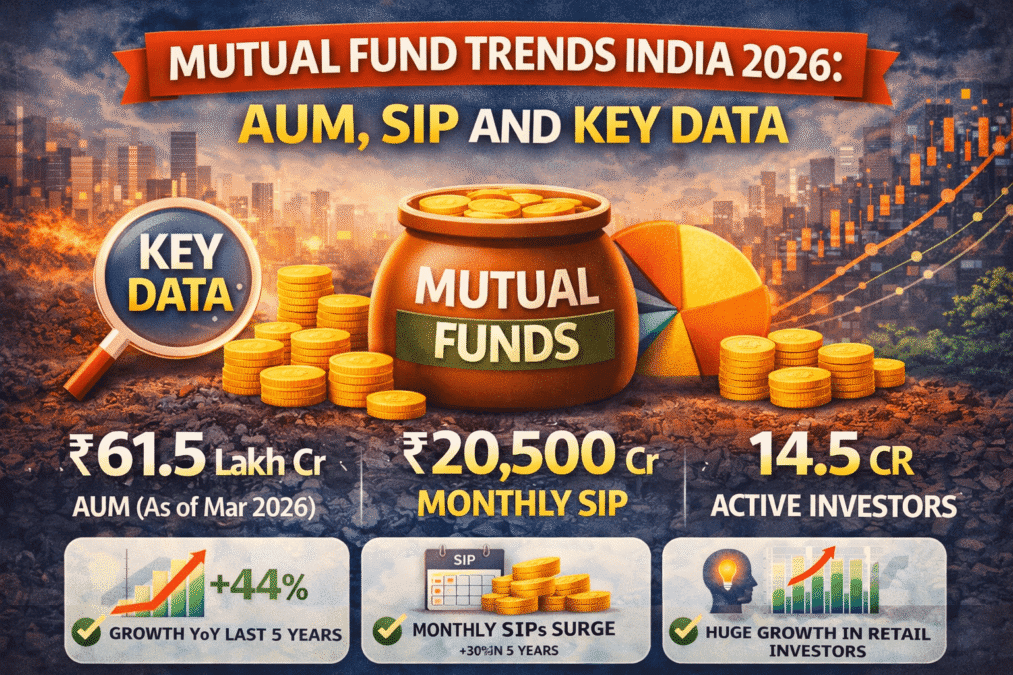
Mutual Fund Trends India 2026: AUM, SIP and Key Data
MUTUAL FUND TRENDS INDIA 2026 Mutual Fund Trends India 2026: AUM Hits Rs 82 Lakh…

Defence Sector Mutual Funds: Is It the Right Time to Invest?
Your Inbox Has a New Message. Read This Before You Act. West Asia is in…