
Last Updated: March 17, 2026
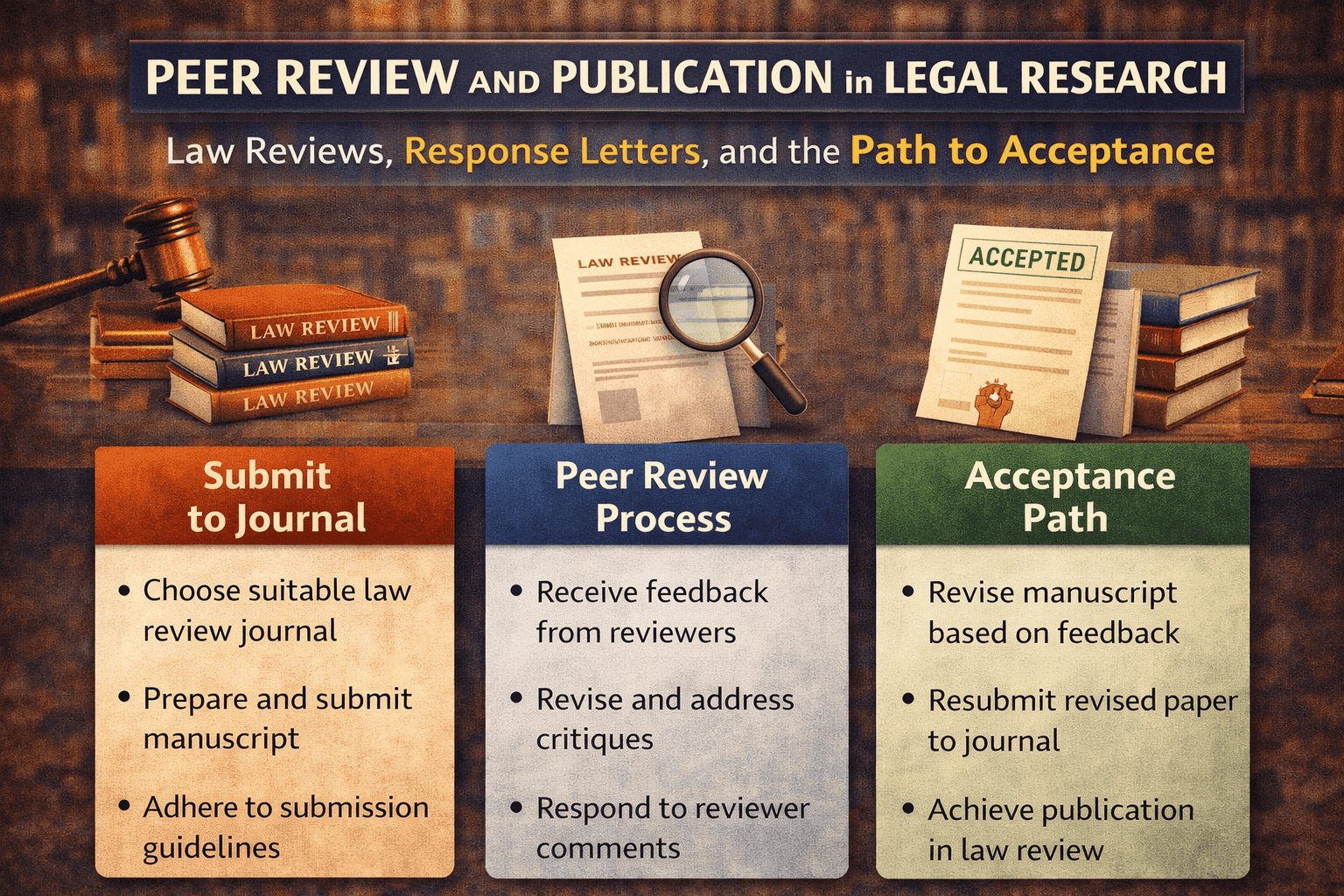
Peer Review and Publication in Legal Research: Law Reviews, Response Letters, and the Path to Acceptance
Academic Writing Mastery: The Complete 2026 Guide To Research Papers, Thesis & Dissertation Writing
Peer Review and Publication in Legal Research
The five cluster posts in Module 6 cover decoding decision letters, writing response letters, making revisions, preparing for the viva voce, and publication strategy for Indian academic careers. All of that applies to legal researchers — but the peer review and publication system in law operates differently from science and social science in ways that directly affect how you submit, respond to reviewers, and build a publication record.
Legal scholarship has two parallel publication tracks — law reviews and peer-reviewed journals — that operate by different processes, serve different audiences, and carry different weight in different career contexts. Understanding which track your work belongs on, and how each track’s review process works, is the foundational decision in legal research publication strategy.
This post covers: the law review vs peer-reviewed journal distinction across India, UK, US, and Australia; how law journal peer review actually works; decoding decision letters specific to legal scholarship; writing response letters for doctrinal papers; and building a publication strategy that serves both research impact and Indian academic career requirements.
The Two Publication Tracks in Legal Scholarship
Legal scholarship is unique among academic disciplines in having two distinct publication tracks with different selection processes, different review structures, and different audiences. Most guides to academic publishing treat law journals as a single category. They are not.
Track 1: Law reviews and law journals (editorial selection)
Law reviews — including most of the prestigious NLU journals, the major UK law reviews, and the top US law reviews — use editorial selection rather than blind peer review. A board of editors (typically faculty at the institution, or in the US case, student editors) reads submissions and decides on acceptance based on the quality of the argument, originality of the legal claim, and relevance to the journal’s scope.
Key characteristics of editorial selection journals:
- No anonymisation: Your name, institution, and credentials are typically visible to editors. Institutional prestige and author reputation influence selection, particularly at student-edited US law reviews.
- Faster turnaround: Editorial decisions typically take 4–12 weeks. Many Indian law journals and UK law reviews respond within 6–8 weeks.
- Substantive editing: Law reviews often provide detailed editorial feedback and may request revisions before final acceptance. This is not peer review — it is editorial development.
- Citation format enforcement: Editorial selection journals typically enforce their citation style strictly. Submissions in the wrong citation format are often returned before substantive review.
Track 2: Peer-reviewed law journals (blind review)
A growing number of law journals — including journals indexed in Scopus and Web of Science — use double-blind peer review identical to social science journals. Reviewers are anonymous, the author is anonymous to reviewers, and the review process is explicitly methodological.
Key characteristics of peer-reviewed law journals:
- Double-blind anonymisation: Remove all identifying information from the manuscript before submission. In a doctrinal paper, this includes removing acknowledgements, institution-specific case examples that identify the author’s location, and any self-citations in the body text (move to ‘Author’s prior work’ in references).
- Longer turnaround: First review decisions typically take 8–20 weeks. Revise and resubmit decisions are common and should be treated as positive outcomes.
- Methodological assessment: Reviewers explicitly assess whether the research method (doctrinal, empirical, comparative) is appropriate for the research question and rigorously executed. Peer reviewers of doctrinal papers will assess source comprehensiveness, engagement with counter-authority, and argument construction.
- UGC-CARE and Scopus indexing: Most journals that count for Indian API scoring purposes and UGC-CARE listing are peer-reviewed rather than editorially selected. This has career implications for Indian researchers that favour peer-reviewed journal publication.
| Journal type | Review process | Indian examples | UK examples | Career weight (India) |
| Student-edited law review | Editorial selection by student board | Not common in India | Oxford Law Review, Cambridge Law Review, Harvard-modelled student journals | Low for API; high for prestige |
| Faculty-edited law review | Editorial selection by faculty board | NUJS Law Review, NALSAR Law Review, NLSIR, JILI | Modern Law Review (editorial board), Law Quarterly Review | Medium — UGC-CARE listed counts for API |
| Peer-reviewed law journal | Double-blind peer review | Indian Law Review (T&F), Journal of Indian Law and Society, Socio-Legal Review | Journal of Law and Society, Legal Studies, Oxford Journal of Legal Studies | High — Scopus/WoS indexing gives maximum API credit |
| Open access law journal | Varies — check each journal | NUJS Law Review (open access), SSRN working papers | BAILII Journal, various university OA journals | Depends on UGC-CARE listing status |
Submitting to Law Journals: What the Process Actually Requires
Pre-submission checklist for law journals
Before submitting to any law journal, complete this checklist. Skipping steps is the primary cause of desk rejection in legal scholarship.
- Citation style compliance: Download the specific journal’s citation guide — not just the general Bluebook or OSCOLA manual. Many journals have house variations. Check every footnote format against the guide before submitting.
- Word count: Check the journal’s word count limit and whether it includes or excludes footnotes. Indian law journals typically count footnotes. Most UK journals exclude them. A submission that exceeds the limit will be returned before review.
- Abstract format: Most peer-reviewed law journals require a structured abstract (150–250 words). Law reviews often require a shorter, unstructured abstract or no abstract. Some Indian law journals require an abstract followed by keywords — typically 5–8 keywords in legal terminology.
- Blinding for peer-reviewed journals: Remove author name, institution, acknowledgements, and any identifying self-citations from the manuscript file. Keep author details only in the title page, submitted as a separate file.
- Cover letter: Include a brief cover letter (3–4 paragraphs) stating: the title and argument in one sentence; why this journal is the right venue for this paper; any ethical declarations (no conflicts of interest, no simultaneous submission); and your contact details.
- Simultaneous submission policy: Most Indian and UK law journals prohibit simultaneous submission — submitting the same paper to multiple journals at once. US law reviews typically permit it. Check the policy before submitting to multiple venues.
The cover letter for a law journal submission
The cover letter is the editor’s first contact with your paper. It is read before the manuscript. A weak cover letter — or no cover letter — signals inexperience.
Sample cover letter structure for an Indian law journal:
Dear [Editor’s name or Editorial Board],
I submit for your consideration ‘The Proportionality Standard Under Article 21 After Puttaswamy: Doctrinal Coherence and the AI Surveillance Gap’ (approximately 9,200 words including footnotes). The paper argues that the Supreme Court’s post-Puttaswamy application of proportionality to AI surveillance contexts has been constitutionally inadequate because it accepts government necessity assertions without independent judicial verification — a failure the paper documents through analysis of six post-2017 surveillance judgments and addresses by developing a structured necessity framework drawn from German Constitutional Court doctrine.
The paper is submitted exclusively to [Journal Name] and has not been previously published. There are no conflicts of interest to declare.
I am [designation] at [institution]. My prior work on constitutional privacy law has appeared in [journal names if relevant].
Yours sincerely, [Name]
Decoding Decision Letters from Law Journals
Module 6 Cluster Post 1 covers decision letters in detail. This section covers the law-specific patterns in how legal scholarship decision letters communicate editorial and reviewer assessments.
The four outcomes and what they mean for law papers
| Decision | What it means for a law paper | What to do |
| Accept without revisions | Rare. Usually means minor copyediting only. The argument and citation are accepted as submitted. | Respond within the deadline. Check all copyedits carefully — editorial teams sometimes introduce citation errors. |
| Accept with minor revisions | The argument is accepted. Specific corrections are required — typically citation format, clarification of a specific legal claim, or addition of a recent judgment. | Make all requested changes. Do not use this as an opportunity to substantially revise sections not mentioned. Respond within 2–4 weeks. |
| Revise and resubmit (R&R) | The paper has potential but requires substantive work. This is the most common outcome at quality law journals. It is a positive outcome — not a rejection. | Read all reviewer comments carefully before revising. Write a response letter. Revise the paper. Resubmit within the requested timeframe (typically 3–6 months). |
| Reject | The paper is not suitable for this journal as submitted. May be due to scope, argument quality, or citation standards. | Read the rejection letter carefully for reusable feedback. Identify whether the feedback is journal-specific (scope) or paper-specific (argument). Revise if paper-specific, resubmit elsewhere if scope-specific. |
Law-specific rejection reasons and what they signal
Law journal rejection letters often contain specific language that signals what went wrong. Recognising these patterns helps you revise effectively rather than resubmitting the same paper to a different journal.
- ‘The paper does not make a clear legal argument’: The manuscript describes the law without advancing a claim about what it means or should mean. This is the most common rejection reason for doctrinal papers. Fix: identify your central legal claim and make it explicit in the introduction and conclusion.
- ‘The paper does not engage adequately with [case/statute]’: Counter-authority was not addressed. A reviewer or editor identified a case or provision that undermines your argument and which you did not engage with. Fix: engage with the specific authority and explain why it does not defeat your claim.
- ‘The comparative analysis does not establish a clear tertium comparationis’: The comparison lacks a common reference point. You described how two jurisdictions approach X without establishing what function X serves and what the comparison reveals. Fix: state the functional question the comparison addresses before describing each jurisdiction.
- ‘The paper would benefit from engagement with empirical evidence’: The doctrinal claim has empirical implications that the paper does not address. This is increasingly common as law journals become more open to mixed methods. Fix: either add a section acknowledging the empirical dimension and its limits, or frame the paper more precisely as a doctrinal contribution.
- ‘Outside the scope of this journal’: Not a comment on the paper’s quality. Resubmit to a more appropriate journal. Check the journal’s aims and scope before resubmitting elsewhere.
Writing the Response Letter for a Legal Scholarship Paper
Module 6 Cluster Post 2 covers response letters in detail. This section covers the specific challenges of responding to reviewers of doctrinal legal scholarship, where the reviewer’s comments are often about legal argument rather than methodology.
The structure of a law paper response letter
The response letter for a law journal revision follows the same structure as any academic response letter: a brief opening acknowledging the review, a point-by-point response to every reviewer comment, and a closing that directs the editor to the changes made. The law-specific challenges are:
- Responding to legal argument disagreements: Reviewers of doctrinal papers sometimes disagree with your legal argument, not just your methodology. This requires a different response than a methodological concern. You must engage with the reviewer’s legal position seriously — explain why your interpretation of the authority is correct and theirs is not, or acknowledge the tension and clarify how your argument accommodates it.
- Responding to ‘missing authority’ comments: When a reviewer identifies a case or statute you did not engage with, do not simply add a citation. Read the authority, assess its relevance to your argument, and either integrate substantive analysis of it into the paper or explain explicitly why it does not affect your argument.
- Maintaining the argument while accommodating revisions: Revisions in response to reviewers should strengthen the paper’s central argument, not dilute it. If a reviewer’s comment would require you to abandon the paper’s central claim, explain in the response letter why you cannot accept the change and what you have done instead to address the underlying concern.
Reviewer comment: ‘The paper does not engage with the Supreme Court’s decision in Anuradha Bhasin v. Union of India (2020), which significantly developed the proportionality framework after Puttaswamy.’
Weak response: ‘We have added a citation to Anuradha Bhasin in footnote 47.’
Strong response: ‘We thank the reviewer for this observation. Anuradha Bhasin (2020) is directly relevant to our argument in Section 3 about the application of the necessity limb of proportionality. We have added a new sub-section (3.2, pages 18–21) analysing Anuradha Bhasin in detail. Our analysis shows that the Court’s approach in that case confirms our central argument: the Court accepted the government’s necessity assertion on the basis of a sealed cover procedure, without independent judicial verification of the factual basis for the internet shutdown. Far from undermining our argument, Anuradha Bhasin provides the most direct doctrinal support for our claim that the necessity limb has been applied inadequately. We have revised the conclusion (pages 34–35) to explicitly acknowledge Anuradha Bhasin as a key example of the pattern we identify.’
Publication Strategy for Legal Researchers: India, UK, US, and Australia
Module 6 Cluster Post 5 covers publication strategy for Indian academic careers. This section covers the law-specific dimensions of publication strategy, including how the Indian API system treats law journal publications and how to build an international publication record alongside Indian journal publications.
API scoring for law publications: what counts
The Academic Performance Indicator (API) system governs faculty appointments and promotions at Indian universities under UGC regulations. For law researchers, the API treatment of publications is:
- UGC-CARE Group I journals (Indian): Highest API credit. Most major NLU law reviews are in this category if UGC-CARE listed. Verify listing status before submitting — the list is updated, and journals are added and removed.
- UGC-CARE Group II journals (Scopus/WoS indexed): Equivalent or higher API credit. Scopus-indexed international law journals (Journal of Law and Society, Legal Studies, Oxford Journal of Legal Studies, Asian Journal of Law and Society) qualify. This is the strongest API strategy for law researchers who can publish internationally.
- Non-listed journals: No API credit regardless of journal prestige. Publishing in a well-regarded law journal that is not UGC-CARE listed or Scopus/WoS indexed produces no API benefit for Indian faculty appointments. Check listing status before investing submission effort.
- Book chapters: API credit for book chapters in edited volumes from recognised publishers is lower than for journal articles. For law researchers building a career at Indian law schools, journal publications should be prioritised over book chapters.
The Indian law journal landscape: where to submit
| Journal | Type | UGC-CARE / Scopus | Scope | Notes |
| NUJS Law Review | Faculty-edited law review | UGC-CARE listed | Constitutional law, human rights, international law, corporate law | One of India’s most cited law reviews. Bluebook citation. 8,000–12,000 words. |
| NALSAR Law Review | Faculty-edited law review | UGC-CARE listed | Broad legal scholarship | Strong in socio-legal and access to justice scholarship. |
| NLU Delhi Journal of Legal Studies | Faculty-edited | UGC-CARE listed | Constitutional, criminal, corporate law | Accepts both doctrinal and empirical. |
| Journal of the Indian Law Institute (JILI) | Faculty-edited | UGC-CARE listed | All areas of Indian law | One of India’s oldest law journals. OSCOLA citation style. |
| Indian Law Review | Peer-reviewed (Taylor & Francis) | Scopus indexed | Broad Indian and comparative law | Double-blind peer review. Highest API credit. International readership. |
| Socio-Legal Review (NLSIU) | Peer-reviewed | UGC-CARE listed | Socio-legal, empirical legal research | Strong for empirical and interdisciplinary legal scholarship. |
| NLSIR (National Law School of India Review) | Faculty-edited | UGC-CARE listed | Constitutional, public, and private law | NLSIU’s flagship journal. High citation count. |
International publication strategy for Indian law researchers
Building an international publication record alongside Indian journal publications is increasingly important for Indian law researchers seeking positions at NLUs and research universities. The strategy differs by career stage:
- PhD/early career: One strong Indian journal publication (NUJS Law Review or Indian Law Review) plus one working paper on SSRN establishes a research profile. SSRN is free to upload, widely read by international law academics, and generates citation counts that demonstrate research impact.
- Post-PhD/assistant professor: Target one Scopus-indexed international journal publication per two years alongside Indian publications. Asian Journal of Law and Society, Indian Law Review, Journal of Indian Law and Society are accessible targets with international reach.
- Established researcher: Oxford Journal of Legal Studies, Journal of Law and Society, Modern Law Review, and Law Quarterly Review for UK. Law & Society Review, Law & Social Inquiry for US socio-legal work. These require strong methodological contributions and are competitive but achievable.
On SSRN: SSRN (Social Science Research Network) is the standard working paper platform for legal scholarship globally. Upload every paper to SSRN at the time of journal submission or upon acceptance. SSRN download counts are cited in job applications, grant proposals, and tenure files as evidence of research impact. Most law journals permit SSRN posting of working paper versions.
UK, US, and Australian law journal submission — key differences
| Jurisdiction | Submission system | Citation style | Simultaneous submission | Typical word limit |
| India (NLU journals) | Email or editorial manager; journal-specific | Bluebook (primary); some journals use OSCOLA | Prohibited at most journals | 8,000–12,000 words including footnotes |
| UK (law reviews) | Email or ScholarOne; journal-specific | OSCOLA mandatory | Prohibited | 8,000–12,000 words excluding footnotes |
| US (law reviews) | ExpressO or Scholastica for law reviews; email for peer-reviewed | Bluebook mandatory | Permitted and expected for law reviews | 20,000–35,000 words including footnotes (law reviews); 8,000–12,000 for peer-reviewed |
| Australia (law journals) | Email or journal management system | AGLC mandatory | Prohibited | 8,000–15,000 words |
The Viva Voce in Legal Research: What Is Different
Module 6 Cluster Post 4 covers viva voce preparation comprehensively. Module 5 Cluster Post 7 covers the NLU PhD viva in detail. This section covers the specific aspects of viva preparation for legal researchers that neither post addresses — primarily the examination of the legal argument itself and how to handle examiner disagreement with your doctrinal positions.
Examiner disagreement with your legal argument
Unlike science or social science theses, where examiners primarily assess methodology and evidence, law thesis examiners frequently disagree with the candidate’s legal argument. This is not a failure of the thesis — legal arguments are contestable by nature. How you handle disagreement in the viva determines the outcome.
- Distinguish methodological criticism from doctrinal disagreement: If the examiner says ‘you have not engaged with this case’ — that is a methodological criticism, and you must concede it if correct. If the examiner says ‘I think the proportionality test should be applied differently’ — that is a doctrinal disagreement, and you are entitled to defend your position with reasoning.
- Defend with reasoning, not repetition: If you have already made the argument in the thesis and the examiner challenges it, do not simply repeat what the thesis says. Advance a new formulation, cite additional authority, or acknowledge the tension and explain why your position is still defensible despite it.
- Know when to concede: If an examiner identifies a genuinely strong counter-authority you did not engage with, concede that the thesis should have addressed it and explain how you would address it in revision. Defending an indefensible position is worse than conceding it and proposing a solution.
Examiner: ‘Your argument in Chapter 3 assumes that the Puttaswamy proportionality test requires independent judicial verification of necessity. But in State of Madhya Pradesh v. Bharat Singh (2020), the Court accepted the government’s assertion of necessity in a surveillance case without independent verification, and you don’t engage with this case at all.’
Weak response: ‘I believe my argument still holds because Puttaswamy established the three-part test.’
Strong response: ‘You are right that I did not engage with Bharat Singh, and I should have. It is directly relevant. Looking at it now, the Court’s approach in Bharat Singh represents precisely the pattern I identify in the six cases I did analyse — acceptance of necessity on assertion. Rather than undermining my argument, Bharat Singh would strengthen it as a seventh example of the same inadequacy. I would add substantive analysis of Bharat Singh to the revised Section 3.2 and acknowledge it in the conclusion as additional support for the pattern I identify. I accept this as a required revision.’
References
Garner, B. A. (Ed.). (2020). The Bluebook: A Uniform System of Citation (21st ed.). Harvard Law Review Association.
Oxford University Faculty of Law. (2012). OSCOLA: Oxford University Standard for the Citation of Legal Authorities (4th ed.). University of Oxford.
Hutchinson, T. (2015). Developing Legal Research Skills: Expanding the Paradigm. Melbourne University Law Review, 38(3), 1065–1105.
Beall, J. (2016). Predatory journals threaten the quality of published medical research. Journal of Orthopaedic & Sports Physical Therapy, 47(1), 3–5.
University Grants Commission. (2022). UGC-CARE Reference List of Quality Journals. UGC CARE Journals List 2022 | PDF | Science
SSRN Legal Scholarship Network: ssrn.com/en/index.cfm/lsn.
Academic Writing Mastery: The Complete 2026 Guide To Research Papers, Thesis & Dissertation Writing

10 Common Content Writing Mistakes You Must Avoid in 2026
Common Content Writing Mistakes Why Most Content Fails (And It’s Not What You Think) Here’s…

MV Act 1988 Permit Rules in India : Complete Guide 2026
MV Act 1988 permit rules India MVA-05 -Part of Motor Vehicles Act 1988 India: Complete…

Vehicle Registration Rules in India : Complete Guide Under Motor Vehicles Act, 1988
Vehicle Registration Rules India MVA-04 Part of Motor Vehicles Act 1988 India: Complete Guide Rohan…

Driving Licence Rules in India:Complete Guide Under Motor Vehicles Act, 1988
Driving Licence Rules India: Part of: Motor Vehicles Act 1988 India: Complete Guide Imagine you…

10 Best Content Writing Tools in 2026 Every Writer must Know
10 Best Content Writing Tools in 2026 Why Every Content Writer Needs the Right Tools…

Key Definitions Under Motor Vehicles Act, 1988 — Section 2 Explained Simply
Motor Vehicles Act Section 2 definitions (Key Definitions) Part of: Motor Vehicles Act 1988 Series…