Last Updated: March 21, 2026
Cluster Post 4 | Module 10: Research Ethics and the IRB Process
From Concept to Submission Series | 2026
Academic Writing Mastery: The Complete 2026 Guide To Research Papers, Thesis & Dissertation Writing
Ethical Research with Vulnerable Populations
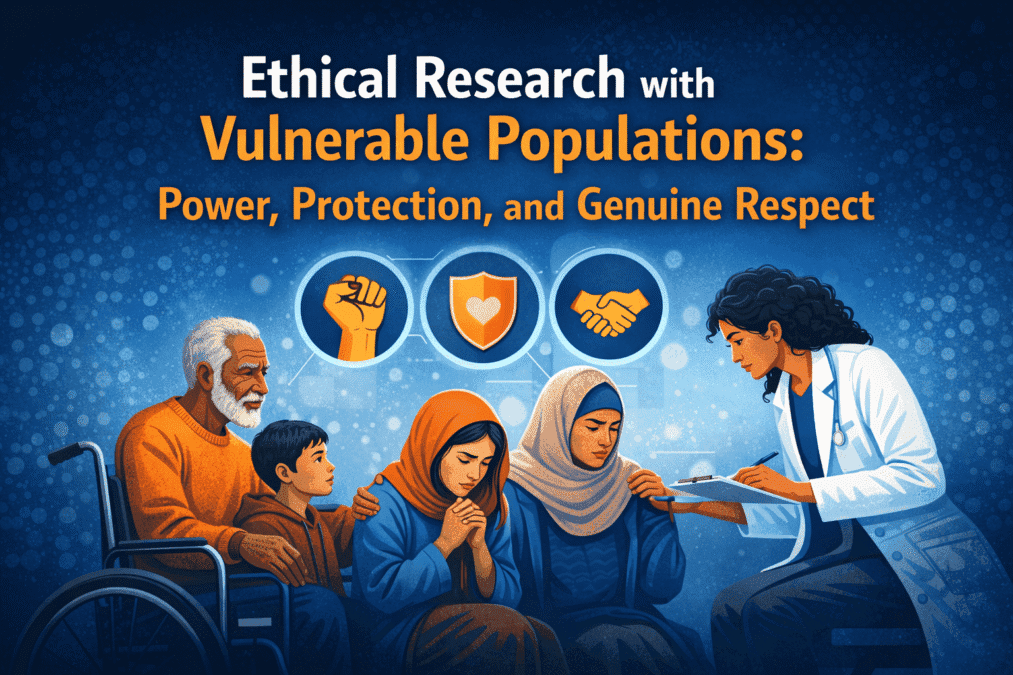
The module overview lists vulnerable populations and extra protections. This post goes deeper: what vulnerability actually means in research contexts beyond formal categories, the specific ethical challenges of research with children, students, and low-income communities in India, how to design research that respects rather than merely protects, and the problematic dynamic where researchers treat vulnerable participants as subjects of protection rather than people with perspectives.
What Vulnerability Means in Research
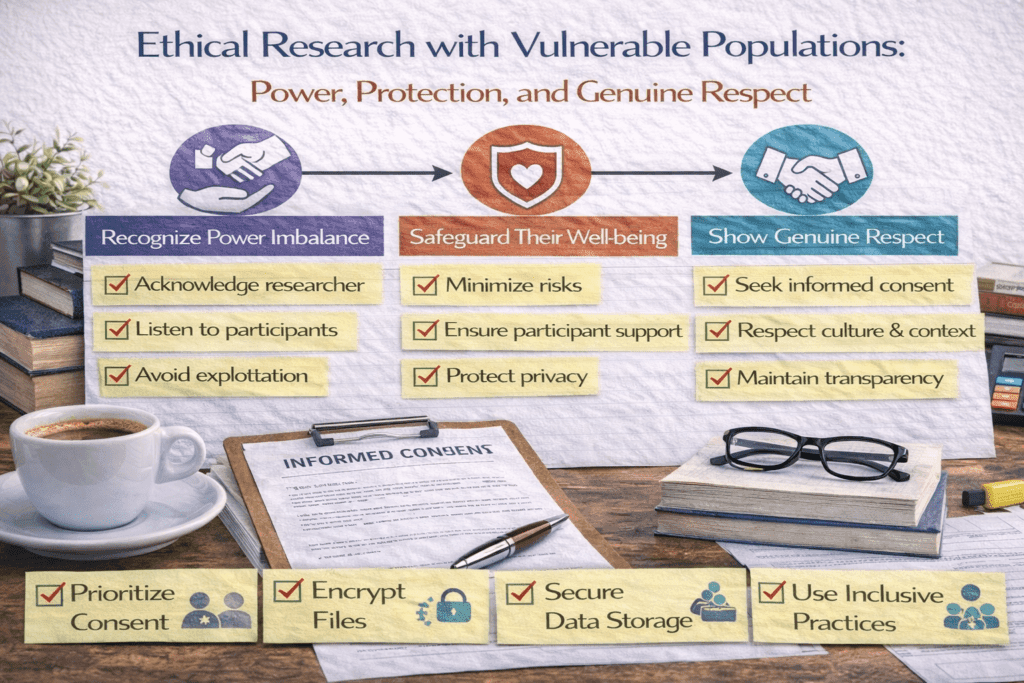
The standard classification of vulnerable populations — children, prisoners, pregnant women, cognitively impaired individuals — is a starting point, not a complete picture. Vulnerability in research is situational: it arises from the relationship between the researcher’s power and the participant’s capacity to freely choose participation.
Three sources of vulnerability that the standard categories understate: (1) Power differentials — teachers researching their own students, employers studying their employees, senior researchers studying junior colleagues; (2) Dependency relationships — participants who rely on the researcher’s institution for services, housing, employment, or welfare; (3) Community vulnerability — communities with histories of being researched without benefit, who may participate out of obligation or past experience of pressure rather than genuine choice.
Recognising these additional sources of vulnerability changes how you design research. It is not enough to check whether a participant falls into a standard category — you need to ask whether the research relationship itself creates conditions that compromise voluntariness.
Research with Children and Young People
The assent process in practice
The module describes parental consent plus child assent as the requirement. The practical challenge is that child assent processes are often meaningless — a rushed explanation to a child who feels obligated to agree because an adult (their parent, their teacher, the researcher) has already said yes.
A genuine assent process: explain the research in language matched to the child’s developmental level; be explicit that the child can say no even though their parents said yes; make the ‘no’ option feel genuinely available by noting a concrete alternative activity or simply time to themselves; and monitor for signs of reluctance during data collection. A child who becomes withdrawn, gives very short answers, or tries to finish quickly may be signalling discomfort that a genuine assent process should respond to.
School-based research in India
Research in Indian schools involves a specific power structure: the research relationship passes through principals (who give institutional access), teachers (who facilitate classroom access), parents (who give legal consent), and students (who give assent). Each layer in this chain can create pressure that compromises the next layer’s genuine voluntariness.
The teacher-as-recruiter problem: when teachers present research to their students and oversee the consent process, students may feel that the ‘correct’ choice is to participate. The solution: where possible, have the researcher — not the class teacher — present the research to students, and make consent collection happen outside the classroom context. If the teacher must be present, explicitly instruct the teacher not to comment on students’ decisions.
Student data from schools is subject to specific protections under the UGC’s student data guidelines and applicable state education regulations. Check institutional requirements before accessing any student performance, attendance, or personal data.
Research with Low-Income and Marginalised Communities
Research ethics guidelines were developed primarily in North American and European contexts, and their application in Indian community research requires cultural adaptation. Several specific issues arise:
The justice problem: who benefits?
The Belmont Report’s justice principle requires that research burdens and benefits be distributed fairly. In practice, much Indian social science research involves researchers from relatively privileged institutional backgrounds studying communities that bear the burden of participation (time, potential risks, disruption) while the primary benefits flow to the researcher’s career and academic knowledge in general. This is not necessarily unjust, but it should be explicitly considered.
Questions to ask: Will this community have access to the findings? In what form — an academic journal they cannot access, or a report in their language? Will the research produce any direct benefit to them, or only to knowledge in the abstract? Have community members had any input into what questions are worth asking? These are not rhetorical questions — they require genuine reflection and, where possible, community consultation before research design is finalised.
Compensation: meaningful vs. coercive
Compensating research participants for their time is ethical and appropriate. But compensation can become coercive when it is large enough relative to participants’ economic situation that people participate despite genuine unwillingness in order to receive it. For research with very low-income participants, even modest compensation by middle-class standards can create this dynamic.
The IEC will ask about compensation and its potential for coercion. The standard: compensation should cover participants’ costs (travel, childcare, lost wages) and provide modest recognition of their time, but should not be so large that economic incentive overrides genuine consent. In most Indian community research contexts, ₹200–500 for a 60-minute interview is in the non-coercive range; ₹2,000–5,000 for a 30-minute interview would raise questions in most IEC reviews.
Research with Adivasi and Dalit communities
Research with Scheduled Tribe and Scheduled Caste communities carries historical weight: these communities have long been studied as subjects of curiosity or pity rather than as people with perspectives worth understanding on their own terms. They have frequently participated in research without seeing any benefit and sometimes with harm.
Community consultation before formal data collection is not just ethically good practice — it builds the trust without which research in these communities is either impossible or produces distorted data. This means spending time in the community before recruiting participants, discussing the research with community leaders and members, and being genuinely responsive to concerns they raise about the research’s purpose, design, or potential consequences.
Free, Prior, and Informed Consent (FPIC) — the standard developed in international indigenous rights law — is not a formal legal requirement for most Indian academic research, but its principles provide valuable guidance for community-level consent processes in Adivasi research.
Research with Students as Participants — Your Own Students
The module identifies students as vulnerable when their professor is the researcher. This is common in Indian education and social science research, and the vulnerability is real. A student who believes their participation affects their grade, their relationship with their supervisor, or their institutional standing cannot give genuinely voluntary consent.
The minimum requirement: if you are researching your own students, have a third party (another faculty member, a research coordinator) obtain consent without your presence, and ensure students have a genuine alternative to participation that carries no academic penalty.
The better practice: redesign the research to use students from other classes, other institutions, or students with whom you have no current teaching or supervisory relationship. The IEC will ask whether you have considered this alternative.
Legal Research and Writing: Complete Guide for Law Students and Legal Researchers
FAQs
Q: Who counts as a vulnerable population in research?
Vulnerable populations are groups whose circumstances reduce their ability to give fully free and informed consent or who face elevated risk of harm from research participation. They include: children and young people under 18; people with cognitive or intellectual disabilities; prisoners and people in detention; patients in medical settings; people in dependent relationships (students researched by their teacher, employees by their employer); undocumented migrants; and communities experiencing poverty, marginalisation, or social exclusion. The designation is contextual — the same person may not be vulnerable in one research context but may be in another.
Q: How do you research children ethically?
Research with children requires: written consent from a parent or legal guardian; the child’s own assent — their agreement to participate, expressed in age-appropriate language; research procedures designed to be understandable and non-distressing for the child’s developmental stage; no deception; the right to withdraw at any time without explanation; and a clear plan for responding if the child discloses abuse or harm. The ethics committee will review all materials used with children: consent forms for parents, assent forms for children, interview guides. Materials that are suitable for adults are not automatically suitable for use with children.
Q: What special ethical considerations apply to research with prisoners?
Research with prisoners requires: institutional ethics approval plus approval from the prison administration (Inspector General of Prisons or equivalent); a consent process that specifically addresses voluntariness in a coercive environment — participation must have no effect on legal situation, parole decisions, or prison conditions; clear explanation of the researcher’s independence from prison administration; protection against participation affecting legal proceedings (do not ask undertrial detainees about the facts of their case); and consideration of the risk that prison officials may have access to research data. Allow 3–6 months for access negotiation before expected data collection.
Q: What is the difference between power and vulnerability in research?
Power differentials in research exist when the researcher has social, professional, or institutional authority over participants. Vulnerability refers to reduced capacity for free and autonomous decision-making. A student researched by their supervisor is both in a power-differential situation and potentially vulnerable — they may fear academic consequences of non-participation. A community leader may be powerful in their community but vulnerable in relation to a government-affiliated researcher. Ethical research addresses both: reducing power effects through structural design choices and addressing vulnerability through additional protective measures.
Q: How do you conduct trauma-informed research?
Trauma-informed research recognises that research participants may have experienced trauma that affects their engagement with research. Principles include: safety (creating a physical and emotional environment where participants feel secure); trustworthiness (clear, transparent communication about what the research involves and how data will be used); choice (genuine voluntariness at every stage, including which questions to answer); collaboration (treating participants as experts on their own experience); and empowerment (focusing on strengths, not only deficits). Have referral resources available for participants who experience distress. Brief participants before and debrief them after potentially difficult conversations.
References
- Levine, C., et al. (2004). The Limitations of ‘Vulnerability’ as a Protection. American Journal of Bioethics, 4(3).
- ICMR National Ethical Guidelines (3rd ed., 2023). icmr.gov.in
- Minkler, M., & Wallerstein, N. (2020). Community-Based Participatory Research (3rd ed.). Jossey-Bass.
Next: Cluster Post 5 — Research Integrity: Data Handling Authorship Ethics and the Indian Regulatory Framework
- Module 1 The Complete Guide to Research Paper and Thesis Structure
- Module 2 The Academic Writing Process: Complete Guide from First Draft to Submission (2026)
- Module 3 Research Methodologies: Complete Guide to Quantitative, Qualitative, Mixed Methods & Legal Research (2026)
- Module 4 Data Analysis and Results Presentation: Complete Guide for Quantitative, Qualitative & Legal Research (2026)
- Module 5 Organization and Academic Tone: Complete Guide to Professional Scholarly Writing (2026)
- Module 6 Peer Review and Publication: Complete Guide from Submission to Acceptance (2026)
- Module 7 AI Tools in Academic Research: Opportunities, Ethics, and Best Practices (2026)
- Module 8 Grant Writing and Research Funding: Complete Guide to Finding Money for Your Research (2026)
- Module 9Academic Career Development: Complete Guide to Building Your Professional Life in Research (2026)
- Module 10 Research Ethics and the IRB Process: Complete Guide to Doing Research Responsibly (2026)
No post found!