
Cluster Post 3 | Module 3: Research Methodologies
From Concept to Submission Series | 2026
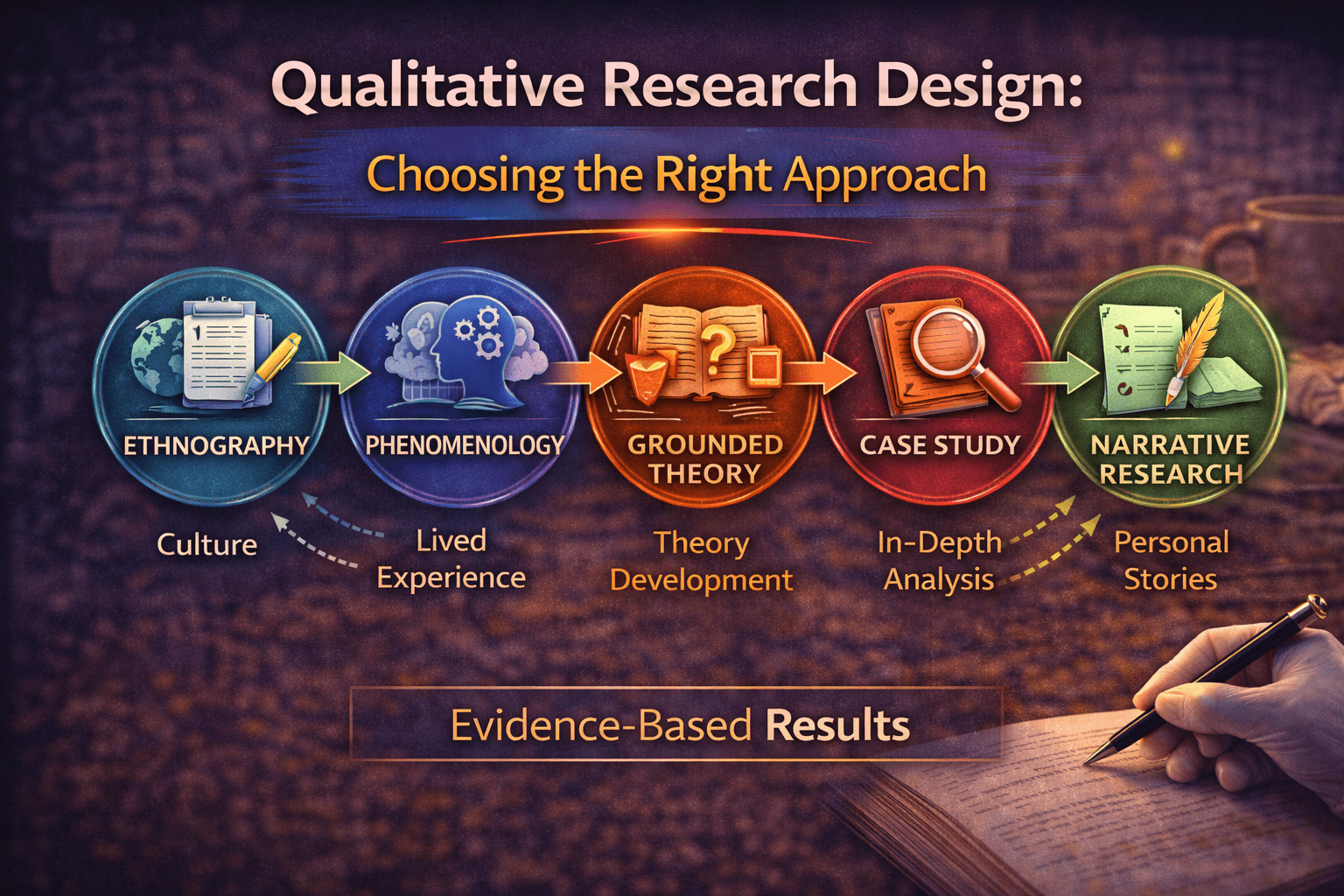
Qualitative Research Design: Choosing the Right Approach
The module overview described five qualitative traditions. This post goes deeper: what each tradition is actually for and what question types it can and cannot answer, the most common misapplication of each, a decision guide for choosing between them, and how to write your design choice in a way that satisfies examiners.
The Selection Problem: Why Choosing a Tradition Matters
Many researchers choose their qualitative tradition the way they choose a restaurant — by familiarity rather than fit. Thematic analysis is chosen because everyone in the department uses it. Case study is chosen because the module mentioned it. Grounded theory is chosen because it sounds rigorous.
Tradition choice is a methodological claim. Each qualitative tradition rests on specific assumptions about what kind of knowledge it produces, what questions it can answer, and what counts as rigorous execution. Using grounded theory when you already have a theoretical framework, or using phenomenology when you are not interested in lived experience, produces not just weak methodology but fundamentally misaligned research — work that cannot deliver what its framing promises.
The questions to ask when choosing a tradition are: What kind of knowledge do I need? Do I need to understand the essence of an experience, build a theory from the ground up, understand a culture from inside, investigate a specific case in depth, or identify themes across a body of text? The answer to this question points to the tradition, not the other way around.
The Five Traditions: What Each Is Actually For
Phenomenology: understanding the essence of lived experience
Phenomenology asks: what is the essential structure of this experience — what makes it this kind of experience rather than some other kind? It is the right choice when your research question concerns how a specific phenomenon is experienced by the people who live through it, and when capturing the essence of that experience is the goal.
The key word is essence. Phenomenology is not satisfied with collecting accounts of experience — it seeks the invariant structure that runs through all those accounts, the features without which the experience would not be what it is. This requires both collecting rich experiential data (usually through in-depth interviews asking participants to describe their experience in detail) and a specific analytical process aimed at identifying essential themes.
Right fit: “What is the lived experience of first-generation students navigating the cultural gap between their home environment and government college academic culture?” Wrong fit: “How do students describe their peer mentoring experiences?” — This is a descriptive question about content, not an inquiry into essential structure. Thematic analysis or case study would serve it better.
Most common misapplication: treating any interview-based study as phenomenological. Phenomenology has a specific philosophical heritage (Husserl, Heidegger, Merleau-Ponty) and a specific analytical procedure (bracketing, horizonalisation, cluster of meanings, essence description). Research described as phenomenological that does not follow this procedure is misnamed.
Grounded theory: building theory from data
Grounded theory is designed for one specific purpose: generating theory that is grounded in — derived from and supported by — systematic data. It is the right choice when the phenomenon you are studying is poorly theorised and the goal is to develop a conceptual framework that explains it, not to describe it or test an existing theory.
The defining features of grounded theory are theoretical sampling (you collect new data based on the emerging theory, not a pre-specified sample), constant comparative analysis (new data is continuously compared to existing codes and categories), and theoretical saturation (collection stops when new data no longer generates new theoretical insights). These are not optional features — they are what makes a study grounded theory rather than interview research with open coding.
Right fit: “What theory explains how peer mentors develop their mentoring identity and practice in the absence of formal training?” — There is no existing theory specifically for this; the goal is to develop one from what mentors say and do. Wrong fit: “How do peer mentors experience their role?” — If you already have a theoretical framework (social identity theory, for instance) and want to apply it, grounded theory is not appropriate. You are not building theory; you are testing or illustrating it.
Most common misapplication: using the words “grounded theory” to describe any qualitative study that uses inductive coding. Inductive coding is a feature of many qualitative approaches. Grounded theory specifically requires theoretical sampling and constant comparison, neither of which most “grounded theory” studies in thesis literature actually implement.
Ethnography: understanding culture from inside
Ethnography is designed to understand how a culture or social group makes sense of its world — from the perspective of its members, in the context of their daily lives. It requires sustained immersion in the research setting, typically through participant observation combined with interviews and document analysis.
The defining feature of ethnography that distinguishes it from other qualitative research is the insider-outsider position: the ethnographer is present in the setting long enough to understand it from within, while maintaining enough analytical distance to make the familiar strange. This takes time — weeks or months at minimum, more for complex settings. A study that calls itself ethnographic but involves three observation visits is not ethnographic; it is observation-based qualitative research.
Right fit: “How do peer mentoring relationships operate as a cultural practice within government college student communities — what norms, expectations, and social scripts govern them?” Wrong fit: A study with a tight timeline, a geographically dispersed sample, or a primarily interview-based approach. Ethnography requires physical presence and sustained engagement that many thesis timelines cannot accommodate.
Most common misapplication: claiming ethnographic design when the data collection is primarily or entirely interview-based. Interviews are part of ethnography, but ethnography without observation is not ethnography.
Case study: understanding complexity in context
Case study is designed for in-depth investigation of a bounded unit — a person, institution, programme, event, or decision — in its real-world context. It is the right choice when the boundaries between the phenomenon and its context are not clear and when understanding the context is essential to understanding the phenomenon.
Yin’s (2018) canonical definition specifies that case study is appropriate when you are asking how or why questions about contemporary events over which you have no control. This is a more specific claim than most researchers realise. Case study is not simply “I am studying one organisation” — it is a design for investigating how and why phenomena unfold as they do in specific, bounded contexts.
Right fit: “How did one government college successfully implement peer mentoring when comparable colleges have failed — what factors explain the difference?” Wrong fit: “I am describing the mentoring programme at one college.” Description of a single site is not case study research; it is site-specific description. Case study requires analysis of how and why, not just what.
Most common misapplication: using case study to mean “I studied one place.” The bounded case, the how/why question, and the contextual analysis that connects the case to its setting are all required for a study to be genuinely case study research.
Narrative research: understanding identity through story
Narrative research is designed to analyse how people construct meaning through the stories they tell — about their lives, their experiences, or events they have witnessed. It is the right choice when the structure, sequence, and form of stories are analytically important, not just their content.
Narrative research attends to how stories are told as well as what they say. Who is positioned as the hero, the victim, the villain? Where does the story begin and end? What is omitted? What cultural narrative templates shape how the story is structured? These formal features reveal how the teller makes sense of experience and constructs identity.
Right fit: “How do first-generation students narrate their college experience — what story of transformation, struggle, or belonging do they construct, and how does peer mentoring figure in that story?” Wrong fit: Questions about prevalence, patterns across many cases, or content that can be analysed without attending to narrative structure.
A Decision Guide
| Your research question asks… | Consider this tradition |
| What is the essential structure of this experience? | Phenomenology |
| What theory explains this poorly understood phenomenon? | Grounded theory |
| How does this culture or community operate from inside? | Ethnography |
| How and why did this specific case unfold as it did? | Case study |
| How do people construct meaning and identity through story? | Narrative research |
| What themes appear across this body of text or data? | Thematic analysis (not a tradition but a method — can be used within several traditions) |
Thematic analysis deserves a note. It is the most widely used qualitative analytical method, but it is not a research tradition — it is a method that can be used within several traditions (and without any explicit tradition, in what Braun and Clarke call a reflexive thematic analysis approach). Do not confuse choosing thematic analysis as your analytical method with choosing your overall research tradition.
Writing Your Design Choice in the Methodology Chapter
Examiners expect you to name your qualitative tradition, explain what it is designed to do, justify why it fits your research question, and describe how you implemented it. The most common methodology chapter failure is naming the tradition without justifying the choice.
Insufficient: “This study uses a phenomenological design.” Sufficient: “This study uses interpretive phenomenological analysis (IPA; Smith, Flowers & Larkin, 2009), a qualitative approach designed to investigate how individuals make sense of significant personal experiences. IPA is appropriate here because the research question concerns how first-generation students experience the cultural navigation demands of government college life — a question about meaning and subjective sense-making that requires detailed exploration of individual accounts rather than the breadth of pattern-based approaches. The small, purposively selected sample of eight participants reflects IPA’s commitment to depth over breadth.”
Four sentences. They name the tradition and its specific variant (IPA), state what it is designed to do, connect it to the research question, and draw one implication for sample size. This is the minimum that satisfies examiner expectations. More detail on implementation belongs in the data collection and analysis subsections, not here.
🔱 For Law Students
Qualitative methods in legal research appear primarily in socio-legal studies — research that examines how law operates in social contexts, how legal institutions function, how people experience legal processes, or how legal norms are understood and applied by non-specialists. The qualitative traditions described above apply directly to this work.
Which traditions are most common in socio-legal research
Case study is the most widely used qualitative design in legal scholarship, though it is often not named as such. Studies of how a particular court, tribunal, or regulatory body operates; investigations of how a specific piece of legislation was implemented; analyses of how a landmark case reshaped legal practice — all of these are case studies in Yin’s sense, even when researchers do not use that terminology.
Ethnography has a strong tradition in socio-legal research, particularly in studies of courts, legal aid organisations, police practice, and informal justice systems. Courtroom ethnography — sustained observation of how trials actually unfold, as opposed to how they are described in legal textbooks — has produced some of the most important insights in empirical legal studies.
Narrative research is increasingly used to study how victims, litigants, prisoners, and marginalised communities tell stories about their encounters with law — and how those stories differ from the official legal account. This work has direct implications for access to justice, evidence law, and the design of legal processes.
A note on doctrinal research as qualitative
Some legal methodologists argue that doctrinal research is itself a form of qualitative research — that close reading of cases and statutes, identification of interpretive themes, and construction of doctrinal categories are all qualitative analytical processes applied to legal texts. This framing is intellectually defensible but practically risky in an Indian law thesis context, where examiners trained in traditional legal methodology may find it unfamiliar. The safer approach is to describe doctrinal research as legal hermeneutics or doctrinal analysis, reserving qualitative language for the empirical components of your research.
References
- Creswell, J. W., & Creswell, J. D. (2022). Research Design: Qualitative, Quantitative, and Mixed Methods Approaches (6th ed.). Sage.
- Merriam, S. B., & Tisdell, E. J. (2016). Qualitative Research: A Guide to Design and Implementation (4th ed.). Jossey-Bass.
- Smith, J. A., Flowers, P., & Larkin, M. (2009). Interpretative Phenomenological Analysis: Theory, Method and Research. Sage.
- Charmaz, K. (2014). Constructing Grounded Theory (2nd ed.). Sage.
- Yin, R. K. (2018). Case Study Research and Applications: Design and Methods (6th ed.). Sage.
- Braun, V., & Clarke, V. (2022). Thematic Analysis: A Practical Guide. Sage.
- Denzin, N. K., & Lincoln, Y. S. (Eds.). (2018). The SAGE Handbook of Qualitative Research (5th ed.). Sage.
Next: Cluster Post 4 — Qualitative Data Collection and Analysis: Interviews, Coding, and Trustworthiness

The Complete Guide to Research Paper Structure: IMRAD Format, Thesis Organization & Academic Writing (2026)
From Concept to Submission: A Complete Guide to Research Paper and Thesis Writing Module 1:…

The IMRAD Framework: Why It Exists, How It Really Works, and Where It Breaks Down
Cluster Post 1 | Module 1: Understanding the Structure of Research Papers and Theses From…

How to Write a Research Introduction That Reviewers Cannot Ignore
Cluster Post 2 | Module 1: Understanding the Structure of Research Papers and Theses From…

How to Write a Methods Section That Reviewers Will Trust
Cluster Post 3 | Module 1: Understanding the Structure of Research Papers and Theses From…

The Results Section: How to Present Findings Without Letting Interpretation Slip In
Cluster Post 4 | Module 1: Understanding the Structure of Research Papers and Theses From…

The Discussion Section: How to Turn Findings Into Knowledge
Cluster Post 5 | Module 1: Understanding the Structure of Research Papers and Theses From…

Complete Thesis Structure: A Chapter-by-Chapter Guide
Cluster Post 6 | Module 1: Understanding the Structure of Research Papers and Theses From…

10 Structural Mistakes That Get Research Papers Rejected — And How to Fix Every One
Cluster Post 7 | Module 1: Understanding the Structure of Research Papers and Theses From…

The Academic Writing Process: Complete Guide from First Draft to Submission (2026)
From Concept to Submission: A Complete Guide to Research Paper and Thesis Writing Module 2,…

How to Start Writing — and Keep Going
Cluster Post 1 | Module 2: The Academic Writing Process From Concept to Submission Series …

How to Write Clear Engaging Academic Prose
Cluster Post 2 | Module 2: The Academic Writing Process From Concept to Submission Series …

The Revision Process: How to Turn a Draft Into a Submission
Cluster Post 3 | Module 2: The Academic Writing Process From Concept to Submission Series …

Citation Styles Explained: APA, MLA, Chicago, IEEE, and Bluebook
Cluster Post 4 | Module 2: The Academic Writing Process From Concept to Submission Series …
Reference Management: Zotero and Mendeley from Setup to Submission
Cluster Post 5 | Module 2: The Academic Writing Process From Concept to Submission Series …
Research Methodologies: Complete Guide to Quantitative, Qualitative, Mixed Methods & Legal Research (2026)
Why Methodology Determines Research Quality Here’s what thesis examiners focus on first: your methodology section…