
— Legal Specialist, Consultant & Researcher, AspirixWriters
Report Cyber Fraud in India
If money has just been taken from your account through UPI, a card, net banking, or a scam call — stop reading and call 1930 first. Then come back and read the rest of this guide for what to do next.
For everyone else researching this calmly: here’s the complete, simple version of what to do if you’ve been hit by online fraud, hacking, or harassment.

Cybercrime investigators call the period right after a fraud the “golden hour.” The faster you report it, the better the chance that:
- The bank can freeze the money before the fraudster withdraws it.
- Police can trace the transaction while the digital trail is still fresh.
- You qualify for stronger protection under banking rules.
Reporting after a few days still matters and can still help — but reporting within the first hour matters much more.
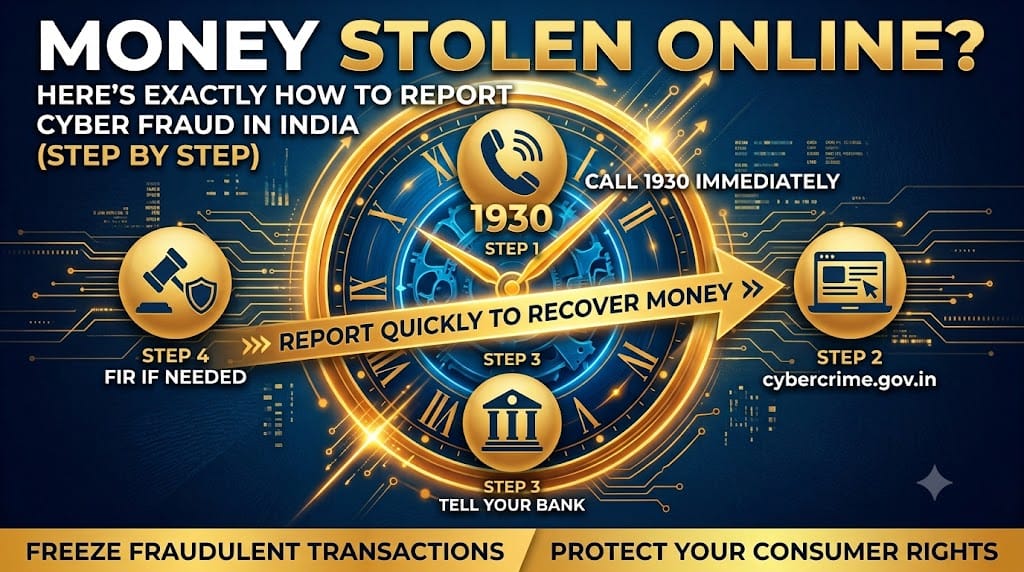
Step 1: Call 1930 Immediately (This Is Free)
📞 1930 — India’s national cybercrime helpline, run 24×7 by the government’s Indian Cyber Crime Coordination Centre (I4C).
- It’s toll-free from any Indian mobile network.
- It works in Hindi, English, and major regional languages.
- If it’s a money fraud (UPI, card, net banking), the operator can flag the receiving account and try to get it frozen before the money moves further.
- You’ll be given a complaint reference number — save this, you’ll need it for everything else.
Have this ready when you call:
- Roughly when the fraud happened
- The amount and the account/card involved (last 4 digits are enough)
- The transaction ID / UPI reference number, if you have it
- Screenshots of any messages, links, or calls that led to it
Step 2: File the Full Complaint Online
Go to cybercrime.gov.in — this is the official National Cyber Crime Reporting Portal (NCRP), and it’s where your 1930 call gets backed up with full details and evidence.
- For money-related fraud, choose “Report Financial Fraud.”
- For other cybercrimes — hacking, stalking, harassment, sextortion, fake profiles, morphed images — choose “Report Other Cyber Crimes.” There’s also a dedicated, more private section for crimes against women and children, with an option to report anonymously.
Upload what you have:
- Screenshots (chat, SMS, the fraudulent link or profile)
- Bank/transaction statements
- Any emails involved (including the header, if you can get it)
- The 1930 reference number from Step 1
Once submitted, you’ll get a complaint acknowledgement — download and save this. It’s your proof that you reported the crime, and you’ll need it for your bank and for any FIR later.
Step 3: Tell Your Bank Too — Separately, and Fast
Reporting to cybercrime.gov.in does not automatically notify your bank. Do this as its own step, because your legal protection depends on it.
Under an RBI rule from 2017, if money was taken from your account without your involvement:
- Report to your bank within 3 working days of getting the bank’s alert (SMS/email) about the transaction → you likely have zero liability — meaning you shouldn’t lose the money at all, if the fraud wasn’t your fault.
- Report between 4–7 working days → your liability is capped at a limited amount (roughly ₹5,000–₹25,000 depending on your account/card type).
- Report after 7 working days → what you’re liable for depends on your bank’s own policy.
- Once you report, the bank is required to credit the disputed amount back to your account within 10 working days, even before its investigation is fully complete.
In short: call your bank’s fraud helpline the same day, even if you’ve already called 1930. They’re two different systems and both need to hear from you.
Step 4: If You Need a Formal FIR
For serious cases, or if you need documentation for insurance, court, or a large-value claim, visit your nearest cyber crime police station (or any police station — they’re required to register it and forward it if it isn’t the right one) and ask to file an FIR.
Bring with you:
- The cybercrime.gov.in acknowledgement
- The 1930 reference number
- All your evidence (screenshots, statements, etc.)
If the police refuse to register your FIR, you have options:
- Send a written complaint to the Superintendent of Police, along with proof that you already tried.
- Apply to a Magistrate under Section 156(3) of the CrPC, asking the court to direct the police to register it.
- In serious or urgent cases, approach the High Court.
What Counts as “Cybercrime” You Can Report?
More than most people expect — this isn’t limited to money fraud:
- UPI, card, or net banking fraud
- Hacked email, social media, or WhatsApp accounts
- Online job scams, fake investment/trading schemes
- Phishing links, fake customer-care numbers
- Cyberstalking, harassment, or threats
- Sextortion or morphed/intimate images shared without consent
- Ransomware or malware attacks
- Identity theft
Quick Checklist: What to Save Before You Report
- [ ] Screenshots of the fraud (message, call log, fake site, profile)
- [ ] Transaction ID / UPI reference / last 4 digits of card
- [ ] Time and date the fraud happened
- [ ] Bank SMS/email alerts
- [ ] Any communication with the fraudster
- [ ] The 1930 reference number, once you have it
- Got Cheated While Shopping Online? Here’s Exactly What You Can Do (Simple Guide)
- How to File for Mutual Divorce in India: Process, Documents, Timeline & Remarriage Rules
- What to Do If Your Fundamental Rights Are Violated in India: A Complete Guide to Article 32 & Article 226
Frequently Asked Questions
Is 1930 really free?
Yes, completely free from any Indian mobile network, 24 hours a day.
I’ve heard of a different number, 155260 — is that still used?
No. 1930 replaced that older number to make it easier to remember. If anyone tells you to call 155260, they’re working off outdated information.
Do I have to file a police FIR every time?
Not always — many cases are handled through the 1930/cybercrime.gov.in process and your bank alone, especially where the money can be traced and frozen quickly. An FIR becomes more important for larger losses, insurance claims, or if you need formal legal proceedings.
What if I only realise the fraud happened a few days later?
Still report it — right away. Your chances of recovering the money are lower after the golden hour has passed, but reporting late is always better than not reporting at all, and your bank-liability protection is still based on when you report, not when the fraud actually happened.
Can I report anonymously?
For sensitive crimes like sextortion or child sexual abuse material, yes — the portal has a dedicated, more private reporting option for this.
About the Author
Dr. Rekha Khandelwal is a Legal Specialist, Consultant, Researcher, and Author. She provides research-backed legal insights, AI governance guidance, and educational content to help individuals, students, and professionals better understand the law.
Disclaimer
The content on AspirixWriters is provided for educational and informational purposes only and does not constitute legal advice. For advice on specific legal matters, please consult ………….
Need Professional Assistance?
For legal research, legal writing, AI governance, compliance, or consultancy services, you may contact Dr. Rekha Khandelwal through AspirixWriters.
Official References
- National Cyber Crime Reporting Portal — Indian Cyber Crime Coordination Centre (I4C), Ministry of Home Affairs
- National Cybercrime Helpline: 1930
- RBI Circular RBI/2017-18/15, DBR.No.Leg.BC.78/09.07.005/2017-18 — “Customer Protection: Limiting Liability of Customers in Unauthorised Electronic Banking Transactions” (6 July 2017)
- Information Technology Act, 2000, via India Code
- Bharatiya Nyaya Sanhita, 2023 — applicable provisions for cyber-enabled offences
- Code of Criminal Procedure, 1973 — Section 156(3), on Magistrate’s power to direct police investigation
Facing Domestic Violence in India? Here’s How to Get Protection and Claim Compensation
Facing Domestic Violence in India? Legal Specialist, Consultant & Researcher, AspirixWriters If you are in…

How to Check If a Property Has a Clear Title Before Buying in India
How to Check If a Property Has a Clear Title Before Buying in India Legal…

Got Cheated While Shopping Online? Here’s Exactly What You Can Do (Simple Guide)
— Legal Specialist, Consultant & Researcher, AspirixWriters | Reviewed & Approved Got Cheated While Shopping…

How to File for Mutual Divorce in India: Process, Documents, Timeline & Remarriage Rules
How to File for Mutual Divorce in India By Dr. Rekha Khandelwal — Legal Specialist,…

What to Do If Your Fundamental Rights Are Violated in India: A Complete Guide to Article 32 & Article 226
What to Do If Your Fundamental Rights Are Violated in India If a government official…
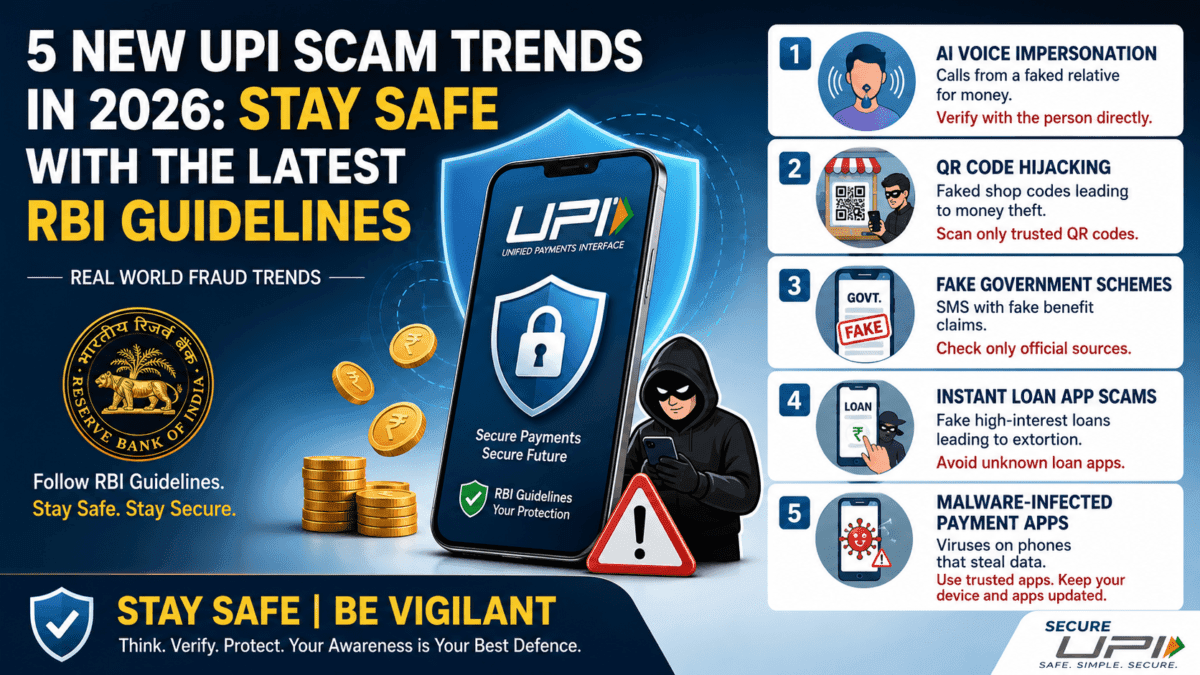
5 New UPI Scam Trends in 2026: Stay Safe with the Latest RBI Guidelines
Your phone buzzes at 11 PM. An unknown number. You pick up — and hear…