
Cluster Post 3 | Module 2: The Academic Writing Process
From Concept to Submission Series | 2026
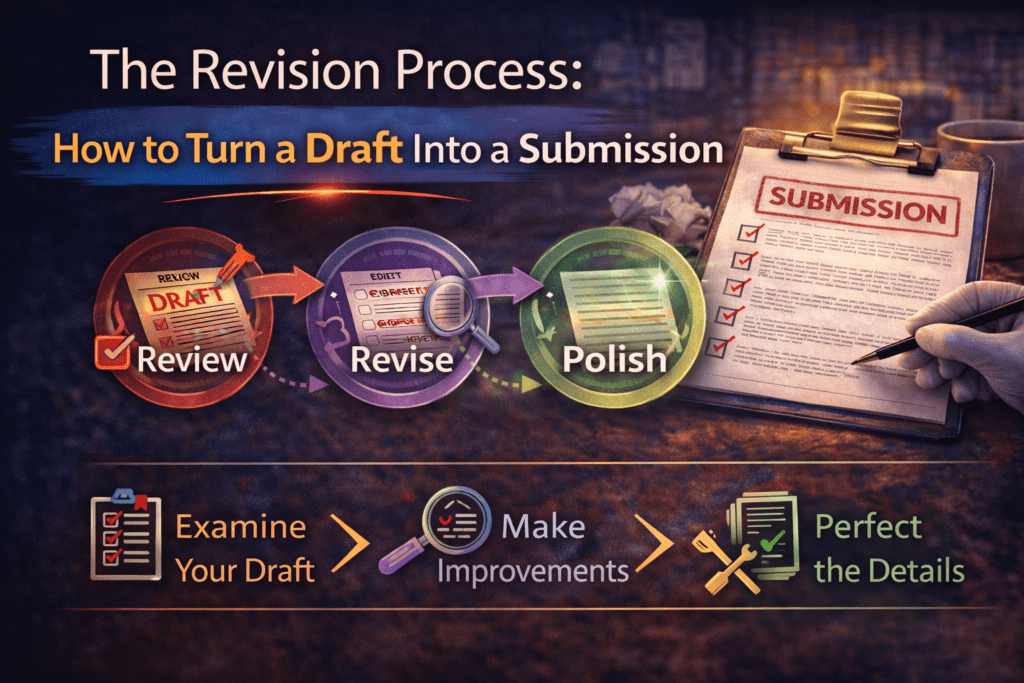
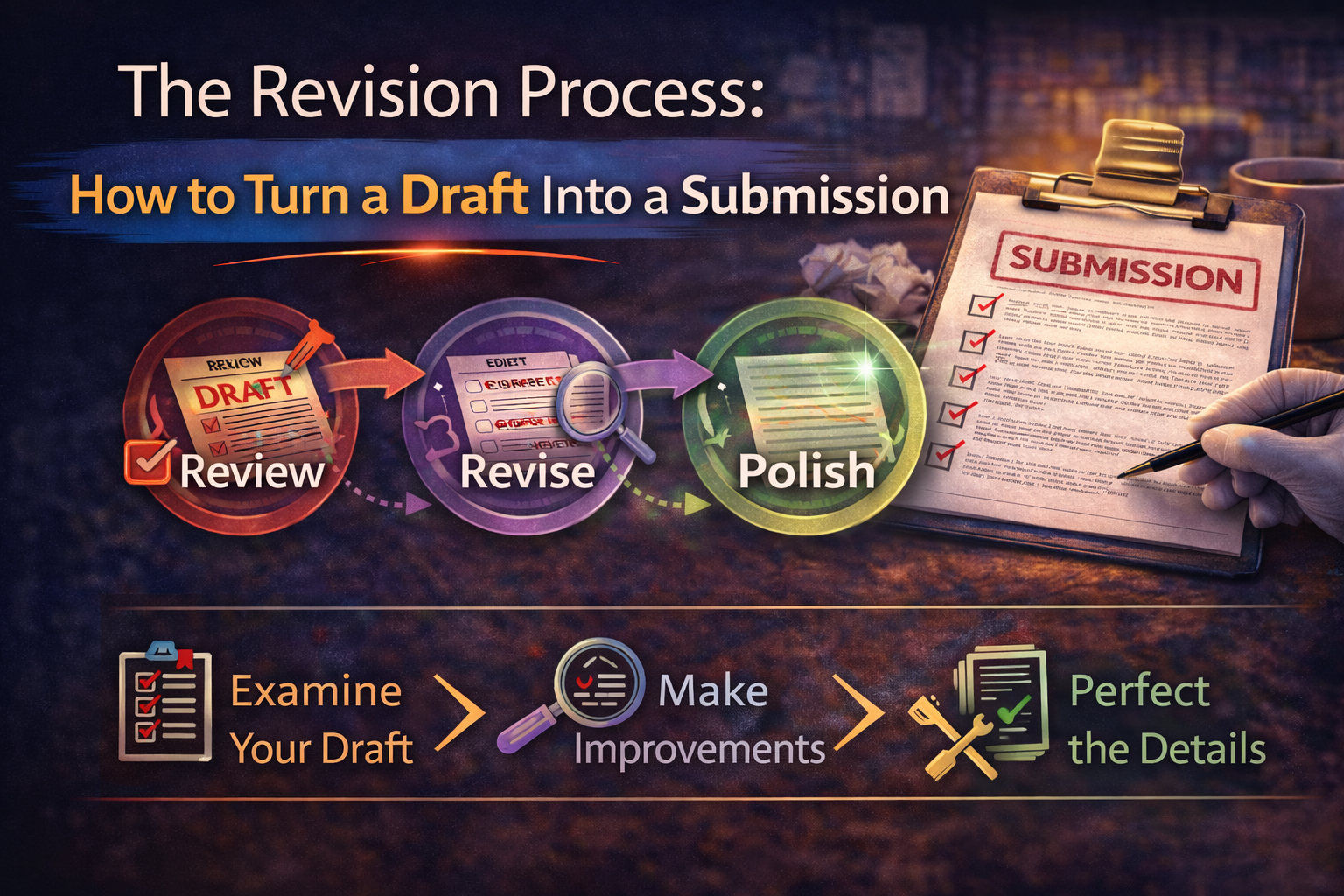
The Revision Process: How to Turn a Draft Into a Submission
The module overview described four revision stages. This post goes deeper: exactly what to look for in each stage, the reverse outline method for finding structural problems, how to respond to reviewer comments systematically, and the specific checks that prevent desk rejection before your paper reaches a reviewer.
Why Most Researchers Revise Badly
Most researchers approach revision as anxious re-reading — reading through the draft, changing words here and there, feeling vaguely dissatisfied but not knowing what specifically to fix. This produces papers that are slightly more polished but structurally unchanged. It does not produce papers that are ready to submit.
The reason is that undirected re-reading conflates four completely different tasks: checking whether the argument works, checking whether paragraphs are coherent, checking whether sentences are clear, and checking for mechanical errors. Each of these requires a different kind of attention. Trying to do all four at once means you do none of them well.
Effective revision is staged. You give each pass a single, specific job. You finish that job completely before moving to the next. The result is a draft that has been systematically examined at every level — not one that has been read through several times without a clear purpose.
Stage 1: The Argument Pass
The first revision pass asks one question: does the argument work? Not whether the sentences are good, not whether the formatting is correct — just whether the central claim is established, supported, and sustained throughout the paper.
The reverse outline
The most powerful tool for this stage is the reverse outline — and it is almost never taught explicitly. After your first full draft, go through the paper paragraph by paragraph and write one sentence describing what each paragraph does. Not what it says — what it does in the argument.
Examples of reverse outline entries: Paragraph 1: Establishes the scale of the retention problem in Indian higher education. Paragraph 2: Identifies the gap — financial factors are studied but peer support is not. Paragraph 3: States the research question and significance. Paragraph 4: Explains why this is the right research design for this question. Paragraph 5: Repeats the point about financial factors. (→ Cut or merge with Paragraph 2.)
When you read the reverse outline as a list, structural problems that were invisible in the prose become obvious. You can see immediately if the argument repeats itself, if there are gaps in logic, if sections are in the wrong order, if a paragraph is doing two things that should be separated, or if three paragraphs are all doing the same thing and could be one.
The reverse outline also reveals whether your introduction promises what your paper actually delivers. If the introduction sets up three research questions but the discussion addresses only two, the reverse outline catches it. Fix the mismatch before anything else.
What to look for in the argument pass
- Is the central claim stated explicitly? Not implied, not gradually revealed — stated in a single identifiable sentence that a reader could point to.
- Does every section support the claim? If a section can be removed without weakening the argument, it either needs strengthening or cutting.
- Are there logic gaps? Places where the argument jumps from A to C without establishing B. These are the transitions your readers will stumble over.
- Is anything in the wrong place? Evidence that belongs in results appearing in the introduction. Discussion that appears in the middle of the methods. Background that would be better as an appendix.
- Is the conclusion earning its place? Does it advance beyond summarising the discussion, or is it just a weaker version of what came before?
Stage 2: The Paragraph Pass
Once the argument structure is sound, examine each paragraph individually. This pass has three checks.
The topic sentence check
Every paragraph should have a sentence — usually the first — that signals what the paragraph will do. Read only the first sentence of each paragraph in sequence. Do they tell a coherent story? If not, the paragraph openings need rewriting.
A paragraph whose first sentence does not signal its purpose forces the reader to read the whole paragraph before understanding why it is there. In a 7,000-word journal article, readers will do this. In a 200-page thesis, they will not — they will skim, misread, or lose the thread of the argument.
The unity check
Every sentence in a paragraph should relate to the paragraph’s main idea. If a sentence belongs to a different idea, it belongs in a different paragraph. This sounds obvious but the violation is extremely common — a paragraph begins about peer mentoring, develops the idea for three sentences, then introduces a new point about financial support, which properly belongs in the next paragraph.
The test: read each sentence in the paragraph and ask whether it could be removed without breaking the paragraph’s logic. If removing it would break the logic, it is doing essential work. If removing it would not, it is either redundant or misplaced.
The flow check
Read the paragraph aloud. Where you stumble or lose the thread, the prose needs work. Spoken English and written English are different registers, but stumbling when reading aloud is a reliable indicator that something is wrong at the sentence level — a transition is missing, a sentence is structured awkwardly, or two ideas are being forced into one sentence that should be two.
Stage 3: The Sentence Pass
The sentence pass is where you improve individual sentences — but only after the argument and paragraphs are stable. Polishing sentences in Stage 1 is wasted effort: you are likely to cut or restructure sections, and the sentences you polished will disappear with them.
The concision check
For each sentence, ask whether every word is earning its place. Apply the wordiness tests from Cluster Post 2: cut throat-clearing openers, replace inflated phrases, dissolve hedging chains. A sentence that can be shortened without losing precision should be shortened.
The precision check
Vague verbs weaken academic prose more than almost any other single factor. “Shows,” “discusses,” “looks at,” “deals with,” “addresses” are the vague verbs that most frequently need replacing. What is the paper actually doing? It analyses, demonstrates, argues, establishes, contradicts, extends, qualifies, challenges. Choose the verb that names the precise intellectual action.
Vague: “This paper looks at how courts deal with privacy cases involving AI.” Precise: “This paper analyses how Indian courts have applied the Puttaswamy proportionality framework to AI surveillance cases, identifying three interpretive inconsistencies that the existing doctrine has not resolved.”
The precise version is longer, but every additional word is carrying information. Length in service of precision is not wordiness.
The read-aloud test
Read your draft aloud, at normal reading speed. Mark every place you stumble, hesitate, or have to re-read. Those marks are your editing targets. You do not need to analyse why the sentence is difficult — the stumble tells you it is. Rewrite it until you can read it smoothly.
Stage 4: The Proofreading Pass
Proofreading is its own distinct activity, separate from all revision. It looks for mechanical errors — spelling, grammar, punctuation, citation formatting, page numbers, heading consistency. Do it last, when the content is finalised, because proofreading a sentence you later cut is wasted time.
The most effective proofreading technique is reading backwards — starting from the last sentence and working toward the first. This breaks the narrative flow that causes your eye to read what you intended rather than what is there. Every sentence becomes an isolated unit that must stand on its own grammatical merits.
For citations: check every in-text citation against the reference list. Every source cited in the text must appear in the references; every reference must be cited somewhere in the text. This check cannot be done by a spell-checker and is easy to miss in long documents. Do it systematically, not by scanning.
Responding to Reviewer Comments: A Systematic Approach
If your paper has been through peer review and returned with comments, revision takes on a different character. You are not revising to your own standard — you are responding to specific concerns from specific readers, and you need to do so in a way that is visible and verifiable.
Read all comments before changing anything
Read the complete set of reviewer comments before making a single change to the manuscript. Reviewers sometimes raise concerns early in their report that they qualify or contextualise later. Acting on Comment 3 before reading Comment 11 can send you in the wrong direction.
Categorise before you respond
Sort reviewer comments into three categories: comments you will address fully, comments you will address partially with explanation, and comments you will not address with a reasoned justification. You do not have to accept every suggestion. But you must acknowledge every comment and explain your response.
| Comment type | How to handle it |
| Request for clarification | Add the clarification. Note in your response letter exactly where. |
| Request for additional analysis | Conduct the analysis if feasible. If not feasible, explain why and what the limitation means. |
| Disagreement with your interpretation | Engage with the reviewer’s alternative interpretation. Either revise to accommodate it, or explain why your interpretation is better supported by the data. |
| Request for additional citations | Add the citations if the sources are relevant. If you disagree that they are relevant, explain why. |
| Formatting or style issues | Fix them. Do not argue with formatting requests. |
The response letter
For every comment, write a response that does three things: acknowledges the concern, states what you did in response, and quotes or cites the specific passage in the revised manuscript where the change can be found. Reviewers cannot be expected to re-read the entire manuscript looking for your changes. Make it easy for them.
Comment: “The methods section does not sufficiently justify the choice of semi-structured interviews over a survey instrument.” Response: “We thank the reviewer for this observation. We have added a justification for the interview approach in the Methods section (p. 8, second paragraph): ‘Semi-structured interviews were selected because the research question concerns how students experience and interpret peer support — a question requiring the exploration of meaning and process that closed-ended survey items cannot adequately capture (Creswell & Creswell, 2022).’ “
This response format — thank, explain what you did, point to the specific location — is the professional standard for manuscript revision responses. It signals to editors and reviewers that you have taken the comments seriously and responded systematically.
For Law Students
Revision in legal writing follows the same four-stage logic, but the argument pass has specific features that are particular to doctrinal scholarship.
The doctrinal coherence check
In the argument pass for legal writing, the central question is whether your doctrinal argument is internally coherent and externally grounded. Internal coherence means that the principles you identify in early cases are consistent with the principles you identify in later ones — or, if they are inconsistent, that you have identified and addressed the inconsistency rather than ignored it. External grounding means that every doctrinal claim is traceable to a specific case, statute, or recognised scholarly authority.
The reverse outline applied to a doctrinal thesis might look like this: Chapter 3 establishes the Puttaswamy proportionality framework. Chapter 4 analyses how that framework has been applied in technology cases. Chapter 5 identifies three cases where the application departed from the framework without explanation. Chapter 6 proposes an interpretive principle that resolves the departures. If the reverse outline reveals that Chapter 4 is doing the work of both Chapters 4 and 5, you have a structural problem that no amount of sentence-level polishing will fix.
Responding to thesis examiner comments
Thesis examiner reports in Indian law universities often ask for substantive additions — more case analysis, additional comparative material, a clearer statement of original contribution. Treat these comments with the same systematic response approach described above: read all comments before acting, categorise them, and respond to each specifically in your viva or written response.
One comment that appears frequently in Indian law PhD examiner reports is a request for a clearer statement of original doctrinal contribution. If you receive this comment, it means your conclusions chapter has not made explicit what was not known before your thesis that is now known because of it. Add one paragraph to your conclusions that begins: “The original contribution of this thesis is…” and states the specific doctrinal principle, interpretive framework, or analytical argument that your research has established. Do not hedge this statement. State it directly.
References
- Belcher, W. L. (2019). Writing Your Journal Article in Twelve Weeks (2nd ed.). University of Chicago Press.Writing Your Journal Article in Twelve Weeks, Second Edition: A Guide to Academic Publishing Success, Belcher
- Sword, H. (2012). Stylish Academic Writing. Harvard University Press.
- Murray, R. (2011). How to Write a Thesis (3rd ed.). Open University Press.
- Williams, J. M., & Bizup, J. (2017). Style: Lessons in Clarity and Grace (12th ed.). Pearson.
- Creswell, J. W., & Creswell, J. D. (2022). Research Design: Qualitative, Quantitative, and Mixed Methods Approaches (6th ed.). Sage.
Next: Cluster Post 4 — Citation Styles Explained: APA, MLA, Chicago, Bluebook, IEEE
The Complete Guide to Research Paper Structure: IMRAD Format, Thesis Organization & Academic Writing (2026)
From Concept to Submission: A Complete Guide to Research Paper and Thesis Writing Module 1:…
The IMRAD Framework: Why It Exists, How It Really Works, and Where It Breaks Down
Cluster Post 1 | Module 1: Understanding the Structure of Research Papers and Theses From…

How to Write a Research Introduction That Reviewers Cannot Ignore
Cluster Post 2 | Module 1: Understanding the Structure of Research Papers and Theses From…

How to Write a Methods Section That Reviewers Will Trust
Cluster Post 3 | Module 1: Understanding the Structure of Research Papers and Theses From…
The Results Section: How to Present Findings Without Letting Interpretation Slip In
Cluster Post 4 | Module 1: Understanding the Structure of Research Papers and Theses From…

The Discussion Section: How to Turn Findings Into Knowledge
Cluster Post 5 | Module 1: Understanding the Structure of Research Papers and Theses From…
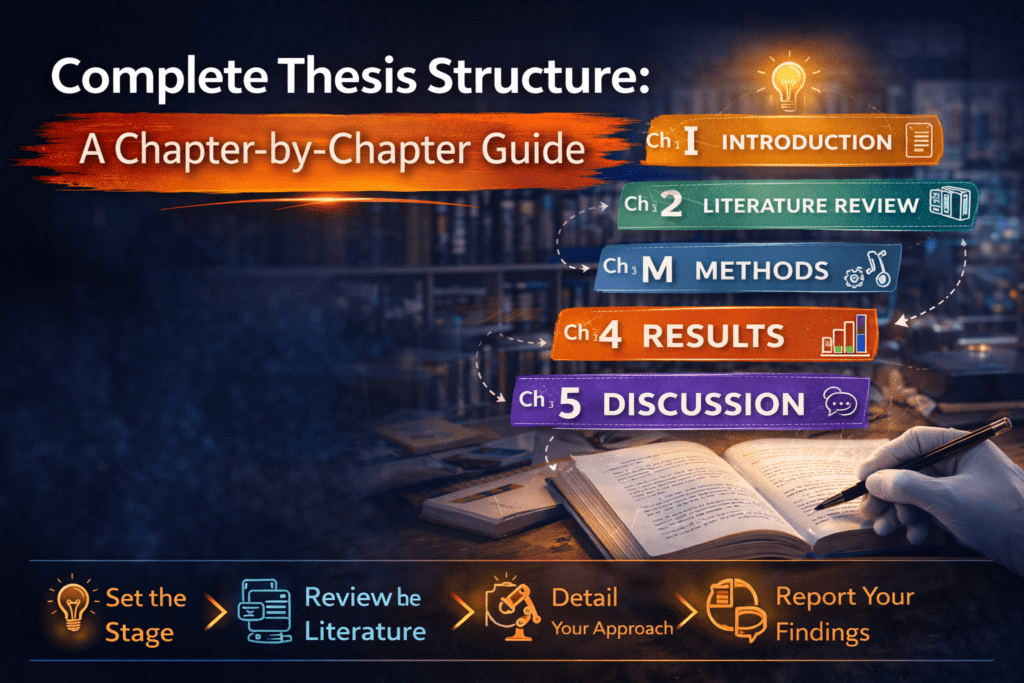
Complete Thesis Structure: A Chapter-by-Chapter Guide
Cluster Post 6 | Module 1: Understanding the Structure of Research Papers and Theses From…

10 Structural Mistakes That Get Research Papers Rejected — And How to Fix Every One
Cluster Post 7 | Module 1: Understanding the Structure of Research Papers and Theses From…
The Academic Writing Process: Complete Guide from First Draft to Submission (2026)
From Concept to Submission: A Complete Guide to Research Paper and Thesis Writing Module 2,…
How to Start Writing — and Keep Going
Cluster Post 1 | Module 2: The Academic Writing Process From Concept to Submission Series …
How to Write Clear Engaging Academic Prose
Cluster Post 2 | Module 2: The Academic Writing Process From Concept to Submission Series …
The Revision Process: How to Turn a Draft Into a Submission
Cluster Post 3 | Module 2: The Academic Writing Process From Concept to Submission Series …