
Last Updated: April 11, 2026
Topic Cluster Strategy
Why Your Content Isn’t Ranking — Even When It Should Be
Here’s a situation that frustrates bloggers more than almost anything else.
You’ve written a genuinely good article. The research is solid. The keyword is placed correctly. The grammar is clean and the structure makes sense. You publish it, wait a few weeks, and check Google.
Page four. Sometimes lower.
And then you look at what’s sitting at position one for your keyword. It’s not dramatically better than your piece. The information overlaps heavily. In some cases, you’ve clearly written the more thorough article.
So what’s the difference?
When I first encountered this problem, I assumed it was a backlink gap or a domain authority gap. Sometimes it is. But very often — particularly for newer and mid-sized blogs — the real issue is something structural: the site behind the ranking article has demonstrated topical authority, and yours hasn’t.
Topical authority means Google has enough evidence that your website is a comprehensive, trustworthy resource on a specific subject — not just the author of a single article about it.
When I finally understood this and built my first proper topic cluster — a group of interconnected articles covering a subject from multiple angles, all linking back to a central pillar page — the results were significant. Several articles that had been stuck between positions 15 and 30 moved to the first page within four months. Not because I’d changed the content, but because I’d connected it.
That connection is what this guide is about.
Topic cluster strategy is the most practical method for building topical authority available to any content marketer or blogger working today. This guide walks you through every step — from choosing your core topic to a free planning template you can copy and use immediately.
What Is a Topic Cluster Strategy? (Simple Explanation)
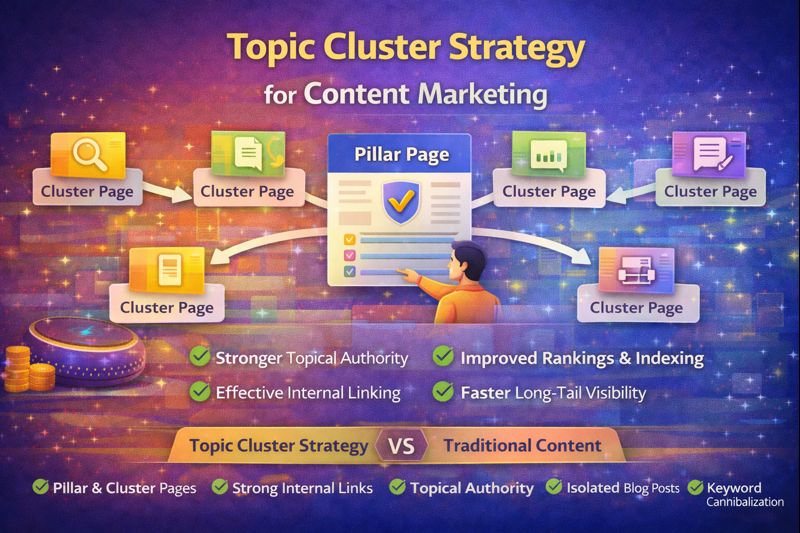
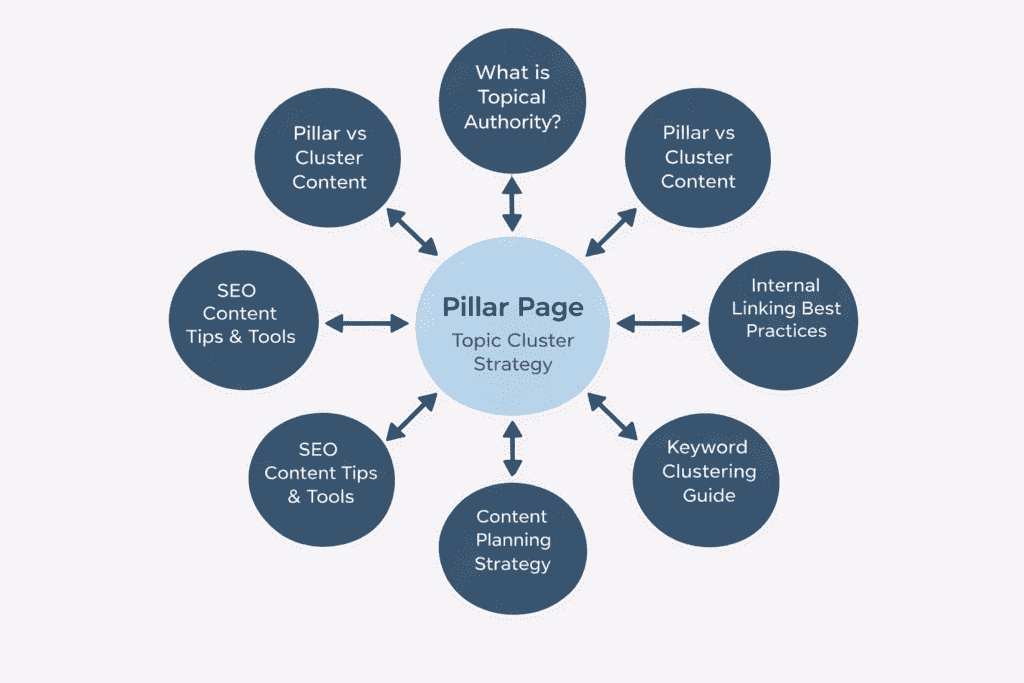
A topic cluster strategy is a content planning method in which one central, comprehensive article (called a pillar page) covers a broad topic, and a set of supporting articles (called cluster pages) cover specific subtopics in greater depth. All cluster pages link back to the pillar, and the pillar links out to all cluster pages — creating a tightly connected web of content on a single subject.
A concrete example:
Imagine your blog covers content writing. Rather than publishing individual, unconnected articles whenever an idea occurs to you, you build a complete Content Writing Hub:
- Pillar Page: “The Complete Guide to Content Writing in 2026” (2,500–3,500 words)
- Cluster Article 1: Content Writing Tips for Beginners
- Cluster Article 2: How to Write an SEO-Optimised Blog Post
- Cluster Article 3: Common Content Writing Mistakes and How to Avoid Them
- Cluster Article 4: Best Tools Every Content Writer Must Use
- Cluster Article 5: Time Management for Writers
- Cluster Article 6: How to Write Engaging Blog Introductions
- Cluster Article 7: Evergreen vs Trending Content Strategy
- Cluster Article 8: How to Create an SEO Content Strategy
Every article in this cluster links back to the pillar. The pillar links out to all of them. Related cluster articles link to each other where naturally relevant.
→ How to Create an SEO Content Strategy for Your Website
What does Google see?
A website that hasn’t published one article about content writing, but an entire library — covering the subject from multiple angles, with every piece connected to the others. That pattern signals expertise, depth, and authority. It tells Google: “This site doesn’t just mention content writing. It comprehensively covers it.”
That signal is topical authority. And that authority lifts every article in the cluster.
The Pillar + Cluster Model — How It Works
Think of the structure like a tree:
PILLAR PAGE (Main Trunk)
“Complete Guide to Content Writing”
Cluster 1: Content Writing Tips for Beginners
Cluster 2: SEO Blog Writing Guide
Cluster 3: Content Writing Mistakes
Cluster 4: Writing Tools
Cluster 5: Time Management for Writers
Cluster 6: Blog Introduction Writing
Cluster 7: Evergreen vs Trending Content Strategy
Cluster 8: How to Create an SEO Content Strategy
What a pillar page is:
- Covers a broad topic comprehensively at an overview level
- Typically 2,500 to 4,000 words
- Targets a broader, moderate-competition keyword
- Links out to all cluster articles within its topic
- Serves as the “home base” for that subject on your site
What cluster content is:
- Covers one specific subtopic in depth
- Typically 1,000 to 2,000 words — focused and detailed
- Targets a long-tail, lower-competition keyword
- Always links back to the pillar page
- Links to other related cluster articles where naturally relevant
The internal linking structure:
- Pillar page links to every cluster article (once each, with descriptive anchor text)
- Every cluster article links back to the pillar page (once, with keyword-relevant anchor text)
- Related cluster articles link to each other where the connection is genuine and natural
This structure creates a connected web that Google’s crawler navigates comprehensively — teaching the algorithm that your entire site, not just individual pages, is an authoritative resource on the topic.
Why Topic Clusters Build Topical Authority
Understanding the mechanism behind this strategy helps you implement it with intention rather than guesswork.
1. Google evaluates topic-level relevance, not just page-level relevance. A single article — even an excellent one — demonstrates that you know about a topic. A cluster of ten interconnected articles demonstrates that you are an authority on it. Google’s systems are increasingly sophisticated at making this distinction.
2. The E-E-A-T framework rewards depth. Google’s quality evaluation guidelines (Experience, Expertise, Authoritativeness, Trustworthiness) specifically reward content that demonstrates genuine depth of knowledge. A topic cluster is one of the clearest structural signals of that depth.
3. Internal linking improves crawlability and indexing. When all articles in a cluster are connected to each other and to the pillar, Google’s crawler can navigate the entire cluster from any single entry point. This improves indexing speed and ensures that all pages in the cluster receive regular crawl attention.
4. Topic clusters eliminate keyword cannibalization. When multiple articles on a site cover similar topics without being clearly related, they compete against each other in search results — effectively splitting the ranking signal. The cluster model gives each article a distinct keyword focus, with the internal linking structure helping Google understand which page is the primary resource for each query.
5. Long-tail cluster keywords deliver quick wins. The pillar page targets a broader, more competitive keyword — which takes time to rank for. Cluster articles target long-tail, lower-competition keywords — which rank faster and begin generating traffic while the pillar builds authority. Both levels reinforce each other over time.
How to Build a Topic Cluster – Step by Step
Step 1 — Choose Your Core Topic
Your core topic becomes the subject of your pillar page. It should be:
- A broad subject that genuinely represents your site’s expertise or focus
- Evergreen — something people will consistently search for, not a passing trend
- Deep enough to support at least 8–10 distinct subtopic articles
- Something your target audience actively needs guidance on
Practical examples by site type:
- Content writing blog → “Content Writing”
- CA firm website → “GST Compliance” or “Income Tax Filing”
- Digital marketing agency → “Social Media Marketing” or “SEO Strategy”
- Health and wellness blog → “Nutrition for Beginners” or “Home Fitness”
The most important rule for new bloggers: Choose one core topic and complete that cluster before moving to another. A partial cluster — three articles with no pillar — builds almost no topical authority. A complete cluster of eight articles with a strong pillar builds substantial authority that benefits every article in the group.
Pro Tip: Use Google Autocomplete on your broad topic to see how many related searches exist. If typing your topic generates fifteen or more distinct autocomplete suggestions, the topic has enough depth to support a full cluster.
Step 2 — Do Keyword Research
Before writing anything, identify the keyword for your pillar page and the individual keywords for each cluster article.
What to look for in cluster keywords:
- Search volume: 100–2,000 searches per month (appropriate for growing sites)
- Keyword difficulty: Under 30 for new sites, under 45 for established ones
- Clear informational intent: The searcher wants to learn, not buy
- Distinct focus: Each cluster article should target a keyword that no other cluster article targets
Free tools for keyword research:
Google Autocomplete and “People Also Ask”: The fastest free method. Type your core topic into Google and collect every autocomplete suggestion and every PAA question. These are real searches that directly map to potential cluster topics.
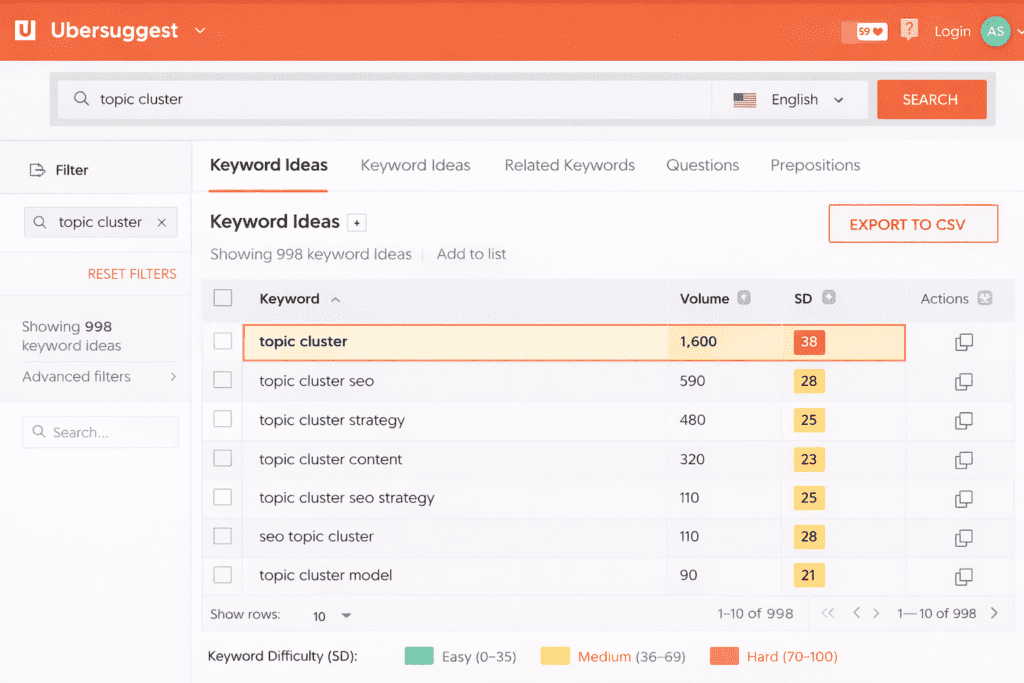
Ubersuggest (Free Plan): Enter your core topic, filter by low difficulty and appropriate volume, and export the keyword ideas list. This becomes your cluster topic shortlist.
AnswerThePublic (Free — 3 searches/day): Generates the complete question landscape around any topic. Use it to identify which questions your cluster should answer.
Pro Tip for Ahrefs users: The Content Gap tool is one of the most efficient ways to find cluster opportunities. Enter your competitor’s domain and see which keywords they rank for that your site doesn’t cover. These missing keywords are directly actionable cluster article topics.
→ 10 Powerful Tools Every Content Writer Must Use in 2026
Step 3 — Find Content Gaps
Content gaps are the subtopics within your core subject that are either missing from your site entirely or covered poorly in existing content.
Free method — SERP analysis: Google your core topic and open the top five ranking articles. For each one, scan the headings and note which subtopics they cover. Build a list of subtopics that appear consistently across multiple top results but aren’t currently covered on your site. These are your cluster gaps.
What you’re looking for:
- Subtopics that multiple competitors cover but you don’t
- Questions in the “People Also Ask” section that your site doesn’t answer
- Angles covered shallowly across the web that you could cover more thoroughly
- Local or audience-specific angles that generic articles don’t address
Why this matters: Your cluster doesn’t just need articles — it needs articles that are genuinely useful additions to what already exists. A cluster article that duplicates what ten other sites have already written thoroughly adds little topical value. A cluster article that fills a genuine gap adds a great deal.
→ Step-by-Step Guide to Writing an SEO-Optimised Blog
Step 4 — Create Your Pillar Page
The pillar page is the cornerstone of the entire cluster. It should be the most comprehensive, best-structured article on your site for its topic.
Pillar page structure:
- Title: “The Complete Guide to [Core Topic] in 2026”
- Introduction: Problem statement, promise, and a brief roadmap of what the guide covers
- Table of Contents: Essential for both readers and Google’s understanding of structure
- H2 sections: One for each major subtopic — covering each at overview depth
- Internal links: Every cluster article linked once within the relevant section
- FAQ section: 5–7 high-search questions answered directly
- Conclusion: Summary and clear next step or call to action
The critical principle: The pillar page provides an overview of each subtopic and directs readers to cluster articles for depth. It does not attempt to cover every subtopic comprehensively — that’s the cluster articles’ job. The pillar is a roadmap. The clusters are the destinations.
A pillar page that tries to cover everything in exhaustive depth leaves no role for cluster articles and ends up being too long to read and too unfocused to rank well.
Pro Tip: Write the pillar page after you have a clear view of all your cluster topics. That way you can naturally reference and link to each cluster article as you write the relevant overview section — rather than retrofitting links into a pillar page written in isolation.
Step 5 — Write Your Cluster Articles
Each cluster article has one job: cover one specific subtopic more thoroughly than any competing page currently does.
For each cluster article:
- Target one long-tail keyword — distinct from every other article in the cluster
- Cover the subtopic completely and honestly — don’t pad to a word count, but don’t leave gaps either
- Include your genuine perspective, experience, or original examples — the thing that makes this article different from a generic treatment of the topic
- Link back to the pillar page at least once, using anchor text that includes the pillar’s target keyword
- Link to 1–2 related cluster articles where the connection is natural and genuinely useful
- Write a FAQ section using questions from the “People Also Ask” section of Google for the target keyword
Publishing order: Publish the pillar page first, even if it initially links to cluster articles that don’t exist yet. Then publish cluster articles sequentially, updating the pillar page as each one goes live. This creates a growing, visibly expanding resource that Google can observe developing over time.
Step 6 — Set Up Your Internal Linking Structure
Internal linking is where the cluster becomes a cluster rather than a collection of individual articles.
The non-negotiable rules:
- Every cluster article must link back to the pillar page — every single one, without exception
- The pillar page must link to every published cluster article — updated as new articles are added
- Anchor text must be descriptive — never “click here” or “read more”
- Anchor text from cluster to pillar should include the pillar’s target keyword or a close variation
The recommended practices:
- Related cluster articles should link to each other where genuinely relevant (not forced)
- When a new cluster article is published, update 2–3 older related articles to link to it
- Review the cluster’s internal link structure every 3 months and update as the cluster grows
Practical organisation: Maintain a simple spreadsheet or Notion database with all cluster articles listed, their target keywords, their published status, and which other articles they currently link to. This takes ten minutes to set up and saves hours of confusion as the cluster grows.
Internal Linking Strategy for Content Marketing: Boost SEO Rankings
Tools for Topic Cluster Strategy
Google Search (Completely Free) The most underrated research tool available. Google Autocomplete, “People Also Ask,” “Related Searches,” and the SERP result types all provide direct, free insight into your topic’s structure and your audience’s questions. Five minutes of SERP analysis before planning each cluster article saves significant misdirected effort.
Ubersuggest (Free Plan) Keyword research, difficulty scores, and related keyword ideas from a single interface. The free plan is sufficient for most individual bloggers planning their first clusters. Use it to build the keyword list for each cluster article and confirm that each article’s target keyword is distinct.
AnswerThePublic (Free — 3 searches/day) Generates the full question landscape around any topic — questions, prepositions, comparisons, and alphabetical variations. Use it to identify which questions your cluster should answer and to generate FAQ section content for both the pillar and cluster articles.
Ahrefs (Paid) The Content Gap tool identifies which keywords your competitors rank for that your site doesn’t cover — directly actionable cluster opportunities. Keywords Explorer provides accurate difficulty scores and search volumes. Site Audit identifies internal linking gaps and orphan pages within existing clusters.
Semrush (Paid — Free Trial Available) The Topic Research tool generates a complete content cluster plan from a single core topic input — showing related subtopics, questions, and competing content. The Keyword Magic Tool filters by intent and difficulty to build a cluster keyword list efficiently.
Notion or Google Sheets (Free) A simple content cluster planning spreadsheet is one of the most practical tools in this entire list. Article title, target keyword, published status, internal links to/from — a ten-minute setup that keeps your entire cluster organised and prevents the planning gaps that undermine topical authority.
Personal recommendation: For most bloggers who are building their first clusters without a large budget, Google Search + Ubersuggest free plan + AnswerThePublic + a Notion planning template is entirely sufficient. Paid tools accelerate the process significantly once you’re managing multiple clusters or client projects — but they are not necessary to get started.
Free Topic Cluster Template (Copy and Use)
Copy this template into your Notion workspace or Google Sheets. Fill it in for every cluster you build.
TOPIC CLUSTER PLANNING TEMPLATE
Core Topic (Pillar Subject): ___________________________ Pillar Page Title: ___________________________ Pillar Target Keyword: ___________________________ Pillar Page Status: [ ] Planned [ ] Drafted [ ] Published
| # | Cluster Article Title | Target Keyword | Monthly Volume | Difficulty | Word Count Target | Links To | Status |
|---|---|---|---|---|---|---|---|
| 1 | 1,200–1,500 | Pillar + Cluster #2 | Planned | ||||
| 2 | 1,000–1,500 | Pillar + Cluster #1 | Planned | ||||
| 3 | 1,200–1,800 | Pillar + Cluster #4 | Planned | ||||
| 4 | 1,000–1,200 | Pillar + Cluster #3 | Planned | ||||
| 5 | 1,500–2,000 | Pillar + Cluster #6 | Planned | ||||
| 6 | 1,000–1,500 | Pillar + Cluster #5 | Planned | ||||
| 7 | 1,200–1,500 | Pillar | Planned | ||||
| 8 | 800–1,200 | Pillar + Cluster #1 | Planned |
FILLED EXAMPLE — Content Writing Cluster
Core Topic: Content Writing Pillar Page: “The Complete Guide to Content Writing in 2026” Pillar Keyword: content writing guide
| # | Cluster Article | Target Keyword | Volume | Difficulty | Status |
|---|---|---|---|---|---|
| 1 | Content Writing Tips for Beginners | content writing tips for beginners | 800–1,200 | Low | Published |
| 2 | Common Content Writing Mistakes | content writing mistakes to avoid | 400–700 | Low | Published |
| 3 | SEO Blog Writing Guide | how to write SEO optimised blog | 500–900 | Low | Published |
| 4 | Best Content Writing Tools | content writing tools 2026 | 300–600 | Low | Published |
| 5 | Time Management for Writers | time management for writers | 300–600 | Low | Published |
| 6 | Writing Engaging Blog Introductions | how to write blog introductions | 400–700 | Low | Published |
| 7 | Evergreen vs Trending Content | evergreen vs trending content strategy | 300–600 | Low | Published |
| 8 | SEO Content Strategy Guide | how to create SEO content strategy | 500–800 | Low | Published |
Topical Authority Building Checklist 2026
Work through this checklist as you build and maintain each cluster:
Planning Phase:
- Core topic defined — specific, evergreen, depth-sufficient
- Pillar keyword researched (broad, moderate competition)
- Minimum 8 cluster topics identified (each with a distinct long-tail keyword)
- Cluster planning template completed in Notion or Google Sheets
- Each cluster keyword verified as distinct — no two articles targeting the same query
Content Creation Phase:
- Pillar page published first (2,500+ words, links to all planned cluster articles noted)
- Minimum 4 cluster articles published
- Every cluster article includes a link back to the pillar page
- Every cluster article includes at least one link to a related cluster article
- Focus keyword appears naturally in the title and introduction of every article
- Meta title and description written for every article
Internal Linking Phase:
- Pillar page updated with links to all live cluster articles
- All anchor text is descriptive — no “click here” or “read more”
- No orphan pages — every article receives at least two internal links
- WordPress users: Rank Math or Yoast SEO internal linking suggestions reviewed
Ongoing Maintenance:
- Google Search Console — all cluster article URLs confirmed as indexed
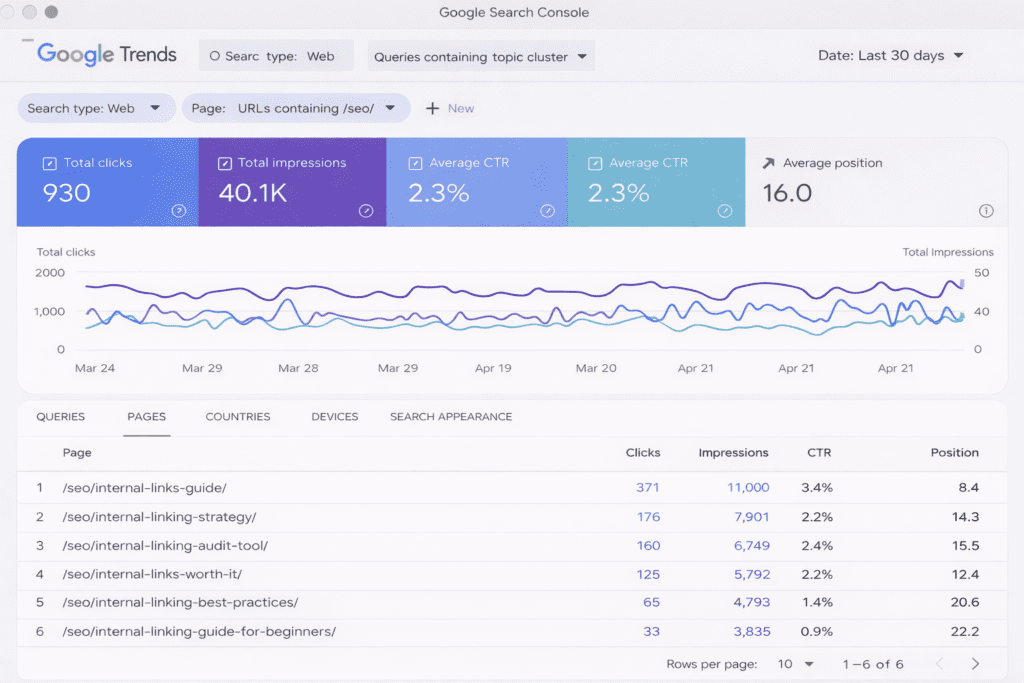
- Monthly review of cluster article impressions and clicks
- Quarterly pillar page update — new cluster links added as articles are published
- Annual content refresh — outdated statistics and examples updated across the cluster
Content Silo Structure -WordPress Setup Guide
A content silo is the technical implementation of a topic cluster within WordPress — using categories and URL structure to reflect the cluster architecture in your site’s navigation.
Setting up a content silo in WordPress:
Step 1 — Create categories that match your content pillars. In WordPress, go to Posts > Categories and create one category for each core topic cluster. Example categories: “Content Writing,” “SEO Strategy,” “Blogging Tips,” “AI Tools.”
Step 2 — Set your URL structure to include the category. Go to Settings > Permalinks > Custom Structure and enter: /%category%/%postname%/ This means every cluster article’s URL automatically includes its category: yoursite.com/content-writing/seo-blog-writing-guide/ yoursite.com/content-writing/common-writing-mistakes/
The URL structure itself signals cluster membership to Google — reinforcing the topical grouping.
Step 3 — Optimise each category page. Each category page is effectively a lightweight pillar — a landing page for the entire cluster. Add an introductory paragraph describing the topic, why it matters, and what the category covers. Use your SEO plugin to write a meta description for each category page.
Step 4 — Use a related posts plugin for cluster-to-cluster links. Plugins like Link Whisper (paid) or the built-in Yoast/Rank Math internal linking suggestions automatically surface relevant articles to link to as you write. This makes cluster-to-cluster linking a natural part of the drafting process rather than a retrofit task.
For sites with existing content published without a silo structure: Don’t rebuild everything at once. Reorganise your categories first, assign existing articles to the appropriate category, then adjust the URL structure — and set up 301 redirects from old URLs to new ones. Google will update its index within a few weeks.
→ Evergreen vs Trending Content Strategy
Common Mistakes in Topic Clustering
Starting too many clusters simultaneously. Beginning three different topic clusters at the same time and publishing two or three articles in each before completing any of them. The result is three partial clusters — none of which builds sufficient topical authority. Complete one cluster to at least 6–8 articles before beginning the next.
Writing the pillar page as an exhaustive deep dive. A pillar page that attempts to cover every subtopic in thorough detail leaves no distinct role for cluster articles. The pillar becomes impossibly long to read and unfocused in its keyword targeting. The pillar’s job is breadth and navigation — depth belongs in the clusters.
Publishing cluster articles without internal linking. Articles published as part of a cluster but not connected to the pillar or to each other are functionally no different from standalone articles. The topical authority benefit of clustering comes entirely from the connected structure — without the links, the cluster doesn’t exist from Google’s perspective.
Targeting the same keyword across multiple cluster articles. Two articles in the same cluster competing for the same keyword undermine each other — this is keyword cannibalization at the cluster level. Verify that every cluster article has a distinct, non-overlapping keyword focus before publishing.
Abandoning a cluster when early rankings are slow. Topic clusters typically take 3–6 months to produce significant ranking improvements. The authority signal builds gradually as more cluster articles are published, indexed, and begin receiving engagement. Many bloggers give up at month two — just before the compound effect would have become visible.
→ Common Content Writing Mistakes and How to Avoid Them
My Personal Experience Building a Content Cluster
When I first started publishing content seriously, I had no cluster strategy. I wrote articles whenever a topic felt interesting — finance, then writing, then AI tools, then a recipe, then SEO. The topics were scattered across five different subjects.
After twelve months, my most popular article had around 200 organic visits per month. Most articles had fewer than 20. Google couldn’t identify what my site was actually about.
I stopped publishing for three weeks and reorganised everything. I identified content writing as my primary topic — the one I had the most material on and the strongest genuine knowledge of. I built a cluster plan: a pillar page and eight cluster articles. I spent the next six weeks writing and connecting them.
The results started appearing at month four. By month six, my organic traffic had tripled — not from new articles, but from existing articles suddenly performing far better because they were now part of a coherent, interconnected topic cluster.
The single most important lesson from that experience: Google doesn’t rank articles in isolation — it ranks sites that demonstrate authority on subjects. Building a cluster is how you demonstrate that authority, regardless of how small or new your site is.
CTA → SEO Blog Writing Services page
Frequently Asked Questions
Q1. How do you build a topic cluster strategy step by step?
Start by choosing one core topic that represents your site’s expertise. Research a pillar keyword for the broad topic and 8–10 long-tail keywords for individual cluster articles. Write your pillar page first — a comprehensive overview that links to all cluster articles.
Then publish cluster articles sequentially, each covering one subtopic in depth and linking back to the pillar. Connect related cluster articles to each other through natural internal links. Review and update the cluster quarterly as it grows.
Q2. Where can I find a free topic cluster planning template?
This article includes a complete, copy-paste-ready template in the section above — compatible with both Google Sheets and Notion.
The template includes columns for article title, target keyword, monthly volume, keyword difficulty, word count target, internal links planned, and publication status. A filled content writing example is also provided to show exactly how to use it.
Q3. How long should a pillar page be, and what should it cover?
A pillar page should be 2,500–4,000 words and cover every major subtopic within the core topic at an overview level — not in exhaustive depth.
Each subtopic section should provide enough information to be genuinely useful on its own, while naturally directing readers to the relevant cluster article for a complete treatment. Include a table of contents, internal links to all cluster articles, and a FAQ section targeting high-search questions about the core topic.
Q4. What are the best free tools for building a topic cluster strategy?
Three free tools cover the core needs: Google Search (People Also Ask + Autocomplete for topic and keyword discovery), Ubersuggest free plan (keyword research with difficulty and volume data), and AnswerThePublic free plan (question-based content gap identification).
For WordPress users, Rank Math’s free plugin provides internal linking suggestions directly within the editor. Ahrefs and Semrush offer more sophisticated cluster analysis but require a paid subscription.
Q5. How long does it take for a topic cluster to improve SEO rankings?
Most sites begin to see meaningful ranking improvements 3–6 months after completing a topic cluster. The first 2–3 months involve indexing and early ranking signals. Month 4–6 typically shows the compound effect — pillar page authority strengthening as cluster articles begin ranking individually, which in turn reinforces the pillar.
The timeline varies based on domain authority, content quality, and how competitive the core topic is.
Q6. Can a new blog benefit from a topic cluster strategy?
Yes — and new blogs often benefit more than established ones, proportionally. A new blog with a scattered content approach has minimal authority signal. A new blog that publishes 8–10 tightly connected, well-researched articles on a single focused topic builds measurable topical authority quickly — much faster than publishing the same number of articles across different unrelated subjects.
Topic clustering is one of the most effective strategies for new sites trying to establish a foothold in competitive niches.
Final Thoughts
There’s a simple way to understand why topic clustering works:
Google doesn’t just want to find content that contains the right words. It wants to find the most authoritative, comprehensive source on a subject — and direct searchers there.
A topic cluster is the clearest possible signal that your site is that source.
When you publish a pillar page and eight tightly connected cluster articles, all linking to each other and to the pillar, you’re not just creating more content. You’re building a structure that tells Google: “This site doesn’t just mention this subject in passing. This site has covered it thoroughly, from multiple angles, with genuine depth. This site is a reliable resource.”
That signal — established through structure, not just through quality — is what produces the compound ranking improvements that most bloggers spend years chasing through individual article optimisation.
Start with one topic. Build the pillar. Publish the cluster. Connect the links. Give it the time it needs.
The results will follow.
References:
- HubSpot — The Topic Cluster Model: https://blog.hubspot.com/marketing/topic-clusters-seo
- Ahrefs — Topical Authority and Content Clusters: https://ahrefs.com/blog/topical-authority/
- Google Search Central — Creating Helpful Content: https://developers.google.com/search/docs/fundamentals/creating-helpful-content
- Semrush — Topic Research Tool: https://www.semrush.com/topic-research/
- Screaming Frog SEO Spider: https://www.screamingfrog.co.uk/seo-spider/
About the Author
Dr. Rekha Khandelwal is a content strategist, academic writer, and SEO-focused content consultant specializing in content structure, topical authority, and ethical digital growth. Through AspirixWriters, she helps creators and businesses build Google-friendly, AdSense-safe content systems that rank and scale.
Author Profile Dr. Rekha Khandelwal | Academic Writer, Legal Technical Writer, AI Expert & Author | AspirixWriters
Must Read – Content Marketing Strategy That Ranks on Google (Complete Guide)
Writing Services
- Academic Writing
- Editing & Proofreading
- SME Writing Services
- SEO Blogwriting Services
- Creative & Ghostwriting

Low-Competition Keyword Research for Content Marketing (Step-by-Step)
low-competition keyword research for content marketing – One of the biggest mistakes content creators make…