
Last Updated: April 9, 2026
The Day Google Stopped Sending Me Traffic the Old Way
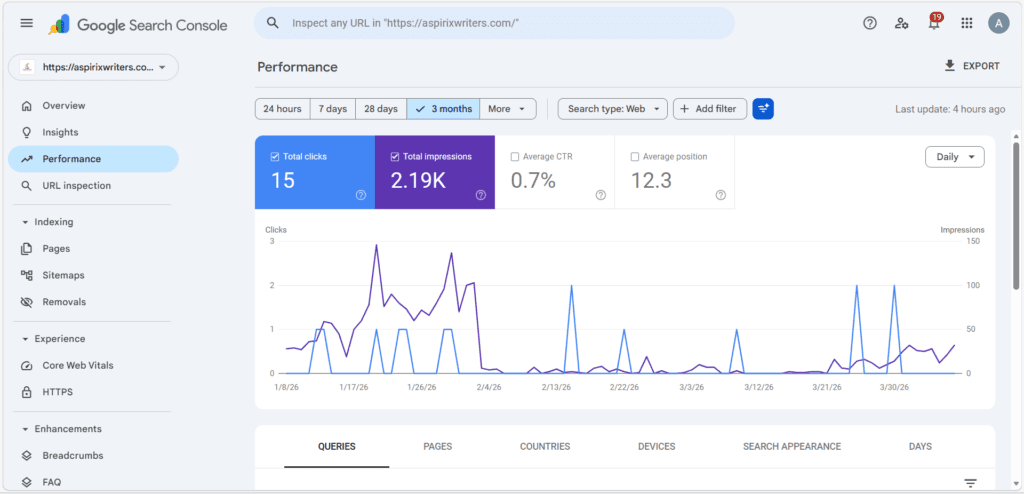
There was a point in early 2024 when I noticed something unsettling in my Google Search Console data.
Impressions were steady. But clicks were falling.
My articles were still ranking. People were still seeing them in search results. They just weren’t clicking through as often — because Google was answering their questions directly on the results page, before they ever reached my blog.
AI-generated summaries at the top of search results. “People Also Ask” boxes expanding. Featured snippets pulling exact answers from my content. Readers were getting what they came for without visiting the source.
If you’re a content marketer, blogger, or SEO strategist — and you haven’t felt this shift yet — you will. Because the way Google surfaces and presents content has fundamentally changed, and the old playbook of “write good content with the right keywords” is no longer the complete picture.
That’s where Generative SEO comes in. And understanding it — genuinely, practically — is now one of the most important things a content marketer can do in 2026.
This guide explains what it is, why it matters, and exactly how to use it to grow your traffic and authority in the AI search era.
What Is Generative SEO? (simple Explanation)
Let’s cut through the jargon.
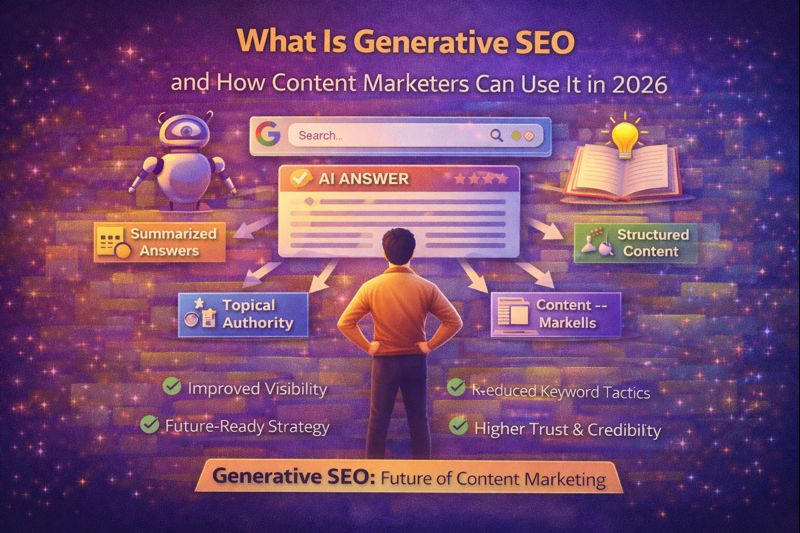
Generative SEO is the practice of creating and optimising content so that it gets surfaced, cited, and referenced by AI-powered search systems — including Google’s AI Overviews (formerly SGE), ChatGPT search, Perplexity, Bing Copilot, and similar tools.
Traditional SEO was about ranking your page in the top 10 blue links. Generative SEO is about making sure your content is the source that AI systems pull answers from when they respond to a query.
Think of it this way:
- Traditional SEO: Your article ranks #1. Reader clicks your link. Visits your site.
- Generative SEO: AI reads your article. Summarises it. Cites your site as the source. Reader might click — or might already have their answer.
Both outcomes are valuable. But the second requires a different content strategy to achieve.
In 2026, the most successful content marketers are building for both: content that ranks in traditional search and content that gets picked up, cited, and referenced by AI-generated responses. That intersection is where generative SEO lives.
How AI Search Has Changed the Game for Content Marketers
Here’s what’s actually different now — and why it matters for everything you publish.
AI Overviews appear above organic results. On many informational queries, Google now generates an AI-written summary at the very top of the results page. Below it are the traditional blue links. Content marketers need their material to be the source those summaries draw from.
Search queries are getting longer and more conversational. Instead of typing “SEO tips,” people now ask “what’s the best SEO strategy for a new blog in 2026 with no backlinks?” AI search is built for natural language. Content that matches conversational, long-tail queries gets surfaced more often.
Authority and trust signals matter more than ever. AI systems are trained to cite credible, authoritative sources. Generic, surface-level content gets ignored. Content with clear expertise, original insight, and factual depth gets cited.
Zero-click searches are rising. More queries are being answered without the user clicking through to a website. For content marketers, this means visibility metrics like impressions and citations now matter alongside clicks and traffic.
Content freshness is being weighted more heavily. AI systems prefer current, updated content. An article published in 2022 and never touched since is increasingly at a disadvantage against a 2025 piece covering the same topic.
Understanding these shifts is the foundation of a generative SEO strategy that actually works.
Core Principles of Generative SEO in 2026
Before the tactical steps, here are the principles that underpin everything:
Helpfulness over optimisation. Google’s Helpful Content guidelines are more influential than ever. AI systems are trained on these same quality signals. Content that genuinely helps a specific reader will always outperform content engineered to rank.
Depth over breadth. One comprehensive, authoritative article on a specific topic outperforms ten shallow articles on related topics. AI systems are looking for the most complete, trustworthy answer — not the most articles.
Structure that AI can parse. Clear headings, direct answers to questions, short paragraphs, and logical flow make content easier for AI to extract and summarise correctly. Poorly structured content often gets ignored entirely.
Original perspective and experience. AI systems are increasingly good at identifying content that adds nothing new to the conversation. First-person experience, original data, and genuine perspective differentiate your content from the thousands of similar articles on any topic.
Consistent topical authority. Publishing ten related, interlinked articles on a topic builds domain authority that signals expertise to AI systems — far more effectively than publishing one article per topic across dozens of unrelated themes.
How Content Marketers Can Use Generative SEO (Step by Step)
Step 1 — Optimise for AI Overviews and Featured Snippets
What it is: Structuring specific sections of your content to directly answer the questions that trigger AI Overviews and featured snippet boxes in Google.
Why it matters: When Google’s AI Overview cites your content, it drives brand visibility even on zero-click searches. Your site name appears as a source — which builds authority and drives some users to click through for the full context.
How to do it:
- Identify the exact question your target keyword implies
- Answer that question directly and completely within the first 2–3 sentences of the relevant section
- Use the question itself as an H2 or H3 heading
- Follow the direct answer with a deeper explanation — AI pulls the summary, engaged readers read the depth
Real example: For the keyword “what is generative SEO,” your article should have a section with the H2 heading “What Is Generative SEO?” followed immediately by a 2–3 sentence simple-English definition. That’s exactly what AI systems extract.
Common mistake: Burying the answer to the main question in the middle of a long paragraph, after two sentences of context-setting. AI skips this structure. Readers leave. Nobody wins.
After publishing, Google your target keyword and look at what appears in the AI Overview or featured snippet. If it’s not your content — note the exact phrasing of the answer that was pulled, and rewrite your version to be more direct and complete.
Step 2 — Write for Conversational, Long-Tail Queries
What it is: Targeting multi-word, question-based search phrases that reflect how people actually speak to AI search tools — rather than brief, keyword-style phrases.
Why it matters: AI search is conversational by nature. “How to rank in AI search results 2026” is the kind of query people type into Perplexity or ChatGPT — and content that matches that natural phrasing gets surfaced far more often than content targeting just “AI SEO.”
How to do it:
- Use AnswerThePublic and Google’s “People Also Ask” to find the exact question formats your audience uses
- Build H2 and H3 headings around complete questions: “How Do Content Marketers Benefit from Generative SEO?” not just “Benefits”
- Write in conversational, natural language throughout — the way the searcher speaks is the way your content should read
Real example: Instead of optimising only for “generative SEO,” this article also targets “how to optimise blog content for AI overviews,” “content marketing strategy for AI search,” and “what is generative SEO in 2026” — all of which reflect real conversational queries.
Read your article aloud. If it sounds like a research paper, rewrite it until it sounds like an expert answering a question in conversation. That tone is what AI search systems reward in 2026.
Step 3 — Build Topical Authority, Not Just Individual Articles
What it is: Publishing a cluster of interlinked, in-depth articles around a central topic — so that Google and AI systems recognise your site as a reliable, comprehensive resource on that subject.
Why it matters: A site with one article on generative SEO will rarely be cited as authoritatively as a site with eight interconnected articles covering generative SEO, AI search strategy, AI content tools, E-E-A-T optimisation, and zero-click search trends.
How to do it:
- Identify your 3–5 core content pillars
- For each pillar, plan a cluster of 6–10 related articles
- Link every article in a cluster to the others — especially back to a central “pillar” page
- Update older articles in the cluster when you publish new ones
Common mistake: Publishing one thorough article on a topic and considering it done. A single article — no matter how good — rarely builds the topical authority that a connected content cluster does.
How to Create an SEO Content Strategy for Your Website
Step 4 — Structure Content for AI Readability
What it is: Formatting your articles in a way that makes it easy for AI systems to extract, summarise, and cite your content accurately.
Why it matters: AI systems parse structure before they parse content. An article with clear H2/H3 headings, short paragraphs, direct answers, and logical flow gets understood and cited correctly. An article that’s a wall of dense text — no matter how insightful — often gets ignored entirely.
Structural elements that AI prioritises:
- H2/H3 headings phrased as questions or clear topic statements — these act as navigation for AI extraction
- Direct answer in the first sentence of each section — AI pulls the first clear statement; context comes after
- Bullet points and numbered lists — easily extracted for summarisation
- Short paragraphs (2–3 lines) — reduce parsing friction for both AI and human readers
- Definition boxes or callout sections — clearly signals “this is the authoritative answer to X”
Action step: Go back to your three best-performing articles. Check whether each H2 heading answers a complete question. Check whether the first sentence of each section gives a direct answer. These two fixes alone can improve AI citation likelihood significant.
→ Step-by-Step Guide to Writing an SEO-Optimised Blog
Step 5 — Focus Deeply on E-E-A-T Signals
What it is: Building the four signals Google uses to evaluate content quality — Experience, Expertise, Authoritativeness, and Trustworthiness — into every article you publish.
Why it matters: AI search systems are trained on Google’s quality guidelines. Content with strong E-E-A-T signals is far more likely to be cited by AI Overviews than content that reads as generic or anonymous.
How to strengthen each signal:
Experience: Add first-person insights, personal examples, and real outcomes from applying what you’re writing about. “In my experience…” signals real-world application, not just theoretical knowledge.
Expertise: Demonstrate depth — go beyond the surface, explain the why behind your recommendations, and cite credible external sources where relevant.
Authoritativeness: Publish consistently on your core topics. Link to and from authoritative sources. Build an author bio that establishes credentials clearly.
Trustworthiness: Be honest about limitations and nuances. Don’t overpromise. Cite your sources. Keep information current and updated.
Common mistake: Publishing entirely anonymous content with no author attribution, no personal experience, and no original perspective. In the AI search era, this content has almost no chance of being cited or trusted.
Add a visible author bio to every article — even a short one. “Written by [Name], content strategist with 5 years of experience in SEO blogging” is more than most sites include, and it matters to both Google and AI citation systems.
Common Content Writing Mistakes and How to Avoid Them
Step 6 — Use Generative AI as a Research and Ideation Tool (Not a Ghostwriter)
What it is: Using AI tools like ChatGPT, Claude, or Gemini to accelerate your research, ideation, and outline creation — while keeping the actual writing, insight, and perspective genuinely human.
Why it matters: The irony of generative SEO is this: the content most likely to rank in AI search is the content with real human insight, experience, and original thinking. Content written entirely by AI — without a human layer of genuine perspective — is increasingly easy for Google to identify as low-value.
How to use AI productively without undermining your content:
- Use AI to brainstorm article angles, generate outline options, and identify questions to answer
- Use AI to research background facts and existing coverage — then write your own synthesis
- Use AI for first-draft structure — then rewrite every section in your own voice with your own examples
- Never publish AI-generated content without substantial human editing, personalisation, and added insight
Real example: For this article, AI tools were useful for identifying what questions content marketers are asking about generative SEO. The explanations, examples, personal reflections, and strategic recommendations are human-authored — which is exactly what makes this content citable.
The test for AI-assisted content is simple: does this article contain anything a reader couldn’t find by asking ChatGPT themselves? If not, rewrite it until it does. Original insight is the only truly defensible moat in the AI search era.
What Generative SEO Does NOT Mean
Let’s be direct about a few misconceptions circulating in marketing circles:
It does not mean “optimise your content for ChatGPT rankings.” There are no official “ChatGPT rankings.” Generative SEO is about being cited by AI systems broadly — which primarily means being a high-quality, authoritative source that Google’s AI Overview trusts.
It does not mean producing more AI-generated content faster. This is the exact opposite of what works. AI search rewards genuine expertise and original perspective. More low-quality content, AI-generated or otherwise, will not improve your visibility.
It does not mean abandoning traditional SEO. Generative SEO is an evolution of traditional SEO, not a replacement. Keywords, backlinks, page speed, and on-page optimisation still matter. Generative SEO adds a new layer — it doesn’t replace the foundation.
It does not mean every article needs to be 5,000 words. Length follows topic, not strategy. A 600-word article that directly and completely answers a specific question will outperform a 3,000-word article that pads its way to a word count target.
Generative SEO vs Traditional SEO: Key Differences
| Factor | Traditional SEO | Generative SEO |
|---|---|---|
| Primary goal | Rank in top 10 blue links | Be cited by AI search responses |
| Query type | Short, keyword-focused | Conversational, question-based |
| Success metric | Clicks and rankings | Citations, impressions, authority |
| Content style | Keyword-optimised | Intent-matched, experience-driven |
| Authority signal | Backlinks | E-E-A-T + topical depth |
| Structure priority | Headings + meta tags | Direct answers + AI-parseable format |
| Content freshness | Helpful but not critical | Increasingly important |
| Zero-click impact | Minimal | High — brand visibility without click |
The key insight: These are not competing strategies. The best-performing content in 2026 is optimised for both simultaneously — traditional on-page SEO foundations with a generative layer of depth, structure, and E-E-A-T signals on top.
Tools That Help Content Marketers with Generative SEO
Google Search Console — track AI Overview visibility Monitor your pages’ impressions vs click-through rates. A high impression / low CTR gap often signals your content is appearing in AI Overviews without driving clicks — which is still valuable for brand visibility, and worth optimising for citation accuracy.
AnswerThePublic — find conversational queries The exact question formats your audience uses when searching conversationally. These become your H2/H3 headings and FAQ sections — the structure AI systems parse most readily.
Surfer SEO or NeuronWriter — content depth analysis These tools analyse what top-ranking pages cover for a given keyword and identify gaps in your content. In the generative SEO context, they help ensure your article has sufficient topical depth to be considered authoritative.
Grammarly + Hemingway Editor — readability and clarity AI systems prefer clearly written, readable content. Grammarly ensures correctness; Hemingway ensures your sentences are direct and accessible. Both contribute to the clean structure that AI citation systems favour.
Notion — content cluster planning Map your content pillars and article clusters in Notion before publishing. Seeing the full topical architecture helps you identify gaps, plan internal links strategically, and build the interconnected depth that signals topical authority.
Common Mistakes Content Marketers Make in the AI Search Era
Publishing for volume instead of depth. Ten thin articles covering a topic shallowly will never build the topical authority that three deeply researched, interconnected articles will. The AI search era rewards depth over quantity — significantly.
Ignoring content freshness. An article about “SEO trends in 2024” is increasingly likely to be bypassed by AI systems in favour of a 2026 equivalent. Audit your high-potential content annually and update it with current data, examples, and references.
No clear author or expertise signal. Anonymous content has no E-E-A-T. If your articles have no visible author, no credentials, and no first-person perspective, they’re fighting with one hand behind their back in AI search.
Answering questions vaguely instead of directly. AI systems extract direct answers. If your article spends two paragraphs contextualising before giving the actual answer, the AI moves to the next source. Lead with the answer. Follow with the context.
Treating AI tools as content creators instead of assistants. Fully AI-generated content, published without substantial human editing and original insight, is becoming increasingly identifiable — and increasingly filtered out by quality-focused AI search systems. Use AI to accelerate your process, not to replace your thinking.
My Personal Shift: How I Adapted My Content Strategy in 2026
When I first noticed my click-through rates declining despite stable rankings, my first instinct was to publish more content.
That made things worse.
More thin content meant less topical authority per article, more diluted internal link equity, and more pages competing with each other for the same queries. My Search Console looked busier. My results got weaker.
What actually worked:
I stopped publishing for publishing’s sake. Instead of two articles a week, I moved to one thoroughly researched, deeply structured article per week — with a clear E-E-A-T layer built in from the outline stage.
I rebuilt my content into clusters. I audited everything I’d published and organised articles into 4 core topic pillars. Then I identified gaps in each cluster and published to fill them — always linking back to the pillar page.
I started answering questions directly. Every section of every new article now opens with a direct, 2–3 sentence answer before expanding into depth. This single structural change improved my AI Overview citation rate noticeably within three months.
I added genuine personal experience to every article. Not forced anecdotes — real reflections on applying the advice I was giving. That layer of authenticity is something AI-generated content structurally cannot replicate.
The result wasn’t an overnight spike. It was a steady, sustainable improvement in organic visibility, citations in AI Overviews, and brand authority within my niche.
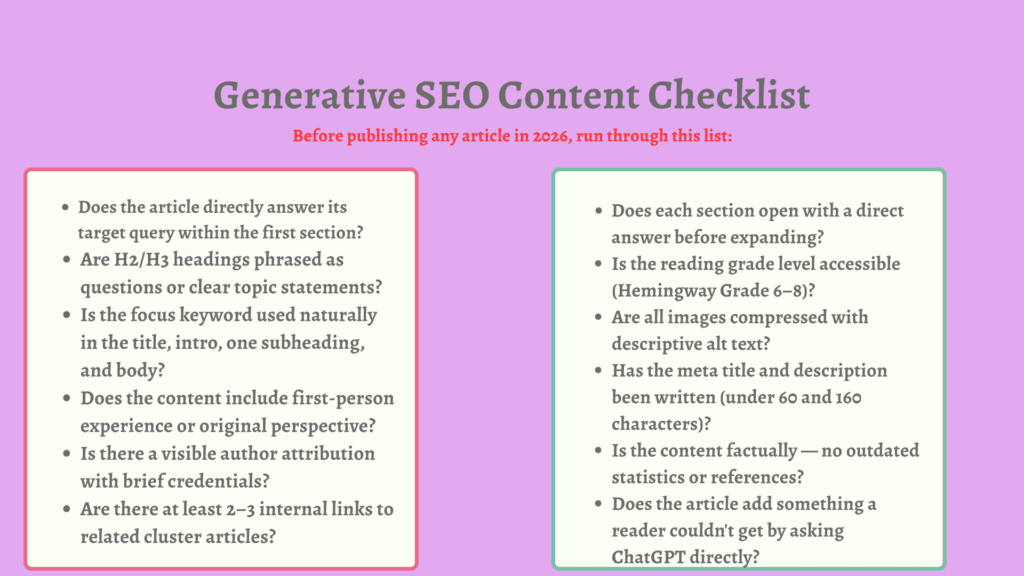
Generative SEO Content Checklist
Before publishing any article in 2026, run through this list:
- Does the article directly answer its target query within the first section?
- Are H2/H3 headings phrased as questions or clear topic statements?
- Is the focus keyword used naturally in the title, intro, one subheading, and body?
- Does the content include first-person experience or original perspective?
- Is there a visible author attribution with brief credentials?
- Are there at least 2–3 internal links to related cluster articles?
- Does each section open with a direct answer before expanding?
- Is the reading grade level accessible (Hemingway Grade 6–8)?
- Are all images compressed with descriptive alt text?
- Has the meta title and description been written (under 60 and 160 characters)?
- Is the content factually current — no outdated statistics or references?
- Does the article add something a reader couldn’t get by asking ChatGPT directly?
❓ Frequently Asked Questions
Q1. What is generative SEO in simple terms?
Generative SEO is the practice of creating content that AI-powered search tools — like Google’s AI Overviews, ChatGPT search, and Perplexity — can find, understand, and cite in their responses. Instead of just ranking in traditional blue-link search results, generative SEO focuses on becoming the authoritative source that AI systems quote when answering a user’s question.
Q2. How is generative SEO different from traditional SEO?
Q2. How is generative SEO different from traditional SEO? Traditional SEO focuses on ranking your page in the top 10 organic results for a keyword. Generative SEO focuses on being cited by AI-generated responses — which requires deeper topical authority, stronger E-E-A-T signals, more conversational content structure, and direct answers to specific questions. Both matter in 2026, and the best strategies combine both.
Q3. Do I need to completely change my content strategy for generative SEO?
No — you need to evolve it. If you’re already writing genuinely helpful, well-structured content with proper SEO fundamentals, you’re closer than you think. The key additions are: structuring sections to answer questions directly, building content clusters for topical authority, strengthening E-E-A-T signals, and targeting conversational long-tail queries.
Q4. How do I know if my content is being cited in AI Overviews?
Check your Google Search Console performance report. Filter by “Search Appearance” and look for AI Overview data. You can also manually Google your target keywords and check whether an AI Overview appears — and whether your site is listed as a source. This is the fastest way to see where you currently stand.
Q5. Can small blogs or new websites compete in generative SEO?
Yes — potentially more effectively than in traditional SEO. Generative SEO rewards depth and authority on a specific topic, not just domain age or backlink volume. A small blog with 15 deeply researched, well-structured articles on one niche topic can outperform a large site with 200 thin, scattered articles. Focused topical depth is the competitive advantage available to every content creator.
Q6. Is AI-generated content bad for generative SEO?
Not inherently — but low-quality, unedited AI content is. Google’s systems are increasingly effective at identifying content that adds no original value. Content written entirely by AI without meaningful human editing, original perspective, or genuine experience is unlikely to be cited by AI search systems. The irony of generative SEO is that the content AI systems trust most is content with clear human expertise and original insight.
Q7. How long does it take to see results from a generative SEO strategy?
Faster than traditional SEO in some respects — AI systems update their citations more dynamically than Google’s core algorithm. Structural improvements (direct answers, clear headings, E-E-A-T additions) can improve AI Overview citation rates within weeks. Building full topical authority through content clusters typically takes 3–6 months of consistent publishing, similar to traditional SEO timelines.
Final Thoughts
Generative SEO isn’t a threat to content marketers who are willing to adapt. It’s an opportunity — specifically for those who create content with genuine depth, real experience, and a clear human perspective.
The content that gets cited by AI systems in 2026 is exactly the content that deserves to be cited: helpful, specific, well-structured, authoritative, and honest. There’s nothing manipulative or algorithmic about that standard. It’s just good content, built the right way.
The writers and marketers who will struggle are those still producing thin, keyword-stuffed, generic articles at scale and hoping volume compensates for quality. It won’t — not anymore.
The writers and marketers who will thrive are those who build real topical authority, write from genuine experience, structure their content for both human readers and AI systems, and consistently ask: “Does this article add something the reader couldn’t get anywhere else?”
Start with one pillar. Build your cluster. Add your E-E-A-T layer. Optimise your structure for direct answers. Publish consistently.
That’s generative SEO — and it’s entirely within reach.
References:
- Google Search Central — Creating Helpful Content: https://developers.google.com/search/docs/fundamentals/creating-helpful-content
- Google Search Central — E-E-A-T and Quality Rater Guidelines: https://developers.google.com/search/docs/fundamentals/creating-helpful-content#expertise
- Google AI Overviews Help: https://support.google.com/websearch/answer/14901683
- AnswerThePublic: https://answerthepublic.com
- NeuronWriter: https://neuronwriter.com
Author Bio
Dr. Rekha Khandelwal is a content strategist, academic writer, and SEO-focused consultant specializing in content marketing, search intent optimization, and ethical digital growth. Through AspirixWriters, she helps creators and businesses build Google-friendly, AdSense-safe content strategies that remain relevant as search evolves.
Author Profile Dr. Rekha Khandelwal | Academic Writer, Legal Technical Writer, AI Expert & Author | AspirixWriters
- Academic Writing
- AI Ethics & Future
- AI in Academic Research
- AI in Business & Marketing
- AI in Content Creation
- AI in Design & Development
- AI in Education/Teaching
- AI Tools & Review
- Finance
- Indian Laws
- SEO & Digital Marketing
- Writing & Content Creation
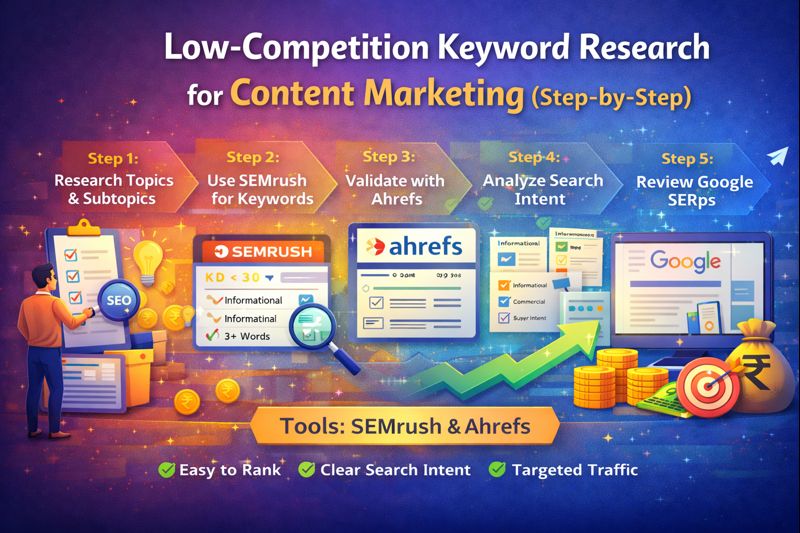
Low-Competition Keyword Research for Content Marketing (Step-by-Step)
low-competition keyword research for content marketing – One of the biggest mistakes content creators make…