Last Updated: April 19, 2026
Complete Thesis Structure
Module 1: Understanding the Structure of Research Papers and Theses
From Concept to Submission Series | 2026
Academic Writing Mastery: The Complete 2026 Guide To Research Papers, Thesis & Dissertation Writing
← Back to Main Post: The Complete Guide to Research Paper Structure
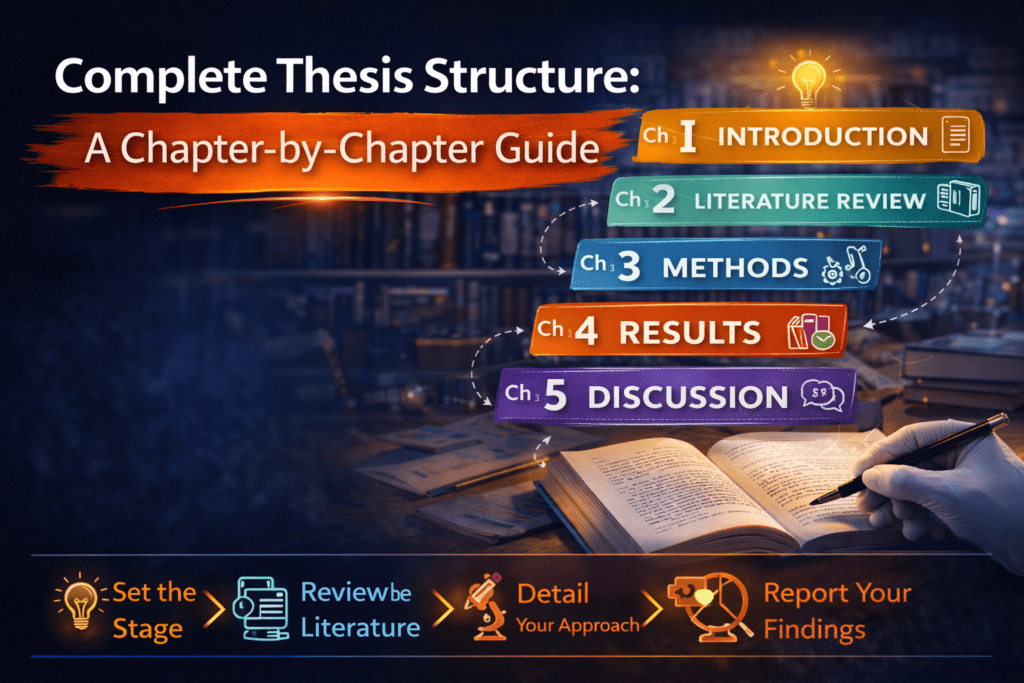
Complete Thesis Structure: A Chapter-by-Chapter Guide
Your main post listed the components of a thesis. This post goes deeper: what examiners are actually looking for in each chapter, how to write the abstract using a proven formula, what chapterization means and why it matters, the right proportions for each chapter, and India-specific UGC requirements that most students discover too late.
A Thesis Is Not a Long Journal Article
This distinction matters more than it sounds. A journal article is written for expert readers who already know the field. It can assume shared vocabulary, skip foundational context, and compress methodology into a few hundred words. A thesis cannot do any of these things.
A thesis must demonstrate that you are capable of independent scholarship — from identifying a problem worth studying, through designing and executing a rigorous investigation, to situating your findings within the field’s existing knowledge. Examiners are not just evaluating your findings. They are evaluating your capacity as a researcher. Every chapter serves this purpose, and understanding that purpose changes how you approach each one.
The other key difference is audience. A thesis examiner may be a specialist in an adjacent rather than identical area. You cannot assume they know every paper you cite or every methodological convention you follow. The thesis requires you to make your thinking visible in a way that a journal article — written for insiders — does not.
Front Matter: The Professional Face of Your Work
Front matter is often treated as administrative formality. It is not. Each element serves a specific purpose, and getting them wrong creates a poor first impression before an examiner has read a word of your actual research.
Title page
Your title is the first signal of your scholarly identity. It needs to be specific enough that a reader knows exactly what you studied, but concise enough to be usable as a reference. A good thesis title names the phenomenon studied, the population or context, and often the methodological approach.
Too vague: “A Study of Privacy and Technology in India” Specific: “Constitutional Protection of Privacy Rights in AI-Powered Surveillance: An Analysis of Article 21 Jurisprudence, 2017–2025” Specific: “Peer Mentoring and First-Year Retention in Indian Government Colleges: A Quasi-Experimental Study in Rajasthan”
The title page must include your full name, thesis title, degree sought, department, institution, supervisor name, and submission date. In Indian universities, the supervisor’s name and department affiliation are required elements — not optional acknowledgements.
Abstract — write this last, revise it most
The abstract is the most-read part of your thesis. It is indexed in databases, read by potential collaborators, and often the only part external readers ever see. Despite this, most researchers write it quickly at the end and revise it least. This is exactly backwards.
A strong abstract follows a six-sentence formula. Each sentence has a specific job:
- Background (1–2 sentences): The broad problem and why it matters.
- Gap (1 sentence): What remains unknown that your study addresses.
- Purpose (1 sentence): What your study investigated, stated plainly.
- Methods (2–3 sentences): Design, sample, key instruments — enough to evaluate rigour.
- Results (2–3 sentences): Main findings, with key statistics for quantitative work.
- Conclusions (1–2 sentences): What the findings mean and why they matter.
“Student retention in Indian government colleges remains a persistent equity challenge, with first-year dropout rates averaging 35% — nearly double those at private institutions. While financial factors are extensively studied, the role of peer support mechanisms in retention decisions remains largely unexamined. This thesis examined how peer mentoring influences first-year retention at three government colleges in Rajasthan. Using a quasi-experimental design, surveys (n = 450) and semi-structured interviews (n = 30) were administered across one academic year. Intervention colleges showed significantly higher retention (82% vs. 71%, p = .003), with mentoring frequency and quality as the strongest predictors. These findings extend social integration theory to resource-constrained Indian contexts and suggest that structured peer mentoring represents a low-cost, scalable retention strategy for government colleges.”
Target length: 250–350 words. Write it after every other chapter is complete. Revise it at least three times.
The Main Chapters: What Examiners Look For
Chapter 1: Introduction
The thesis introduction is longer and more elaborate than a journal article introduction. It typically runs 15–25 pages and covers more ground — not just context and research question, but a preview of your methodology, a statement of scope and limitations, and a chapterization section that maps the entire thesis.
Chapterization is a paragraph or short section at the end of the introduction that tells readers what each chapter contains and how the chapters connect. Examiners use it as a map. A good chapterization does more than list chapters — it explains the logic connecting them.
“Chapter 2 reviews literature on peer support, social integration theory, and retention in Indian higher education, building the theoretical foundation for the intervention tested here. Chapter 3 describes the quasi-experimental design and data collection procedures. Chapters 4 and 5 present quantitative and qualitative findings respectively. Chapter 6 synthesises these findings, interprets them against existing theory, and proposes a practical mentoring model. Chapter 7 draws conclusions and offers recommendations for institutions, policymakers, and future researchers.”
Notice: each chapter is described not just by its contents but by its function in the overall argument. Chapter 2 is not just a literature review — it is the foundation for the intervention. Chapter 6 is not just a discussion — it proposes a practical model.
Chapter 2: Literature Review
The literature review is an argument, not a summary. By the end of it, readers should understand what the field knows, where it is genuinely incomplete, and why your research question is the necessary next step. This argument structure — known as Creswell’s funnel model — moves from broad context to specific gap to your research questions.
The most common literature review failure is organising by author rather than by theme. Listing what each researcher found, in sequence, produces a catalogue rather than a synthesis. Organise your review thematically: group studies by what they investigated, what they found collectively, and where they leave questions unanswered.
A literature review ends where your Introduction ends — with the gap clearly identified and your research questions stated as the logical response to that gap. If the final pages of your literature review do not flow naturally into your methodology chapter, the review has not done its structural job.
Chapter 3: Methodology
In a thesis, the methodology chapter is substantially more detailed than a journal article methods section. You have space — and are expected — to justify your philosophical stance, explain your methodology choice, and describe procedures in full.
The element most students miss is the paradigm discussion. Are you working from a positivist, interpretivist, critical realist, or pragmatist position? What does this mean for how you understand knowledge, evidence, and validity? Two to three paragraphs on this signals to examiners that you understand the foundations of your own research design, not just its surface procedures. Supervisors often forget to ask for this explicitly; examiners do not forget to look for it.
Results and Discussion chapters
In a thesis, you may have one results chapter and one discussion chapter, or you may split results across two chapters if your data volume warrants it. The same rules from Posts 4 and 5 apply — results present, discussion interprets. What changes at thesis scale is depth: a thesis discussion is typically 30–50 pages, not 1,000 words, and you have space to develop each interpretive thread properly rather than summarising it.
Conclusions chapter
The conclusions chapter is not a summary of your discussion. It is your final opportunity to state clearly what your research has contributed. It should be readable as a standalone document — someone who reads only your conclusions should understand what you studied, what you found, and why it matters.
The most important element of a conclusions chapter that most researchers underwrite is the original contribution statement — a clear, explicit account of what was not known before your study that is now known because of it. This is not modesty and it is not boasting. It is precision. Examiners need to be able to point to something specific and say: this is the contribution this thesis makes to the field.
Proportions: How Long Should Each Chapter Be
Disproportionate chapters are one of the most common structural problems in Indian PhD theses. A literature review that is three times longer than the methodology signals that the researcher spent more time reading than designing. A two-page conclusions chapter after 200 pages of analysis signals exhaustion at exactly the wrong moment.
| Chapter | Approximate proportion of an 80,000-word thesis |
| Introduction | 8,000–12,000 words (10–15%) |
| Literature Review | 15,000–20,000 words (18–25%) |
| Methodology | 10,000–15,000 words (12–18%) |
| Results / Findings | 15,000–25,000 words (18–30%) |
| Discussion | 10,000–15,000 words (12–18%) |
| Conclusions | 6,000–10,000 words (7–12%) |
These are approximations, not rules. A qualitative thesis with rich data may have longer findings chapters. A highly focused quantitative study may have a shorter methodology. The test is balance — no single chapter should dominate the thesis so heavily that the others feel rushed or neglected.
India-Specific UGC Requirements
Many Indian PhD students discover UGC regulatory requirements late in the process, when changes are costly. The key requirements under the UGC (Minimum Standards and Procedures for Award of Ph.D. Degree) Regulations 2022 are worth knowing from the start.
- Coursework: A minimum of one semester of coursework is required, including research methodology, domain-specific courses, and a course on research and publication ethics.
- Pre-submission seminar: Most Indian universities require an open departmental seminar presenting complete findings before thesis submission. This is your dress rehearsal for the viva. Treat it seriously.
- Anti-plagiarism certificate: A Shodhgandhi or equivalent plagiarism report is required at submission. Most institutions set a similarity threshold of 10–20%. Check your institution’s specific limit early — revising for plagiarism at the submission stage is painful and preventable.
- Shodhganga submission: After the degree is awarded, the thesis must be submitted to the Shodhganga national repository. This is a post-award requirement, not a pre-submission one — but budget time for it.
- External examiner: UGC regulations require at least one external examiner. The examiner list is approved by the Board of Studies and cannot be changed at the last minute. Your supervisor typically manages this, but you should know it is a requirement.
For Legal Researchers & Students
Must read Research Methods: A Complete Guide To Doctrinal, Empirical And Comparative Legal Research (Module 1)
FAQs
Q: What is the standard structure of a PhD thesis?
A standard PhD thesis has six core chapters: Introduction (research problem, questions, methodology overview, chapter outline); Literature Review (critical engagement with existing scholarship); Methodology (paradigm, design, methods, ethics); Results/Findings (data presentation); Discussion (interpretation, theoretical contribution); and Conclusion (synthesis, limitations, future directions). Empirical theses follow this structure; humanities and law theses may have different configurations based on argument logic.
Q: How many chapters should a PhD thesis have?
Most PhD theses have 5–8 chapters; 6 is most common. Social science empirical theses typically have 6. Science theses may have multiple results chapters for separate experiments. Humanities and law theses may have 7–9 chapters with separate analytical chapters rather than a single results chapter. UGC does not prescribe a fixed number — your institution’s regulations and supervisor’s guidance determine the structure.
Q: How is a Master’s dissertation different from a PhD thesis?
A Master’s dissertation is 25,000–50,000 words versus 80,000–120,000 for a PhD. The literature review is selective rather than comprehensive; the methodology chapter is shorter; the contribution claim is more modest. A Master’s dissertation demonstrates research competence and a defensible argument. A PhD thesis must advance the field with an original contribution. Both require the same chapter structure but depth differs substantially.
Q: What goes in the introduction chapter of a thesis?
The thesis introduction covers: the research problem and its significance; the specific knowledge gap; the research questions (1 primary + 2–4 sub-questions); a methodology overview; scope and delimitations; key definitions; and a chapter outline describing each chapter’s contribution to the argument. Typically 8,000–12,000 words for a PhD. Write it last — after all other chapters are complete — so it accurately describes what the thesis does.
Q: How do you write a thesis conclusion chapter?
A: The conclusion must: synthesise what each research question found and how answers combine into the central contribution; state the original contribution explicitly — what the thesis established that was not known before; acknowledge limitations with their effect on conclusions; and identify specific future research directions. Do not repeat the discussion. Answer: what does the reader now know that they did not, and why does it matter? Typically 5,000–8,000 words.
Author
Dr. Rekha Khandelwal, a legal scholar and academic writing expert, is the founder of AspirixWriters. She has extensive experience in guiding students and researchers in writing research papers, theses, and dissertations with clarity and originality. Her work focuses on ethical AI-assisted writing, structured research, and making academic writing simple and effective for learners worldwide.
Author Profile Dr. Rekha Khandelwal | Academic Writer, Legal Technical Writer, AI Expert & Author | AspirixWriters
References
- Turabian, K. L. (2018). A Manual for Writers of Research Papers, Theses, and Dissertations (9th ed.). University of Chicago Press.
- Paltridge, B., & Starfield, S. (Eds.). (2020). The Handbook of English for Specific Purposes. Wiley Blackwell.UGC (Minimum Standards and Procedures for Award of Ph.D. Degree) Regulations 2022.
- Shodhganga National Repository of Theses and Dissertations, INFLIBNET.
- Shodhgandhi Anti-Plagiarism Tool, INFLIBNET.
Next: — 10 Structural Mistakes That Get Research Papers Rejected — And How to Fix Every One
← Back to Main Post: The Complete Guide to Research Paper Structure
Next in Series:
- Complete Guide : The Academic Writing Process: Complete Guide from First Draft to Submission (2026) (Module 2)
- Complete Guide: Research Methodologies: Complete Guide to Quantitative, Qualitative, Mixed Methods & Legal Research (2026) (Module 3)
- Complete Guide: Data Analysis and Results Presentation: Complete Guide for Quantitative, Qualitative & Legal Research (2026) (Module 4)
- Complete Guide: Organization and Academic Tone: Complete Guide to Professional Scholarly Writing (2026) (Module 5)
- Complete Guide: Peer Review and Publication: Complete Guide from Submission to Acceptance (2026) (Module 6)
- Complete Guide: AI Tools in Academic Research: Opportunities, Ethics, and Best Practices (2026) (Module 7)
- Complete Guide: Grant Writing and Research Funding: Complete Guide to Finding Money for Your Research (2026) (Module 8)
- Complete Guide: Academic Career Development: Complete Guide to Building Your Professional Life in Research (2026) (Module 9)
- Complete Guide: Research Ethics and the IRB Process: Complete Guide to Doing Research Responsibly (2026)
No post found!