Last Updated: April 19, 2026
10 Structural Mistakes That Get Research Papers Rejected
Module 1: Understanding the Structure of Research Papers and Theses
From Concept to Submission Series | February 2026
Academic Writing Mastery: The Complete 2026 Guide To Research Papers, Thesis & Dissertation Writing
← Back to Main Post: The Complete Guide to Research Paper Structure
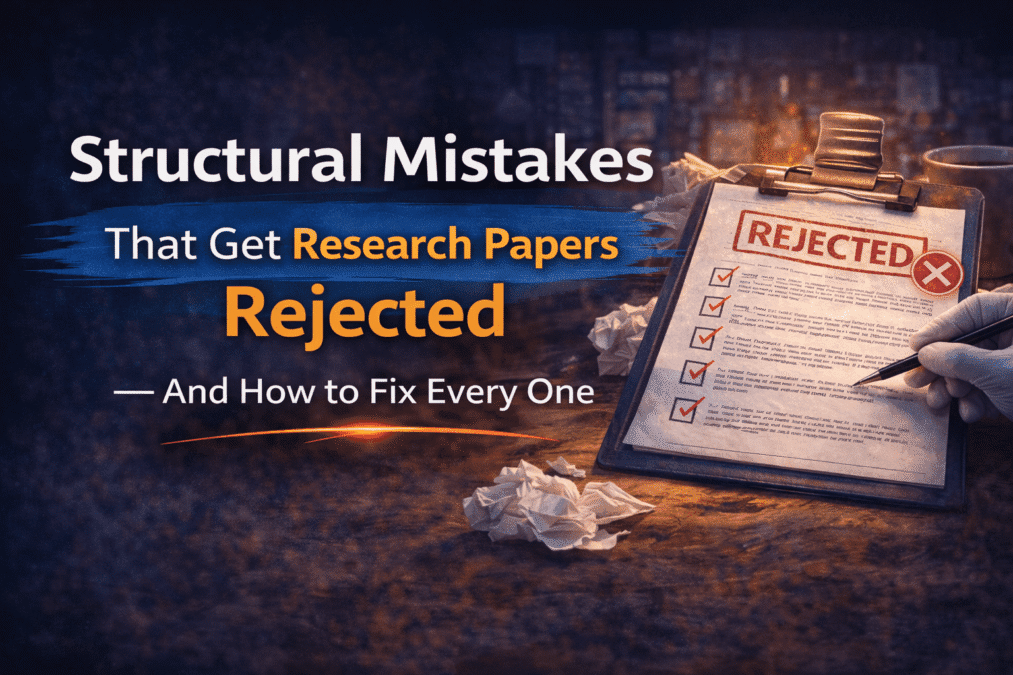
10 Structural Mistakes That Get Research Papers Rejected — And How to Fix Every One
Your main post named six common structural mistakes. This post goes further: ten named mistakes with a precise diagnosis for each, a before-and-after example, and a specific fix — plus a pre-submission checklist you can use on any paper or thesis chapter before it goes anywhere.
Why Structural Mistakes Are the Most Preventable Cause of Rejection
Journal rejections and thesis examination concerns have many causes — weak methodology, insufficient literature, overclaiming from limited data. But structural mistakes are unique among them: they are entirely preventable without collecting more data, reading more literature, or running more analyses. You already have everything you need to fix them. You just need to know what they are.
UGC examiner reports consistently identify structural problems as the most common weakness in Indian PhD theses — more common than methodology gaps, more common than literature gaps. The ten mistakes below cover the patterns that appear most frequently across disciplines.
Mistake 1: Burying the Research Question
The research question is the most important sentence in your paper. If readers have to search for it, their patience — and confidence in your work — erodes before they have evaluated a single finding.
Buried: “…and so, given the importance of this area, the present study aims to examine some of these issues in the Indian context.” Explicit: “This study examines whether peer mentoring frequency and quality predict first-year retention at Indian government colleges, controlling for financial need and prior academic performance.”
The fix: State your research question in its own sentence, in the final paragraph of your introduction. It should name the construct, the population, the context, and the relationship being examined. If someone reads only that one sentence, they should know exactly what your study investigates.
Mistake 2: Front-Loading Too Much Background
Context matters. But context that runs for four pages before the reader knows what you are studying works against you. By the time you state your research question, the reader is exhausted and the question feels like an afterthought.
The fix: Give readers exactly enough background to understand why your question matters, then state the question. Ask of every background paragraph: does this help the reader understand my specific research question, or does it just demonstrate how much I know about the topic? The latter belongs in the literature review, not the introduction.
Mistake 3: A Gap That Is Implied Rather Than Stated
Many researchers gesture toward a gap without ever stating it plainly. The Introduction describes what previous research has found, then announces the research question — but never explicitly names the thing that is unknown, contested, or unresolved that the study addresses.
Implied gap: “Several studies have examined peer support in educational settings. Smith (2019) found… Jones (2021) found… This study examines peer support in Indian government colleges.” Explicit gap: “Existing research on peer support has been conducted predominantly in Western residential university settings. The specific mechanisms through which peer support influences retention in Indian government colleges — where students typically attend far from home without established social networks — remain unstudied. This gap matters because interventions designed for Western contexts may not transfer to settings with different social infrastructure.”
The fix: Write one sentence that begins: “However, what remains unclear / unstudied / unresolved is…” Then write one sentence explaining why this matters. These two sentences are your gap statement. If you cannot write them, your gap is not yet clearly defined in your own thinking.
Mistake 4: Methods That Describe Without Justifying
A methods section that lists what you did without explaining why gives a sceptical reviewer nothing to evaluate except whether you followed convention. Reviewers are not asking what you did. They are asking whether what you did was the right approach to your research question.
Description only: “Semi-structured interviews were conducted with 30 students.” Description with justification: “Semi-structured interviews were conducted with 30 students because the research question concerns how students experience peer support — a question about meaning and interpretation that closed-ended survey instruments cannot adequately capture.”
The fix: For every significant methodological choice, add one sentence beginning “because” or “in order to.” Why this design rather than alternatives? Why this sample size? Why this instrument? One sentence of justification transforms a procedure list into a defended research design.
Mistake 5: Mixing Results and Discussion
This is the most common IMRAD violation and the one that most damages credibility with reviewers. When you present a finding and immediately explain what it means in the same sentence, you make it impossible for readers to evaluate your data separately from your interpretation of it.
Mixed: “Students in the intervention group showed higher retention (82%), which demonstrates that peer mentoring is an effective strategy for improving persistence.” Separated — Results: “Students in the intervention group showed higher retention (82%) than control students (71%), χ²(1, N = 450) = 8.92, p = .003.” Separated — Discussion: “The 11-percentage-point retention gap suggests peer mentoring addresses social integration factors that financial or academic support alone cannot provide.”
The fix: Search your Results section for the words “suggests,” “demonstrates,” “indicates,” “because,” and “therefore.” Every sentence containing these words is mixing results with interpretation. Move the interpretive half to Discussion.
Mistake 6: Vague Statistical Reporting
Reporting “p < .05” and nothing else tells a reviewer almost nothing. Statistical significance says only that an effect exists — not how large it is, not whether it is meaningful in practice. Incomplete statistical reporting is one of the most common reasons quantitative papers attract revision requests.
Incomplete: “There was a significant difference between groups (p = .003).” Complete: “Intervention students showed significantly higher retention (82% vs. 71%), χ²(1, N = 450) = 8.92, p = .003, φ = .14.”
The fix: Every statistical result needs four elements: the test statistic, degrees of freedom, p-value, and effect size. Effect size (Cohen’s d, η², φ, r) is the element most consistently omitted and most consistently required by reviewers. Add it to every result.
Mistake 7: Limitations Listed, Not Analysed
A limitations section that reads as a list of apologies — “the sample was small,” “self-report measures may be inaccurate,” “more research is needed” — signals that the researcher has not thought carefully about what their study can and cannot support. Examiners and reviewers find this more damaging than the limitations themselves.
Apologetic: “This study has several limitations. The sample was small and from only one region. The design was cross-sectional.” Analytical: “The three-college Rajasthan sample limits generalisability to other regional contexts — government colleges in tribal and hill regions, or in other states with different social infrastructure, may show different retention patterns. The cross-sectional design also means causation cannot be established: students who were already more likely to persist may have sought out mentoring rather than being retained because of it. A longitudinal randomised design would resolve this ambiguity.”
The fix: For each limitation, write two sentences: one naming the limitation, one explaining what it means for the conclusions you can draw. What can your study support? What cannot it support? Analytical limitations are a sign of methodological sophistication, not weakness.
Mistake 8: Implications That Are Generic
“This study has important implications for policy and practice” is a sentence that could appear in any paper in any field. It communicates nothing. Implications that do not specify who should do what, based on which specific finding, are indistinguishable from filler.
Generic: “These findings have important implications for educational policy in India.” Specific: “Government college principals can implement structured peer mentoring within existing staff capacity — our model required eight hours of mentor training and bi-weekly coordinator check-ins. UGC should link peer mentoring implementation to the retention performance metrics already required under NEP 2020 reporting, creating an incentive for evidence-based adoption rather than ad hoc approaches.”
The fix: For every implication, name the specific actor (a principal, UGC, a legislative committee), the specific action (implement, revise, fund), and the specific finding that supports it. If you cannot link an implication to a specific finding, cut it.
Mistake 9: Inconsistent Organisation Across Sections
If your Results section organises findings by three research questions — RQ1, RQ2, RQ3 — your Discussion must follow the same order. If your Results presents quantitative then qualitative findings, your Discussion should interpret them in the same sequence. Inconsistency forces readers to mentally reorganise your work, and it suggests the researcher does not have a clear grasp of their own argument’s structure.
The fix: Before you write your Discussion, create a simple map: list your Results subheadings in column one, and match each to its corresponding Discussion subheading in column two. If the match is not one-to-one, restructure before you write. This five-minute exercise prevents hours of revision.
Mistake 10: A Conclusion That Summarises Instead of Concludes
A conclusions chapter or section that simply summarises the Discussion — which already summarised the Results — is the academic equivalent of ending a speech by reading your slides aloud. It adds nothing and leaves the reader with a sense of anticlimax at exactly the moment when your work should feel most significant.
Summary disguised as conclusion: “This study examined peer mentoring at three government colleges in Rajasthan. It found that intervention students had higher retention rates. The study also found that mentoring frequency and quality were important predictors.” Genuine conclusion: “This study provides the first quasi-experimental evidence that structured peer mentoring improves first-year retention in Indian government college contexts — a finding that matters because it identifies a low-cost mechanism for addressing the retention gap that NEP 2020 expansion has widened rather than closed. The navigational function of peer mentors — helping first-generation students access institutional resources they did not know existed — extends social integration theory in ways that have implications for how colleges design induction programmes across India.”
The fix: A genuine conclusion answers three questions your reader has after reading the whole paper: What is new that we now know? Why does it matter? What should happen next? If your conclusion cannot answer all three specifically, it is summarising rather than concluding.
Pre-Submission Checklist
Use this before submitting any paper or thesis chapter. These questions are sharper than the standard element-based checklists because they test whether sections are doing their intellectual jobs, not just whether they exist.
Introduction
- Is my research question stated in a single explicit sentence — not implied, not buried?
- Is there a gap statement that names specifically what is unknown, not just that more research is needed?
- Does the opening paragraph earn its place — specific enough to be informative, not so broad it could open any paper in the field?
Methods
- Does every significant choice have a rationale, not just a description?
- Could a researcher at another institution replicate this study exactly from my description?
- Have I addressed ethics approval, consent process, and — for qualitative work — positionality?
Results
- Have I searched for “suggests,” “demonstrates,” “because,” and “therefore” and moved every instance to Discussion?
- Does every statistical result include test statistic, degrees of freedom, p-value, and effect size?
- Is every table and figure referenced in the text before it appears, with a note on what to notice?
Discussion
- Does the opening restate findings in fresh language — not repeat them in the same language as Results?
- For each major finding, have I explained why — the mechanism — not just what?
- Are limitations described analytically (what they mean for conclusions) rather than listed apologetically?
- Are there practical, theoretical, and policy implications — not just one type?
- Are future research directions specific enough that another researcher could design a study from them?
Overall
- Does the organisation of my Discussion match the organisation of my Results?
- Does my conclusion answer: what is new, why it matters, and what should happen next?
- Is every source cited in-text present in the reference list — and vice versa?
For Legal Researchers & Law Students
Must read Legal Research Methods: A Complete Guide To Doctrinal, Empirical And Comparative Legal Research (Module 1)
FAQs
Q: Why do research papers get rejected by journals?
Papers are rejected for structural and communication reasons as often as for substantive quality. The most common structural causes: no explicit gap statement; literature review that summarises rather than synthesises; methods without justification; results containing interpretation; discussion that repeats results without advancing analysis; and conclusion introducing new material. These structural failures signal unclear thinking about the research design and each section’s role in building the argument.
Q: What is the most common reason a research introduction fails peer review?
The absence of a specific, explicit gap statement. Reviewers need one sentence stating what was not known before this study and why that matters. Introductions that describe the topic at length and then state ‘more research is needed’ have not made a gap argument. A gap is not ‘no Indian studies exist’ — it is a specific unresolved question whose answer would change practice, theory, or policy in a defined way.
Q: How do you fix a paper that is too descriptive?
Description reports what exists; analysis explains what it means. To fix an overly descriptive paper: in the literature review, replace source summaries with analytical claims about the field’s state; in results, name themes analytically rather than just describing them; in discussion, add explicit interpretive sentences explaining why patterns occurred. Ask of every paragraph: is this telling the reader what exists, or what it means?
Q: What is the most common mistake in a thesis methodology chapter?
Describing the research design without justifying it. Stating you used semi-structured interviews and thematic analysis is description. Explaining why — because you needed to understand participants’ own frameworks that closed survey questions cannot capture — is justification. Examiners assess whether the methodology was appropriate for the research question. A described-but-unjustified methodology cannot be evaluated for appropriateness.
Author
Dr. Rekha Khandelwal, a legal scholar and academic writing expert, is the founder of AspirixWriters. She has extensive experience in guiding students and researchers in writing research papers, theses, and dissertations with clarity and originality. Her work focuses on ethical AI-assisted writing, structured research, and making academic writing simple and effective for learners worldwide.
Author Profile Dr. Rekha Khandelwal | Academic Writer, Legal Technical Writer, AI Expert & Author | AspirixWriters
References
- Belcher, W. L. (2019). Writing Your Journal Article in Twelve Weeks (2nd ed.). University of Chicago Press.
- Booth, W. C., Colomb, G. G., Williams, J. M., Bizup, J., & FitzGerald, W. T. (2024). The Craft of Research (5th ed.). University of Chicago Press.
- Sword, H. (2012). Stylish Academic Writing. Harvard University Press.
- American Psychological Association. (2020). Publication Manual of the APA (7th ed.).
- UGC (Minimum Standards and Procedures for Award of Ph.D. Degree) Regulations 2022.
- K.S. Puttaswamy v. Union of India, (2017) 10 SCC 1. Supreme Court of India.
Next — How To Write A Journal Abstract That Gets Your Paper Read
← Back to Main Post: The Complete Guide to Research Paper Structure
Next in Series
- Complete Guide: The Academic Writing Process: Complete Guide from First Draft to Submission (2026)(Module 2)
- Complete Guide: Research Methodologies: Complete Guide to Quantitative, Qualitative, Mixed Methods & Legal Research (2026) (Module 3)
- Complete Guide: Data Analysis and Results Presentation: Complete Guide for Quantitative, Qualitative & Legal Research (2026) (Module 4)
- Complete Guide: Organization and Academic Tone: Complete Guide to Professional Scholarly Writing (2026) (Module 5)
- Complete Guide: Peer Review and Publication: Complete Guide from Submission to Acceptance (2026) (Module 6)
- Complete Guide: AI Tools in Academic Research: Opportunities, Ethics, and Best Practices (2026) (Module 7)
- Complete Guide: Grant Writing and Research Funding: Complete Guide to Finding Money for Your Research (2026) (Module 8)
- Complete Guide: Academic Career Development: Complete Guide to Building Your Professional Life in Research (2026) (Module 9)
- Complete Guide: Research Ethics and the IRB Process: Complete Guide to Doing Research Responsibly (2026) (Module 10)
No post found!