Last Updated: April 19, 2026
Reference Management
Module 2: The Academic Writing Process
From Concept to Submission Series | 2026
Academic Writing Mastery: The Complete 2026 Guide To Research Papers, Thesis & Dissertation Writing
Module 1 (Complete Guide)- The Complete Guide To Research Paper Structure: IMRAD Format, Thesis Organization & Academic Writing (2026)
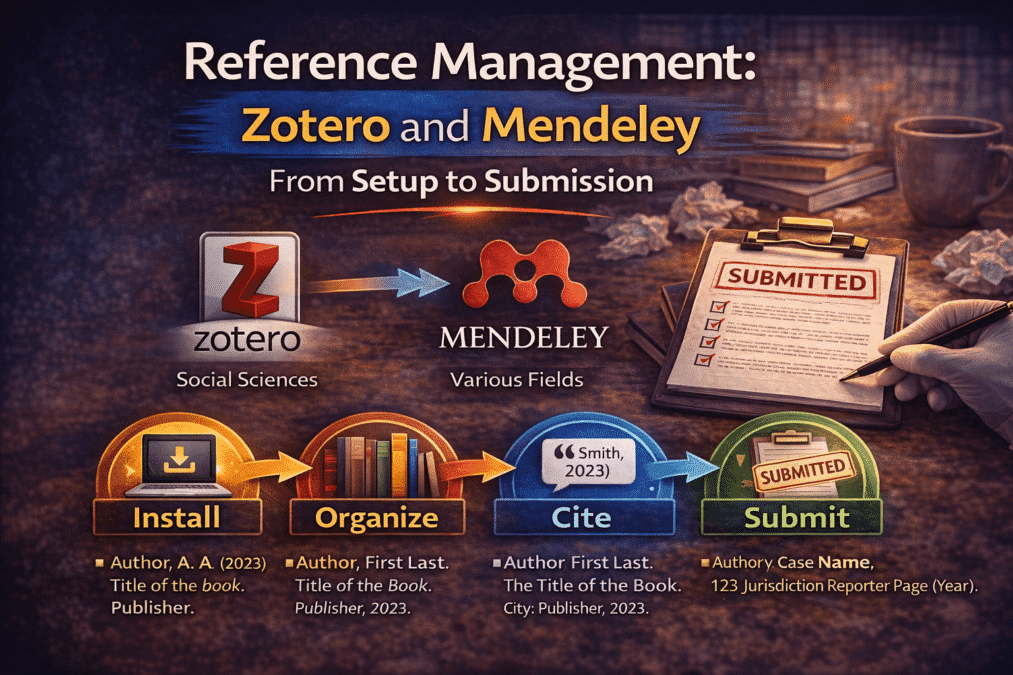
Reference Management: Zotero and Mendeley from Setup to Submission
The module overview introduced Zotero and Mendeley. This post goes deeper: a complete setup guide for both tools, how to organise your library so it stays useful at 500 sources, the specific cleaning tasks that prevent citation errors at submission, and how to handle the sources that reference managers get wrong most often.
Why Manual Citation Management Fails at Scale
When you have ten sources, managing citations manually is inconvenient. When you have a hundred, it is error-prone. When you have two hundred or more — which is normal for a PhD thesis — it becomes unmanageable, and the errors it produces are exactly the ones that get flagged in format reviews and examiner reports.
A source cited in the text but missing from the reference list. A reference in the list that was never cited. An author name spelled differently in two places. A journal name italicised in some entries and not others. A DOI present for some articles and absent for others with no clear logic. These are not signs of careless writing — they are the inevitable result of managing complex bibliographic data by hand across a document that changes hundreds of times during drafting and revision.
Reference management software solves all of these problems automatically. It stores your sources once, formats them correctly in whatever style you specify, keeps your in-text citations and reference list synchronised, and lets you switch citation styles across an entire document in thirty seconds. Learning to use it well is one of the highest-return investments you can make in your research workflow.
Zotero: Setup to First Citation
Zotero is free, open-source, and used by researchers at institutions worldwide. It has no meaningful feature limitations for academic use and is the tool most worth learning if you are starting from scratch.
Step 1: Install the three components
- Download Zotero desktop application from zotero.org — this is where your library lives.
- Install the browser connector for Chrome, Firefox, or Safari — this lets you save sources directly from journal websites and databases with one click.
- Install the Word or Google Docs plugin — this inserts citations and generates your reference list from within your document.
The three components work together. Without the browser connector, you add sources manually. Without the Word plugin, you copy citations manually. Both defeat the purpose of using the software.
Step 2: Save your first sources
Navigate to a journal article on any major academic database — JSTOR, Google Scholar, PubMed, SCC Online. You will see a small Zotero icon in your browser toolbar (usually looks like a page or folder). Click it. Zotero captures all the bibliographic information automatically — author, title, journal, volume, issue, pages, DOI — and saves it to your library. If a PDF is freely available, it downloads that too.
For sources that cannot be captured automatically — a physical book, a government report with no online version, a Supreme Court judgment — use the manual entry form in Zotero desktop. Select the source type from the dropdown (book, legal case, report), fill in the fields, and save. This takes two minutes and is far faster than formatting the citation by hand every time you need it.
Step 3: Insert a citation in your document
Open your document in Word or Google Docs. Place your cursor where the citation should go. In the Zotero toolbar, click Add/Edit Citation. A search bar appears — type the author name or a keyword from the title. Zotero finds the source, you press Enter, and the correctly formatted in-text citation appears at your cursor.
When your document is complete, click Add/Edit Bibliography — Zotero generates the entire reference list in the correct format for your chosen style. Change the style setting once, and every citation and every reference list entry reformats automatically.
Mendeley: When to Choose It Instead
Mendeley, owned by Elsevier, does the same core job as Zotero. The practical differences are small but real, and knowing them helps you choose the right tool.
| Zotero | Mendeley |
| Free for all storage (syncs via Zotero servers) | Free up to 2GB; paid tiers for more storage |
| Better browser capture across more databases | Better built-in PDF reader and annotation tools |
| Open source — your data is yours | Owned by Elsevier — consider data privacy implications |
| Larger community, more citation styles available | Social network feature shows what others in your field read |
| Slightly steeper initial setup | Cleaner interface for new users |
| Better for legal and non-standard sources | Better for large PDF-heavy natural science libraries |
For most Indian researchers — especially those in social sciences, humanities, or law — Zotero is the better choice because of its broader database compatibility and stronger handling of non-journal sources like government reports, Supreme Court judgments, and grey literature. Mendeley’s advantages are most apparent for researchers managing hundreds of PDFs with heavy annotation needs.
Whichever you choose, start using it from the first day of your research — not six months in when you have forty sources already saved in various folders and documents. Retroactively importing a large unorganised collection is the most time-consuming way to use a reference manager.
Organising Your Library: A System That Scales
A reference manager with no organisation structure is a pile rather than a library. The following system works for a thesis with up to 500 sources and adapts easily for larger projects.
Collections and subcollections
In Zotero, sources are organised into Collections (equivalent to Mendeley’s Folders). Create one collection per thesis chapter or major section. Then create subcollections within each for specific topics.
Example structure: 1st File for – Literature Review 2nd File for- Peer support — theory 3rd File for -Peer support — India 4th File for- Retention — quantitative studies 5th File for – Retention — qualitative studies 6th File for – Methodology 7th File for -Mixed methods design 8th File for- Survey instruments 9th File for- Results and Discussion 10th File for- To Read 11th File for- Key Sources (your 20–30 most important references)
A source can belong to multiple collections without being duplicated. A paper on peer support in Indian colleges belongs in both “Peer support — India” and “Retention — qualitative studies.” In Zotero, drag it to both. This is one of the most useful features of reference managers that researchers consistently underuse.
Tags
Use tags for cross-cutting categories that do not fit neatly into the folder structure. Tags like “methodological critique,” “contradicts my argument,” “strong evidence,” “needs follow-up,” and “cited in draft” let you filter your library by dimension without restructuring your collections.
One tag that is particularly useful: “cited” — add it to every source once you have cited it in your draft. At submission, filter by this tag and check every tagged source against your reference list. Any source you have cited but not yet verified should be easy to find.
Notes
Zotero and Mendeley both allow you to attach notes to individual sources. Use them. A note that says “Argues financial factors explain 60% of dropout, but sample is US residential colleges only — generalisability to India is limited” is far more useful at writing time than having to re-read the abstract. Write notes when you read the source, not six months later when you cannot remember what it argued.
Keeping Your Library Clean: The Errors That Cause Submission Problems
A reference manager generates citations from whatever data it has stored. If the stored data is wrong, the generated citation is wrong. Three categories of error cause the most submission problems.
Duplicates
Duplicates occur when the same source is saved twice — often because you imported it from Google Scholar and again from the publisher’s website. Zotero has a Duplicate Items finder under the Tools menu. Run it every few weeks, especially after importing a large batch of sources. Merge duplicates rather than deleting one — merging preserves any notes or tags attached to either copy.
Incomplete records
Automatic import is reliable for journal articles from major databases but often incomplete for other source types. Check every imported source for missing fields: volume and issue number for journal articles, edition for books, report number for government documents, court name and year for cases. A missing volume number produces a malformed reference. Five missing volume numbers produce five malformed references — and if the reference list has fifty entries, a reviewer noticing five errors will question the accuracy of all fifty.
Wrong source type
Reference managers sometimes guess the source type incorrectly. A chapter imported from Google Scholar might be classified as a journal article. A conference paper might be classified as a book. Source type determines which fields are used and how the citation is formatted — a wrong type produces a fundamentally malformed reference regardless of whether the individual fields are correct. Check the source type of every entry when you import it, especially for non-standard sources.
Sources That Reference Managers Handle Poorly
Reference managers are excellent for journal articles and books from major publishers. They are unreliable for several source types that are common in Indian academic research.
Supreme Court and High Court judgments
Legal databases like SCC Online and Manupatra do not integrate with Zotero or Mendeley’s automatic import. You must add case citations manually. In Zotero, select “Case” as the source type and fill in the case name, court, year, reporter, and page fields. The citation format generated will depend on your chosen style — Bluebook and OSCOLA handle case citations very differently, so verify the output against your style guide’s case citation format.
Government reports and policy documents
Reports from UGC, AISHE, NITI Aayog, and similar bodies are often missing from Zotero’s automatic capture or are captured with incomplete information — no author name, no report number, no URL. Save these manually using the “Report” source type. Include the issuing organisation as the author, the report number if available, the URL, and the date accessed.
Unpublished theses from Shodhganga
Shodhganga theses can sometimes be imported via the browser connector, but the capture is unreliable. Save these manually using the “Thesis” source type. The required fields are author, title, year, type of thesis (PhD or MPhil), university, and the Shodhganga URL. Note that APA 7th edition requires you to specify the database name (Shodhganga) in the reference.
Backing Up: The One Step Most Researchers Skip
If your computer is stolen, crashes, or fails the day before submission, your reference library disappears with it unless you have backed it up. Zotero stores your library in a folder on your computer. Find it (on Windows: C:\Users\[username]\Zotero; on Mac: ~/Zotero) and back it up to an external drive or cloud service every week. Zotero’s free sync account backs up your library metadata but not your PDFs unless you pay for storage — check what your sync account actually covers.
Mendeley syncs to the cloud automatically, but export a backup copy anyway: File → Export Library → RIS format. This gives you a file you can import into any reference manager if you ever need to switch tools or recover from a sync failure.
For Law Students & Legal Researchers
Legal Writing Process And Citation: A Complete Guide For Law Students And Legal Researchers
FAQs
Q: What is the best reference management software for researchers?
Zotero and Mendeley are the two most widely used free reference managers. Zotero is open-source, has superior browser capture of Indian legal and academic sources, and integrates with Word and Google Docs. Mendeley has better PDF annotation features and institutional usage through Elsevier. Both support APA, MLA, Chicago, and other styles. For legal citation (Bluebook, OSCOLA), both require manual verification — neither handles legal citation automatically with full accuracy.
Q: How do you use Zotero for academic writing?
Install Zotero desktop and the browser connector. As you research, click the browser connector to capture sources directly from journal websites, Google Scholar, and databases. Organise sources into collections by project or chapter. In Word, use the Zotero plugin to insert in-text citations and generate the reference list automatically. Select your citation style in Zotero preferences. Always verify auto-generated references against the source — Zotero captures metadata accurately most of the time but not always.
Q: How do you manage references for a PhD thesis?
Create one master Zotero or Mendeley library for your entire PhD, with sub-collections for each chapter. Add every source you read, not just those you cite — you may need a source you read in Year 1 when writing Chapter 5 in Year 3. Tag sources by theme, chapter, and source type. Export the full library in your required citation format at the end. Never build the bibliography manually from footnotes — you will miss sources and introduce inconsistencies.
Q: Can Zotero handle Bluebook citation for Indian law?
Zotero does not have a reliable built-in Bluebook style for Indian case citation. It can generate basic Bluebook formats for journal articles and books, but Indian case citations (Supreme Court, High Court, statutory references) require manual formatting. Use Zotero for secondary sources (books, journal articles) and maintain a separate manually formatted citation list for primary legal sources. Check every auto-generated legal citation against the Bluebook 21st edition before submission.
Q: What is the difference between a bibliography and a reference list?
A reference list contains only sources cited in the paper — every in-text citation must appear in the reference list and vice versa. A bibliography contains all sources consulted, including those not cited. APA, MLA, and IEEE use reference lists. Chicago Notes-Bibliography system uses a bibliography. Theses sometimes require both: a reference list of cited sources and a separate bibliography of sources consulted. Check your institution’s or journal’s requirement — submitting a bibliography when a reference list is required (or vice versa) is a formatting error.
Author
Dr. Rekha Khandelwal, a legal scholar and academic writing expert, is the founder of AspirixWriters. She has extensive experience in guiding students and researchers in writing research papers, theses, and dissertations with clarity and originality. Her work focuses on ethical AI-assisted writing, structured research, and making academic writing simple and effective for learners worldwide.
Author Profile Dr. Rekha Khandelwal | Academic Writer, Legal Technical Writer, AI Expert & Author | AspirixWriters
References
- Zotero — free reference management software. zotero.org
- Mendeley — reference manager by Elsevier. mendeley.com
- SCC Online — Supreme Court Cases database.
- Manupatra — Indian legal research database.
- American Psychological Association. (2020). Publication Manual of the APA (7th ed.).
- OSCOLA: Oxford University Standard for the Citation of Legal Authorities (4th ed.).
Next – Preparing A Submission Ready Document: The Complete Pre-Submission Checklist
Next in Series
- Complete Guide: Research Methodologies: Complete Guide to Quantitative, Qualitative, Mixed Methods & Legal Research (2026) (Module 3)
- Complete Guide: Data Analysis and Results Presentation: Complete Guide for Quantitative, Qualitative & Legal Research (2026) (Module 4)
- Complete Guide: Organization and Academic Tone: Complete Guide to Professional Scholarly Writing (2026) (Module 5)
- Complete Guide: Peer Review and Publication: Complete Guide from Submission to Acceptance (2026) (Module 6)
- Complete Guide: AI Tools in Academic Research: Opportunities, Ethics, and Best Practices (2026) (Module 7)
- Complete Guide: Grant Writing and Research Funding: Complete Guide to Finding Money for Your Research (2026) (Module 8)
- Complete Guide: Academic Career Development: Complete Guide to Building Your Professional Life in Research (2026) (Module 9)
- Complete Guide: Research Ethics and the IRB Process: Complete Guide to Doing Research Responsibly (2026) (Module 10)
No post found!