
Last Updated: March 21, 2026
Cluster Post 5 | Module 8: Grant Writing and Research Funding
From Concept to Submission Series | 2026
Academic Writing Mastery: The Complete 2026 Guide To Research Papers, Thesis & Dissertation Writing
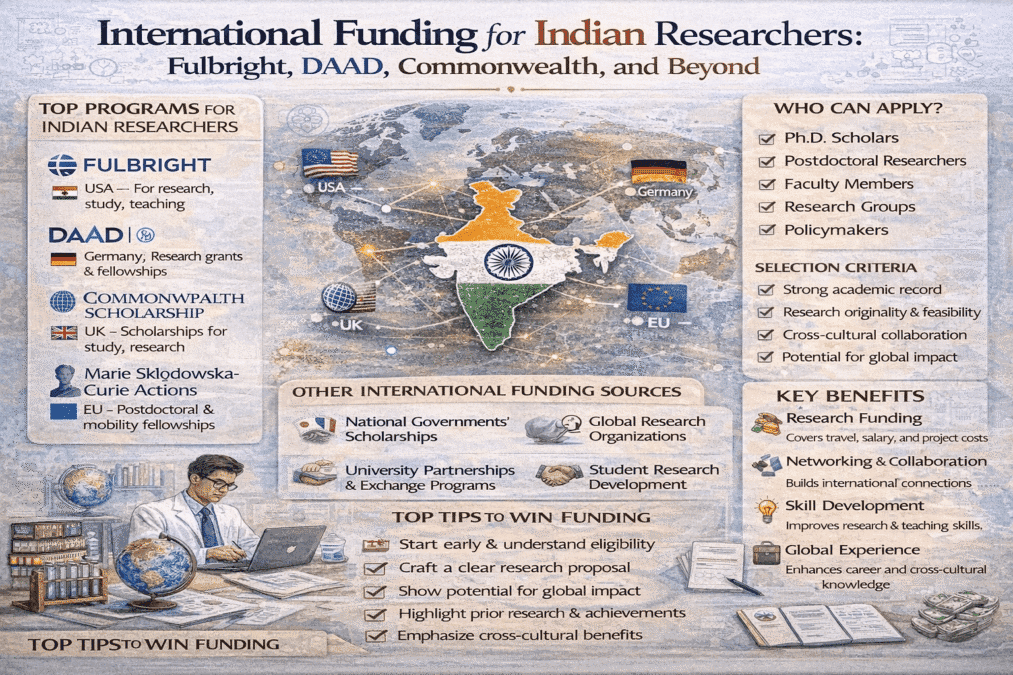
International Funding for Indian Researchers
The module overview lists international funding opportunities briefly. This post goes deeper: honest evaluations of eligibility and competitiveness for each major scheme, what distinguishes funded from unfunded applications, the research positioning strategies that make Indian researchers competitive internationally, and the schemes most relevant to law and social science researchers specifically.
Why International Funding Is Worth Pursuing
International fellowships and grants serve purposes that Indian domestic funding cannot. Beyond the financial support, they provide: access to research environments, archives, and networks that are not available in India; an international credential that carries weight in academic hiring; and the experience of operating in a different scholarly context, which invariably sharpens your own research perspective.
The most important strategic point: Indian researchers systematically underestimate their competitiveness for international fellowships. Selection committees at Fulbright, DAAD, and Commonwealth actively seek strong candidates from India — India is a high-priority country for most of these programmes. A well-prepared Indian researcher from a recognised institution with a clear research project is genuinely competitive, not a long shot.
Fulbright-Nehru Programme
What it is: The Fulbright-Nehru programme is the primary US-India academic exchange programme, administered by the United States-India Educational Foundation (USIEF). It offers several award types relevant to researchers.
Fulbright-Nehru Doctoral Research Fellowship
For enrolled PhD students at Indian universities. Provides nine to eleven months of support at a US institution to conduct thesis research. The award covers travel, stipend, and institutional fees. You must have a US host institution willing to host you before applying — identifying and securing this affiliation is part of the application process.
What distinguishes funded applications: a research project that genuinely requires access to US-based resources (archives, datasets, research groups, specific methodological expertise) that are not available in India. Applications that could be completed equally well in India — where the US period is valuable but not essential — are weaker than applications where the US period is necessary. Be explicit about what specific US resources your research needs and why those resources matter for your thesis.
Realistic competitiveness assessment: highly competitive, but not inaccessible. USIEF receives several hundred applications annually and funds approximately 15–25 doctoral research fellows per year. Social science and law applicants are competitive — these fields are not dominated by STEM applicants in the Fulbright programme the way they are in SERB. Strong language skills, a well-defined project, and a genuine US affiliation are the distinguishing factors.
Fulbright-Nehru Postdoctoral Research Fellowship
For researchers within three years of completing their PhD. Longer duration (six to nine months) and higher stipend. The same US-resource-necessity criterion applies. This fellowship is particularly valuable for early-career researchers building an international publication profile.
DAAD (German Academic Exchange Service)
What it is: DAAD is Germany’s largest funding organisation for international academic exchange, with several schemes specifically for Indian researchers.
DAAD Research Grants for Doctoral Candidates and Young Researchers
Funding for PhD students and postdoctoral researchers to spend one to twenty-four months at a German research institution. Covers monthly stipend, travel, and health insurance. No German language requirement for research conducted in English.
What distinguishes funded applications: a clear intellectual rationale for why the research requires time in Germany specifically — a particular research group, an archive, a laboratory, a methodological tradition that is particularly strong in German academia. The statement of purpose must explain the German connection, not just the research project.
For social science and law: Germany has particularly strong research groups in comparative constitutional law, European law, socio-legal studies, and development economics. Indian researchers studying comparative constitutional issues, EU-India relations, or comparative development policy are well-positioned. The Max Planck Institutes — particularly the Max Planck Institute for Comparative Public Law and International Law (Heidelberg) and the Max Planck Institute for Social Anthropology (Halle) — are strong host institutions for law and social science researchers.
Helmut-Schmidt Programme (DAAD)
Specifically for Master’s students and early PhD students from developing countries studying governance, democracy, and rule of law. Provides full funding for a German university programme. For law and public policy researchers at the very early stages, this can be the entry point into the DAAD ecosystem.
Commonwealth Scholarship Commission
What it is: The Commonwealth Scholarship Commission (UK) funds researchers from Commonwealth countries to study or conduct research in the UK.
Commonwealth Split-Site Scholarships
For PhD students at Indian universities to spend twelve months at a UK university as part of their doctorate. Covers travel, stipend, and tuition fees at the UK institution. The split-site model means you remain registered at your Indian university — this is particularly practical for students who do not want to interrupt their Indian PhD.
What distinguishes funded applications: a research project where twelve months at a specific UK institution produces a clearly-defined, stand-alone piece of work — a chapter, a data collection strand, an archival study — that complements but does not duplicate the Indian component of the thesis. The weakness of many applications is proposing to ‘continue’ UK research that overlaps with what is being done in India. The strongest applications have a UK component that the Indian component cannot replicate.
Commonwealth Rutherford Fellowships
For postdoctoral researchers. Six to twelve months in the UK. More competitive than split-site scholarships; the bar for demonstrated research capacity is higher. Publication track record matters.
European Research Fellowships for Indian Researchers
| Scheme | Key features and law/social science relevance |
| Marie Skłodowska-Curie Actions (MSCA) — Postdoctoral Fellowships | EU-funded postdoctoral fellowships for researchers of any nationality to work at European institutions. Two-year fellowships covering salary and research costs. Indian researchers are eligible. Strong for comparative EU-India research or researchers with European host institution connections. Highly competitive (success rate ~15%) but prestigious. |
| ERC Starting Grants | For early-career researchers within 7 years of PhD, based at a European host institution. Very large grants (up to €1.5 million). Indian researchers are eligible if they relocate to a European institution. Not suitable for researchers who wish to remain India-based. |
| Alexander von Humboldt Foundation (Germany) | Prestigious postdoctoral and experienced researcher fellowships for researchers worldwide to conduct research at German institutions. 6–24 months. Strong for interdisciplinary and humanities/social science researchers. India is one of the largest sending countries. Applications reviewed year-round. |
| Swiss Government Excellence Scholarships | For PhD students and postdoctoral researchers to study or research in Switzerland. Covers all costs. Switzerland has strong research groups in international law, development economics, and public health. |
| Erasmus+ Doctoral Mobility | Exchange funding through Indian universities’ Erasmus+ partnerships. Less competitive than standalone fellowships; depends on whether your institution has a relevant partnership. |
Australia, Japan, and Other Destinations
Australia Awards: The Australian Government’s flagship international scholarship programme. Open to Indian researchers for PhD study or research at Australian universities. Covers full costs. Australia has strong research groups in comparative constitutional law, Asian studies, development economics, and environmental law. The application emphasises development impact — research with relevance to India’s development challenges is well-positioned.
Japan Society for the Promotion of Science (JSPS) Fellowships: For postdoctoral researchers to spend one to two years at a Japanese research institution. Strong for researchers with Japan-related research interests or who benefit from specific Japanese research infrastructure. Less accessible for researchers without Japan connections, but worth exploring for those studying Asian comparative law, development, or environmental issues.
Rotary Peace Fellowship: For researchers and practitioners working in peace, conflict prevention, and development. Covers a Master’s or professional certificate programme at one of six Rotary Peace Centres worldwide. Relevant for law and social science researchers studying conflict, transitional justice, or peacebuilding.
What Makes Indian Researchers Competitive Internationally
Selection committees for international fellowships are not only assessing the research — they are assessing whether the applicant will make the most of the fellowship opportunity and return with enhanced capacity to contribute to their home country’s research environment. The following factors consistently distinguish successful applications:
- A specific, necessary reason for the international period: not ‘I will benefit from exposure to international scholarship’ but ‘the archive at the British Library holds the only complete collection of colonial-era presidency court records central to my research, which are not available digitally and have not been analysed by existing scholarship.’
- A credible return and impact plan: fellowships invest in researchers who will bring benefits back to India. Applications that describe specific ways the international period will enhance your research capacity and contribution to Indian scholarship — courses you will teach, collaborations you will establish, a research network you will join — are stronger than applications that treat the fellowship as personal enrichment.
- Evidence of language and cultural readiness: for programmes in non-English-speaking countries (Germany, Japan, France), evidence of language engagement — even beginning-level courses — demonstrates genuine commitment to the host country context.
- Strong reference letters from supervisors who know international expectations: a reference letter that uses the vocabulary of international academic standards (‘this researcher’s work would be publishable in leading international journals’) is more useful than one that uses only Indian institutional comparisons (‘she ranked first in her cohort at the university’).
Legal Research and Writing: Complete Guide for Law Students and Legal Researchers
FAQs
Q: What international fellowships are available for Indian researchers?
Major international fellowships for Indian researchers include: Fulbright-Nehru Academic and Professional Excellence Awards (6–12 months at a US institution); DAAD (German Academic Exchange Service) research grants and fellowship schemes; Commonwealth Scholarships for Master’s and PhD study in Commonwealth countries; British Council research collaboration grants; Newton-Bhabha Fund for UK-India research partnerships; and European Research Council (ERC) grants for researchers at European institutions. Each has specific eligibility, research focus, and career stage requirements. Check current guidelines — many fellowships have been updated post-pandemic.
Q: How do you apply for a Fulbright-Nehru fellowship from India?
Fulbright-Nehru Academic and Professional Excellence Awards are administered in India by USIEF (United States-India Educational Foundation). Applications open annually, typically in June–July for awards beginning the following academic year. Requirements: Indian citizenship; a PhD or equivalent professional degree; institutional affiliation; a proposed host US institution (contact prospective hosts before applying); a research statement; letters of reference; and language proficiency documentation. Competition is high — a strong publication record and a clearly defined research project with US institutional support significantly improve chances.
Q: What is the DAAD fellowship and how can Indian researchers apply?
DAAD (Deutscher Akademischer Austauschdienst) offers multiple schemes for Indian researchers: Research Stays for University Academics and Scientists (1–6 months); Research Grants for Doctoral Candidates (up to 24 months for PhD research in Germany); Postdoctoral Researchers International Mobility Experience (PRIME); and bilateral project funding with Indian institutions. Applications are submitted directly to DAAD or through partner institutions depending on the scheme. German language skills are not required for most research-focused schemes. DAAD has a New Delhi office — check daad.in for India-specific schemes and deadlines.
Q: What is the Newton-Bhabha Fund for Indian researchers?
The Newton-Bhabha Fund is a UK-India bilateral research partnership programme funded by the UK government (UKRI) and Indian counterpart funders (DST, DBT, ICMR, CSIR, and others). It supports collaborative research projects across science, technology, and innovation. Projects are jointly submitted by UK and Indian institutions. Funding covers researcher exchange, workshops, and collaborative research costs. It does not fund individual fellowships but bilateral projects with both UK and Indian co-investigators. Contact your institution’s research office and identify a UK institutional partner before applying.
Q: What is FCRA and why do Indian researchers need to know about it?
FCRA (Foreign Contribution (Regulation) Act, 2010) regulates receipt of foreign funds by Indian individuals and organisations. Institutions receiving international research grants must be registered under FCRA with the Ministry of Home Affairs. Individual researchers at registered institutions can typically receive international fellowship funds without personal FCRA registration. Organisations that are not FCRA-registered cannot receive international research grants. Before applying for any international funding that will be received in India, verify your institution’s FCRA registration status with the finance or research office.
References
- USIEF — Fulbright-Nehru Fellowships. usief.org.in
- DAAD — Scholarships for Indian researchers. daad.de/en/study-and-research-in-germany/scholarships/
- Commonwealth Scholarship Commission. cscuk.fcdo.gov.uk
- Alexander von Humboldt Foundation. humboldt-foundation.de
- Australia Awards — India. australiaawardsindia.org
- MSCA Postdoctoral Fellowships. marie-sklodowska-curie-actions.ec.europa.eu
End of Module 8 Cluster Posts — all 5 complete.
No post found!