Last Updated: March 21, 2026
Cluster Post 1 | Module 9: Academic Career Development
From Concept to Submission Series | 2026
Academic Writing Mastery: The Complete 2026 Guide To Research Papers, Thesis & Dissertation Writing
The Academic CV
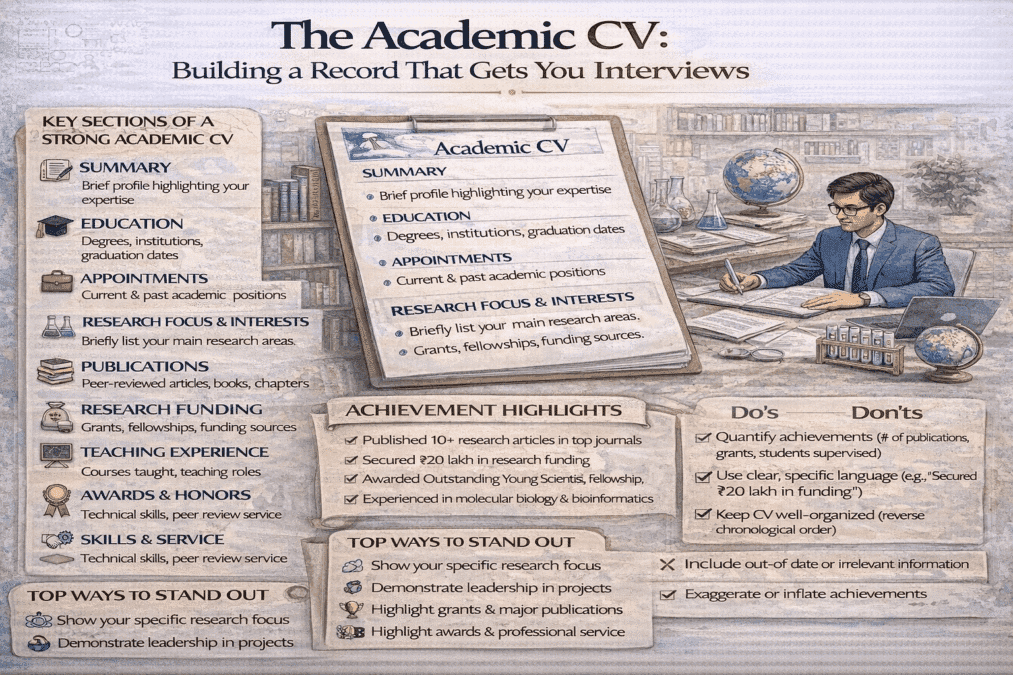
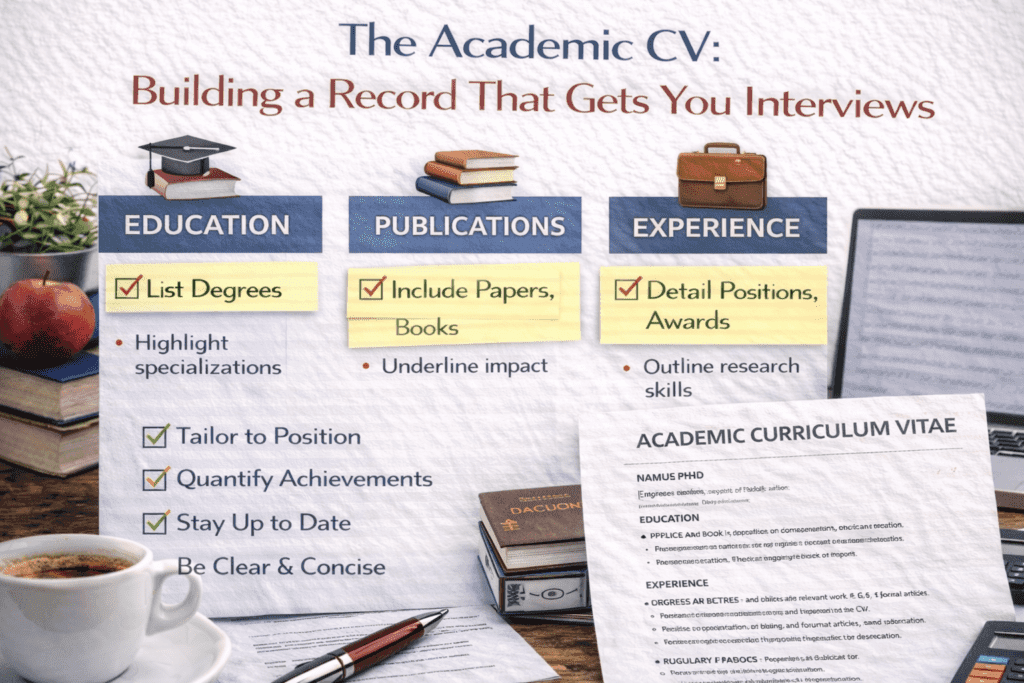
The module overview lists what goes in a CV. This post goes deeper: how to write each entry so it demonstrates impact rather than just activity, the section-ordering logic that signals career stage, the common errors that immediately mark a CV as inexperienced, and what Indian academic hiring committees and international search committees actually look for.
The CV as an Argument, Not a List
Most academic CVs read as lists of activities. The CVs that get interviews read as arguments — coherent narratives that demonstrate intellectual focus, growing capability, and an identifiable research identity. The difference is not what is included but how every entry is written and how the sections are ordered.
The single most important CV principle: every entry should show what you did and what it produced, not just that you did it. ‘Research assistant, Prof. Sharma’s lab, 2023–24’ is an activity. ‘Research assistant (2023–24): led data collection for 400-participant survey study of judicial attitudes toward AI evidence; designed and piloted interview protocol adopted for the full study’ is an argument for capability.
Writing Entries That Demonstrate Impact
Publications — the most important section
Publications are the primary currency of academic career advancement. Every publication entry should include: full citation in the appropriate format for your discipline, the journal’s tier or selectivity (if not obvious), and — for manuscripts under review — the journal name. Never list ‘under review’ without naming where it is under review, as this signals either that the paper does not exist or that it is at a journal too undistinguished to name.
Weak publication entry: Rao, S. (2025). AI surveillance and constitutional rights. Law Review, 12(3), 45-89. Strong entry (adds context): Rao, S. (2025). AI surveillance and constitutional rights under Article 21: Towards a proportionality framework. National Law School of India Review, 37(2), 112–156. [Peer-reviewed; double-blind review; acceptance rate approximately 8%]
The acceptance rate note is appropriate only for journals where this is public information and meaningfully high-selectivity. Do not add it for every journal.
Conference presentations — show trajectory
List conference presentations in reverse chronological order. Include: conference name, location, year, and presentation title. For early-career CVs where publications are thin, a strong conference record demonstrates active scholarly engagement. Include whether the paper was peer-reviewed for acceptance — many conferences have competitive peer review; noting this distinguishes them from open-submission events.
Research experience — lead with method and scale
Research experience entries should lead with what you did methodologically, not with your job title. ‘Research Associate’ tells a hiring committee nothing. ‘Conducted 26 semi-structured interviews with retired judges across four High Courts; led thematic analysis of 400+ pages of transcript data’ tells them your methodological capability and the scale of work you can handle.
Teaching experience — show growth
For teaching entries, note the course level (undergraduate/postgraduate), enrolment size, and — if available — teaching evaluation scores or qualitative feedback. A single positive phrase from a teaching evaluation, accurately quoted, is a legitimate and effective addition: ‘Student evaluations noted: “made complex constitutional doctrine genuinely accessible.”‘
Section Ordering: What Signals Career Stage
The order of CV sections communicates priorities. The conventional order changes at career transition points:
| Career stage | Recommended section order |
| PhD student (no publications yet) | Education → Research Experience → Teaching Experience → Conference Presentations → Awards/Fellowships → Skills → Service |
| PhD student (1–3 publications) | Education → Publications → Research Experience → Conference Presentations → Teaching Experience → Awards → Skills |
| Early postdoc | Publications → Education → Research Experience → Teaching Experience → Grants → Conference → Service |
| Applying for faculty position | Publications → Grants/Fellowships → Education → Teaching Experience → Research Experience → Service → Professional Development |
The logic: publications move up as they accumulate, because they are what hiring committees weight most. Education moves down as career progresses, because the PhD becomes a credential rather than an achievement.
The Five Most Common CV Errors
- Functional vagueness: ‘Assisted with data collection’ instead of specifying what data, how, at what scale. Every research experience entry should answer: what did you actually do, and how much of it?
- Undifferentiated conference presentations: listing every presentation as if equivalent. A presentation at an international peer-reviewed conference is more significant than a departmental seminar. Format and context should reflect this difference.
- No ORCID or Google Scholar ID: these are now expected at most international institutions and allow hiring committees to verify citation counts and publication history instantly. Create both profiles and include them in your header.
- Inconsistent formatting: mixing citation styles within a section, inconsistent date formats, uneven indentation. These signal lack of attention to detail — a quality academic hiring committees value.
- Including everything from before the PhD: extensive undergraduate activities, pre-PhD jobs unrelated to research, high school awards. The CV should grow forward from the PhD, not backward from childhood.
Tailoring for Indian vs International Academic Markets
The same research record reads differently in Indian and international academic markets. Indian institutional CVs — for UGC-regulated positions — often require specific formats with API (Academic Performance Indicator) documentation. International academic CVs follow different conventions. Maintaining two versions is practical.
| Indian academic market | International academic market |
| API score documentation often required (see Cluster Post 4) | No API equivalent; publications and grants are assessed directly |
| UGC-NET/SLET qualification typically required for faculty positions | PhD is the primary qualification; postdoctoral experience increasingly expected |
| Institution reputation carries significant weight in Indian hiring | Research record and fit with department’s needs drive decisions more than institutional prestige of current position |
| Teaching load expectations typically higher at most Indian universities than international comparators | Research productivity expectations often higher at international research universities |
| Caste and community certificates may be relevant for reserved category positions | Diversity statements increasingly required at US and some other international institutions |
Legal Research and Writing: Complete Guide for Law Students and Legal Researchers
FAQs
Q: How is an academic CV different from a regular resume?
An academic CV is a comprehensive record of all scholarly activities — typically 3–10 pages for an established researcher versus a 1–2 page professional resume. It includes: education; publications (peer-reviewed articles, books, chapters, working papers — separately categorised); grants and fellowships; conference presentations; teaching experience; supervision of students; professional service (editorial boards, review committees, professional associations); and awards. There is no length limit — completeness and accuracy matter more than brevity. It grows throughout your career and is never shortened the way a professional resume is.
Q: How do you organise publications on an academic CV?
Organise publications in reverse chronological order (most recent first) within each category. Separate categories clearly: peer-reviewed journal articles; book chapters in edited volumes; authored books; edited books; working papers and preprints; and book reviews or other publications. For each article, include: all authors in order, article title, journal name, volume, issue, page numbers, year, and DOI or URL. Note UGC-CARE Group I or Scopus/WoS indexing status after the journal name — this signals publication quality to Indian selection committees without requiring them to check.
Q: What should an early-career researcher include on their academic CV?
An early-career researcher’s CV should include: education (degree, institution, thesis title, supervisor, year); publications (even working papers and conference papers if peer-reviewed journal articles are few); thesis information (external examiners, if prestigious); conference presentations; any grants or fellowships received; teaching experience (even as a teaching assistant or guest lecturer); research skills (methodologies, software, languages); and professional memberships. Do not pad with irrelevant items — a short CV with genuine content is better than a long CV with filler activities.
Q: How do you list a paper that is under review on an academic CV?
List papers under review in a separate section titled ‘Papers Under Review’ or ‘Submitted Manuscripts.’ Include: author(s), paper title, and the journal submitted to with the notation ‘(under review).’ Do not list papers as ‘under review’ that have not been formally submitted — this is misleading. Do not list a paper at two journals simultaneously (most journals prohibit simultaneous submission). Papers that have received a revise-and-resubmit decision can be listed as ‘(revise and resubmit at [Journal Name])’ — this signals engagement with quality journals.
Q: How do you write an academic CV for an NLU faculty application?
For NLU faculty applications, include: complete educational history (all degrees with institution, year, thesis title, and supervisor); publications categorised by type with UGC-CARE or Scopus indexing noted; thesis details including external examiner names if prestigious; conference presentations at national and international law conferences; teaching experience with course names and levels; any grants or research funding received; bar enrolment if applicable; and moot court achievements for early-career candidates. Tailor the CV’s emphasis to the advertised position — constitutional law positions should foreground constitutional law publications prominently.
References
- Vick, J. M., et al. (2022). The Academic Job Search Handbook (6th ed.). University of Pennsylvania Press.
- Kelsky, K. (2023). The Professor Is In. Penguin.
- ORCID — researcher identifier. orcid.org
Next: Cluster Post 2 — Conference Strategy: Choosing, Presenting, and Networking Effectively
- Module 1 The Complete Guide to Research Paper and Thesis Structure
- Module 2 The Academic Writing Process: Complete Guide from First Draft to Submission (2026)
- Module 3 Research Methodologies: Complete Guide to Quantitative, Qualitative, Mixed Methods & Legal Research (2026)
- Module 4 Data Analysis and Results Presentation: Complete Guide for Quantitative, Qualitative & Legal Research (2026)
- Module 5 Organization and Academic Tone: Complete Guide to Professional Scholarly Writing (2026)
- Module 6 Peer Review and Publication: Complete Guide from Submission to Acceptance (2026)
- Module 7 AI Tools in Academic Research: Opportunities, Ethics, and Best Practices (2026)
- Module 8 Grant Writing and Research Funding: Complete Guide to Finding Money for Your Research (2026)
- Module 9Academic Career Development: Complete Guide to Building Your Professional Life in Research (2026)
Next in series
Module 10 Research Ethics and the IRB Process: Complete Guide to Doing Research Responsibly (2026)
No post found!