Last Updated: March 26, 2026
Academic Career Development (Module 9)
Academic Writing Mastery: The Complete 2026 Guide To Research Papers, Thesis & Dissertation Writing
Why Academic Career Development Starts During Your PhD—Not After
Most PhD students think career development begins after graduation. That’s too late. The choices you make during your doctorate shape your career options in ways that are very difficult to undo later.
Whether you want to become a professor, work in industry research, join a policy think tank, or build a hybrid career across multiple sectors, you need to start now. Not after your viva. Not after your first publication. Now.
The good news: career development during your PhD doesn’t require extra time so much as intentional attention to what you’re already doing. Presenting at conferences, building relationships with colleagues, and publishing strategically all serve your thesis AND your career simultaneously.
This comprehensive guide covers:
- Building an academic CV that tells your professional story
- Networking authentically in academia without feeling fake
- Presenting your research at conferences with confidence
- Understanding different career paths beyond tenure-track faculty
- Navigating the academic job market and negotiating offers
- Building your online presence and managing career setbacks
- UGC career advancement requirements for Indian academics (2026)
Building Your Academic CV: Your Professional Story
Your CV (curriculum vitae) is a comprehensive record of your academic career—not a resume. Unlike a resume, which is tailored for specific jobs and kept short, your CV grows throughout your career as a complete professional history.
What Goes in an Academic CV
| Section | What to Include |
| Header | Name (prominent), current position (e.g., ‘PhD Candidate in Law’), institution, email, ORCID ID, personal website if available |
| Education | PhD (institution, department, expected date, advisor, dissertation title), Master’s, Bachelor’s. Most recent first. |
| Publications | Peer-reviewed articles, book chapters, conference proceedings. Bold your name in author lists. Use correct citation format. |
| Conference Presentations | Paper presentations, poster presentations, invited talks. Include conference name, location, date, title. |
| Research Experience | RA positions, field work, research projects. Include role, supervisor, dates. |
| Teaching Experience | Courses taught, TA positions, guest lectures, curriculum development. |
| Awards and Honors | Fellowships, scholarships, grants, prizes. Include amounts for significant awards. |
| Skills | Research methods, software (SPSS, R, NVivo, Python), languages (with proficiency level). |
| Professional Service | Journal reviewing, conference organizing, student organizations, committees. |
Writing Strong CV Entries
Wrong – Weak: “Worked on research project”
Right – Strong: “Research Assistant, Education Policy Project, supervised by Dr. Smith, analyzed data from 500 schools using multilevel modeling (2022–2023)”
CV Length and Formatting
- PhD students: 2–4 pages is typical
- Early postdocs: 4–6 pages
- Established faculty: 10+ pages is normal and expected
- Keep a comprehensive ‘master CV’—then tailor for specific opportunities by emphasizing relevant sections
- Update immediately when you add accomplishments. Don’t try to remember everything later.
What NOT to Include
- Photo (unless common in your specific country/context)
- Personal information: age, marital status, religion (unless required)
- High school information once you have graduate degrees
- Irrelevant jobs (unless directly transferable skills)
- Explanations of gaps—save those for interviews
Networking in Academia: Building Real Relationships
Academia runs on relationships. Who you know matters—not for shady reasons, but because colleagues recommend you for opportunities, senior scholars mentor your career, and peers become collaborators.
Reframing What Networking Means
Many people, especially introverts, feel networking is fake or manipulative. It’s not. Academic networking is simply making friends with people who share your intellectual interests, learning from others in your field, and building genuine professional relationships. Think of it as making friends who happen to work in your area.
Where to Network
| Setting | How to Make the Most of It |
| Conferences | Attend talks, ask questions thoughtfully, introduce yourself to speakers, attend coffee breaks and receptions, exchange contact information |
| Your institution | Departmental seminars, brown bag lunches, student research groups, cross-departmental events |
| Online (Twitter/X, LinkedIn, ResearchGate) | Follow scholars in your field, share your work, engage respectfully, use field-specific hashtags |
| Professional associations | Join, attend annual meetings, participate in early-career member groups, volunteer for committees |
How to Approach People at Conferences
“Hi, I’m [your name]. I really enjoyed your talk on [specific thing]. I’m working on related research about [your topic]. Could I ask you about [specific question]?”
The key: be specific, show genuine interest, have a question ready. Don’t ask people to read your dissertation. Don’t only talk to famous scholars. Do listen more than you talk.
Following Up After Meetings
Within one week of meeting someone, send a brief, specific email:
“Dear Dr. Smith, It was great to meet you at [conference] last week. I appreciated our conversation about [specific topic]. I’m attaching a recent paper of mine on [related topic] that you might find interesting given your work on [their topic]. Best regards, [Your name]”
Brief. Specific. Gives them something. Doesn’t ask for anything. That’s the formula.
Maintaining Your Network
- Send congratulations when people have successes—publications, grants, awards
- Share relevant articles or opportunities when you come across them
- Offer to help when you genuinely can—make introductions, provide feedback
- Critical rule: Don’t only reach out when you need something. Networking is building relationships, not collecting contacts you use instrumentally.
Presenting at Conferences: Share Your Research, Build Your Name
Conferences are where you share research, get feedback, and become known in your field. Even a single good conference presentation can open doors that take months of networking to create otherwise.
Choosing the Right Conferences
| Conference Type | Best For |
| Large disciplinary associations (1000+ people) | Exposure and prestige. Harder to network but great for being seen. |
| Specialized conferences (50–200 people) | Deeper feedback and easier networking. Great for building real relationships. |
| Regional / national conferences | Lower cost, good practice, often welcoming to students. |
| Graduate student conferences | Lower stakes environment to build confidence and presentation skills. |
Applying to Present: Writing a Strong Abstract
Most conferences use a call for proposals (CFP). You submit an abstract; reviewers decide whether to accept it.
| Conference Abstract Structure (250–500 words) |
| Context/Problem: What is the issue? Why does it matter? |
| Gap: What don’t we know? Why does that gap matter? |
| Your study: What did you do to address the gap? |
| Methods: How did you do it? (brief) |
| Findings: What did you find? (if you have results—some abstracts are submitted before completion) |
| Significance: Why does this matter for your field? |
Follow word limits exactly. Match conference themes if there are any. Proofread carefully—grammatical errors in abstracts signal carelessness. Submit at least a day before the deadline (systems crash at the last minute).
Preparing Your Conference Presentation
| Paper Presentations (15–20 min) | Poster Presentations |
| Don’t read your paper word-for-word | Must be readable from 3–4 feet away |
| Use slides with minimal text | Organize left to right, top to bottom |
| Focus on your main argument, not everything | Use charts and graphs—minimize text blocks |
| Leave 5 minutes for questions | Prepare a 2-minute ‘elevator pitch’ |
| Structure: Problem → Gap → Methods → Findings → Implications | Have business cards or a QR code to your work |
Handling Questions Like a Pro
Questions are usually friendly even when they feel scary. Here’s how to handle each type:
| Question Type | How to Respond |
| Clarification: ‘Could you explain your sampling method?’ | Clarify briefly and directly. Don’t over-explain. |
| Methodological challenge: ‘Why didn’t you control for X?’ | Explain your rationale. Or: ‘That’s a good point—this is something I’m exploring in future work.’ |
| Theoretical: ‘How does this relate to Smith’s theory?’ | If you know it, connect. If not: ‘I’m not familiar—could you say more? I’d love to look into it.’ |
| Critical disagreement: Someone challenges your approach | Stay calm: ‘That’s interesting. My thinking was [rationale]. Happy to discuss more afterward.’ |
| You don’t know the answer | Be honest: ‘Great question—I don’t have a good answer now. Could I have your email to follow up?’ |
Being honest about what you don’t know is always better than making something up. Reviewers and audiences respect intellectual honesty.
Understanding Your Career Options
Tenure-track professorship is one career path among many. The academic labor market has changed significantly—and the career landscape for PhDs is richer and more diverse than it was a decade ago.
Tenure-Track Faculty (Research Universities)
The Path
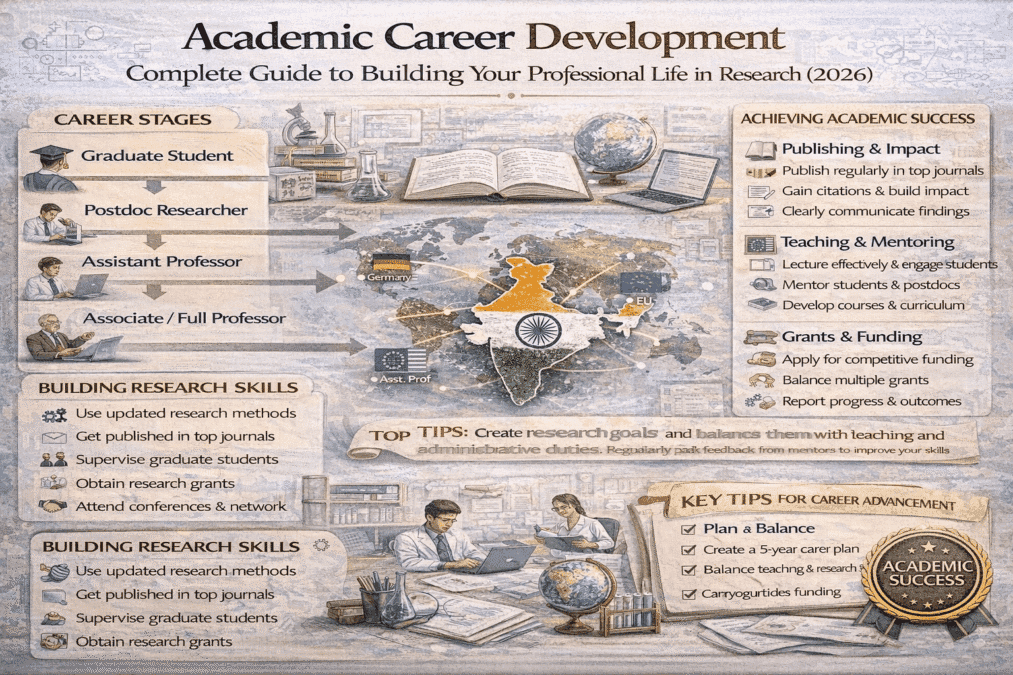
PhD → Postdoc (often 1–3 years) → Assistant Professor → Associate Professor (with tenure, after ~6 years) → Full Professor
India-Specific Requirements (2026) — UGC Framework
- PhD in relevant subject (mandatory)
- UGC-NET (JRF) or SLET qualification OR strong research publication record in UGC-approved journals
- Academic Performance Indicator (API) score calculated under UGC framework
- Career Advancement Scheme (CAS): Assistant Professor → Associate Professor (after 4 years + criteria) → Professor (after 5 more years + enhanced criteria)
- NEP 2020 emphasis: research publications, funded projects, PhD supervision, NAAC quality assessments
- UGC Career Progression Guidelines | UGC-NET
| Pros | Cons |
| Intellectual freedom to pursue your research | Very competitive—hundreds of applicants per position |
| Job security (after tenure) | High pressure to publish and get grants constantly |
| Work with students who care about ideas | 6+ years of pre-tenure stress |
| Respected and stable position | May require moving cities or states for jobs |
Teaching-Focused Faculty
Positions focused primarily on teaching, less on research. Often more job openings than research positions. Typically heavier teaching loads (4–5 courses per semester) but better work-life balance and stronger student-centered culture.
Success requires: excellent teaching, some publications (institution-dependent), curriculum development skills, student mentoring.
Postdoctoral Research
Temporary positions (1–3 years) to publish from your dissertation, learn new skills, and build your CV before a permanent job. Often required for research university positions.
| Individual Fellowships | Lab/Project Postdocs |
| You propose your own research project | You join someone’s funded research program |
| More independence and control | More structured, clearer deliverables |
| Strengthens faculty job applications more | Easier to find—more openings available |
| Examples: Fulbright, ICSSR postdoc, DST National Postdoc | Lab postdocs in STEM, project postdocs in social sciences |
Research Institutes and Think Tanks
Non-university research organizations focused on policy-relevant work. Often more applied than academic research, with direct policy impact.
- Indian examples: Centre for Policy Research (CPR), ICRIER, Observer Research Foundation (ORF), Tata Institute of Social Sciences research centers.
- Pros: Policy-relevant impact, less teaching, intellectual community.
- Cons: Grant-dependent (less secure), project-driven work, may have less academic freedom.
Government Research Positions
- Examples in India: NITI Aayog, Indian Council of Agricultural Research (ICAR), DRDO, government research labs.
- Pros: Job security, good benefits, stable salary, direct policy impact.
- Cons: Bureaucratic processes, less academic freedom, publication may be restricted.
Industry and Alternative Careers (Rapidly Growing in India 2026)
India’s expanding research economy is creating significant new opportunities for PhD holders:
| The Growing PhD Job Market in India (2026) |
| Global Capability Centers (GCCs): 1.6M+ research jobs in India. Tech: Google, Microsoft, Amazon research labs. Pharma: Dr. Reddy’s, Sun Pharma, Biocon R&D. Pay: ₹12–30 lakhs annually. |
| Consulting: McKinsey, BCG, Deloitte research divisions. High pay, fast-paced applied research. |
| Data Science & AI/ML roles: Growing demand across sectors. Especially for quantitative PhDs. ₹15–40 lakhs. |
| EdTech: Byju’s, Unacademy—content development, curriculum design, assessment. Growing sector. |
| Hybrid Careers (increasingly common): Academia + consulting, part-time faculty + industry research, adjunct teaching + independent consulting. |
Navigating the Academic Job Market
If you want a tenure-track faculty position, understand the process and timeline. This market is competitive, but preparation makes a significant difference.
The Timeline (India and Global)
| Stage | Typical Timing |
| Jobs posted | August–November (for positions starting next August) |
| Applications due | October–January |
| Initial interviews (phone/video) | January–March |
| Campus visits | February–April |
| Offers made | March–May |
Application Materials That Win Positions
| Document | What It Must Accomplish |
| Cover Letter (2–3 pages) | Why this specific position, your research agenda, teaching interests, how you fit the department. Tailor every letter—never send generic. |
| CV (comprehensive) | Your complete professional record as detailed in Section 1 of this guide. |
| Research Statement (2–5 pages) | Your research so far, future plans, contribution to the field, fit with the department’s strengths. |
| Teaching Statement (1–3 pages) | Your teaching philosophy, experience, courses you can teach, evidence of effectiveness. |
| Writing Sample | Published paper or dissertation chapter. Your absolute best work (20–30 pages). |
| Letters of Recommendation (3–4) | Your advisor (always), committee members, teaching reference, collaborator if appropriate. |
The Campus Visit: What to Expect
Campus visits typically last 1–2 days and are exhausting but crucial. They’re evaluating fit as much as qualifications.
- Job talk (50 minutes): Present your research. Practice until it runs perfectly to time.
- One-on-one meetings with faculty: They’re assessing whether you’ll be a good colleague.
- Meeting students: Often a formal lunch or informal conversation. Students’ opinions matter.
- Teaching demonstration: Sometimes required, especially for teaching-focused positions.
- Dinner with committee: Semi-formal. Be collegial and ask genuine questions.
Remember: Campus visits are two-way. You’re also deciding if you want to work there. Ask about collegial culture, research resources, course loads, and mentorship for junior faculty.
Negotiating Your Job Offer
If you receive an offer, negotiate. It’s expected—not aggressive. Most institutions have flexibility.
| What You Can Negotiate | How to Do It Well |
| Salary | Know market rates (ask mentors). Justify requests with data. |
| Start-up funding (lab/research expenses) | Essential for researchers who need equipment. |
| Moving expenses | Often available but sometimes not offered automatically. |
| Course releases (time to focus on research) | Especially valuable in your first year. |
| Teaching load | Can you teach your specialty? Can you reduce load initially? |
| Summer salary | One or two months of additional pay for research. |
Be professional, be grateful, justify your requests, and be flexible. Get everything agreed in writing. Two rounds of negotiation is usually the maximum.
Building Your Online Academic Presence
In 2026, an online presence is a professional necessity, not an optional extra.
What You Need (and What Helps)
| Essential | Strongly Recommended |
| Institutional email (check regularly) | Google Scholar profile (tracks citations automatically) |
| Updated institutional webpage | ResearchGate or Academia.edu (share papers, get reach) |
| LinkedIn (professional networking) | |
| ORCID iD (unique researcher identifier—free at orcid.org) | |
| Personal website (shows your work professionally) |
Personal Website: What to Include
- About page: Who you are, your research interests in plain language
- CV: PDF download link (keep it current)
- Publications: With links to PDFs or publisher pages when possible
- Contact information: Email address at minimum
Free options: WordPress.com, Wix, Squarespace, or GitHub Pages if you’re comfortable with code.
An outdated website is worse than no website. If you create one, commit to updating it at least twice a year.
Social Media for Academics
- Share your research when published—link to papers, explain findings in plain language
- Engage respectfully with field developments—comment thoughtfully on others’ work
- Use relevant hashtags (#AcademicTwitter, field-specific tags)
Wrong – Constant self-promotion—share others’ work generously
Wrong – Arguing aggressively—future colleagues and employers can see your public posts
Wrong – Sharing unprofessional content—even on ‘personal’ accounts
Managing Career Setbacks and Building Resilience
Academic careers involve rejection at every stage. This isn’t a personal failure—it’s the nature of the work. What matters is what you do with it.
Common Setbacks (And That They’re Normal)
| Setback | Reality Check |
| Job applications rejected (sometimes 50+ with no offers) | Even brilliant researchers face multiple search years. Persistence is the differentiator. |
| Papers rejected repeatedly | Most published papers were rejected 1–5 times before acceptance. |
| Grants not funded (90% rejection for some programs) | Experienced researchers have much higher rejection rates than success rates. |
| Criticism of your work | Peer review is the system working—it makes work better. |
| Imposter syndrome | Almost universal among PhD students and faculty. You’re not alone. |
Strategies That Actually Build Resilience
- Separate feedback from self-worth: A rejected paper doesn’t mean you’re not a good researcher.
- Learn from rejection: What specifically can you improve? Make it a diagnostic, not a verdict.
- Maintain perspective: One rejection isn’t career-ending. Accumulation of them creates careers.
- Build support networks: Colleagues who understand academia’s pressures are invaluable.
- Celebrate small wins: Every accepted paper, every positive teaching evaluation, every new connection.
- Seek help when needed: Therapy, counseling, and mentoring aren’t signs of weakness.
Legal Research and Writing: Complete Guide for Law Students and Legal Researchers
FAQs
Q: How do you build an academic career in India?
Building an academic career in India requires: completing UGC-NET (or PhD exemption); publishing in UGC-CARE listed or Scopus-indexed journals to build API score; presenting at national and international conferences to establish visibility; gaining teaching experience through guest lectures, tutorials, or adjunct positions; completing a PhD at a recognised institution; and applying to faculty positions through the prescribed process at UGC-regulated universities or NLU selection committees. Start building all these elements during the PhD, not after — the academic job market is competitive and track record takes years to build.
Q: What is the API system for Indian academics?
The Academic Performance Indicator (API) system is a scoring framework under UGC (Minimum Qualifications for Appointment of Teachers) Regulations 2018 used for faculty appointments and promotions at Indian universities. It assigns points for: research publications (highest for Scopus/WoS indexed journals); conference presentations; books and book chapters; research projects; and teaching activities. Minimum API thresholds must be met for appointment and promotion. Top NLUs increasingly assess publication quality beyond API scores — a Scopus journal publication carries more weight than multiple publications in unindexed journals.
What qualifications do you need to become a professor in India?
Under UGC 2018 regulations: Assistant Professor requires a PhD from a recognised institution plus UGC-NET (or equivalent) qualification, or 55% at Master’s level with NET for some disciplines. Associate Professor requires: 8 years of teaching/research experience as Assistant Professor with required API score and at least two peer-reviewed publications. Professor requires: 10 years total experience as Associate Professor with a higher API threshold. NLUs may have additional requirements — always check the specific institution’s latest recruitment notification.
Q: How important is UGC-NET for an academic career in India?
UGC-NET is mandatory for Assistant Professor appointments at central universities and most state universities unless the PhD exemption applies under the 2009 or 2018 regulations. For NLUs: most require NET or a PhD from a recognised institution, but several NLUs waive NET for strong PhD holders with publications. NET qualification alone is not sufficient for competitive faculty positions — it is the minimum threshold, not the differentiating factor. Candidates are shortlisted primarily on research output, PhD quality, and teaching experience.
Q: When should you start preparing for academic job applications?
Start preparing academic job application materials in the final year of your PhD: draft and revise your academic CV; write a research statement describing your research programme and next three years of work; prepare a teaching statement with specific examples; identify and cultivate relationships with two or three referees who know your research well; and publish at least one paper from your thesis before applying. The academic job market moves slowly — applications submitted without publications are rarely shortlisted at competitive institutions.
Key Takeaways from Module 9
Your academic career is a marathon, not a sprint. Here’s what to carry forward:
| What to Remember |
| Start now: Career development begins during your PhD, not after. Every presentation, paper, and relationship counts. |
| Your CV is your story: Update it regularly and be specific. Vague entries tell employers nothing. |
| Networking is about real relationships: Make friends who share your interests. Give before you ask. |
| Conferences are opportunities: Present, listen, ask questions, follow up within a week. |
| Multiple career paths exist: Tenure-track faculty is one option. Think tanks, policy roles, industry research, and hybrid careers are all legitimate and growing. |
| The job market is competitive but navigable: Preparation, tailored materials, and persistence are your tools. |
| Setbacks are part of the process: Everyone faces rejection. What differentiates successful researchers is learning from it and continuing. |
| Build your online presence: Google Scholar, ORCID, a simple website. Be findable and professional. |
Most importantly: maintain your integrity, help others along the way, and remember that success takes many forms. The goal isn’t just employment—it’s a meaningful career doing work that matters.
Author
Dr. Rekha Khandelwal, a legal scholar and academic writing expert, is the founder of AspirixWriters. She has extensive experience in guiding students and researchers in writing research papers, theses, and dissertations with clarity and originality. Her work focuses on ethical AI-assisted writing, structured research, and making academic writing simple and effective for learners worldwide.
Author Profile Dr. Rekha Khandelwal | Academic Writer, Legal Technical Writer, AI Expert & Author | AspirixWriters
Selected References for Further Reading
Career Development
- Kelsky, K. (2023). The Professor Is In (2023 Edition). Penguin.
- Semenza, G. C. (2024). Graduate Study for the Twenty-First Century (3rd ed.). Palgrave.
- Graf, K. (2024). The Hybrid Academic. Routledge.
CV and Application Materials
- Vick et al. (2022). The Academic Job Search Handbook (6th ed.). U Penn Press.
- Belcher, W. L. (2025). The A+ Academic Job Search. Columbia UP.
Alternative Careers
- Basalla & Debelius (2015). ‘So What Are You Going to Do with That?’ (3rd ed.). U Chicago Press.
- Goldbeck-Wood, S. (2024). PhD to CEO: Industry Careers for Research Scholars. Wiley.
India Academic Context
- UGC National Education Policy 2020: Academic Career Progression Guidelines
- UGC-NET Career Progression Framework
- Association of Indian Universities – Career Resources
- Nature Careers – India PhD Employment Survey (2026)
Networking and Conferences
- Day, R. A. (2022). How to Present at International Conferences. Wiley-Blackwell.
- Austin & McDaniels (2006). Preparing the Professoriate of the Future. Higher Education, 31.
- The Academic CV: Building a Record That Gets You Interviews
- Conference Strategy: Choosing, Presenting, and Networking Effectively
- The Academic Job Application Package: Cover Letter, Research Statement, Teaching Statement
- The Indian Academic Job Market: UGC-NET, API, Promotions, and Navigating the System
- Alternative and Hybrid Careers for Indian Research Scholars
- Module 1 The Complete Guide to Research Paper and Thesis Structure
- Module 2 The Academic Writing Process: Complete Guide from First Draft to Submission (2026)
- Module 3 Research Methodologies: Complete Guide to Quantitative, Qualitative, Mixed Methods & Legal Research (2026)
- Module 4 Data Analysis and Results Presentation: Complete Guide for Quantitative, Qualitative & Legal Research (2026)
- Module 5 Organization and Academic Tone: Complete Guide to Professional Scholarly Writing (2026)
- Module 6 Peer Review and Publication: Complete Guide from Submission to Acceptance (2026)
- Module 7 AI Tools in Academic Research: Opportunities, Ethics, and Best Practices (2026)
- Module 8 Grant Writing and Research Funding: Complete Guide to Finding Money for Your Research (2026)
- Module 9Academic Career Development: Complete Guide to Building Your Professional Life in Research (2026)
- Module 10 Research Ethics and the IRB Process: Complete Guide to Doing Research Responsibly (2026)
No post found!