Last Updated: May 11, 2026
Motor Vehicles Act Section 2 definitions (Key Definitions) MVA 01
Part of: Motor Vehicles Act 1988 Series Motor Vehicles Act 1988 India: Complete Guide
Imagine this: you are reading the Motor Vehicles Act and come across the line — ‘no person shall drive a motor vehicle in any public place.’ Simple enough, right?
But wait — what exactly is a ‘motor vehicle’? Does a tractor count? What about a golf cart inside a hotel property? And what is a ‘public place’? Is your housing society’s internal road a public place?
These are not silly questions. In real court cases — insurance claims, accident disputes, MACT hearings — the answer to ‘what counts as a motor vehicle’ or ‘was that a public place?’ can completely change the outcome of a case.
This is why Section 2 of the Motor Vehicles Act, 1988 exists. It contains 47 definitions — the building blocks of the entire law. Before any section of this Act can be applied, you first need to understand what its key terms mean.
In this post, we explain the most important definitions in Section 2 in simple language — with real-life examples, common mistakes, and the changes introduced by the 2019 Amendment.
Download the free MACT Claim Filing Checklist PDF 2026
What Is Section 2 of the Motor Vehicles Act?
Section 2 is the definitions section. It is Chapter I of the Act — the very first substantive content after the title. It lists 47 defined terms, each of which is used throughout the rest of the Act’s 217 sections.
Think of Section 2 as the dictionary for the entire Act. Just like you cannot read a textbook without understanding the subject-specific vocabulary, you cannot apply any provision of the Motor Vehicles Act without first knowing what its key terms mean.
Why Definitions Matter in Law: In Indian courts, the definition given in the Act is the only legally accepted meaning. You cannot substitute a dictionary meaning or a common-sense understanding. If Section 2(28) says ‘motor vehicle means a mechanically propelled vehicle adapted for use upon roads,’ then a vehicle that runs on rails — even if it has an engine — is NOT a motor vehicle under this Act. Legal definitions override everyday meanings.
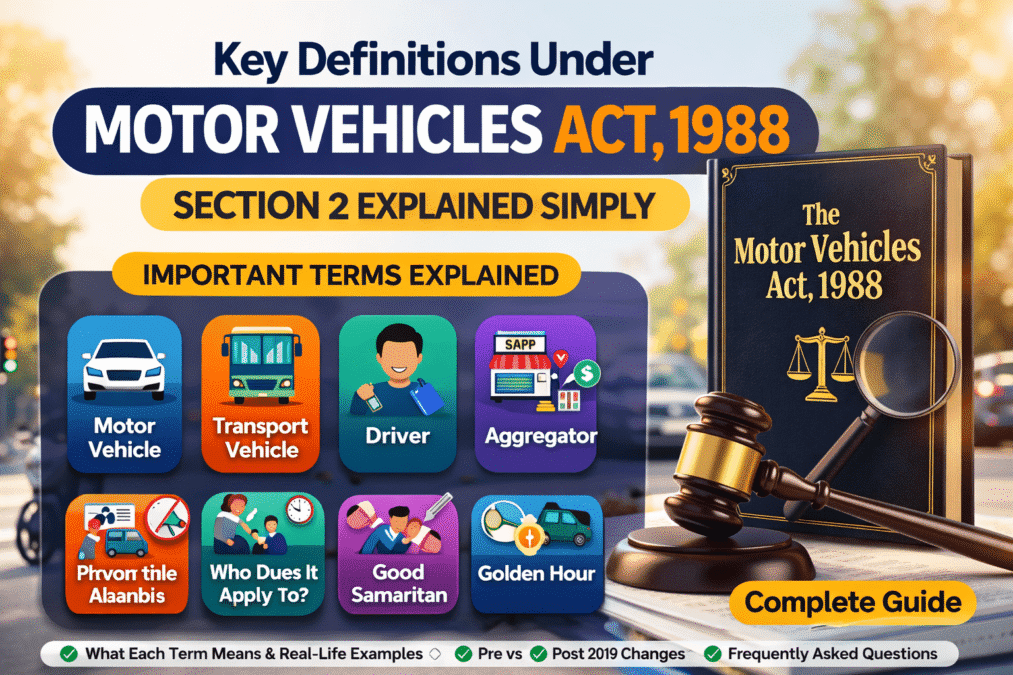
8 Most Important Definitions in Section 2 — Explained Simply
We have picked the 8 definitions that appear most frequently in exams, court cases, and everyday road law situations.
1. Motor Vehicle Section 2(28): Any vehicle that is mechanically propelled (runs on an engine) and is designed or adapted to be used on roads. It does NOT include vehicles that run on rails — so a tram is excluded.
Real-life example: Your car, motorcycle, bus, and truck are all motor vehicles. An electric scooter with a motor is also a motor vehicle. But a cycle rickshaw (no engine) is NOT a motor vehicle. A tram running on rails is NOT a motor vehicle under this Act.
2. Transport Vehicle Section 2(47) A motor vehicle used to carry goods or passengers for hire — in other words, a commercial vehicle. This includes public service vehicles, goods carriages, educational institution buses, and private service vehicles.
Real-life example: The Ola cab you book is a transport vehicle. The truck carrying vegetables from Jaipur to Delhi is a transport vehicle. Your personal car that you drive yourself is NOT a transport vehicle — even if you occasionally give a friend a lift.
3. Driver Section 2(9): Any person who drives or attempts to drive a motor vehicle. Even if you just try to start a vehicle and move it a few inches — you are legally a ‘driver’ under this Act.
Real-life example: Vikram sits in the driver’s seat, starts the ignition, and moves the car 2 feet before being stopped. He has no licence. Under Section 2(9), he is a ‘driver’ and is liable under Section 3 (necessity for driving licence). The word ‘attempts’ is key — you do not need to actually complete a drive.
4. Public Place Section 2(34): Any road, street, or place to which the public has a right of access — whether they pay for it or not. It also includes bus stops and passenger pick-up points. It does NOT require the place to be government-owned.
Real-life example: A national highway, a street in your city, a shopping mall’s car park open to visitors, and a hotel’s driveway used by guests are all ‘public places.’ But a private factory compound where only employees enter on an ID card would generally NOT be a public place. Courts have held that housing society internal roads connected to public roads often qualify as public places.
Common Mistake — ‘Public Place’ is Wider Than You Think: Many people believe that only government roads are ‘public places.’ This is wrong. Under Section 2(34), any place to which the public has a right of access — even a privately owned area like a mall parking lot or a petrol station forecourt — is a public place. This means traffic rules and driving licence requirements apply there too.
5. Permit Section 2(31): A document issued by the State or Regional Transport Authority that authorises a motor vehicle to be used as a transport vehicle on a particular route or area. Without a permit, a commercial vehicle cannot legally operate.
Real-life example: A private bus operator in Rajasthan wants to run a route from Jaipur to Ajmer. Before the first journey, the operator must obtain a Stage Carriage Permit from the State Transport Authority. Driving that bus without a permit is an offence under Section 66, with a fine of up to Rs. 10,000.
6. Aggregator Section 2(1A) — Inserted by 2019 Amendment: A digital platform or app that connects passengers with drivers for transportation services. Like: Ola, Uber, Rapido, and similar ride-hailing apps are all aggregators under this Act.
Real-life example: When you open Ola and book a cab, you are using an aggregator. The app (Ola) does not own the car — it just connects you with a nearby driver. The 2019 Amendment made it mandatory for all such platforms to obtain a licence from the State Government (Section 93, enforced from April 2022 per Gazette S.O. 859(E)).
Pre vs Post 2019: Before the 2019 Amendment, there was NO definition of ‘aggregator’ in the Act. App-based cab services existed in a legal grey zone — regulators had no clear authority over them. The 2019 Amendment inserted Section 2(1A) defining aggregators and Section 93 requiring them to obtain state licences and comply with the IT Act, 2000. This is one of the most practically significant new additions.
7. Good Samaritan Section 134A — Inserted by 2019 Amendment (defined in context): A person who voluntarily and in good faith provides emergency help to an accident victim — medical or non-medical — without expecting any reward or payment in return. Such a person gets full legal protection under the 2019 Amendment.
Real-life example: You are driving on a highway and see a road accident. You stop, help the injured person into your car, and rush them to the nearest hospital. You are a Good Samaritan. Under Section 134A, the police cannot force you to give a statement, cannot detain you at the station, and you cannot be sued for your actions. Before 2019, bystanders feared legal harassment — this definition was a game-changer.
8. Golden Hour Section 2(12A) — Inserted by 2019 Amendment: The one-hour period immediately after a traumatic injury during which prompt medical treatment has the highest chance of preventing death. The Act specifically uses this term to make cashless treatment during the golden hour a legal entitlement for accident victims.
Real-life example: Priya is hit by a car and lies injured on the road at 8 PM. Under the 2019 Amendment’s golden hour scheme (Section 164C), any nearby hospital must provide her cashless treatment without demanding documents or payment upfront during that first hour. The Motor Vehicle Accident Fund covers this cost. The definition of ‘golden hour’ makes this scheme legally enforceable.
Download the free MACT Claim Filing Checklist PDF 2026
Quick Reference — All 8 Definitions
| Term | Section | In One Line | Pre-2019? |
| Motor Vehicle | Sec 2(28) | Engine-powered road vehicle (not on rails) | Yes |
| Transport Vehicle | Sec 2(47) | Commercial vehicle — goods or passengers for hire | Yes |
| Driver | Sec 2(9) | Anyone who drives OR attempts to drive | Yes |
| Public Place | Sec 2(34) | Any road/place the public can access | Yes |
| Permit | Sec 2(31) | Authority to operate a transport vehicle commercially | Yes |
| Aggregator | Sec 2(1A) | App-based cab/taxi platform (Ola, Uber) | New — 2019 |
| Good Samaritan | Sec 134A | Voluntary emergency helper — fully protected | New — 2019 |
| Golden Hour | Sec 2(12A) | First 60 mins post-accident — cashless treatment right | New — 2019 |
3 Common Mistakes People Make About These Definitions
Mistake 1 — ‘My car is not a transport vehicle so permits don’t apply to me’
Correct — your personal car is not a transport vehicle. But the moment you start using it commercially — as an Ola/Uber driver, for example — it becomes a transport vehicle and you need both an LMV-TR (transport) endorsement on your driving licence and your aggregator platform needs a state licence. Using a private car for commercial purposes without the right endorsement is a common and costly error.
Mistake 2 — ‘I only moved the car 3 feet, I wasn’t really driving’
Under Section 2(9), even attempting to drive makes you a driver. If you move a vehicle without a valid licence – even briefly, even inside what you think is a private area – you can be charged under Section 3 (necessity for licence). Courts have held that ‘attempting to drive’ is wide enough to cover any physical act of operating the vehicle.
Mistake 3 — ‘Helping an accident victim will get me in trouble’
Before 2019, this fear was somewhat understandable. After the 2019 Amendment introduced the Good Samaritan provisions (Section 134A), this fear has no legal basis. You are fully protected when you help voluntarily, in good faith, without expecting payment. The police cannot make you a witness, cannot detain you, and you have no civil or criminal liability for the outcome of your assistance.
Latest Update 2026 — What Has Changed?
Latest Update 2026: No new definitions were added to Section 2 in 2025–26. However, the Jan Vishwas (Amendment of Provisions) Act, 2023 — which came into effect in January 2025 – introduced compounding of minor offences (Section 177A), which slightly affects how ‘penalty’ provisions interact with the definitions.
Additionally, with EVs growing rapidly, the Ministry of Road Transport and Highways has been working on clarifications around electric two-wheelers with motors above 250 watts-these clearly fall under the ‘motor vehicle’ definition in Section 2(28). For the latest notifications, always check morth.nic.in and indiacode.nic.in.
Download the free MACT Claim Filing Checklist PDF 2026
Summary — 6 Quick Revision Points
Quick Revision:
1. Section 2 has 47 definitions — the legal dictionary for the entire Motor Vehicles Act.
2. Motor Vehicle = engine-powered + designed for roads + NOT on rails. Trams and rail vehicles are excluded.
3. Public Place is wider than you think — any place the public can access, including private mall parking lots.
4. Aggregator and Good Samaritan are the two most important NEW definitions added by the 2019 Amendment.
5. Golden Hour = first 60 minutes after a traumatic injury — accident victims have a legal right to cashless treatment during this time.
6. Attempting to drive makes you a ‘driver’ under Section 2(9) — even if you barely moved the vehicle. Exam tip: the word ‘attempts’ is key.
FAQ — Key Definitions Under Motor Vehicles Act 1988
Q1. How many definitions are there in Section 2 of the Motor Vehicles Act, 1988?
Section 2 of the Motor Vehicles Act, 1988 contains 49 definitions. These cover every key term used throughout the Act’s 217 sections — from ‘motor vehicle’ and ‘driver’ to ‘permit,’ ‘public place,’ and the newer additions like ‘aggregator’ and ‘golden hour’ inserted by the 2019 Amendment. Knowing these definitions is essential for CLAT, Judiciary, and UGC NET aspirants.
Q2. What is the legal definition of ‘motor vehicle’ in India?
Under Section 2(28) of the Motor Vehicles Act, 1988, a motor vehicle is any mechanically propelled vehicle adapted for use on roads — whether the power comes from an internal or external source. This includes cars, motorcycles, buses, trucks, tractors, and electric vehicles with motors. Vehicles that run on rails (trams, metro trains) are specifically excluded. A cycle with a detachable motor is included.
Q3. What does ‘public place’ mean under the Motor Vehicles Act?
Section 2(34) defines a public place as any road, street, way, or other place to which the public has a right of access — whether or not payment is required for access. This includes government roads, privately owned shopping mall car parks, hotel driveways, petrol station forecourts, and often housing society roads connected to public streets. If the public can generally access an area, it is a public place under this Act.
Q4. What is an ‘aggregator’ under the Motor Vehicles Act?
An aggregator is defined in Section 2(1A) — inserted by the 2019 Amendment — as a digital intermediary or marketplace that connects passengers with drivers for transportation services. Simply put, Ola, Uber, Rapido, and similar app-based cab services are aggregators. Under Section 93 of the Act (effective April 2022), all aggregators must obtain a licence from the State Government and comply with the Information Technology Act, 2000.
Q5. What is the ‘Golden Hour’ rule in the Motor Vehicles Act?
The term ‘golden hour’ is defined in Section 2(12A), inserted by the 2019 Amendment, as the one-hour period following a traumatic injury during which there is the highest likelihood of preventing death through prompt medical care. The Act uses this definition to create the Golden Hour Scheme under Section 164C — under which any accident victim is entitled to cashless treatment at a nearby hospital during the first hour after the accident. The Motor Vehicle Accident Fund covers the cost.
Q6. How does the definition of ‘driver’ affect legal cases in India?
The definition in Section 2(9) includes anyone who ‘drives or attempts to drive.’ This is broader than everyday usage. In insurance and MACT cases, courts have held that even a brief, unsuccessful attempt to move a vehicle — without a valid licence — makes the person a ‘driver’ who has violated Section 3. This definition also affects Section 199A (juvenile driver liability), where even an ‘attempt’ by a minor can trigger guardian liability.
Q7. Were the ‘Good Samaritan’ and ‘Aggregator’ definitions in the original 1988 Act?
No. Both were added by the Motor Vehicles (Amendment) Act, 2019 (Act No. 32 of 2019). The original 1988 Act had no provisions for app-based ride-hailing platforms (they did not exist then) and no formal Good Samaritan protection. The 2019 Amendment inserted Section 2(1A) for aggregators and Section 134A for Good Samaritans — two of its most practically impactful additions. Source: egazette.nic.in; indiacode.nic.in.
Read More – Motor Vehicles Act Series
| Navigate | Post Title | Link |
| ← Previous Post | What is the Motor Vehicles Act, 1988? Simple Explanation | What Is The Motor Vehicles Act 1988 India? |
| ↑ Pillar Post | Motor Vehicles Act 1988 — Complete Legal Guide | Motor Vehicles Act 1988 India: Complete Guide |
| → Next Post | Driving Licence Rules India — Complete Guide (MVA-03) | Driving Licence Rules in India:Complete Guide Under Motor Vehicles Act, 1988 |
| Also Read | Traffic Fines & Penalties India 2024 (MVA-07) | Traffic Rules and Penalties in India 2026 — Complete Guide (Challan, Fines & Sections) |
| Also Read | Good Samaritan Law India — Section 134A Explained | Good Samaritan Law in India — Section 134A MV Act Explained Simply (2026) |
Official References:
- Motor Vehicles Act, 1988 (Act No. 59 of 1988)
Bare Act PDF – India Code - Motor Vehicles (Amendment) Act, 2019 (Act No. 32 of 2019)
PRS Legislative Summary
S.O. 859(E) – Sections 50-57 & 93 Notification - Jan Vishwas (Amendment of Provisions) Act, 2023 (Act No. 18)
Official Gazette PDF
Disclaimer: This article is for educational purposes only and does not constitute legal advice. All statutory provisions are subject to amendment. Verify current rules at indiacode.nic.in. For specific legal problems, consult a qualified advocate. Last Updated: April 2026.
About Author
Dr. Rekha Khandelwal is a Ph.D. in Law, legal researcher, and founder of AspirixWriters.com. She specializes in simplifying Indian laws and academic concepts into clear, practical knowledge for students, aspirants, and the general public.
Dr. Rekha Khandelwal | Academic Writer, Legal Technical Writer, AI Expert & Author | AspirixWriters
P

Free MACT Claim Filing Checklist PDF 2026
MACT Claim Filing Checklist Part of Motor Vehicles Act 1988 India: Complete Guide Road accidents…
Motor Vehicles (Amendment) Act, 2019 Explained — Key Changes, Penalties & Latest Updates 2026
Motor Vehicles Amendment Act 2019 — Complete Guide (MVA-11) Part of Motor Vehicles Act 1988…

Good Samaritan Law in India — Section 134A MV Act Explained Simply (2026)
Good Samaritan Law India — Section 134A (MVA-10) Part of Motor Vehicles Act 1988 India:…
MACT Claims in India: Step-by-Step Process, Compensation & Rules (2026 Guide)
MACT Claim in India 2026 – MVA-09 Part of Motor Vehicles Act 1988 India: Complete…
Motor Insurance & Third Party Law in India : MV Act 1988 Complete Guide 2026
Motor Insurance & Third Party Law India -MVA-08 ← Previous: Traffic Rules & Fines (MVA-07)…
Traffic Rules and Penalties in India 2026 — Complete Guide (Challan, Fines & Sections)
Traffic Rules and Penalties in India 2026 MVA-07: Part of MVA Complete Guide ← Previous:…