
How to File for Mutual Divorce in India
By Dr. Rekha Khandelwal — Legal Specialist, Consultant & Researcher, AspirixWriters | Reviewed & Approved
When both spouses agree that their marriage cannot continue, Indian law provides a simpler and less adversarial way to end the marriage through mutual consent divorce. But what is the legal process? How long does it take? What documents are required? Can you remarry immediately after the divorce decree? This guide answers all these questions in simple language with reference to the applicable laws and Supreme Court judgments.
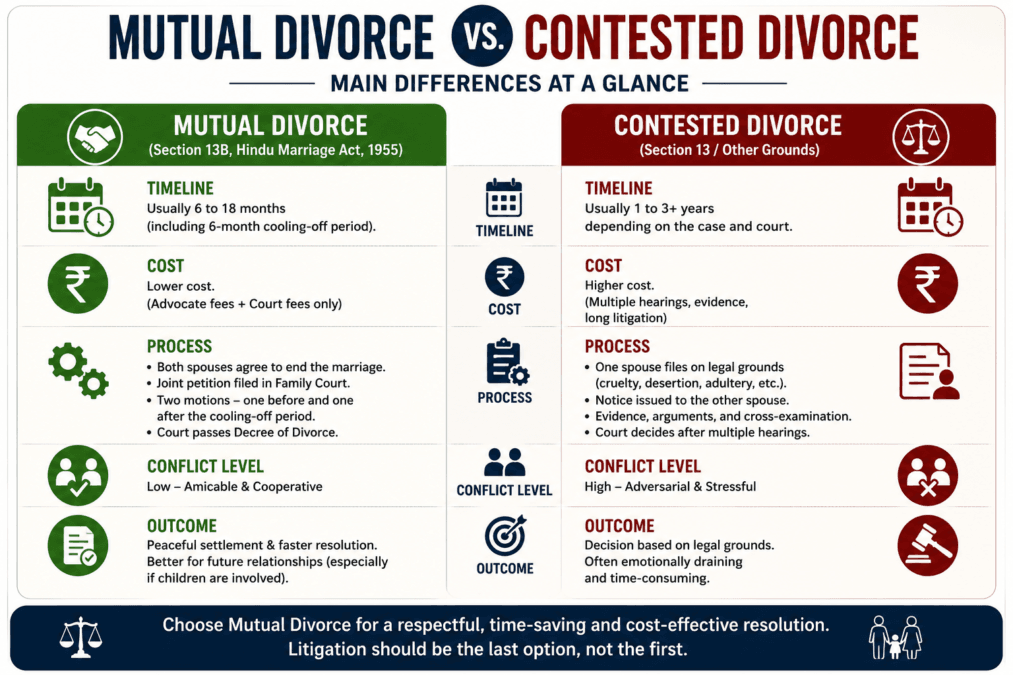
1. What “Mutual Divorce” Actually Means, and Which Law Applies
A mutual consent divorce is a joint petition, filed together by both spouses, asking the court to dissolve a marriage that both agree has irretrievably broken down — without either side having to prove fault such as cruelty or adultery provided both spouses satisfy the statutory conditions under the applicable law. The wife is residing, where permitted under the applicable law. (Section 13B, Hindu Marriage Act, 1955).
Which specific law governs your divorce depends on how — and under which law — your marriage was solemnised:
| Community / Marriage type | Governing provision |
|---|---|
| Hindus, Buddhists, Sikhs, Jains | Section 13B, Hindu Marriage Act, 1955 |
| Interfaith or civil marriages | Section 28, Special Marriage Act, 1954 |
| Christians | Section 10A, Indian Divorce Act, 1869 |
| Parsis | Section 32B, Parsi Marriage and Divorce Act, 1936 |
| Muslims | Dissolution by mutual agreement — Khula or Mubarat, under Muslim personal law |
This guide focuses on the two most commonly used routes — Section 13B (Hindu Marriage Act) and Section 28 (Special Marriage Act) — since their procedure is materially similar.
2. The Legal Conditions You Must Meet
Both Section 13B and Section 28 set out the same three substantive conditions before a joint petition can be filed:
- Living separately for one year or more immediately before filing (Section 13B(1), Hindu Marriage Act, 1955 / Section 28(1), Special Marriage Act, 1954).
- Inability to live together as husband and wife.
- Mutual agreement that the marriage should be dissolved.
“Living separately” does not strictly require two different addresses — courts have accepted couples living under the same roof but without a marital relationship — but you should be prepared to document the separation.
3. The Two-Motion Process, Step by Step
A mutual divorce is not granted in a single hearing. The law builds in two separate appearances before the court, with a mandatory pause in between.
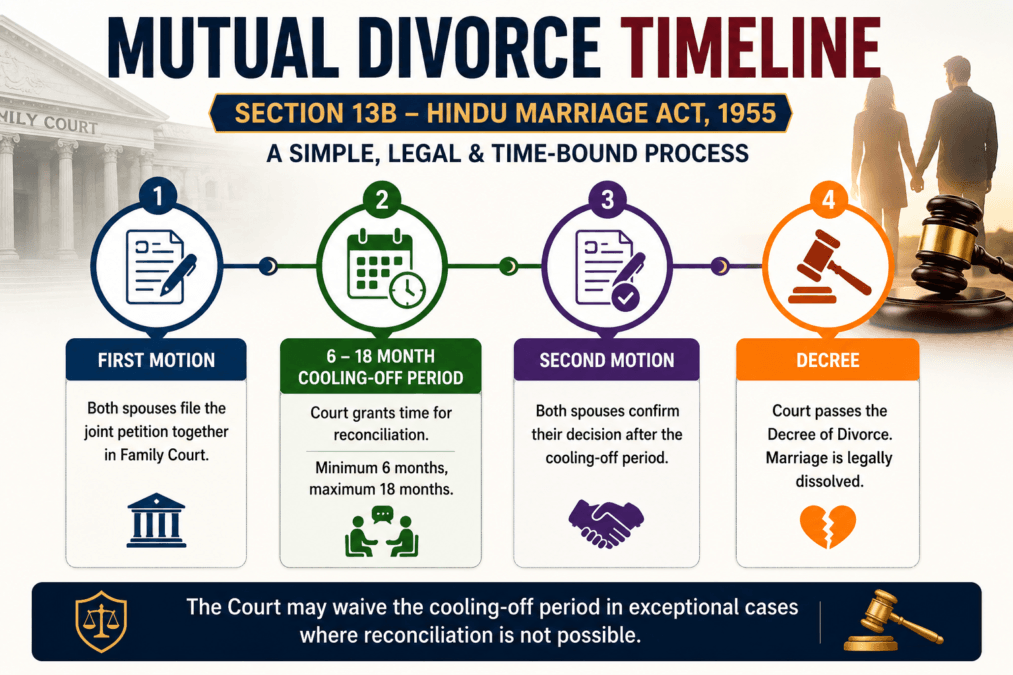
Step 1 — Draft and file the joint petition (First Motion). Both spouses jointly sign and file the petition in the appropriate Family Court, stating the marriage details, the separation period, and their mutual agreement to divorce — along with how they’ve resolved alimony, custody (if there are children), and property, where applicable.
Step 2 — Court records statements and may direct reconciliation. The court hears both spouses, verifies the petition, and — as is standard practice in matrimonial matters — may first refer the couple to mediation or reconciliation before proceeding.
Step 3 — The cooling-off period. After the First Motion, the law requires a wait of not less than six months and not more than eighteen months before the Second Motion can be filed (Section 13B(2), Hindu Marriage Act, 1955). This period exists to give both spouses a final opportunity to reconsider.
Step 4 — The Second Motion. After the cooling-off period, both spouses must appear again to confirm that their consent has not changed. If either spouse withdraws consent at this stage, the mutual petition fails and cannot proceed — the remaining spouse would then need to pursue a contested divorce on a fault ground instead.
Step 5 — Decree of divorce. If the court is satisfied that both parties still consent and all legal requirements are met, it passes a decree of divorce, which legally dissolves the marriage.
Can the six-month wait be skipped? Yes, in appropriate cases. In Amardeep Singh v. Harveen Kaur (2017) 8 SCC 746, the Supreme Court held that the six-month cooling-off period under Section 13B(2) is directory rather than mandatory, and Family Courts can waive it where the couple has already been separated for a significant period, mediation has genuinely failed, and there is no possibility of reconciliation. Separately, the Supreme Court has used its special power under Article 142 of the Constitution to dissolve marriages directly in appropriate cases — but this power belongs only to the Supreme Court, not to Family Courts or High Courts (Shilpa Sailesh v. Varun Sreenivasan, 2023 INSC 468).
4. Where to File: Jurisdiction
The petition must be filed in the Family Court (or District Court, where no separate Family Court exists) having jurisdiction over the couple’s case. In practice, this generally means the court within whose territory:
- the marriage was solemnised, or
- the couple last resided together as husband and wife, or
- the wife is currently residing.
5. Documents You Will Typically Need
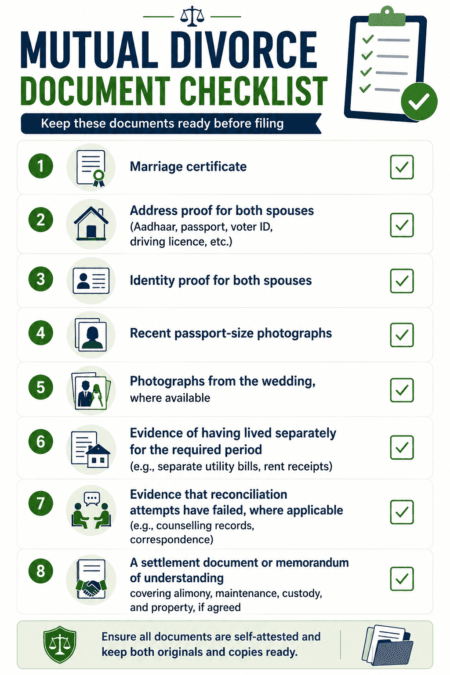
- Marriage certificate
- Address proof for both spouses (Aadhaar, passport, voter ID, driving licence, etc.)
- Identity proof for both spouses
- Recent passport-size photographs
- Photographs from the wedding, where available
- Evidence of having lived separately for the required period (e.g., separate utility bills, rent receipts)
- Evidence that reconciliation attempts have failed, where applicable (e.g., counselling records, correspondence)
- A settlement document or memorandum of understanding covering alimony, maintenance, custody, and property, if agreed
6. Cost and Timeline
Court fees for a mutual divorce petition are nominal — often a fixed, low amount set by the relevant state’s court-fee schedule — and are separate from any advocate’s fees, which vary depending on the city, lawyer’s experience, and complexity of the settlement. Because the process legally requires two motions separated by a cooling-off period, even an uncontested mutual divorce typically takes a minimum of six months from the First Motion, and can extend to twelve months or longer depending on the court’s schedule — unless the cooling-off period is waived under the Amardeep Singh precedent.
7. When Can You Remarry?
This is one of the most common follow-up questions, and the honest answer has two layers — the strict legal position, and the practical caution most lawyers give.
The statutory position: Under Section 15 of the Hindu Marriage Act, 1955, a divorced person may remarry once there is no right of appeal against the divorce decree, or the time limit for filing an appeal has expired without an appeal being filed, or an appeal has been filed and dismissed. Although mutual consent divorces are rarely appealed, waiting until the appeal period expires is generally considered the safer course before remarrying.
The practical caution: Under the Civil Procedure Code, either party generally has up to 90 days from the date of the decree to file an appeal. Because remarrying during this window carries some legal risk if the decree were later challenged or reversed, most family lawyers advise waiting out this appeal period — even in mutual consent cases where an appeal is uncommon — before remarrying, and to keep the certified copy of the divorce decree on hand for marriage registration purposes afterward.
8. Common Mistakes That Delay or Derail a Mutual Divorce
- Filing before completing one year of separation. The petition can be rejected as premature if this statutory condition isn’t met.
- Leaving alimony, custody, or property terms vague. Disputes over these terms at the Second Motion stage are one of the most common reasons a “mutual” case turns contested.
- Assuming consent, once given, is irrevocable. Either spouse can withdraw consent any time before the final decree — including during the cooling-off period — which will stall the mutual route entirely.
- Filing in the wrong court. Jurisdiction mistakes cause delays and, in some cases, require re-filing.
- Remarrying before the appeal period lapses. Even where legally arguable, this is a risk most lawyers recommend avoiding.
9. Frequently Asked Questions
Can we file for mutual divorce without a lawyer?
Yes, this is legally permitted. However, given the drafting requirements for the petition and settlement terms, most couples still engage a lawyer to avoid errors that could delay proceedings.
What happens if one spouse changes their mind after the First Motion?
The mutual consent petition becomes invalid. The other spouse would then need to pursue a contested divorce under the fault-based grounds in Section 13 of the Hindu Marriage Act (or the equivalent under their governing law).
Do we need to have lived in different cities to prove “separation”?
No. Courts have recognised that “living separately” does not necessarily require different residences. Depending on the facts, spouses living under the same roof but leading separate lives may satisfy this requirement.
Is the six-month cooling-off period compulsory in every case?
Not necessarily. Following Amardeep Singh v. Harveen Kaur (2017), Family Courts have discretion to waive it in appropriate cases.
Can NRIs file for mutual divorce in India?
Yes, subject to establishing the correct jurisdiction in India (typically based on where the marriage was solemnised or last shared residence). Courts have permitted remote participation, including video conferencing, in appropriate cases, but procedural requirements should be confirmed with a lawyer familiar with NRI matters.
Can mutual divorce be completed online?
While petitions may be prepared electronically and some courts permit video conferencing in appropriate cases, mutual divorce proceedings generally require compliance with the procedural requirements of the Family Court having jurisdiction.
About the Author
Dr. Rekha Khandelwal is a Legal Specialist, Consultant, Researcher, and Author. She provides research-backed legal insights, AI governance guidance, and educational content to help individuals, students, and professionals better understand the law.
Disclaimer
The content on AspirixWriters is provided for educational and informational purposes only and does not constitute legal advice. Some content may be prepared with AI-assisted tools; however, every article is reviewed, verified and approved by Dr. Rekha Khandelwal. For advice on specific legal matters, please consult …….
Need Professional Assistance?
For legal research, legal writing, AI governance, compliance, or consultancy services, you may contact Dr. Rekha Khandelwal through AspirixWriters.
Official References
- Hindu Marriage Act, 1955 — Sections 13, 13B, and 15, via India Code
- Special Marriage Act, 1954 — Section 28, via India Code
- Indian Divorce Act, 1869 — Section 10A (Christian marriages)
- Parsi Marriage and Divorce Act, 1936 — Section 32B
- Landmark judgments referenced: Amardeep Singh v. Harveen Kaur, (2017) 8 SCC 746; Shilpa Sailesh v. Varun Sreenivasan, 2023 INSC 468; Lila Gupta v. Laxmi Narain, (1978) 3 SCC 258
- National Legal Services Authority (NALSA) — for those who qualify for free legal representation in matrimonial matters
- eCourts Services Portal — case filing and status tracking
- What to Do If Your Fundamental Rights Are Violated in India: A Complete Guide to Article 32 & Article 226
- maintenance/alimony under Family Law
- child custody in divorce
CCFS 2026: Clear Pending ROC Filings with Just 10% Penalty – Limited Time MCA Relief
Companies Compliance Facilitation Scheme 2026 (CCFS 2026): Waive Late fees on Delayed Filings – Act…
Motor Vehicles Act 1988 India: Complete Guide
Motor Vehicles Act 1988 — India’s Complete Road Law Explained Imagine this: you are driving…

What is the Motor Vehicles Act, 1988? (Simple Explanation for Beginners)
What is the Motor Vehicles Act, 1988 India? Motor Vehicles Act 1988 India: Complete Guide…