
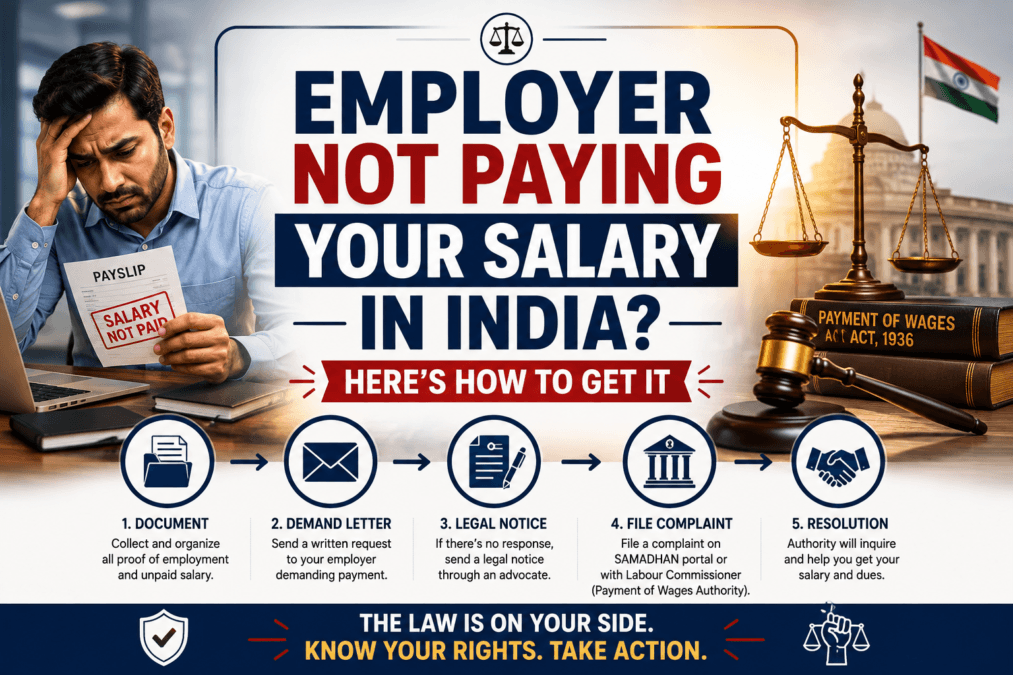
Employer Not Paying Your Salary in India?
Legal Specialist, Consultant & Researcher, AspirixWriters
Unpaid or delayed salary is one of the most common workplace disputes in India — and one of the most misunderstood, because most employees don’t realise the law gives them a fast, largely free way to get their dues back, with compensation on top. This guide walks through exactly how that works.
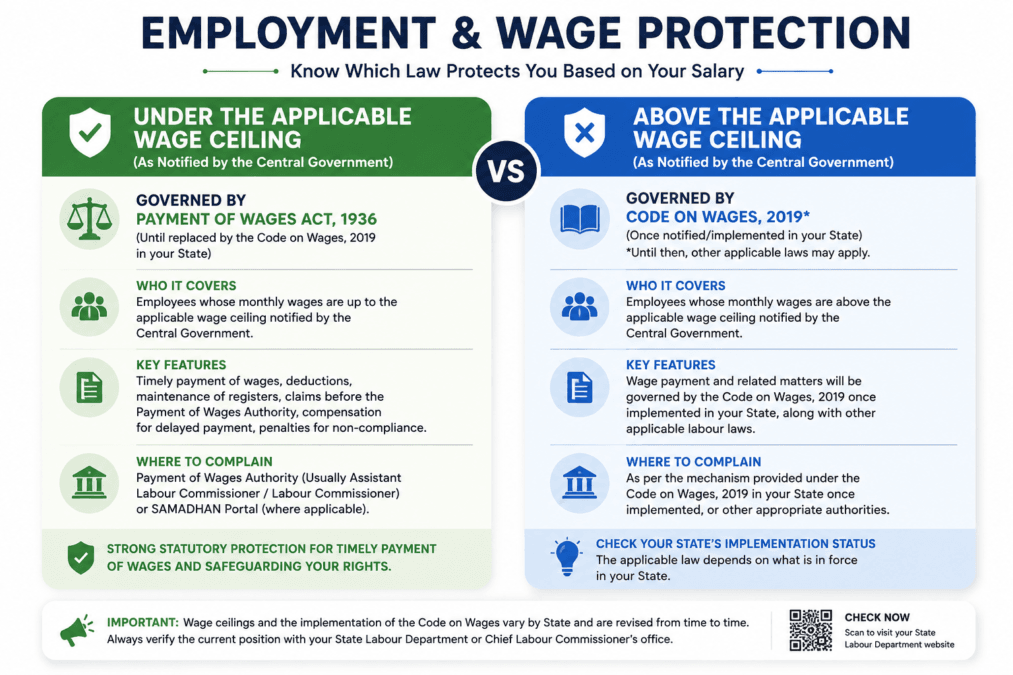
1. The Law That Protects You: Payment of Wages Act, 1936 and the Code on Wages, 2019
The legal framework governing delayed or unpaid wages in India primarily consists of the Payment of Wages Act, 1936 and the Code on Wages, 2019, depending on the applicable legal regime and implementation status in the relevant jurisdiction. Historically, the Payment of Wages Act has been one of India’s oldest labour laws, with a direct purpose: to make sure employees are paid in full, on time, and without unauthorised deductions.
Who it covers: Historically, the Payment of Wages Act, 1936 applied to employees up to a statutory wage limit prescribed by the Central Government. With the enactment of the Code on Wages, 2019, the legal framework is transitioning, and the applicable provisions depend on the implementation status of the Code in the relevant jurisdiction. Employees should verify the current legal position, including any applicable wage thresholds, through the Chief Labour Commissioner (Central), the Ministry of Labour & Employment, India Code, or the relevant State Labour Department before relying on a particular figure.
When your salary is legally due: (Section 5, Payment of Wages Act, 1936)
- Employers with fewer than 1,000 employees must pay wages before the end of the 7th day after the wage period closes.
- Employers with 1,000 or more employees must pay before the end of the 10th day.
What deductions are allowed: Only the specific deductions listed under Section 7(2) of the Act — such as tax, PF, authorised fines, or advances already agreed to. Anything outside this list is an unauthorised deduction, and you can claim it back.
A note on both of the above: these specific timelines and deduction rules come from the 1936 Act. Once the Code on Wages, 2019 is fully in force in your state, it may prescribe different timelines or a different deduction framework — confirm which regime currently governs your situation before relying on the exact figures above.
2. What If You Earn Above the Applicable Wage Ceiling?
The Payment of Wages Act’s direct complaint mechanism is built for employees under the applicable wage threshold. If you earn more:
- If you qualify as a “workman” under the applicable industrial relations framework — historically the Industrial Disputes Act, 1947, now being progressively replaced by the Industrial Relations Code, 2020 depending on your state’s implementation status (broadly, non-managerial/non-supervisory roles, though the exact test depends on your actual duties, not your job title) — the Labour Court is generally the right forum.
- If you’re in a genuinely managerial or supervisory role, your remedy is typically a civil suit for breach of contract. In appropriate contractual money claims, a summary suit under Order XXXVII, CPC may be available where the specific legal requirements are satisfied — this can help recover money faster than a regular civil suit, but it isn’t automatically available for every wage dispute.
- For very large unpaid dues from a company that appears financially unable to pay, some employees pursue insolvency proceedings before the NCLT under the IBC — this is a more specialised route, worth discussing with a lawyer if it applies to you.
3. Step-by-Step: How to Recover Unpaid Salary
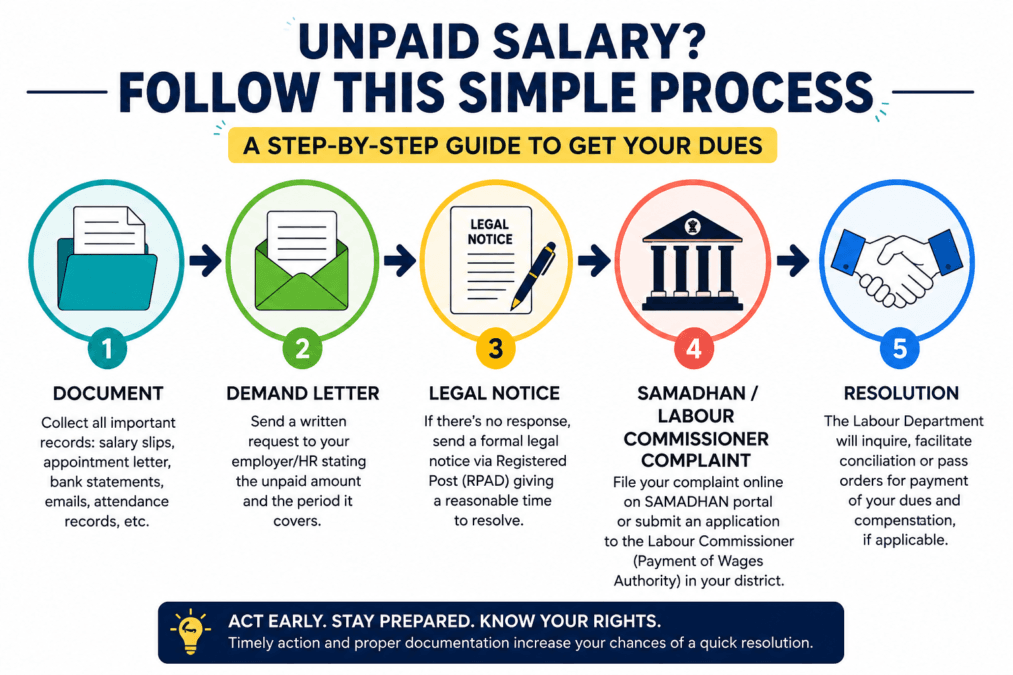
Step 1 — Document everything. Salary slips, appointment letter, bank statements showing (or not showing) salary credits, attendance records, and any written communication about the non-payment. If there’s no formal contract, don’t worry — an employer-employee relationship can still be proved through bank credits, ID cards, emails, or attendance records.
Step 2 — Send a written demand, then a formal legal notice. Start with a simple written request to your employer/HR, clearly stating the amount owed and the period it covers. If that doesn’t work, a formal legal notice — ideally sent by Registered Post with Acknowledgment Due (RPAD), so there’s proof of delivery — is the next step. A legal notice commonly provides the employer with a reasonable period (often 15–30 days) to respond before further legal action, although the appropriate time may vary depending on the circumstances..
Step 3 — File a complaint if the employer still doesn’t pay. Depending on the facts of your case and the applicable legal framework, employees may have one or more of the following options:
- The SAMADHAN portal (samadhan.labour.gov.in) — the Ministry of Labour & Employment’s online system, whose primary purpose is handling labour grievances broadly. Depending on the specific nature of your dispute, employees may be able to submit a wage-related grievance through this portal where applicable — but not every unpaid-salary claim is automatically processed through this exact channel, so confirm the correct route for your specific situation.
- A written application to the Payment of Wages Authority in your district — usually the Assistant Labour Commissioner, Labour Commissioner, or Regional Labour Commissioner, filed under Section 15 of the Act.
Filing is free. Applications before the Payment of Wages Authority generally do not require the employee to pay court fees, though procedural requirements may vary under the applicable legal framework
Step 4 — The Labour Department investigates. The competent authority may summon your employer, examine wage records, conduct an inquiry, facilitate conciliation between you and your employer, or proceed further in accordance with the applicable law — the exact process and outcome depend on the specifics of your case. If your employer cooperates during conciliation, matters are often resolved within a few months; contested cases can take longer.
4. What Can You Actually Claim?
The law Section 15(3) of the Act, doesn’t just help you recover your unpaid salary. In some cases, the Payment of Wages Authority may also award compensation, subject to the limits provided under the Act.:
| Situation | What you can claim |
| Delayed or unpaid wages | Full unpaid amount + compensation, within the range specified under the Act |
| Unauthorised deductions | Full deducted amount + compensation, within the range specified under the Act |
The amount of compensation is decided according to the law and the facts of your case. For the latest applicable limits, you can check with the Payment of Wages Authority or the Labour Departme.
Time limit: Under the Payment of Wages Act, an application should generally be filed within 12 months from the date the wages became due or the deduction was made. In appropriate cases, the Authority may accept a delayed application if sufficient cause for the delay is shown. If the Code on Wages or another legal framework applies in your case, the applicable rules may differ, so don’t delay in taking action..
5. What Happens to the Employer?
Not paying wages can have legal consequences for employers. Depending on the circumstances, the Payment of Wages Act provides for penalties for violations of its provisions. In some cases, the appropriate authority or Labour Inspector may also take action under the law, even without a complaint from the employee. Since the applicable legal framework and penalty provisions may vary, it’s best to verify the current position under the applicable law..
6. A Quick Note on the New Labour Codes
India has introduced four Labour Codes, including the Code on Wages, 2019, which are intended to replace several older labour laws over time. However, the legal position may differ depending on the implementation status in the relevant jurisdiction. As a result, in some situations, provisions of the Payment of Wages Act, 1936 may continue to apply until the new legal framework is fully brought into force.
Before relying on any specific rule, time limit, or procedure, check the current legal position applicable in your State. You can verify this through the Ministry of Labour & Employment, the Chief Labour Commissioner (Central), the relevant State Labour Department, or by seeking advice from a qualified labour law professional.
7. Common Mistakes That Delay Your Claim
- Waiting too long to act. The applicable limitation period is genuinely strict in practice — don’t sit on a wage dispute hoping it resolves itself; confirm the exact current period for your claim and act well within it.
- Signing a “full and final settlement” under pressure. Courts have, in appropriate circumstances, held that statutory rights cannot ordinarily be defeated merely through documents obtained under coercion or undue pressure — so signing such a document doesn’t automatically bar a genuine claim in every case. That said, this is fact-specific and the outcome depends on your particular circumstances, so it’s still best avoided where possible, and worth discussing with a lawyer if you’ve already signed one under duress.
- Skipping documentation. Wage claims move faster and succeed more often when backed by clear records — payslips, bank statements, and written communication.
- Assuming a missing written contract means no legal protection. It doesn’t — your rights under the Act don’t depend on having a formal employment contract.
Someone Posted My Photos Online Without Permission. What Can I Do?
8. Frequently Asked Questions
Do I need a lawyer to file a wage claim?
A lawyer is not mandatory — you can file directly with the Payment of Wages Authority or through the SAMADHAN portal (where applicable) yourself. That said, professional legal assistance may be genuinely useful for drafting a legal notice, or for more complex or contested cases.
Is there a fee to file a complaint under the Payment of Wages Act?
No — filing is free for employees.
What if my employer says I was a “contractor,” not an employee?
The label your employer uses doesn’t automatically decide the legal question. If the actual relationship functioned like employment — fixed hours, direct supervision, regular salary — it may still qualify for protection. Genuine freelancers and independent contractors, by contrast, generally fall outside this Act and would pursue a civil claim for breach of contract instead.
Can I claim unpaid overtime or bonus through this same process?
The Payment of Wages Act primarily addresses timely payment of wages and unauthorised deductions. Related dues like overtime, bonus, gratuity, or PF often fall under separate laws (such as the Payment of Bonus Act or the EPF Act), though the same Labour Commissioner’s office is frequently the right place to start.
What if I’ve already left the company and they still haven’t paid my final settlement?
You can still file a claim — the Payment of Wages Act protects dues owed to you regardless of whether you’re currently employed there, as long as you’re within the applicable limitation window (commonly cited as 12 months from when the wages became due, though it’s worth confirming the exact current period for your specific claim).
About the Author
Dr. Rekha Khandelwal is a Legal Specialist, Consultant, Researcher, and Author. She provides research-backed legal insights, AI governance guidance, and educational content to help individuals, students, and professionals better understand the law.
Disclaimer
The content on AspirixWriters is provided for educational and informational purposes only and does not constitute legal advice. Some content may be prepared with AI-assisted tools; however, every article is reviewed and approved by Dr. Rekha Khandelwal. For advice on specific legal matters, please consult ……….
Need Professional Assistance?
For legal research, legal writing, AI governance, compliance, or consultancy services, you may contact Dr. Rekha Khandelwal through AspirixWriters.
- Got Cheated While Shopping Online? Here’s Exactly What You Can Do (Simple Guide)
- How to File for Mutual Divorce in India: Process, Documents, Timeline & Remarriage Rules
- What to Do If Your Fundamental Rights Are Violated in India: A Complete Guide to Article 32 & Article 226
Official References
- Payment of Wages Act, 1936, via Chief Labour Commissioner and India Code
- Industrial Disputes Act, 1947, and the Industrial Relations Code, 2020 — for “workman” classification and Labour Court jurisdiction, depending on implementation status in your state
- Code on Wages, 2019; Industrial Relations Code, 2020; Code on Social Security, 2020; Occupational Safety, Health and Working Conditions Code, 2020
- Ministry of Labour and Employment — Government of India
- Chief Labour Commissioner (Central)
- SAMADHAN Portal — Ministry of Labour & Employment, for filing wage and other worker grievances online, where applicable
- Shram Suvidha Portal — Ministry of Labour & Employment
- e-Shram Portal — for unorganised sector worker registration, where relevant
- Your State Labour Department — for jurisdiction-specific wage ceiling figures, Code implementation status, and local Payment of Wages Authority contact details
- State Bank of India v. Ramachandra Dubey, (2001) 1 SCC 73 — relevant judicial commentary on the limits of waiving statutory rights under duress; outcomes are fact-specific, so this should not be read as an absolute rule
Facing Domestic Violence in India? Here’s How to Get Protection and Claim Compensation
Facing Domestic Violence in India? Legal Specialist, Consultant & Researcher, AspirixWriters If you are in…

How to Check If a Property Has a Clear Title Before Buying in India
How to Check If a Property Has a Clear Title Before Buying in India Legal…

Got Cheated While Shopping Online? Here’s Exactly What You Can Do (Simple Guide)
— Legal Specialist, Consultant & Researcher, AspirixWriters | Reviewed & Approved Got Cheated While Shopping…