
How to Check If a Property Has a Clear Title Before Buying in India
Legal Specialist, Consultant & Researcher, AspirixWriters
Buying property without checking the title is one of the costliest mistakes a buyer can make in India — disputed ownership, hidden mortgages, and unresolved litigation can surface years after you’ve paid, sometimes putting the entire property at risk. The good news: most of this can be checked before you pay even token money, and a lot of it is public record. Here’s exactly how.
1. What “Clear Title” Actually Means
A property title indicates legal ownership rights — it identifies who the owner is and confirms that they have the legal authority to sell, transfer, lease, or mortgage the property. “Clear title” (also called “marketable title”) means that authority is unbroken and undisputed all the way back through the chain of previous owners, with no unresolved mortgages, liens, or court cases attached to it.
Verification isn’t a single-document exercise. It means checking that several different records — the title deed and its full chain of transfers, the Encumbrance Certificate, the municipal/revenue record (khata or mutation), and the tax and compliance documents — all tell the same consistent story. A common trap is that a seller can produce a clean-looking, recently registered sale deed while the municipal khata is still in a previous owner’s name, or an old mortgage on the Encumbrance Certificate has no corresponding release deed. Any one of these documents in isolation can look fine while still hiding a real problem.
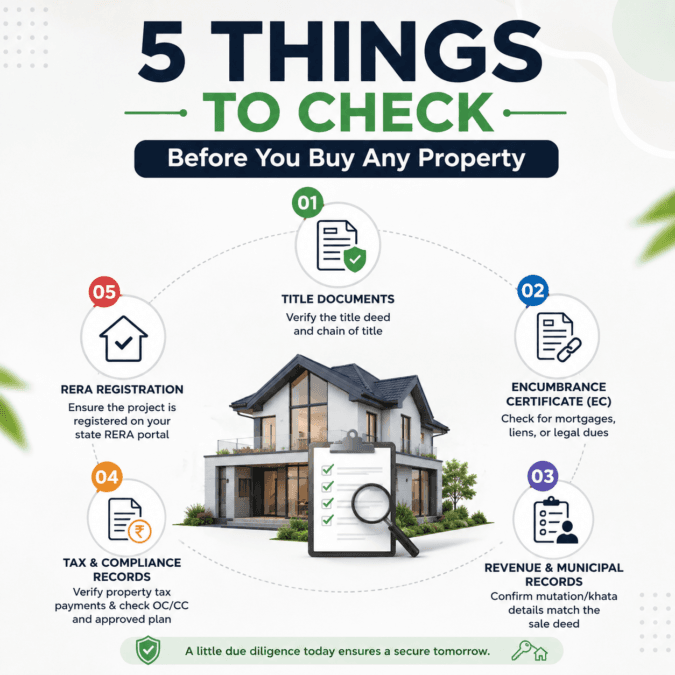
2. The Five Things You Actually Need to Check
1. Ownership chain (the title deed history). Don’t accept just the most recent sale deed. Ask for every prior transfer document going back as far as possible — ideally 30 years — including the mother deed (the original document that first created private title to the land), and any gift, partition, or succession documents if the property passed through inheritance. Every transfer in the chain should connect cleanly to the next; a missing link is a serious red flag.
2. Encumbrances (Mortgages, Liens, and Other Registered Charges): Obtain an Encumbrance Certificate (EC) directly from the jurisdictional Sub-Registrar or through your state’s official land registration portal instead of relying solely on the seller’s copy. The EC records registered transactions affecting the property during the specified search period, including sales, mortgages, leases, gifts, partitions, releases, and other registered instruments. As a matter of prudent due diligence, request an EC covering at least the previous 15 years, and preferably 30 years where records are available.
Carefully examine the certificate for any registered mortgage or charge that does not have a corresponding registered release, discharge, or satisfaction entry. While the absence of such an entry does not conclusively establish that the loan remains unpaid, it indicates that the charge may not have been formally cleared from the registration records and should be independently verified with the lender and supporting documents before proceeding. Keep in mind that an EC reflects only registered transactions for the period searched and may not disclose unregistered interests or litigation that has not been recorded in the registration records.
Important limitation to know: an EC only lists registered transactions. It doesn’t verify their underlying validity, and older or unregistered claims may not show up at all — so treat it as a strong first step, not a complete guarantee.
3. Revenue and Municipal Records (Mutation/Khata): Verify the property’s entry in the relevant revenue or municipal records, which may be known by different names depending on the state, such as mutation records or khata. Confirm that the owner’s name, survey or plot number, property description, and area or extent correspond with the registered sale deed and other title documents. Any discrepancy should be investigated and satisfactorily resolved before proceeding with the transaction, as it may indicate an unrecorded transfer, clerical error, or incomplete update of official records.
Although courts have consistently held that mutation or khata entries are maintained primarily for revenue or municipal purposes and do not by themselves constitute conclusive proof of ownership or title, inconsistencies between these records and the title documents warrant careful verification during due diligence.
4. Tax and Compliance Records: Verify that all recent property tax receipts (commonly covering at least the previous three years) are available and that no property tax arrears are outstanding. Confirm that the property identification details—such as the survey or plot number, municipal property or khata number (where applicable), address, and owner’s name—correspond with the sale deed and other title documents. For apartments and other developed properties, examine the sanctioned building plan approved by the competent authority.
Where the construction has been completed, verify the Completion Certificate (CC) and Occupancy Certificate (OC), wherever applicable under the local building laws. These certificates demonstrate that the building has been completed in accordance with the approved plans and that the competent authority has permitted its occupation. For under-construction projects, also verify that the project has obtained the necessary statutory approvals, including RERA registration where applicable, before proceeding with the purchase.
5. RERA Registration (Builder and Under-Construction Projects): Before booking an apartment or purchasing property in a builder-developed project, verify whether the project is registered with the State Real Estate Regulatory Authority (RERA). Under the Real Estate (Regulation and Development) Act, 2016, registration is generally mandatory for projects exceeding 500 square metres of land area or more than eight apartments (inclusive of all phases), subject to any lower thresholds prescribed by the State Government.
Search the project directly on the official State RERA portal instead of relying solely on the promoter’s representations. Verify the project’s registration status, registration number, promoter details, approved plans, statutory approvals, construction progress, and the declared completion or possession timeline. This is one of the most effective preliminary due diligence checks for builder and under-construction projects, as it allows prospective buyers to independently verify key regulatory information before committing to the purchase.
3. Where to Actually Do These Checks
- Sale deed / title chain: Certified copies are available from the Sub-Registrar’s office where the property is/was registered.
- Encumbrance Certificate: Apply directly through your state’s IGRS (Integrated Registration & Stamp Duty) online portal, or in person at the Sub-Registrar’s office. This typically costs a modest fee and, in many states, is delivered online within 24–48 hours.
- Mutation / revenue records: Your state’s land records portal, or the local municipal/revenue office.
- RERA registration status: Your state’s dedicated RERA portal.
- Pending litigation on the property: You can search relevant court records, including the National Judicial Data Grid (NJDG), for any ongoing cases involving the property or the current owner.
4. Registration: Why It Matters, and What It Doesn’t Prove
Once you’re satisfied with the title, the purchase itself must be formally registered. Under Section 17 of the Registration Act, 1908, any sale of immovable property valued above ₹100 — in practice, this means essentially all residential and commercial transactions — must be registered to be legally recognised. Registration creates a public record of the transfer and establishes your priority against later competing claims; an unregistered sale deed generally cannot be used as evidence of title in court.
A crucial point buyers often misunderstand: registration records that a transaction happened — it does not independently verify that the seller actually had good title to sell in the first place. The Sub-Registrar’s role in registering a document is essentially administrative (ministerial), not adjudicatory; disputes about who truly owns a property are decided by courts, not by the registration office. In other words, a registered deed is proof a transaction was recorded — it is not, by itself, proof you now own a property free of all problems. This is exactly why the title-verification steps above need to happen before registration, not instead of it.
How to File for Mutual Divorce in India: Process, Documents, Timeline & Remarriage Rules
Basic registration steps once you’re ready to proceed:
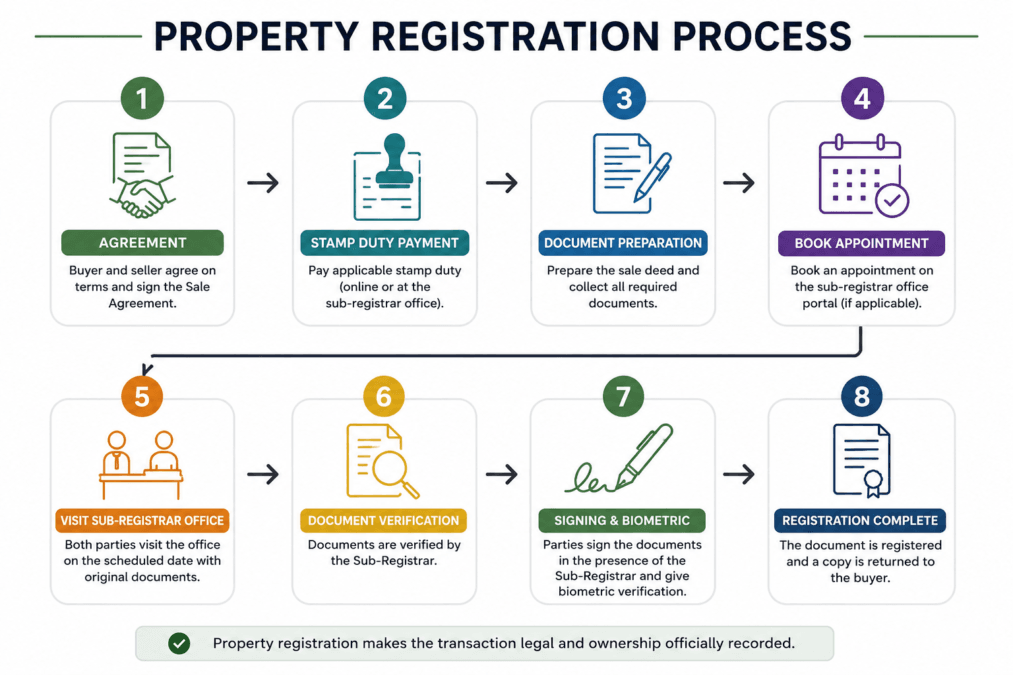
- Check the applicable circle rate (the government’s minimum assessed value) for the property’s locality.
- Pay stamp duty — calculated on whichever is higher: the agreed sale price or the circle rate.
- Draft the sale deed.
- Book a Sub-Registrar appointment (most states allow this online).
- Attend in person with the other party and witnesses for document submission and biometric verification.
- Apply for mutation in the revenue/municipal records after registration, so the property tax and ownership records are updated in your name.
5. Red Flags Worth Pausing Over
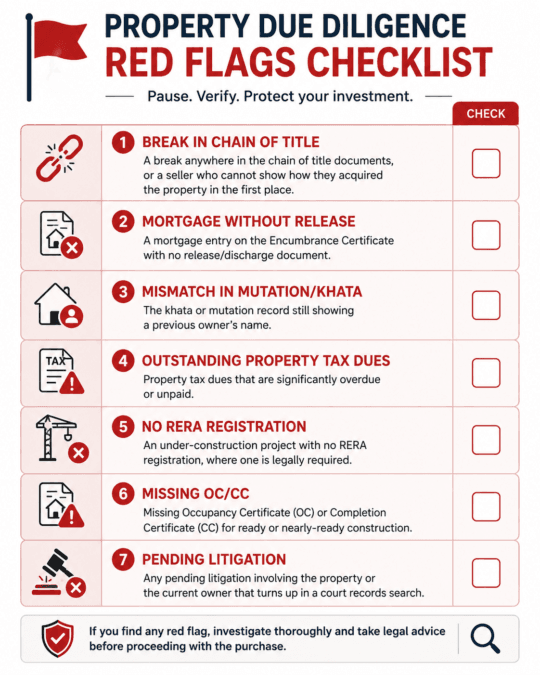
- A break in the chain of title documents, or a seller who cannot adequately establish how they acquired the property. Missing or inconsistent title documents should be investigated before proceeding.
- A registered mortgage or charge appearing on the Encumbrance Certificate (EC) without a corresponding registered release, discharge, or satisfaction entry. Although this does not conclusively prove that the loan remains outstanding, it indicates that the charge may not have been formally removed from the registration records and requires independent verification.
- Revenue or municipal records (such as mutation or khata) that still reflect a previous owner’s name or contain material inconsistencies with the registered title documents. While these records do not by themselves establish ownership, discrepancies may indicate that the records have not been properly updated or that further investigation is necessary.
- Substantial outstanding property tax arrears or other unpaid municipal dues, which should be clarified and settled before completing the transaction.
- An under-construction or builder project that is not registered with the State RERA authority, where registration is legally required under the Real Estate (Regulation and Development) Act, 2016.
- The absence of a legally required Completion Certificate (CC) or Occupancy Certificate (OC) for a completed or occupiable building, or evidence that the construction materially deviates from the sanctioned building plan. The applicable requirements may vary depending on the local building laws.
- Pending litigation, attachment orders, acquisition proceedings, or other legal disputes affecting the property or the seller’s title, as revealed through court records, public records, or documents disclosed during due diligence. The existence of litigation does not automatically invalidate the transaction, but its nature, stage, and potential impact should be carefully assessed before proceeding.
6. Do You Need a Lawyer?
Much of the initial groundwork above — pulling the EC, checking mutation records, confirming RERA status — is genuinely doable yourself using public portals. That said, for anything beyond a very simple, low-value purchase, a property lawyer’s title opinion is strongly recommended, and is typically mandatory anyway if you’re financing the purchase through a bank loan, since lenders require their own legal verification before disbursing funds. A lawyer can also properly interpret older or handwritten documents, inheritance chains, and any ambiguity that a document-by-document checklist can’t fully resolve on its own.
A practical safeguard: if you’re paying any token/advance amount before completing verification, make that amount expressly refundable in your MOU or agreement if the title search doesn’t clear within an agreed timeline.
Got Cheated While Shopping Online? Here’s Exactly What You Can Do (Simple Guide)
7. Frequently Asked Questions
Is an Encumbrance Certificate enough by itself to confirm clear title?
No. It’s an important and often the most accessible starting point, but it only reflects registered transactions and doesn’t independently confirm the validity of the ownership chain, revenue records, or construction compliance. Treat it as one component of a broader check, not the complete picture.
Does a registered sale deed guarantee I now legally own the property?
Not entirely. Registration confirms the transaction was recorded and gives you priority over later competing claims, but it doesn’t independently verify that the seller had valid title to sell in the first place — that’s exactly why title verification needs to happen before you buy, not after.
Can NRIs carry out this verification from abroad?
Yes. Most of the relevant portals (land records, EC, RERA) are accessible online, and property lawyers/verification services can act on an NRI buyer’s behalf, typically under a Power of Attorney.
What if the mutation record and the sale deed don’t match?
Treat this as a flag to resolve before proceeding, not something to ignore — even though mutation alone isn’t conclusive proof of ownership, a mismatch usually indicates something in the chain was never properly updated.
About the Author
Dr. Rekha Khandelwal is a Legal Specialist, Consultant, Researcher, and Author. She provides research-backed legal insights, AI governance guidance, and educational content to help individuals, students, and professionals better understand the law.
Disclaimer
The content on AspirixWriters is provided for educational and informational purposes only and does not constitute legal advice. For advice on specific legal matters, please consult ……….
Need Professional Assistance?
For legal research, legal writing, AI governance, compliance, or consultancy services, you may contact Dr. Rekha Khandelwal through AspirixWriters.
Official References
- Registration Act, 1908 — Section 17 (compulsory registration) and Section 49 (effect of non-registration), via India Code
- Real Estate (Regulation and Development) Act, 2016 — RERA project registration requirements
- Transfer of Property Act, 1882
- State IGRS (Integrated Registration & Stamp Duty) portals — for Encumbrance Certificates and registration appointments
- State-specific RERA portals — for builder project registration status
- National Judicial Data Grid (njdg.ecourts.gov.in) — for court records searches