
Subject: Constitutional Law | Module: Constitutional Foundations | for: 3-Year LL.B. and 5-Year Integrated LL.B. (BA LL.B. / BBA LL.B. / B.Com LL.B.) students
1. Introduction of Preamble to the Constitution of India
The Preamble is the opening statement of the Constitution of India — a single sentence that announces what kind of State India has chosen to be and why. It is often called the “identity card,” the “key to the minds of the makers,” or the “soul” of the Constitution. Although it grants no enforceable rights by itself, the Preamble has repeatedly shaped how the Supreme Court has interpreted the rest of the Constitution — most notably in the doctrine of Basic Structure. This note covers the text of the Preamble, the meaning of each of its key words, whether and how it can be amended, and its evolving judicial status from Berubari Union (1960) to a significant 2024 Supreme Court ruling.
2. Meaning and Text
The Preamble reads:
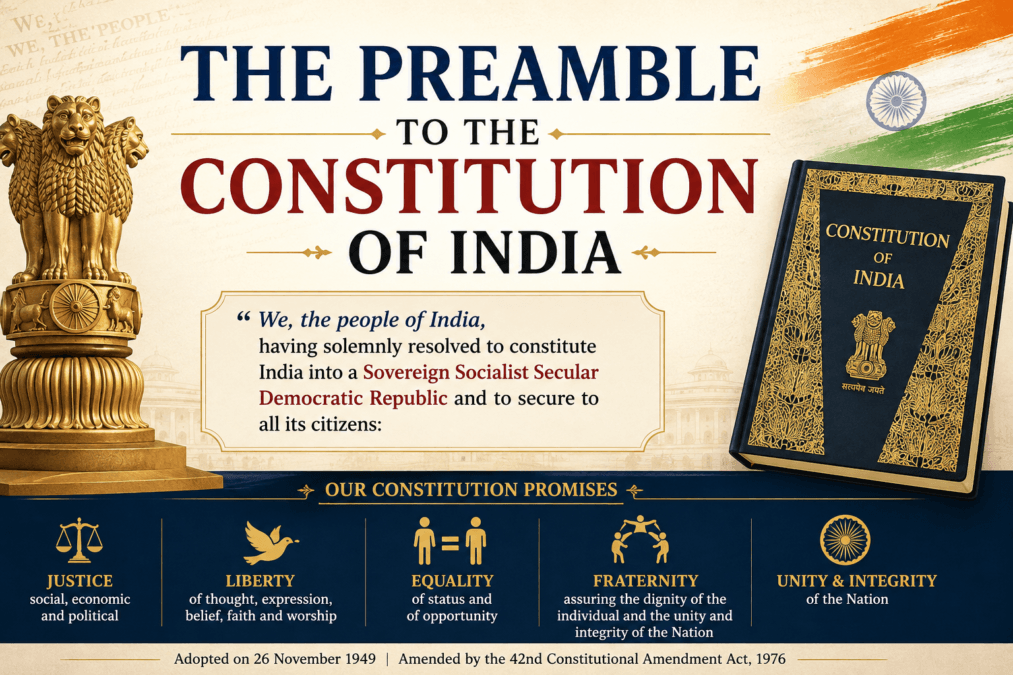
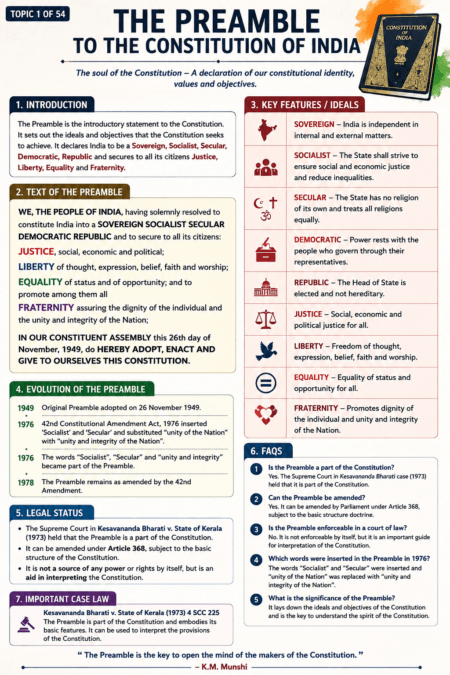
“WE, THE PEOPLE OF INDIA, having solemnly resolved to constitute India into a SOVEREIGN SOCIALIST SECULAR DEMOCRATIC REPUBLIC and to secure to all its citizens: JUSTICE, social, economic and political; LIBERTY of thought, expression, belief, faith and worship; EQUALITY of status and of opportunity; and to promote among them all FRATERNITY assuring the dignity of the individual and the unity and integrity of the Nation; IN OUR CONSTITUENT ASSEMBLY this twenty-sixth day of November, 1949, do HEREBY ADOPT, ENACT AND GIVE TO OURSELVES THIS CONSTITUTION.”
The Preamble is best understood as containing four components:
- Source of authority: “We, the People of India” — sovereignty vests in the people, who gave the Constitution to themselves through the Constituent Assembly.
- Nature of the Indian State: Sovereign, Socialist, Secular, Democratic, Republic.
- Objectives: Justice, Liberty, Equality, Fraternity.
- Date of adoption: 26 November 1949.
3. Legal and Historical Framework
- The Preamble is based on the Objectives Resolution, moved by Jawaharlal Nehru in the Constituent Assembly on 13 December 1946, and adopted by the Assembly on 22 January 1947. Its language and aspirations were later carried into the final Preamble.
- The Preamble was itself adopted by the Constituent Assembly and came into force along with the rest of the Constitution on 26 January 1950.
- It has been amended only once, by the Constitution (Forty-second Amendment) Act, 1976, which inserted “Socialist” and “Secular” and changed “unity of the Nation” to “unity and integrity of the Nation.” This amendment was passed during the Emergency (1975–77) on the recommendation of the Swaran Singh Committee, and received Presidential assent on 18 December 1976, with different provisions brought into force in stages from 3 January 1977.
4. Meaning of the Key Words
| Word | Meaning |
|---|---|
| Sovereign | India is internally and externally independent — free to determine its own affairs without external control, and no other authority is superior to it within its territory. |
| Socialist | Added by the 42nd Amendment (1976). Reflects a commitment to a welfare state, social and economic justice, and reduction of inequality — but does not mandate state ownership of all means of production, and coexists with a mixed economy and private enterprise. |
| Secular | Added by the 42nd Amendment (1976). The State has no religion of its own; it treats all religions equally, neither favouring nor persecuting any, and every person has freedom of conscience and the right to profess, practise and propagate religion. |
| Democratic | Government derives its authority from the will of the people, expressed through periodic, free and fair elections; encompasses both political and (per some interpretations) social/economic democracy. |
| Republic | The Head of State (the President) is elected, directly or indirectly, for a fixed term — not a hereditary monarch. |
| Justice (social, economic, political) | Equitable treatment in society, wealth distribution and political participation, drawn from the Directive Principles and Fundamental Rights. |
| Liberty (thought, expression, belief, faith, worship) | Freedom from arbitrary restraint, given concrete shape in Article 19 and the freedom-of-religion provisions (Articles 25–28). |
| Equality (status and opportunity) | Given concrete shape in Articles 14–18. |
| Fraternity (dignity of the individual, unity and integrity of the Nation) | A sense of common brotherhood, ensuring individual dignity and national unity — reflected in Fundamental Duties and provisions like Articles 17 and 51A. |
5. Core Principles / Doctrines
- Preamble as a part of the Constitution: Settled by Kesavananda Bharati (1973) — the Preamble is part of the Constitution, though it does not confer substantive rights.
- Preamble as an interpretative aid: Even where held “not part of the Constitution” (as in Berubari), courts have consistently used the Preamble to resolve ambiguity in constitutional provisions and to understand the framers’ intent.
- Preamble is not directly enforceable: No person can approach a court claiming a violation of “Justice” or “Fraternity” in the Preamble as a standalone cause of action; it operates through the substantive provisions that give it effect.
- Preamble and Basic Structure: Words like Sovereign, Democratic and Republic — and by judicial recognition, Secularism — reflect features treated as part of the Constitution’s Basic Structure and thus beyond the reach of Parliament’s amending power under Article 368.
- Preamble is amendable, but not to destroy the Basic Structure: Parliament can amend the Preamble under Article 368 (as it did in 1976), but any such amendment cannot alter the identified basic features of the Constitution.
6. Important Case Laws
(a) In Re: The Berubari Union and Exchange of Enclaves, AIR 1960 SC 845 — Landmark, Must Know
- Issue: Whether the Preamble is a part of the Constitution and whether it could be used to expand or override the express provisions of Articles 1 and 3.
- Holding: The Supreme Court held that the Preamble is not a part of the Constitution and is not itself a source of any substantive power; it may, however, be used as a guide to interpretation where the language of a provision is ambiguous. The Preamble cannot control or override clear, unambiguous constitutional language.
- Significance: The earliest authoritative pronouncement on the Preamble’s legal status — later revisited in Kesavananda Bharati.
(b) Kesavananda Bharati v. State of Kerala, AIR 1973 SC 1461; (1973) 4 SCC 225 — Landmark, Must Know
- Court/Bench: Supreme Court of India, 13-judge Constitution Bench (the largest in Indian judicial history), decided 24 April 1973 by a narrow 7:6 majority.
- Issue: The scope of Parliament’s amending power under Article 368, and — as part of that inquiry — the constitutional status of the Preamble.
- Holding: The Court held that the Preamble is part of the Constitution, departing from the position in Berubari. It further held that Parliament’s power under Article 368 is wide but not unlimited — Parliament cannot amend the Constitution so as to damage or destroy its “basic structure” or “basic features.” The Preamble was treated as a key indicator of what those basic features are (e.g., sovereign, democratic character, unity of the nation).
- Significance: Source of the Basic Structure Doctrine, the single most important constraint on the constituent power of Parliament in Indian constitutional law, and the case that settled the Preamble’s status as part of the Constitution.
(c) LIC of India v. Consumer Education and Research Centre, AIR 1995 SC 1811 — Important
- Holding: The Supreme Court reaffirmed and applied the position that the Preamble is an integral part of the Constitution, reinforcing the post-Kesavananda position.
(d) Dr. Balram Singh & Ors. v. Union of India & Anr., 2024 INSC 893 (decided 25 November 2024) — Landmark, Must Know (Contemporary)
- Facts/Issue: Writ petitions (including one by Dr. Subramanian Swamy) filed roughly 44 years after the event challenged the insertion of “Socialist” and “Secular” into the Preamble by the 42nd Amendment, 1976, arguing this was procedurally illegitimate (passed during the Emergency) and substantively problematic (altering the Preamble as originally adopted on 26 November 1949, and allegedly constraining economic and religious freedom).
- Holding: A bench of Chief Justice Sanjiv Khanna and Justice Sanjay Kumar dismissed the petitions. The Court held that Article 368 unquestionably empowers Parliament to amend the Constitution, including the Preamble; that the long delay in challenging a 44-year-old amendment counted against the petitioners; that the Constitution is a “living document” capable of evolution; and that “Socialist” and “Secular,” properly understood in the Indian context (a welfare-oriented mixed economy; equal treatment of all religions rather than state-imposed irreligion), do not conflict with the Constitution’s basic structure.
- Significance: The most recent authoritative confirmation that the 1976 amendment to the Preamble is constitutionally valid — closing, for now, a live challenge that had persisted for decades.
7. Development of Law
Earlier Position (1950–1972): Following Berubari (1960), the Preamble was treated as outside the Constitution proper — a guide to interpretation only, with no independent legal force.
Landmark Development (1973): Kesavananda Bharati reversed this, holding the Preamble to be part of the Constitution and using it as an anchor for identifying the Constitution’s Basic Structure.
Later Development (1976): Parliament exercised its amending power to alter the Preamble itself, adding “Socialist,” “Secular” and “integrity” through the 42nd Amendment — demonstrating that the Preamble, despite being part of the Basic Structure discussion, is not immune from amendment.
Reaffirmation (1995): LIC v. Consumer Education confirmed the Preamble’s status as an integral part of the Constitution.
Contemporary Development (2024): Balram Singh v. Union of India rejected a renewed constitutional challenge to the 1976 amendment itself, confirming its continued validity.
Current Position: Settled. The Preamble is part of the Constitution, was validly amended in 1976, and both the amendment and the Preamble’s interpretative role have been repeatedly and recently reaffirmed by the Supreme Court.
8. Exceptions and Limitations
- The Preamble is not enforceable as an independent source of rights in a court of law.
- The Preamble cannot override unambiguous language of specific constitutional Articles (Berubari).
- Parliament can amend the Preamble under Article 368, but cannot use such an amendment to destroy the Basic Structure of the Constitution identified in Kesavananda Bharati and later cases.
9. Practical Examples
- Secularism in practice: A State law that discriminates between religious communities in the allocation of public benefits would be tested against the “Secular” character declared in the Preamble and given effect through Articles 14, 15, and 25–28.
- Socialism in practice: The word “Socialist” does not prevent a private company from operating in India; per Balram Singh (2024), it reflects a welfare-state commitment compatible with a mixed economy — private enterprise and public welfare measures coexist.
- Democratic and Republic in practice: Free and fair elections (Article 324 onward) and a fixed-term, non-hereditary President (Articles 52 onward) are the operative provisions that give effect to these Preamble ideals.
10. Important Distinctions
| Concept | Distinction |
|---|---|
| Preamble vs. operative Articles | Preamble is part of the Constitution but not directly enforceable; operative Articles (e.g., Part III) are directly enforceable |
| Preamble vs. Fundamental Rights | Preamble states objectives/philosophy; Fundamental Rights are specific, justiciable guarantees that implement parts of that philosophy |
| Basic Structure vs. ordinary constitutional amendment | An ordinary amendment under Article 368 is valid if it does not damage the Basic Structure; the Preamble helps identify what that Basic Structure includes |
11. Current Legal Position
Settled.
- Preamble is part of the Constitution (Kesavananda Bharati, 1973; LIC v. Consumer Education, 1995).
- Preamble is amendable under Article 368, subject to the Basic Structure limitation.
- The 1976 amendment adding “Socialist,” “Secular” and “integrity” is constitutionally valid — most recently and authoritatively reaffirmed in Balram Singh v. Union of India (2024).
- The Preamble continues to be used by courts as an interpretative aid, though it confers no independently enforceable right.
12. Quick Revision Table
| Aspect | Position |
|---|---|
| Part of Constitution? | Yes (settled since Kesavananda Bharati, 1973) |
| Enforceable in court? | No — used only as an interpretative aid |
| Amendable? | Yes, under Article 368, subject to Basic Structure |
| Amended so far? | Once — 42nd Amendment, 1976 |
| Words added in 1976 | “Socialist,” “Secular,” “integrity” |
| Leading historical case | Berubari Union (1960) |
| Leading modern case | Kesavananda Bharati (1973) |
| Most recent validation | Balram Singh v. Union of India (2024 INSC 893) |
14. One-Minute Revision
- Preamble = “We, the People” + nature of State + objectives + date (26 Nov 1949).
- Based on the Objectives Resolution (Nehru, 1946).
- Berubari (1960): Preamble NOT part of Constitution, interpretative aid only.
- Kesavananda Bharati (1973): Preamble IS part of Constitution; source of Basic Structure Doctrine.
- 42nd Amendment, 1976: added “Socialist,” “Secular,” “integrity” — the only amendment to the Preamble so far.
- Preamble is not directly enforceable in court.
- Preamble can be amended, but Parliament cannot use that power to destroy the Basic Structure.
- LIC v. Consumer Education (1995): reaffirmed Preamble as integral part of Constitution.
- Balram Singh v. Union of India (2024): Supreme Court upheld validity of 1976 amendment against a fresh 44-years-later challenge.
- “Socialist” and “Secular” in India have their own contextual meaning — welfare state and religious equality, not state ownership or state irreligion.
15. Limited Practice Questions
Short Questions
- Is the Preamble to the Indian Constitution enforceable in a court of law?
- What two words were added to the Preamble by the 42nd Amendment, 1976, besides “integrity”?
Analytical Question 3. Trace the evolution of the Supreme Court’s position on whether the Preamble is “part of” the Constitution, from Berubari Union to Kesavananda Bharati.
Case/Problem Question 4. A petitioner argues that the word “Socialist” in the Preamble is unconstitutional because it restricts India’s freedom to pursue capitalist economic policy. Discuss, with reference to recent Supreme Court authority.
16. Related Topics
Related Law Notes: Introduction to the Constitution of India (Articles 1–4) · Salient Features of the Constitution · Basic Structure Doctrine · Constitutional Amendment (Article 368) · Fundamental Rights — Overview
Related Legal Provisions: Preamble · Article 368 · Article 13 · Article 32
Related Case Laws: In Re: Berubari Union (1960) · Kesavananda Bharati v. State of Kerala (1973) · LIC of India v. Consumer Education and Research Centre (1995) · Dr. Balram Singh v. Union of India (2024)
Note: This is a free conceptual/revision note. For complete previous-year question bank or exhaustive answer-writing material, Read AspirixWriters Law Success Series.
FAQs — Preamble to the Constitution of India
1. What is the Preamble to the Constitution of India?
The Preamble is the introductory statement of the Constitution. It declares the constitutional identity of India and expresses the objectives the Constitution seeks to secure, including justice, liberty, equality and fraternity. The current Preamble describes India as a Sovereign Socialist Secular Democratic Republic.
2. Is the Preamble a part of the Constitution of India?
Yes. The Supreme Court settled this issue in Kesavananda Bharati v. State of Kerala (1973), holding that the Preamble is part of the Constitution. It can also be used as an important aid in interpreting constitutional provisions, although the Preamble by itself does not confer independently enforceable rights.
3. Can the Preamble be amended?
Yes. The Preamble can be amended under Article 368, subject to the basic structure doctrine. The 42nd Constitutional Amendment Act, 1976 amended the Preamble by inserting the words “Socialist” and “Secular” and changing “unity of the Nation” to “unity and integrity of the Nation.”
4. What are the main objectives mentioned in the Preamble?
The Preamble seeks to secure Justice—social, economic and political; Liberty—of thought, expression, belief, faith and worship; Equality—of status and opportunity; and Fraternity—assuring the dignity of the individual and the unity and integrity of the Nation.
5. Is the Preamble enforceable in a court of law?
The Preamble is not independently enforceable and does not itself create substantive legal rights. However, it is an important constitutional guide and may be used by courts to understand the purpose and values underlying constitutional provisions. The Supreme Court reaffirmed this interpretive role while discussing the Preamble and fraternity in its recent constitutional jurisprudence.
Classmate Pulse Spiral Notebook ✏️ Need a Spiral Notebook for Everyday Writing? A spiral notebook…

Latest Scholarships & Fellowships 2026–27: Open Opportunities for Upcoming call
Latest Scholarships & Research Fellowships 2026–27 Last Verified: 30 September 2026 Students, researchers, PhD scholars…
Writing & Research Resources: Useful Books, Tools & Essentials for Writers and Researchers
Whether you are an author, content writer, law student, academic researcher, PhD scholar, teacher, or…