
Last Updated: August 21, 2026
Intention, Motive, Malice and Fault in Tort
- Law of Torts — Meaning and Definition of Tort LLB Notes
- Is It “Law of Tort” or “Law of Torts”?
- Essential Elements of Tortious Liability Law of Torts LLB Notes
- Tort and Other Civil Wrongs
1. Introduction
When studying the mental elements in tort law, an important question arises:
Does a person have to intend the wrongful act or the resulting harm to be liable in tort?
The answer is no, not in every tort.
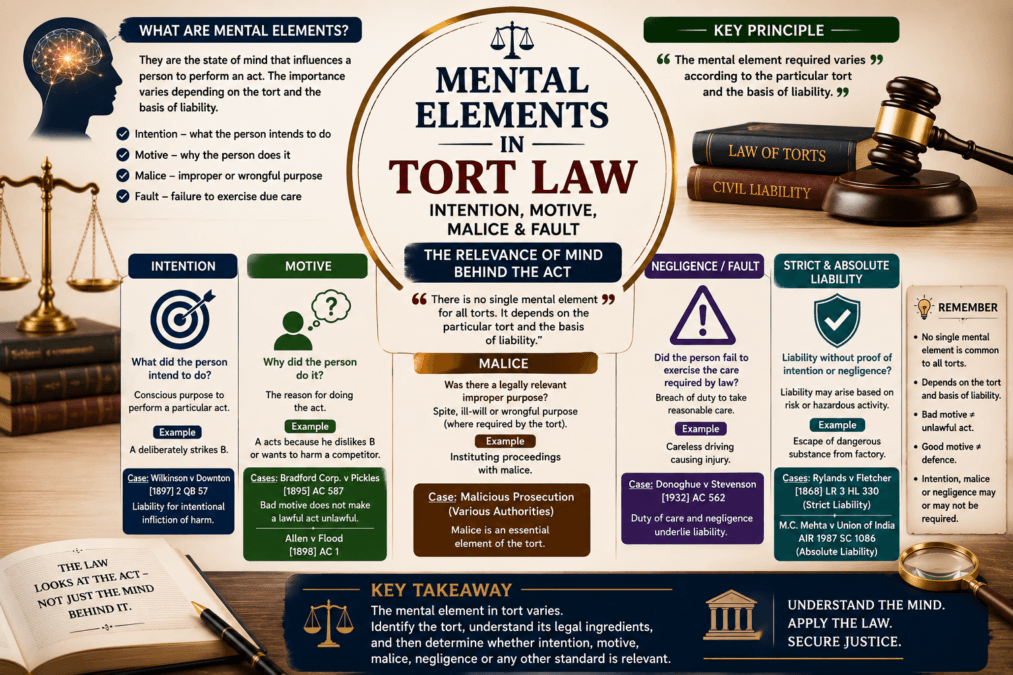
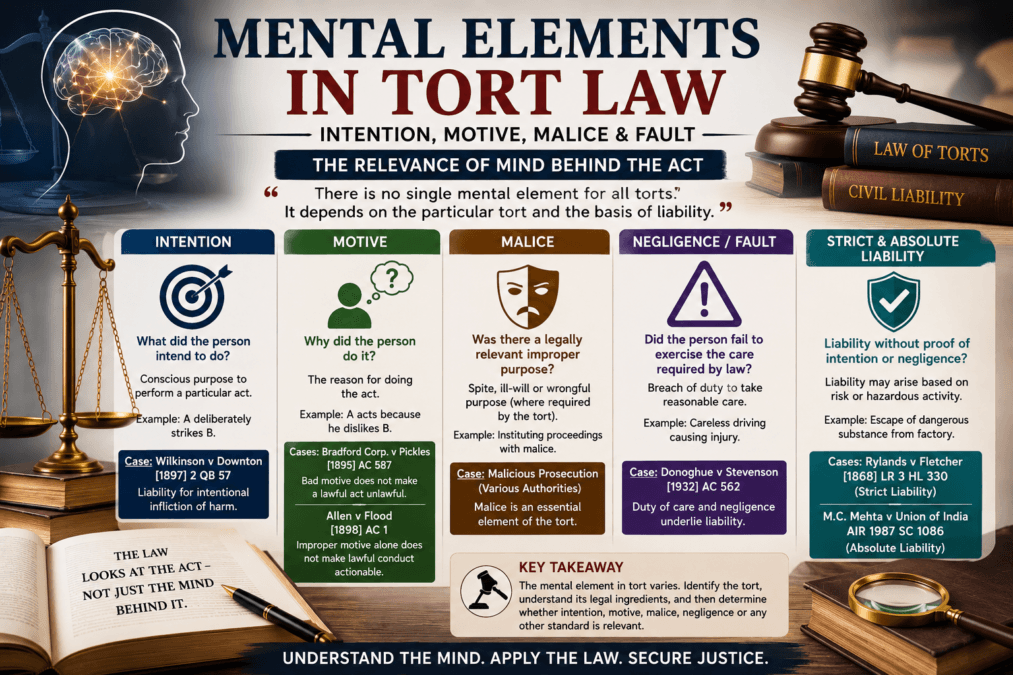
Tort law does not follow one universal rule requiring a particular mental state in every case. The relevance of intention, motive, malice, negligence or other forms of fault depends on the particular tort and the basis of liability.
For example:
- Battery involves intentional conduct.
- Negligence does not require an intention to cause harm.
- Malicious prosecution requires malice as one of its essential elements.
- Strict liability does not depend upon proving ordinary negligence or intention.
- Absolute liability, developed by the Supreme Court of India in M.C. Mehta v. Union of India, goes further and does not depend upon proof of intention or ordinary negligence.
Therefore, the central principle is:
There is no single mental element common to all torts. The required mental element depends upon the particular tort.
2. What Are the Mental Elements in Tort?
The important concepts are:
- Intention
- Motive
- Malice
- Fault
- Negligence
- Recklessness, where relevant
These concepts are connected, but they are not interchangeable.
A simple way to understand them
Intention → What did the person intend to do?
Motive → Why did the person do it?
Malice → Was there a legally relevant improper or wrongful purpose?
Negligence → Did the person fail to exercise the care required by law?
3. Intention
Meaning of Intention
Intention means a person’s conscious decision or purpose to perform a particular act.
In simple words:
When a person deliberately performs an act, the person intends to perform that act.
Example
A deliberately pushes B.
A intended to perform the act of pushing.
This is different from A accidentally bumping into B while walking through a crowded place.
Is Intention Necessary for Every Tort?
No.
This is one of the most important points in this chapter.
Intention is particularly important in intentional torts, but it is not an essential requirement for every tort.
Example: Negligence
A drives carelessly and hits B.
A may never have intended to injure B.
Nevertheless, A may be liable if the requirements of negligence are established.
Thus:
A person may be liable in tort even without intending to cause the resulting harm.
Intention to Perform an Act vs Intention to Cause Harm
Students often make the mistake of assuming:
“If an act is intentional, the defendant must have intended the exact harm that occurred.”
This is not a safe general rule.
The precise mental element depends upon the particular tort.
For example, in an intentional interference with the person, the law may require intention concerning the relevant act, while the precise consequence may not need to have been intended in the same way.
Therefore, always ask:
What exactly does the particular tort require the defendant to intend?
Intention and Negligence
The difference can be understood through a simple example.
Intention
A deliberately strikes B.
Negligence
A drives at excessive speed and, because of careless driving, hits B.
In the second situation, A did not necessarily intend to injure B.
However, A may still be liable because A failed to exercise the reasonable care required by law.
Therefore
Intention concerns deliberate conduct; negligence concerns failure to meet the required standard of care.
Intention in Intentional Torts
Intention becomes particularly important in torts involving direct and deliberate interference with another person or property.
Examples include:
- assault;
- battery;
- false imprisonment;
- trespass to land; and
- certain forms of interference with goods.
Example
A deliberately locks B inside a room without lawful justification.
The question is not whether A intended to cause B financial loss.
The relevant question is whether A intentionally confined B and whether the other legal requirements of false imprisonment are satisfied.
Case – Wilkinson v Downton — Intentional Infliction of Harm
A classic English authority illustrating the importance of intentional conduct is Wilkinson v Downton [1897] 2 QB 57. The case concerned a false statement deliberately made as a practical joke that caused the claimant serious mental shock. (Wikipedia)
Facts
Downton falsely told Mrs Wilkinson that her husband had suffered a serious accident and had been badly injured.
The statement was untrue.
The claimant suffered serious physical and mental consequences as a result.
Importance
The case is historically important in the development of liability for intentional infliction of harm.
Where the law recognises an intentional tort, the defendant’s deliberate conduct may be central to liability.
4. Motive
Meaning of Motive
Motive means the reason why a person performs an act.
It answers:
“Why did the person do it?”
Example
A refuses to sell his property to B.
Why?
Perhaps:
- A dislikes B;
- A wants a higher price;
- A wants to sell it to C; or
- A simply does not want to sell it.
These are different motives.
Intention vs Motive
| Intention | Motive |
|---|---|
| What a person intends to do | Why the person does it |
| Concerns the intended act | Concerns the reason behind the act |
| May be an element of a particular tort | Generally not an essential element of most torts |
| Example: A intentionally blocks B’s path | A blocks B’s path because A dislikes B |
Intention = WHAT?
Motive = WHY?
Is Motive Relevant in Tort Law?
General Rule
Motive is generally irrelevant where the underlying act is lawful.
In simple terms:
A lawful act does not ordinarily become a tort merely because it was performed with a bad motive.
The classic authority is Bradford Corporation v Pickles [1895] AC 587. The House of Lords held that an act which was lawful did not become unlawful merely because it was motivated by an improper or malicious purpose. (Uniset)
Bradford Corporation v Pickles
Facts
Pickles owned land from which underground water flowed towards waterworks used by the Bradford Corporation.
He carried out works on his land which interfered with the flow of the water.
The Corporation alleged that Pickles had acted with an improper motive, including an intention to put pressure on the Corporation.
Issue
Could an otherwise lawful exercise of a person’s rights become unlawful merely because it was motivated by malice or an improper purpose?
Decision
The House of Lords rejected the claim based merely on the defendant’s motive.
The legal principle was that the legality of the conduct was not changed merely because the defendant acted with a bad motive. (Uniset)
Principle
A lawful act does not ordinarily become unlawful merely because it is done with a bad or malicious motive.
Bradford Corporation v Pickles
Lawful act + bad motive ≠ automatically a tort
Good Motive Does Not Make an Unlawful Act Lawful
The reverse is equally important.
Suppose A enters B’s property without permission because A genuinely believes that A is helping B.
A may have a good motive, but the good motive does not automatically make the entry lawful.
Therefore:
A good motive is not automatically a defence to an otherwise actionable tort.
The court primarily examines the legal character of the conduct and the requirements of the particular tort.
Case – Allen v Flood
Another important case concerning motive is Allen v Flood [1898] AC 1.
The case is commonly used to illustrate the principle that an improper motive does not, by itself, make lawful conduct actionable.
The dispute involved conduct by a trade union representative which resulted in workers not being employed. The plaintiffs alleged improper motivation.
The House of Lords held that the conduct did not become actionable merely because of the alleged motive where the relevant acts themselves were lawful.
Principle
Motive alone does not ordinarily create tortious liability where the underlying conduct is lawful.
Allen v Flood → Bad motive alone does not make lawful conduct actionable.
Case – Mogul Steamship Co. v McGregor, Gow & Co.
This case is also useful for understanding the relationship between motive, competition and lawful conduct.
Facts
A group of shipowners combined to strengthen their commercial position. Their actions caused economic difficulty for a competing shipping company.
The plaintiff alleged that the defendants’ conduct was intended to harm its business.
Decision
The House of Lords held that the defendants had not committed an actionable wrong merely because their conduct harmed the plaintiff’s business. The defendants had pursued a lawful commercial objective using lawful means. (Wikipedia)
Principle
Lawful competition does not become tortious merely because it causes economic loss to another.
Important qualification for modern students
This case is a historical English authority. Modern competition law has substantially changed the legal environment surrounding anti-competitive conduct. Therefore, it should be used in LL.B. notes mainly to explain the historical principle concerning lawful competition and motive, not as a statement of modern competition law.
5. Malice
Meaning of Malice
The word malice can have different meanings depending upon the legal context.
In ordinary language, malice means:
Spite, ill-will or a desire to harm another person.
But in law, malice is a technical concept whose meaning depends upon the particular cause of action.
It may involve:
- personal ill-will;
- an improper purpose;
- wrongful intention; or
- action without lawful justification.
Therefore:
Legal malice is not always the same as personal hatred.
Malice in Fact
Malice in fact generally refers to actual personal spite, ill-will or an improper motive.
Example
A takes action against B simply because A personally hates B.
This may demonstrate malice in fact.
Malice in Law
Malice in law is a more technical expression.
Depending on the context, it may refer to an act done:
- wrongfully;
- intentionally;
- without lawful justification; or
- for an improper purpose.
It does not necessarily require personal hatred.
Therefore
Malice in fact → personal spite or ill-will
Malice in law → legally wrongful or improper action, depending on context
Students should avoid treating these as interchangeable expressions.
Malice vs Motive
Motive
The reason behind an act.
Malice
A legally significant improper or wrongful state of mind or purpose where the particular law makes it relevant.
Therefore:
Every bad motive is not necessarily legal malice.
And:
Legal malice does not necessarily require personal hatred.
When Does Malice Become Relevant?
The statement:
“Motive and malice are always irrelevant in tort.”
is incorrect.
They become important when the particular tort makes them part of the cause of action.
The clearest example is:
Malicious Prosecution
Malice is one of the essential requirements of the tort of malicious prosecution.
A claimant generally has to establish matters such as:
- prosecution by the defendant;
- termination of the proceedings in the claimant’s favour;
- absence of reasonable and probable cause;
- malice; and
- resulting damage.
Therefore, in malicious prosecution:
Malice is not merely evidence of bad character; it is a legally relevant element of the cause of action.
6. Fault
The term fault is broader than intention.
A person can be legally at fault without intending to cause harm.
Fault may include, depending upon the area of law:
- intention;
- negligence;
- recklessness; or
- other legally recognised forms of blameworthy conduct.
However, tort law also recognises forms of liability where proof of fault is not the basis of liability.
This is why it is important not to assume:
Fault = intention
They are not the same.
Negligence as a Form of Fault
Negligence is one of the clearest examples of liability without an intention to cause harm.
Example
A drives while distracted and hits B.
A may not have intended to injure B.
But if A failed to exercise the care that a reasonable person would have exercised in the circumstances, A may be liable for negligence.
Basic structure
Duty of Care
↓
Breach
↓
Causation
↓
Damage
↓
Liability, if the requirements are satisfied
Thus:
Negligence is concerned with the failure to meet the required standard of care, not with an intention to cause harm.
6. Strict Liability — Intention Is Not Required
The traditional rule in Rylands v Fletcher provides an important example of liability that does not depend upon proving intention or ordinary negligence.
Where the requirements of the rule are satisfied, liability may arise from the escape of a dangerous thing brought onto land in the circumstances specified by the rule.
The rule also developed with recognised exceptions.
Important Point
Strict liability does not mean liability for every accident.
The claimant still has to establish the requirements of the applicable rule.
7. Absolute Liability in India
Indian law developed an important and stronger doctrine through:
M.C. Mehta v Union of India
Oleum Gas Leak Case
The Supreme Court developed the doctrine of absolute liability for enterprises engaged in hazardous or inherently dangerous activities.
The doctrine was developed in response to the inadequacy of traditional strict liability for modern hazardous industries.
Why is it important for mental elements?
Because liability does not depend upon proving that the enterprise:
- intended to cause the harm; or
- was negligent in the ordinary sense.
Principle
An enterprise engaged in a hazardous or inherently dangerous activity may be absolutely liable for harm resulting from that activity, subject to the scope of the doctrine and applicable law.
The case is reported as AIR 1987 SC 1086; (1987) 1 SCC 395 and is the leading Indian authority on absolute liability. (Wikipedia)
M.C. Mehta → Absolute Liability → Intention is not the basis of liability.
8. Different Bases of Tortious Liability
We can now see why tort law does not have one universal mental element.
| Basis of Liability | Role of Mental Element |
|---|---|
| Intentional tort | Intention may be essential |
| Negligence | Failure to exercise reasonable care |
| Malicious prosecution | Malice is an essential element |
| Strict liability | Intention/negligence need not ordinarily be proved |
| Absolute liability | Liability does not depend upon intention or ordinary negligence |
This table is one of the most important parts of the topic.
9. Intention, Motive, Malice, Negligence and Strict Liability
| Concept | Simple Meaning | Is it universally required? |
|---|---|---|
| Intention | What the defendant deliberately intended to do | No |
| Motive | Why the defendant acted | No |
| Malice | Legally relevant improper/wrongful purpose or state of mind where required | No |
| Negligence | Failure to exercise required care | No |
| Strict liability | Liability without proving ordinary fault, subject to its legal requirements | No single mental element |
10. A Simple Problem to Understand the Difference
Suppose A owns a factory.
Situation 1 — Intention
A deliberately releases a harmful substance to injure B.
Here, intention may be directly relevant to the particular cause of action.
Situation 2 — Negligence
A does not intend to harm B but fails to maintain safety equipment, resulting in an accident.
Here, negligence may establish liability if its legal requirements are satisfied.
Situation 3 — Bad Motive
A operates a lawful business partly because A wants to defeat B’s competing business.
A bad motive alone does not necessarily create tortious liability.
This is the principle illustrated by Bradford Corporation v Pickles and Mogul Steamship. (Uniset)
Situation 4 — Absolute Liability
A hazardous enterprise causes harm in circumstances falling within the doctrine of absolute liability.
The claimant does not need to establish that the enterprise intended to cause the harm.
This illustrates the principle developed in M.C. Mehta v Union of India. (Wikipedia)
11. The Most Important Principle: Mental Element Depends on the Tort
Step 1
What tort is being alleged?
Step 2
What are the legal elements of that tort?
Step 3
Does that tort require intention, negligence, malice, or another form of fault?
Step 4
Does the law impose liability without proof of fault?
12. Indian Position
The Indian law of torts does not prescribe a single mental element for all tortious liability.
The relevance of intention, motive, malice and negligence depends upon the particular cause of action.
Indian law also demonstrates that tortious liability can develop beyond traditional fault-based models. The Supreme Court’s decision in M.C. Mehta v Union of India established absolute liability for hazardous or inherently dangerous enterprises, illustrating that proof of intention is not universally required. (Wikipedia)
At the same time, courts do not impose liability merely because a defendant had a bad motive. The classic rule in Bradford Corporation v Pickles remains an important illustration of the distinction between bad motive and legal wrongfulness. (Uniset)
13. Important Cases at a Glance
| Case | Principle to Remember |
|---|---|
| Wilkinson v Downton | Historical development of liability for intentional infliction of harm |
| Bradford Corporation v Pickles | Bad motive does not ordinarily make a lawful act unlawful |
| Allen v Flood | Improper motive alone does not make lawful conduct actionable |
| Mogul Steamship Co. v McGregor | Lawful competition causing loss was not actionable merely because it harmed a rival |
| Donoghue v Stevenson | Negligence is based on duty and breach of reasonable care, not intention to cause harm |
| Rylands v Fletcher | Traditional strict liability |
| M.C. Mehta v Union of India | Absolute liability for hazardous/inherently dangerous enterprises in India |
Thus, tortious liability cannot be based on a single universal mental element.
General Defences in Law of Torts — General Exceptions | LL.B. Notes
FAQs
Most Important FAQs — Mental Elements in Tort Law
1. Is intention necessary for tortious liability?
No. Intention is important in some intentional torts, but it is not required for every tort. Liability may arise through negligence, strict liability, or absolute liability.
2. What is the difference between intention and motive in tort law?
Intention means what a person deliberately intends to do, whereas motive means the reason why the person does it.
Intention = What? | Motive = Why?
3. Is a bad motive sufficient to make an act a tort?
Generally, no. An otherwise lawful act does not ordinarily become tortious merely because it was done with a bad motive. This principle is illustrated by Bradford Corporation v. Pickles.
4. What is the difference between malice in fact and malice in law?
Malice in fact generally refers to actual spite or ill-will. Malice in law is a broader legal concept that may refer to wrongful or improper action without lawful justification, depending on the context.
5. Is malice necessary in all torts?
No. Malice is relevant only where the particular tort makes it a legal requirement or otherwise gives it legal significance. For example, malice is an essential element of malicious prosecution.
Classmate Pulse Spiral Notebook ✏️ Need a Spiral Notebook for Everyday Writing? A spiral notebook…

Latest Scholarships & Fellowships 2026–27: Open Opportunities for Upcoming call
Latest Scholarships & Research Fellowships 2026–27 Last Verified: 30 September 2026 Students, researchers, PhD scholars…
Writing & Research Resources: Useful Books, Tools & Essentials for Writers and Researchers
Whether you are an author, content writer, law student, academic researcher, PhD scholar, teacher, or…