
Tort and Other Civil Wrongs
- Law of Torts — Meaning and Definition of Tort LLB Notes
- Is It “Law of Tort” or “Law of Torts”?
- Essential Elements of Tortious Liability Law of Torts LLB Notes
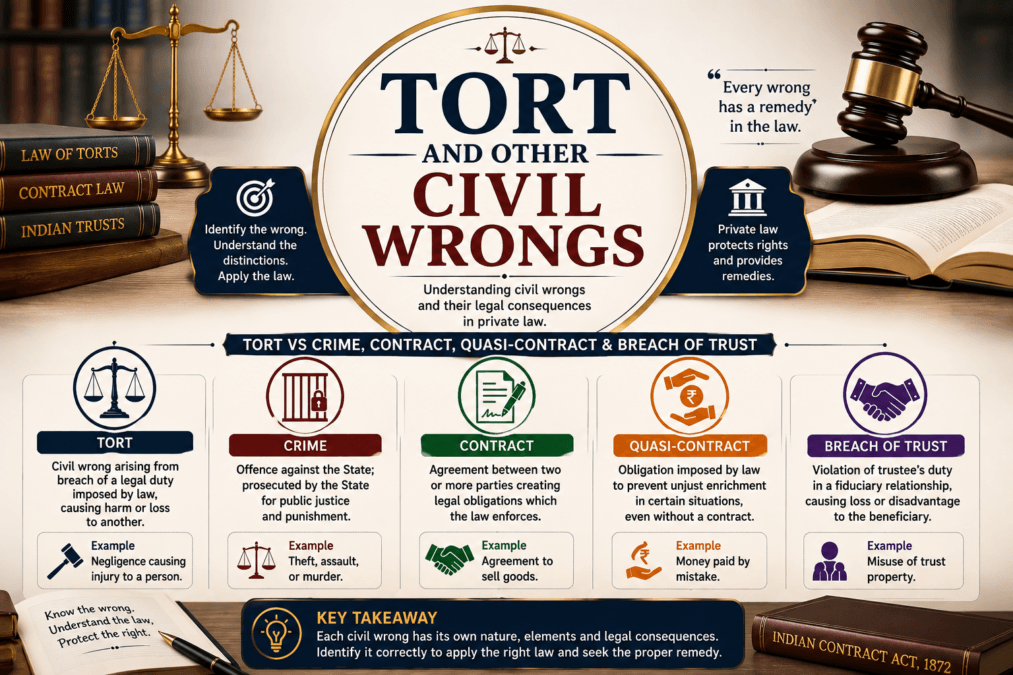
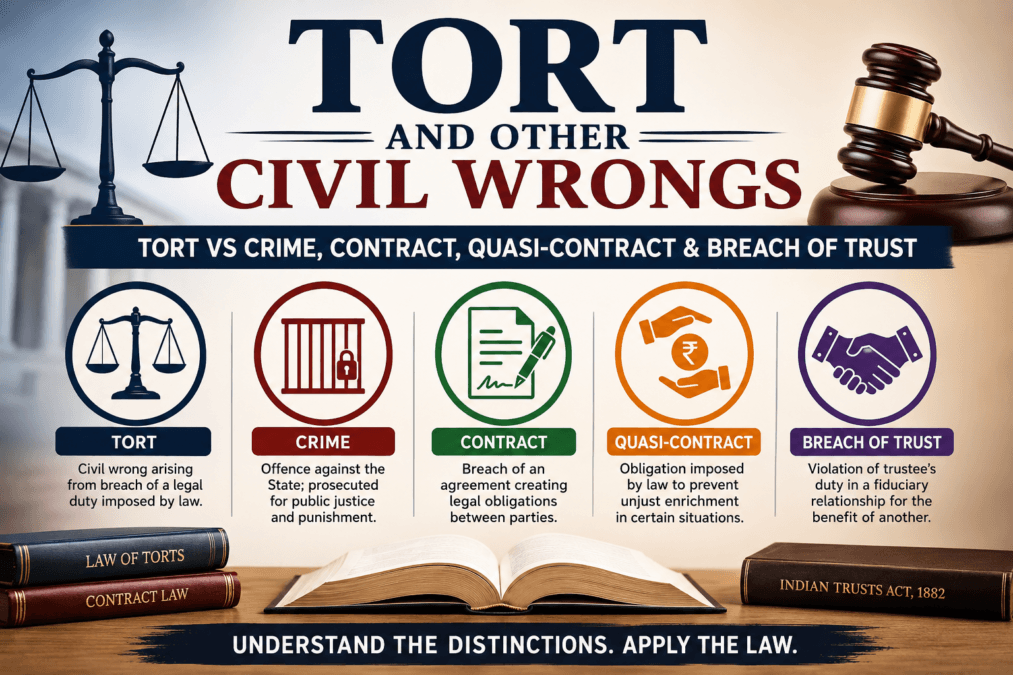
A tort is a civil wrong arising from the breach of a legal duty that is generally imposed by law and for which the law provides a remedy. However, tort is only one category of legal wrong.
A similar-looking dispute may instead involve:
- a crime,
- a breach of contract,
- a quasi-contractual obligation, or
- a breach of trust.
Understanding these distinctions is important because the source of the duty, nature of the right, parties involved, purpose of the proceeding and available remedies may be different.
At the same time, the categories are not always completely isolated. The same facts can sometimes give rise to more than one legal consequence.
For example, a negligent act may create a tort claim and, depending on the circumstances, may also have contractual or statutory consequences.
1. Tort and Crime
What is a Tort?
A tort is primarily a civil wrong for which the injured person may seek a civil remedy.
Examples include:
- negligence,
- nuisance,
- trespass,
- defamation,
- assault, and
- false imprisonment.
The purpose of a tort action is generally to provide an appropriate remedy for the infringement of the claimant’s legally protected interest.
What is a Crime?
A crime is an act or omission that is treated by criminal law as an offence against the State/society.
The primary objective of criminal proceedings is generally:
- punishment of the offender;
- prevention of crime;
- protection of society; and
- maintenance of public order.
The victim may also receive compensation in appropriate circumstances, but criminal liability is distinct from an ordinary private tort action.
Difference Between Tort and Crime
| Basis | Tort | Crime |
|---|---|---|
| Nature | Primarily a civil wrong | Criminal offence |
| Right affected | Primarily a private/civil right | Public interest and public order |
| Person initiating proceedings | Usually injured person/claimant | State through criminal prosecution |
| Main purpose | Remedy/compensation for the injured person | Punishment and prevention |
| Standard of proof | Generally balance of probabilities | Beyond reasonable doubt |
| Result | Civil liability/remedy | Criminal conviction and punishment |
| Typical remedy | Damages, injunction, etc. | Imprisonment, fine, or other criminal punishment |
Important Point
The distinction should not be reduced to:
“Tort = compensation; crime = punishment.”
That is useful for beginners but incomplete.
A single act may have both civil and criminal consequences.
Example
Suppose A intentionally assaults B.
Depending upon the facts:
- B may have a civil claim in tort, and
- the State may prosecute A for the applicable criminal offence.
Thus, one act can constitute both a tort and a crime.
2. Tort and Breach of Contract
This is one of the most important distinctions in the Law of Torts.
Tort
In tort, the relevant duty is generally imposed by law.
The parties do not have to create that duty through an agreement.
For example, a driver owes duties of reasonable care to other road users independently of any contract between them.
Contract
A contract arises from an agreement creating legally enforceable obligations between the parties.
The Indian Contract Act, 1872 governs important aspects of contractual obligations and provides, among other things, rules concerning the consequences of breach of contract. (India Code)
Simple Example
A agrees to sell a laptop to B for ₹50,000.
If A refuses to deliver the laptop in breach of the agreement, B’s claim arises primarily from the contractual obligation created by their agreement.
But if A negligently injures B while delivering the laptop, the same circumstances may potentially raise a tortious claim, depending on the facts.
Tort vs Breach of Contract
| Basis | Tort | Contract |
|---|---|---|
| Source of duty | Generally imposed by law | Created by agreement |
| Consent | No prior agreement necessary | Based on consent/agreement |
| Relationship | No contractual relationship is necessarily required | Contractual relationship normally exists |
| Nature of right | Generally a right available against persons generally | Right against the contracting party/persons bound by the contract |
| Duty | Fixed by law | Determined primarily by contractual terms and applicable law |
| Example | Negligent driving | Failure to perform an agreed obligation |
| Remedy | Often unliquidated damages and other civil remedies | Compensation and other contractual remedies according to law |
Contractual damages may be unliquidated, while a contract may also contain a stipulated sum or penalty clause whose treatment is governed by the applicable law.
Similarly, tort remedies are not limited to damages.
Tort and Contract Can Sometimes Overlap
The same facts can sometimes involve both contractual and tortious duties.
Example
A doctor treats B.
Depending on the legal relationship and circumstances, the facts may raise:
- contractual obligations, and
- a tortious claim based on negligence.
Therefore:
A contractual relationship does not automatically exclude tortious liability.
The precise cause of action depends upon the facts and applicable law.
3. Tort and Quasi-Contract
What is a Quasi-Contract?
The expression “quasi-contract” is a traditional term.
The Indian Contract Act, 1872 does not literally call these arrangements “quasi-contracts.” Instead, Chapter V is titled “Of Certain Relations Resembling Those Created by Contract”, and includes Sections 68–72. (India Code)
These provisions deal with situations such as:
- supply of necessaries to a person incapable of contracting;
- reimbursement of a person who pays money which another is legally bound to pay;
- obligations arising from non-gratuitous acts;
- responsibility of a finder of goods; and
- money or goods received by mistake or under coercion. (India Code)
Why is it called “Quasi-Contract”?
Because there may be no actual agreement between the parties, but the law nevertheless imposes an obligation in order to prevent an unjust result.
Example
A mistakenly delivers goods to B.
B knows that the goods do not belong to him but keeps them.
The law may impose an obligation upon B to deal with the benefit according to the applicable legal rules even though A and B never entered into a contract for that transaction.
Tort vs Quasi-Contract
| Basis | Tort | Quasi-Contract |
|---|---|---|
| Source of obligation | Law | Law |
| Agreement | Not required | Not based on an actual agreement |
| Nature of duty | Generally towards persons within the scope of the legal duty | Generally directed toward a particular person or situation |
| Main concern | Civil wrong and legally protected interests | Restitution/reversal of unjust benefit in recognised situations |
| Remedy | Often damages, injunction and other remedies | Primarily restitution or payment of the legally recoverable amount |
| Example | Negligent injury | Recovery of benefit received in circumstances covered by Sections 68–72 |
The Supreme Court has recognised the distinction between tortious and quasi-contractual liability and explained that quasi-contractual liability may be imposed by law without agreement, while its duty is directed toward a particular person rather than toward persons generally. (Indian Kanoon)
Although both may involve obligations imposed by law, they have different legal foundations and purposes.
The Supreme Court has also recognised quasi-contract/restitution as a distinct category rather than treating it simply as contract or tort. (Indian Kanoon)
4. Tort and Breach of Trust
What is a Trust?
Under the Indian Trusts Act, 1882, a trust is an obligation attached to ownership of property arising from a confidence accepted for the benefit of another.
The Act defines a breach of trust as a breach of a duty imposed upon a trustee, as such, by law. (India Code)
The relationship therefore has a special structure:
Author of Trust → Trustee → Beneficiary
The trustee holds or manages trust property subject to legal duties owed in connection with the trust.
What is a Breach of Trust?
A breach of trust occurs when a trustee breaches a duty imposed upon the trustee in that capacity.
Example
A is appointed trustee to manage property for B’s benefit.
If A unlawfully deals with the trust property contrary to the trustee’s legal duties, the conduct may constitute a breach of trust.
The essential point is that the liability arises from the special fiduciary/trust relationship, not simply from a general duty owed to persons at large.
Tort vs Breach of Trust
| Basis | Tort | Breach of Trust |
|---|---|---|
| Nature | Civil wrong | Breach of a trustee’s legal duty |
| Source of duty | Generally law/common-law principles | Trust law and fiduciary obligations |
| Relationship | No special relationship is necessarily required | Trustee-beneficiary relationship is central |
| Subject matter | Broad range of legally protected interests | Trust property and duties connected with the trust |
| Duty | Generally not dependent on a trust relationship | Duty arises because the person acts as trustee |
| Remedy | Damages, injunction and other remedies | Remedies may include restoration/restitution, compensation, injunction, accounts and other trust-law relief |
| Governing framework | Primarily tort principles plus relevant statutes | Trust law, including the Indian Trusts Act where applicable |
The distinction is expressly reflected in Indian statutory terminology. The Limitation Act, 1963 uses the concept of a tort while separately referring to breach of contract and breach of trust. This is one reason students should not collapse the categories into one another.
5. Tort and Other Civil Wrongs — Comparison Table
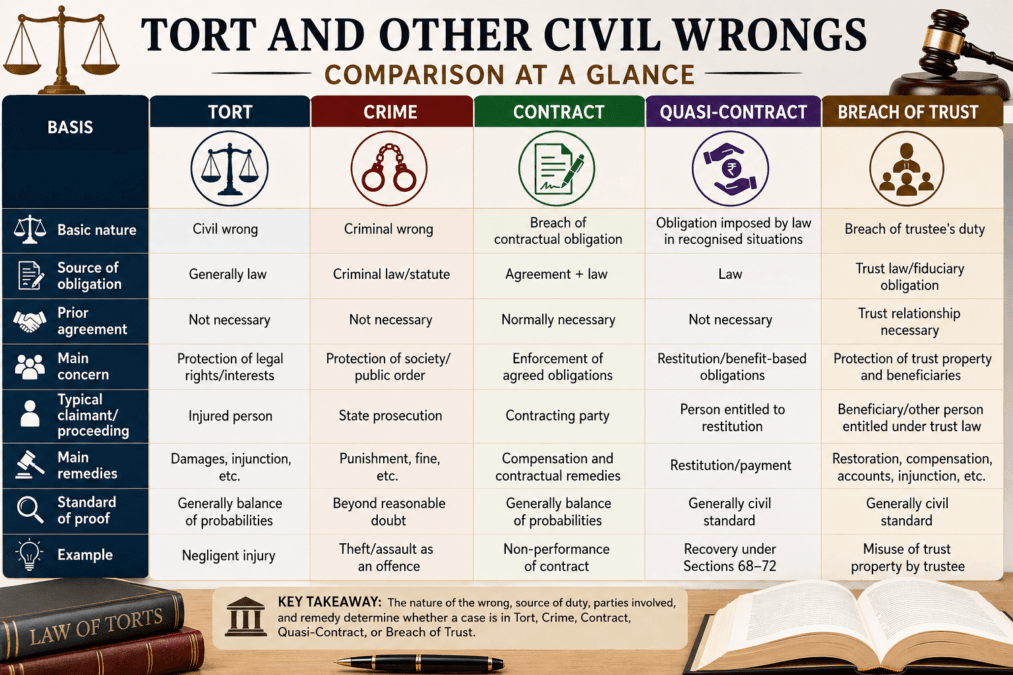
| Basis | Tort | Crime | Contract | Quasi-Contract | Breach of Trust |
|---|---|---|---|---|---|
| Basic nature | Civil wrong | Criminal wrong | Breach of contractual obligation | Obligation imposed by law in recognised situations | Breach of trustee’s duty |
| Source of obligation | Generally law | Criminal law/statute | Agreement + law | Law | Trust law/fiduciary obligation |
| Prior agreement | Not necessary | Not necessary | Normally necessary | Not necessary | Trust relationship necessary |
| Main concern | Protection of legal rights/interests | Protection of society/public order | Enforcement of agreed obligations | Restitution/benefit-based obligations | Protection of trust property and beneficiaries |
| Typical claimant/proceeding | Injured person | State prosecution | Contracting party | Person entitled to restitution | Beneficiary/other person entitled under trust law |
| Main remedies | Damages, injunction, etc. | Punishment, fine, etc. | Compensation and contractual remedies | Restitution/payment | Restoration, compensation, accounts, injunction, etc. |
| Standard of proof | Generally balance of probabilities | Beyond reasonable doubt | Generally balance of probabilities | Generally civil standard | Generally civil standard |
| Example | Negligent injury | Theft/assault as an offence | Non-performance of contract | Recovery under Sections 68–72 | Misuse of trust property by trustee |
6. Indian Position
Indian law recognises these as distinct legal categories, although the boundaries can overlap in particular cases.
1. Tort Law
Indian tort law remains largely based on common-law principles developed through judicial decisions, together with relevant legislation and constitutional developments.
There is no single comprehensive Indian statute codifying the entire law of torts.
2. Contract
The Indian Contract Act, 1872 provides the principal statutory framework for contracts and also contains Chapter V on certain relations resembling those created by contract. (India Code)
3. Quasi-Contract
The traditional expression “quasi-contract” corresponds in Indian statutory law to the relations resembling those created by contract under Sections 68–72 of the Indian Contract Act. (India Code)
4. Trust
The Indian Trusts Act, 1882 defines trusts, trustees, beneficiaries and breach of trust and provides a statutory framework concerning private trusts and trustees. (India Code)
5. Crime
Criminal liability is governed by the applicable criminal statutes and procedural law. A single factual incident can sometimes generate both civil/tortious consequences and criminal proceedings.
Therefore:
Civil liability and criminal liability should be analysed separately even when they arise from the same facts.
7. Important Cases
Jai Laxmi Salt Works (P) Ltd. v State of Gujarat
This Supreme Court decision is useful when studying the conceptual nature of tortious liability and the distinction between tort and other legal obligations.
It is particularly valuable for understanding that tort law cannot be reduced simply to every form of civil liability.
V.S. Ramaswamy Iyer v Brahmayya & Co.
The Supreme Court discussed the distinctions among tort, contract, quasi-contract and obligations in the nature of trusts.
The judgment is particularly useful for understanding the different scope and source of obligations. (Indian Kanoon)
Remember
Tort → generally duty imposed by law
Contract → obligation arising from agreement
Quasi-contract → obligation imposed by law in recognised restitutionary situations
Trust → special duties arising from the trust relationship
A breach of trust arises from a special trust/fiduciary relationship and the trustee’s duties in that capacity.
8. FAQs
1. What is the difference between tort and crime?
A tort is primarily a civil wrong, while a crime is a criminal offence prosecuted by the State. Tort law generally focuses on civil remedies, while criminal law focuses primarily on punishment and public protection.
2. What is the difference between tort and breach of contract?
The main difference is the source of the duty. A tortious duty is generally imposed by law, whereas a contractual duty arises from an agreement between the parties.
3. What is the difference between tort and quasi-contract?
Both may involve obligations imposed by law, but tort concerns civil wrongs and legally protected interests, whereas quasi-contractual liability arises in specified situations where the law imposes an obligation, commonly to prevent unjust benefit or provide restitution.
4. What is the difference between tort and breach of trust?
A tort generally involves breach of a legal duty owed independently of a trust relationship. A breach of trust arises from the special duties of a trustee in relation to trust property and beneficiaries.
5. Can the same act be both a tort and a crime?
Yes. The same conduct can sometimes give rise to both civil/tortious liability and criminal liability. The two proceedings serve different legal purposes and are governed by different rules.
Classmate Pulse Spiral Notebook ✏️ Need a Spiral Notebook for Everyday Writing? A spiral notebook…

Latest Scholarships & Fellowships 2026–27: Open Opportunities for Upcoming call
Latest Scholarships & Research Fellowships 2026–27 Last Verified: 30 September 2026 Students, researchers, PhD scholars…
Writing & Research Resources: Useful Books, Tools & Essentials for Writers and Researchers
Whether you are an author, content writer, law student, academic researcher, PhD scholar, teacher, or…