
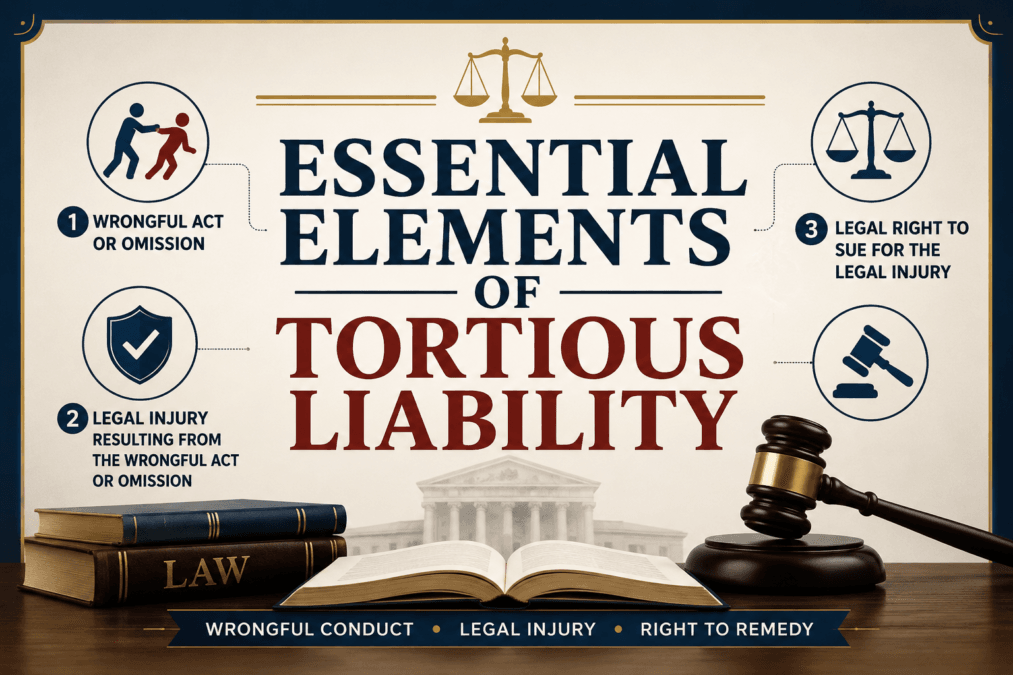
Essential Elements of Tortious Liability
the traditional foundation of tortious liability can be understood through three broad essentials:
- Wrongful act or omission
- Legal injury resulting from the wrongful act or omission
- A legal right to sue for that legal injury
These three should be understood together. A mere act, mere loss, or mere feeling of injustice does not automatically create tortious liability.
1. Wrongful Act or Omission
Meaning
The first essential of tortious liability is that the defendant must have committed a wrongful act or wrongful omission.
A wrongful act is an act that violates a legal duty or interferes with a legally protected right of another person.
An omission means a failure to act where the law imposes a duty to act.
Simple Formula
Wrongful Act/Omission → Breach of Legal Duty → Potential Tortious Liability
What is a Wrongful Act?
A wrongful act is not simply an act that is morally bad or socially undesirable.
It must be wrongful in the eyes of law.
Example
A deliberately enters B’s house without permission.
This may amount to trespass to land, because A has interfered with B’s legally protected interest in possession of the property.
Another example:
A drives a vehicle negligently and injures B.
The relevant question is not merely whether an accident occurred. The law asks whether A breached a legal duty of reasonable care owed to B.
What is an Omission?
An omission means failure to do something.
However, every failure to help another person does not constitute a tort.
An omission becomes legally relevant when the defendant was under a legal duty to act.
Example
If a person has assumed responsibility for another person’s safety and then unreasonably fails to take required precautions, the omission may contribute to tortious liability.
Therefore:
Mere failure to act is not automatically a tort. There must be a legally recognised duty to act in the circumstances.
Act and Omission — Difference
| Wrongful Act | Wrongful Omission |
|---|---|
| Defendant does something legally wrongful | Defendant fails to do something required by law |
| Positive conduct | Failure to act |
| Example: trespassing on another’s land | Example: failure to take required reasonable precautions where a legal duty exists |
An act becomes relevant for tortious liability when it constitutes a breach of a legal duty or infringes a legally protected right, subject to the requirements of the particular tort.
This distinction is extremely important.
2. Legal Injury Resulting from the Wrongful Act or Omission
The second essential is legal injury.
A wrongful act or omission must result in the infringement of a legal right or legally protected interest, or otherwise satisfy the requirements of the particular tort.
What is Legal Injury?
Legal injury means:
Infringement of a right recognised and protected by law.
The Latin expression commonly associated with this idea is:
Injuria = legal injury or infringement of a legal right.
Important distinction
Legal injury ≠ actual financial loss
A person can suffer legal injury even without losing money.
Similarly, a person can suffer financial loss without suffering a legal injury.
This gives rise to two fundamental maxims.
A. Injuria Sine Damno
Meaning
Legal injury without actual damage.
- Injuria = legal injury
- Sine = without
- Damno = damage
It means that a person’s legal right may be infringed even though the person suffers no measurable financial loss.
Case: Ashby v White
Facts
Ashby was a qualified voter.
White, the returning officer, wrongfully refused to allow Ashby to vote.
Although Ashby could not show that the election result had caused him financial loss, his legal right to vote had been violated.
Principle
The case illustrates:
Injuria sine damno — legal injury without actual damage.
What should students remember?
Violation of a legal right can be actionable even without proof of financial loss, where the cause of action otherwise exists.
B. Damnum Sine Injuria
Meaning
Damage without legal injury.
- Damnum = damage or loss
- Sine = without
- Injuria = legal injury
It means that a person may suffer actual loss, but if no legally protected right has been infringed, the loss alone may not give rise to tortious liability.
Case: Gloucester Grammar School Case
Facts
A schoolmaster established a competing school.
Students moved from the existing school to the new school, causing financial loss to the original school.
Principle
The defendant’s conduct was lawful competition and did not infringe a legal right of the plaintiff.
Therefore, the financial loss alone did not create tortious liability.
Exam Point
Gloucester Grammar School Case illustrates damnum sine injuria—actual damage without legal injury.
Legal Injury vs Actual Damage
This distinction is fundamental:
| Legal Injury | Actual Damage |
|---|---|
| Infringement of a legal right | Actual loss or harm |
| Concerned with legal rights | Concerned with actual consequences |
| May exist without financial loss | May exist without infringement of a legal right |
| Injuria sine damno | Damnum sine injuria |
Easy Memory Trick
INJURIA = Legal Injury
DAMNUM = Damage/Loss
Therefore:
Injuria sine damno
→ Right violated, no actual loss.
Damnum sine injuria
→ Actual loss, no legal injury.
Is Actual Damage Always Necessary?
No.
This is an important qualification.
The requirement of actual damage depends upon the particular tort.
In some situations, the infringement of a legal right itself may be sufficient to maintain an action.
In other torts, proof of actual damage or harm forms an important part of the cause of action.
Whether actual damage must be proved depends upon the nature and requirements of the particular tort.
3. Legal Right to Sue for the Legal Injury
The third essential is that the legal injury must be actionable in law.
In simple terms:
The claimant must have a legally recognised right or cause of action that enables them to seek an appropriate legal remedy.
This is connected with the maxim:
Ubi jus ibi remedium
“Where there is a right, there is a remedy.”
Meaning of Ubi Jus Ibi Remedium
Breakdown:
- Ubi = where
- Jus = right
- Ibi = there
- Remedium = remedy
The maxim expresses the principle that where law recognises a legal right, it ordinarily provides a means of legal enforcement or remedy when that right is unlawfully infringed.
Example
Suppose A unlawfully enters B’s property and interferes with B’s legally protected right to possession.
B may have a legal cause of action and may seek an appropriate remedy, such as damages or an injunction, depending upon the circumstances.
The important point is:
The law must recognise the right and the corresponding cause of action.
Important Qualification to Ubi Jus Ibi Remedium
Where the law recognises a legal right and that right is infringed, an appropriate legal remedy may be available, subject to the applicable law and the requirements of the particular cause of action.
For example, a person may suffer financial loss from lawful competition.
The person has suffered damage, but if no legal right has been infringed, the loss alone may not give rise to a tort action.
That is the significance of damnum sine injuria.
Essential Elements of Tortious Liability
How the Three Essentials Work Together
These three essentials should not be studied as completely isolated concepts.
They form a logical sequence:
Step 1 — Wrongful Act or Omission
The defendant does something legally wrongful or fails to do something where a legal duty requires action.
↓
Step 2 — Legal Injury
The wrongful conduct infringes a legally protected right or satisfies the requirements of a recognised tort.
↓
Step 3 — Legal Right to Sue
The law recognises a cause of action and provides an appropriate remedy.
↓
Tortious Liability
Simple Example
Suppose A, while driving carelessly, hits B, causing B physical injury.
Step 1 — Wrongful Act
A’s careless driving may constitute a breach of the legal duty of reasonable care.
Step 2 — Legal Injury
B suffers legally recognised injury resulting from the breach.
Step 3 — Right to Sue
If the requirements of negligence are established, B has a recognised cause of action and may seek an appropriate remedy.
Therefore:
A may be liable in negligence.
Another Example — No Tort Despite Loss
Suppose A opens a shop next to B and sells exactly the same products at lower prices.
B loses customers and suffers financial loss.
Step 1
A has not necessarily committed a wrongful act.
Step 2
B has suffered damage, but there may be no infringement of B’s legal right.
Step 3
Therefore, B cannot ordinarily sue merely because lawful competition caused financial loss.
This illustrates:
Damnum sine injuria
Another Example — Legal Injury Without Financial Loss
Suppose a person has a legally protected right and another person unlawfully prevents its exercise.
Even if the person cannot demonstrate financial loss, the infringement of the legal right may be actionable.
This illustrates:
Injuria sine damno
The classic authority is Ashby v White.
Relationship Between the Three Essentials and Other Tort Concepts
These three essentials provide the basic foundation, but individual torts may require additional elements.
For example:
Negligence
May require examination of:
Duty → Breach → Causation → Damage
Defamation
Requires its own specific requirements relating to the defamatory statement, publication, reference to the claimant and applicable defences.
Trespass
Has different requirements depending upon whether the claim concerns person, land or goods.
Nuisance
Requires consideration of the nature of the interference, the relevant protected interest and other requirements.
Important Cases for the Three Essentials
| Case | Principle | Essential |
|---|---|---|
| Ashby v White | Injuria sine damno | Legal injury |
| Gloucester Grammar School Case | Damnum sine injuria | Damage vs legal injury |
| Donoghue v Stevenson | Duty of care / negligence | Wrongful breach and legal duty |
| M.C. Mehta v Union of India | Absolute liability | Development of tortious liability in India |
Quick Revision
1. Wrongful Act or Omission
Did the defendant do something legally wrongful or fail to perform a legally required duty?
2. Legal Injury
Was a legally protected right or interest infringed?
Remember:
Injuria sine damno → Legal injury without actual damage.
Damnum sine injuria → Damage without legal injury.
3. Legal Right to Sue
Does the law recognise a cause of action and provide an appropriate remedy?
Remember:
Ubi jus ibi remedium → Where there is a right, there is a remedy.
One-line formula
Wrongful Conduct + Legal Injury + Actionable Legal Right = Foundation of Tortious Liability
FAQs — Essential Elements of Tortious Liability
1. What are the three essentials of tortious liability?
The three essentials are (1) wrongful act or omission, (2) legal injury resulting from the wrongful act or omission, and (3) a legal right to sue for the legal injury.
2. What is a wrongful act or omission in tort?
A wrongful act or omission is conduct that breaches a legal duty or infringes a legally protected right. Mere moral wrongdoing or ordinary loss is not necessarily a tort.
3. What is legal injury in tort law?
Legal injury means the infringement of a legally protected right or interest. It may exist even without actual financial loss, as illustrated by Ashby v White.
4. What is the difference between injuria sine damno and damnum sine injuria?
Injuria sine damno means legal injury without actual damage, while damnum sine injuria means actual damage without infringement of a legal right.
5. What is Ubi Jus Ibi Remedium in tort law?
Ubi jus ibi remedium means “where there is a right, there is a remedy.” It indicates that when a legally recognised right is unlawfully infringed, the law may provide an appropriate remedy.
Classmate Pulse Spiral Notebook ✏️ Need a Spiral Notebook for Everyday Writing? A spiral notebook…

Latest Scholarships & Fellowships 2026–27: Open Opportunities for Upcoming call
Latest Scholarships & Research Fellowships 2026–27 Last Verified: 30 September 2026 Students, researchers, PhD scholars…
Writing & Research Resources: Useful Books, Tools & Essentials for Writers and Researchers
Whether you are an author, content writer, law student, academic researcher, PhD scholar, teacher, or…
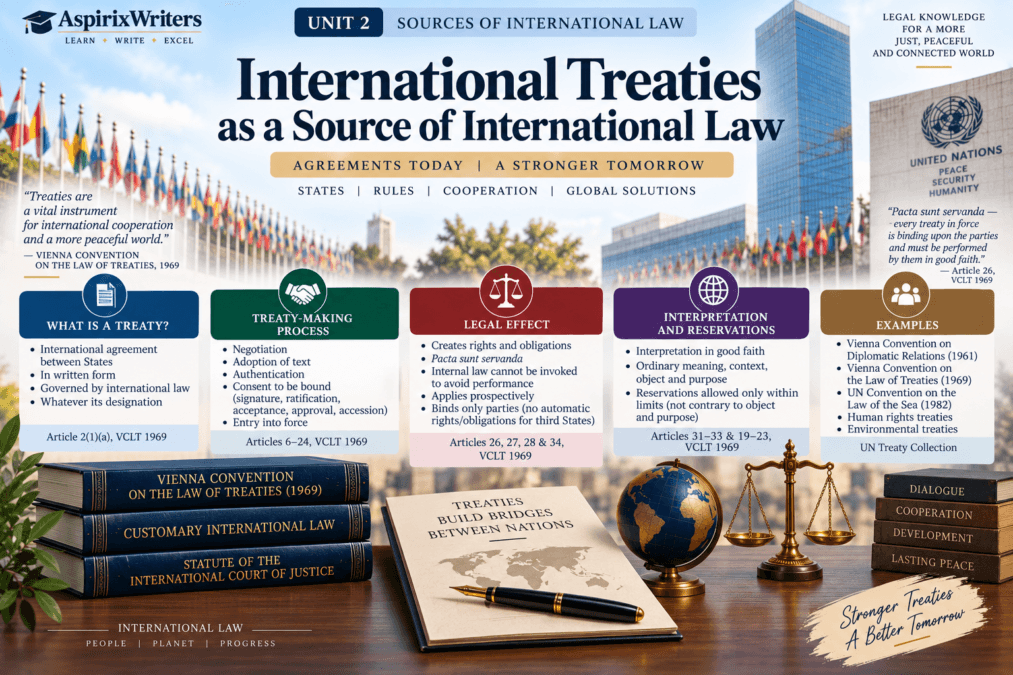
International Treaties as a Source of International Law | LL.B. Notes
International Treaties as a Source of International Law Introduction International treaties are one of the…

The Ultimate Guide to Organizing LLB Notes for Exam Success
LLB Notes for Exam Success Studying law is not simply about reading hundreds of pages….
What Is the Best AI Tool for Legal Research in 2026? A Practical Guide for Lawyers, Law Students and Researchers
What Is the Best AI Tool for Legal Research in 2026? Last updated: September 2026…