
General Defences in Law of Torts
LLB Notes – Law of Torts
- Law of Torts — Meaning and Definition of Tort LLB Notes
- Is It “Law of Tort” or “Law of Torts”?
- Essential Elements of Tortious Liability Law of Torts LLB Notes
- Mental Elements — Intention, Motive, Malice and Fault in Tort
- Tort and Other Civil Wrongs
Introduction– General Defences to Liability in Torts
In the Law of Torts, a person who commits a wrongful act that causes legally recognised injury may ordinarily be held liable. However, liability is not absolute in every case.
There are certain circumstances in which the defendant may escape liability because the law recognises that the act was:
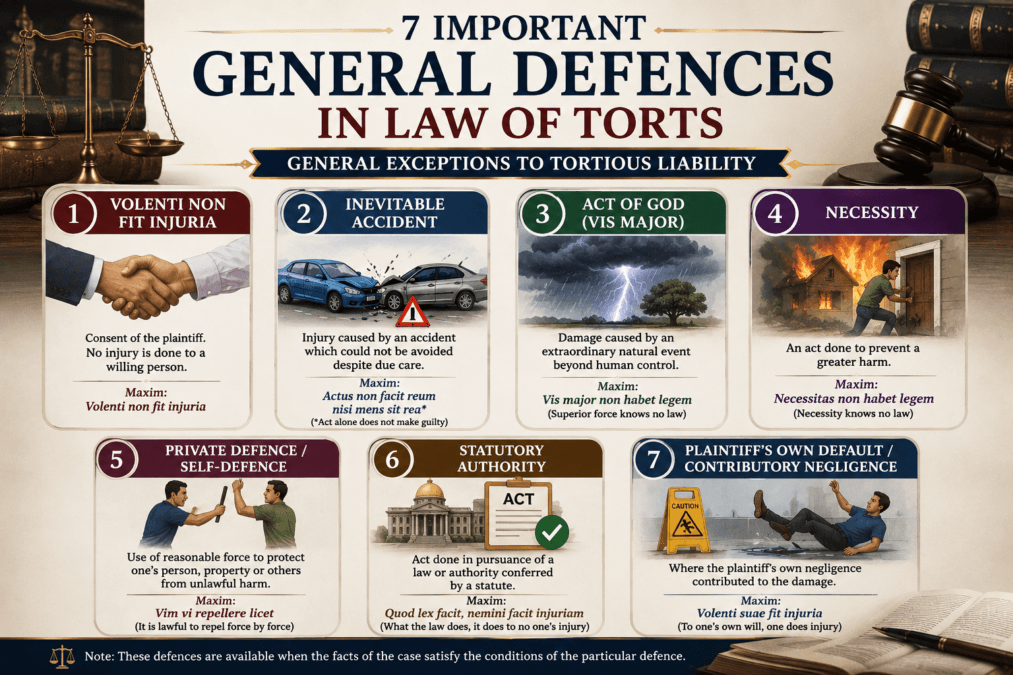
- 1. Volenti Non Fit Injuria (consented to by the plaintiff);
- 2. Inevitable Accident (unavoidable despite reasonable care);
- 3. Act of God — Vis Major (caused by an extraordinary natural event);
- 4. Necessity (necessary to prevent a greater harm);
- 5. Private Defence (done in lawful private defence);
- 6. Plaintiff’s Own Default
- 7. Statutory Authority (authorised by statute);
These are generally known as General Defences in Tort or General Exceptions to Tortious Liability.
Important: A defence does not necessarily mean that no harm occurred. It means that, because of a recognised legal principle, the defendant may not be held liable for that harm.
1. Volenti Non Fit Injuria
Meaning
Volenti non fit injuria is a Latin maxim meaning:
“No injury is done to a person who consents to it.”
The principle is based on voluntary assumption of risk.
If a person knows about a particular risk and freely agrees to accept that risk, he or she may not subsequently complain of injury resulting from that very risk.
Essential Conditions
Two important requirements must generally be established:
1. Knowledge of the Risk
The plaintiff must have knowledge of the nature of the risk.
For example, a person who enters a boxing competition understands that physical contact and the possibility of injury are inherent in the sport.
2. Free and Voluntary Consent
Knowledge alone is not sufficient.
The plaintiff must have voluntarily accepted the risk.
This distinction is extremely important:
Knowledge of a risk ≠ consent to the risk.
A person may know that a workplace is dangerous but still have no genuine freedom to refuse the risk.
Example
A spectator purchases a ticket and voluntarily watches a cricket match from an area intended for spectators. If a ball unexpectedly enters the spectator area and causes an injury that falls within the ordinary risks of attending the match, volenti may become relevant.
However, if the injury resulted from a risk that the spectator could not reasonably have anticipated or accepted, the defence may not apply.
Case: Hall v Brooklands Auto-Racing Club
The plaintiff was a spectator at a motor race. During the race, two cars collided and one of them was thrown into the spectators’ area.
The case is traditionally used to illustrate the principle that a person who voluntarily participates in or attends an activity may be taken to have accepted ordinary and inherent risks of that activity.
Case: Smith v Baker
The House of Lords made an important distinction between knowledge of danger and voluntary acceptance of the risk.
The plaintiff knew that stones were being lifted over his head at his workplace, but that knowledge did not by itself establish that he had voluntarily consented to the risk.
Key Point
Volenti requires both knowledge and voluntary acceptance of the risk.
2. Inevitable Accident
Meaning
An inevitable accident is an accident which could not have been prevented even though the defendant exercised reasonable care and caution.
The important question is not simply:
“Was the accident unexpected?”
The question is:
“Could a reasonable person, exercising appropriate care, have prevented it?”
If the answer is no, the defence may be available.
Example
A person is driving carefully and in accordance with the applicable rules. Suddenly, because of an unforeseeable mechanical failure that could not have been detected through reasonable inspection, the vehicle causes injury.
Depending on the facts, the defendant may rely upon inevitable accident.
Case: Stanley v Powell
The defendant was participating in a shooting expedition. A shot fired by him was deflected by a tree and accidentally injured the plaintiff.
There was no negligence or intention to cause harm.
The court treated the incident as an inevitable accident.
Important Point
An accident does not become an inevitable accident merely because the defendant says:
“I did not intend it.”
The defendant must show that the accident could not reasonably have been avoided.
Easy Formula
Reasonable care + unavoidable accident = Inevitable accident
3. Act of God — Vis Major
Meaning
An Act of God is an extraordinary occurrence caused by natural forces which could not reasonably have been anticipated or prevented by human foresight and care.
Examples may include exceptionally extraordinary:
- floods;
- storms;
- earthquakes;
- volcanic activity; or
- other exceptional natural phenomena.
The expression vis major refers broadly to overwhelming natural force, although in legal usage “Act of God” has a more specific meaning.
Essential Characteristics
An event generally needs to have:
- a natural cause;
- an extraordinary character; and
- a quality that could not reasonably have been anticipated or prevented.
Case: Nichols v Marsland
The defendant maintained artificial lakes. Exceptionally heavy rainfall caused the water to escape and damage the plaintiff’s property.
The extraordinary rainfall was treated as an Act of God.
Act of God vs Inevitable Accident
| Act of God | Inevitable Accident |
| Usually involves extraordinary natural forces | Wider concept |
| Natural event is central | May arise from human or natural circumstances |
| Example: extraordinary flood | Example: unforeseeable mechanical failure |
| A recognised defence in appropriate circumstances | A recognised defence where accident was unavoidable despite reasonable care |
Remember
Every Act of God may involve an unavoidable accident, but every inevitable accident is not necessarily an Act of God.
4. Necessity
Meaning
The defence of necessity applies where a person intentionally interferes with another person’s rights in order to prevent a greater or more serious harm.
The law recognises that, in exceptional circumstances, choosing the lesser harm may be legally justified.
Example
A fire breaks out in a building. To prevent the fire from spreading to neighbouring buildings, a person breaks through a wall or enters another person’s property.
Normally, entering another person’s property without permission could constitute a wrongful interference.
But if the act was reasonably necessary to prevent a much greater danger, the defence of necessity may be relevant.
Important Conditions
The defendant should generally be able to show:
- there was a real and imminent danger;
- the interference was reasonably necessary;
- the act was done to prevent a greater harm; and
- the response was proportionate to the danger.
Important Principle
Necessity is not a licence to interfere with another person’s rights whenever the defendant considers it convenient.
The circumstances must genuinely justify the interference.
Example for Students
Suppose A sees a child trapped inside a burning house. A breaks the door to rescue the child.
A has technically interfered with the property of the owner, but the law may regard the interference as justified by necessity.
5. Private Defence
Meaning
The law recognises a person’s right to protect:
- his or her own person;
- another person;
- property; or
- another legally protected interest,
against an unlawful attack or threat, subject to the applicable legal limitations.
In tort law, private defence may operate as a justification for conduct that would otherwise amount to a tort.
Example
A attacks B with a stick.
B uses reasonable force to protect himself.
B’s use of reasonable force may be justified as an exercise of private defence.
However, if B continues attacking A after the danger has completely disappeared, the justification may no longer apply.
Reasonable Force
The force used must bear a reasonable relationship to the threat.
The principle is:
The law permits reasonable protection, not unnecessary retaliation.
Case: Bird v Holbrook
The defendant placed a spring gun in his garden to protect his property without giving sufficient warning.
The plaintiff entered the garden and was injured.
The defendant was held liable.
The case demonstrates that a property owner cannot use dangerous and disproportionate methods of protection merely to protect property.
6. Statutory Authority
Meaning
A person or organisation may sometimes escape tortious liability where the act complained of was authorised by legislation.
This is known as the defence of statutory authority.
The reasoning is simple:
If Parliament or the competent legislature has authorised an activity, the courts cannot ordinarily treat the very performance of that authorised activity as wrongful merely because it causes an interference that would otherwise amount to a tort.
However, the protection is limited to what the statute actually authorises.
Example
Suppose legislation authorises the construction and operation of a railway.
If the railway company carries out an act that is necessarily authorised by the statute, statutory authority may protect it against certain claims arising from that authorised activity.
But if the company acts negligently or goes beyond the statutory authority, the defence may not be available.
Case: Vaughan v Taff Vale Railway Co.
The case is traditionally cited in relation to statutory authority and railway operations.
Important Rule
Statutory authority protects authorised acts, not every act of a statutory body.
7. Plaintiff’s Own Default
The conduct of the plaintiff may sometimes affect his or her ability to recover damages.
This is particularly important where the plaintiff’s own conduct:
- contributed to the injury;
- involved acceptance of a risk;
- was itself wrongful; or
- creates another recognised legal bar to the claim.
Example
A pedestrian carelessly crosses a busy road while using a mobile phone. A driver is also negligent.
The pedestrian’s conduct may amount to contributory negligence, which can affect the amount of compensation.
It does not necessarily mean that the defendant escapes all liability.
Important Distinction
Plaintiff’s default is a broader concept.
Contributory negligence specifically concerns the plaintiff’s failure to take reasonable care for his or her own safety, contributing to the damage.
General Defences at a Glance
| Defence | Core principle | Key question |
| Volenti non fit injuria | Voluntary acceptance of risk | Did the plaintiff freely accept the risk? |
| Inevitable accident | Unavoidable despite reasonable care | Could the accident reasonably have been prevented? |
| Act of God | Extraordinary natural event | Was the harm caused by an extraordinary natural force? |
| Necessity | Prevention of greater harm | Was the interference reasonably necessary? |
| Private defence | Protection against unlawful attack | Was the force reasonable and necessary? |
| Statutory authority | Legislative authorization | Was the act authorized by statute? |
| Plaintiff’s default | Plaintiff’s own conduct affects claim | Did the plaintiff’s conduct legally contribute to the claim? |
Important Cases to Remember
For examination purposes, the following cases are particularly useful:
- Smith v Baker — knowledge of risk is not necessarily consent.
- Hall v Brooklands Auto-Racing Club — voluntary acceptance of inherent risks.
- Stanley v Powell — inevitable accident.
- Nichols v Marsland — Act of God.
- Bird v Holbrook — unreasonable means of protecting property/private defence.
- Vaughan v Taff Vale Railway Co. — statutory authority.
Conclusion
The general defences in tort are based on an important idea: the existence of harm does not by itself determine liability. The court must also consider whether the defendant has a legally recognised justification or whether the plaintiff’s own conduct affects the claim.
Exam Tip
If the question is “Explain the general defences in tort”, begin with the meaning of general defences, then explain each defence under:
Meaning → Essentials → Example → Leading Case → Limitation → Conclusion.
That will produce a much stronger examination answer than simply listing the names of the defences.
FAQs — General Defences in Law of Torts
1. What are the general defences in the Law of Torts?
General defences are legal grounds on which a defendant may avoid or limit liability for a tort. Important defences include volenti non fit injuria, inevitable accident, Act of God, necessity, private defence, statutory authority and contributory negligence.
2. What is Volenti Non Fit Injuria?
Volenti non fit injuria means “to a willing person, no injury is done.” It applies where the plaintiff knowingly and freely accepts a particular risk.
3. Is mistake a defence in tort?
Generally, no. A mistake of fact or law is ordinarily not a general defence in tort, although its effect may vary according to the particular tort.
4. What is the difference between Volenti Non Fit Injuria and contributory negligence?
Volenti is based on voluntary acceptance of risk, whereas contributory negligence is based on the plaintiff’s failure to take reasonable care for their own safety. Volenti, when established, generally operates as a complete defence; contributory negligence generally results in reduction of damages.
5. What is an Act of God in tort law?
An Act of God is an extraordinary natural event that could not reasonably have been anticipated or prevented, such as an exceptionally severe natural phenomenon. Nichols v Marsland is a leading case.