
Last Updated: September 1, 2026
Novus Actus Interveniens in Tort Law
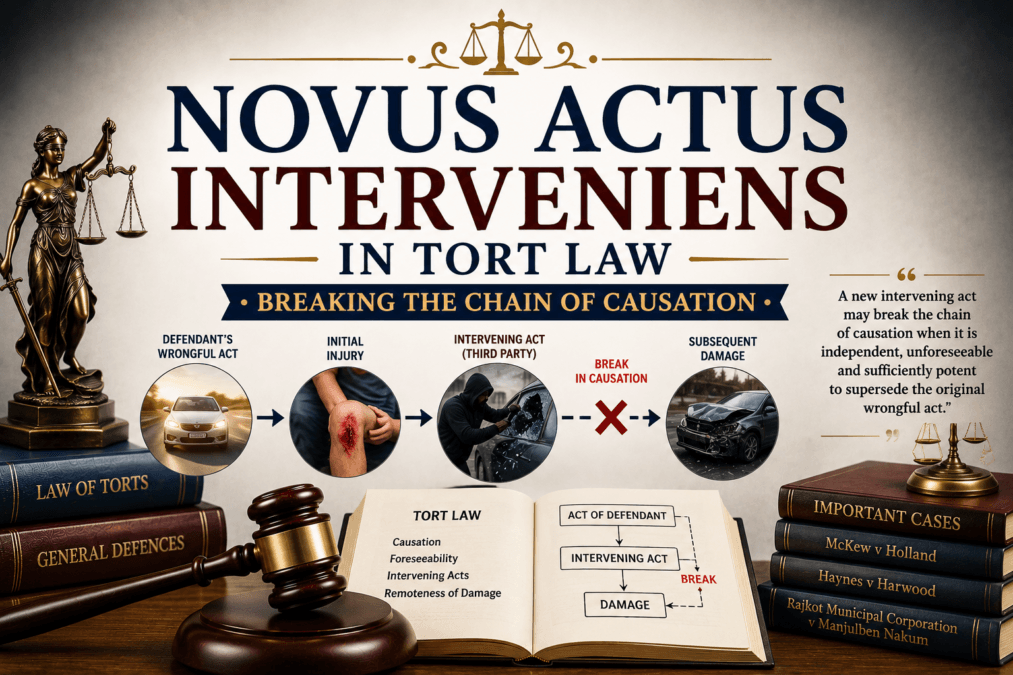
Novus Actus Interveniens is an important concept in the Law of Torts, particularly under causation and remoteness of damage. It deals with a new intervening act or event that occurs after the defendant’s wrongful act and may, in appropriate circumstances, break the chain of causation.
Don’t Miss New Law Opportunities!
Join our WhatsApp community for verified updates on Law Jobs, Internships, Competitions, Scholarships, LLB Notes & more.
For LL.B. students, one point is especially important:
Novus actus interveniens is not a separate tort defence in the same sense as Volenti Non Fit Injuria or Inevitable Accident. It is primarily a principle of causation used to determine whether the defendant’s original wrongful act remains legally responsible for the subsequent damage.
Recent Indian authority continues to emphasise that an intervening event does not automatically break causation. The intervention must be sufficiently independent and potent to displace the original cause. (Indian Kanoon)
1. Meaning of Novus Actus Interveniens
The Latin expression novus actus interveniens means:
“A new intervening act.”
In tort law, it refers to a subsequent act, event or conduct that intervenes between the defendant’s wrongful act and the claimant’s eventual damage.
The central question is:
Has the later event become so independent, unreasonable or unforeseeable that the defendant’s original wrongful act should no longer be regarded as the legal cause of the damage?
If the answer is yes, the chain of causation may be broken.
If the answer is no, the original defendant may remain liable.
The Supreme Court of India has explained that human intervention does not per se sever causation; the intervening act must be sufficiently unwarrantable, unreasonable, extraneous or extrinsic in the circumstances. (Indian Kanoon)
2. Where Does Novus Actus Interveniens Fit in Tort Law?
It should be placed under:
Causation → Legal Causation → Intervening Acts → Novus Actus Interveniens
It is therefore closely connected with:
- causation;
- factual causation;
- legal causation;
- remoteness of damage;
- foreseeability;
- intervening acts;
- acts of third parties;
- claimant’s own conduct; and
- medical treatment.
3. Simple Example
Suppose:
A drives negligently and injures B.
B is taken to hospital.
During treatment, B suffers a normal medical complication arising from the original injury.
A may still be liable because medical treatment is a natural consequence of the original accident.
But suppose an entirely independent and extraordinary event occurs that completely supersedes the original injury.
The court may then conclude:
A’s negligence → original injury → independent intervening event → later damage
If the intervening event is sufficiently independent and unforeseeable, it may break the chain.
4. The Chain of Causation
The doctrine is best understood through a chain:
Defendant’s wrongful act
↓
Initial injury
↓
Intervening event
↓
Further damage
The court asks whether the intervening event merely forms part of the sequence or whether it supersedes the original wrongful act.
If the chain continues:
Defendant remains legally responsible.
If the chain is broken:
Defendant may not be liable for the subsequent damage.
5. Factual and Legal Causation
Before considering novus actus interveniens, causation should generally be considered at two levels.
A. Factual causation
The question is:
Would the damage have occurred but for the defendant’s wrongful act?
This is commonly expressed through the “but for” test.
The recent Delhi High Court decision in United India Insurance Co. Ltd. v. Mamta Rani discussed factual causation through the but-for test and distinguished it from legal causation. (Indian Kanoon)
B. Legal causation
Even where the defendant’s act is a factual cause, the law must decide whether the connection is sufficiently close to impose liability.
Here, courts consider matters such as:
- foreseeability;
- remoteness;
- intervening events;
- reasonableness;
- independence of the later act; and
- the defendant’s responsibility for the risk.
The Supreme Court in Rajkot Municipal Corporation v. Manjulben Jayantilal Nakum discussed foreseeability and the role of novus actus interveniens in determining whether the chain of causation remains intact.
6. When Does an Intervening Act Break the Chain?
There is no single mechanical formula applicable to every case.
The court considers the circumstances as a whole.
Important questions include:
- Was the intervening act foreseeable?
- Was it independent of the defendant?
- Was it voluntary or deliberate?
- Was it unreasonable?
- Did the defendant have a duty to anticipate or prevent it?
- Did the defendant create the situation in which the intervention occurred?
- Was the later event sufficiently powerful to supersede the original wrongdoing?
A recent 2026 Delhi High Court judgment summarised these considerations and stated that an intervening act breaks causation only when it is sufficiently independent and potent to displace the original cause.
7. Foreseeability Is Extremely Important
Foreseeable intervention
If the later event was a foreseeable consequence of the defendant’s negligence, it generally will not break the chain.
Unforeseeable and independent intervention
If the later event was extraordinary, independent and sufficiently unforeseeable, it is more likely to constitute a novus actus interveniens.
This principle was clearly discussed by the Supreme Court in Rajkot Municipal Corporation v. Manjulben Jayantilal Nakum. (Indian Kanoon)
8. Important Case:
Haynes v Harwood [1935]
This is an important case concerning an intervening human act and the reaction of a person confronted with danger.
Facts
A horse-drawn van was left unattended in a crowded street. The horses bolted after a boy threw a stone at them.
A police officer intervened to stop the horses and was injured.
Principle
The defendant could not simply argue that the boy’s act was an intervening cause.
The intervention was within the kind of risk created by leaving the horses unattended in a crowded street.
The case is therefore useful for the proposition that a foreseeable intervention does not necessarily break causation. The principle has subsequently been discussed by English and Indian courts.
Exam point
Foreseeable human intervention → generally no novus actus interveniens.
The Oropesa
The Oropesa [1943] P 32
This is a classic authority concerning human intervention.
The case involved a collision between vessels followed by subsequent actions taken in response to the collision.
The court recognised that human action does not automatically break causation.
The question is whether the later conduct is so unreasonable, extraneous or independent that the original wrongdoing should no longer be regarded as a legal cause.
The reasoning from The Oropesa has been referred to in later cases, including McKew v Holland and Indian decisions.
McKew v Holland
McKew v Holland & Hannen & Cubitts (Scotland) Ltd [1969]
This is one of the most important cases on the claimant’s own conduct as an intervening act.
Facts
The claimant suffered an injury at work due to the defendant’s negligence.
The injury caused weakness in his leg, which could suddenly give way.
Later, he attempted to descend a steep staircase without adequate assistance and suffered a serious second injury.
Decision
The House of Lords held that the claimant’s unreasonable conduct could constitute a novus actus interveniens.
The first injury did not automatically make the defendant responsible for everything that subsequently happened.
The claimant’s conduct in placing himself in the dangerous situation was regarded as sufficiently unreasonable to break the chain.
Principle
Unreasonable conduct by the claimant may constitute a novus actus interveniens.
Important qualification
The court also recognised that a person confronted with an emergency should not be judged too harshly for an instinctive reaction.
9. Reasonable Reaction to an Emergency
This is an important examination point.
If the defendant’s negligence creates a dangerous situation and the claimant reacts instinctively or reasonably, that reaction ordinarily does not break the chain of causation.
For example:
Defendant’s negligence → claimant faces immediate danger → claimant takes reasonable action to escape → claimant is injured
The defendant may remain liable.
The law does not generally require a person facing an emergency created by the defendant to make a perfect decision.
This principle can be contrasted with McKew v Holland, where the claimant’s later conduct was found sufficiently unreasonable to break the chain.
Knightley v Johns
Knightley v Johns [1981]
This case demonstrates that negligent conduct by another person can sometimes constitute a novus actus interveniens.
Facts
Following a road accident, a police inspector gave an incorrect instruction concerning traffic control inside a tunnel. Another officer was subsequently injured.
Decision
The Court of Appeal held that the later negligent conduct could break the chain of causation in the circumstances.
However, the court emphasised that a human intervention does not automatically break causation.
Principle
A later human act may break the chain where it is sufficiently independent and unreasonable, but foreseeability remains important.
10. Act of a Third Party
A third party’s conduct is one of the most common forms of alleged intervening act.
For example:
A negligently creates danger → B, a stranger, intervenes → C suffers damage.
The court asks whether B’s conduct was:
- foreseeable;
- independent;
- deliberate;
- unreasonable; or
- within a risk created by A.
The Supreme Court in Rajkot Municipal Corporation explained that human action does not automatically sever causation. (Indian Kanoon)
Therefore:
Third-party act ≠ automatically novus actus interveniens.
This is an important correction to the common simplified treatment of the doctrine.
11. Home Office v Dorset Yacht
Home Office v Dorset Yacht Co Ltd [1970] AC 1004
This is a major authority concerning third-party conduct and control.
Borstal trainees escaped while under the supervision of Home Office officers and subsequently damaged the claimant’s yacht.
The House of Lords recognised that the relationship of control and the foreseeable risk could give rise to a duty of care.
Therefore, the conduct of the third parties did not automatically relieve the Home Office of responsibility.
Principle
Where the defendant has responsibility or control over the third party and the harm is foreseeable, the third party’s conduct may not break the chain.
12. Medical Treatment and Novus Actus Interveniens
Medical treatment frequently arises in causation cases.
The general approach is:
Medical treatment necessitated by the defendant’s original wrongdoing does not ordinarily break the chain of causation.
For example:
Negligent accident → injury → hospital treatment → complication → additional injury
The defendant may remain liable for the consequences.
The recent 2026 Delhi High Court decision in United India Insurance Co. Ltd. v. Mamta Rani specifically discussed medical treatment and held that ordinary treatment following an accident did not constitute an independent intervening event capable of displacing the original cause.
13. Medical Negligence Can Sometimes Break the Chain
This does not mean that medical negligence can never constitute a novus actus interveniens.
The question is one of degree and circumstances.
An exceptionally independent, unreasonable or extraordinary medical intervention may potentially break causation.
The recent Delhi High Court discussion in United India Insurance Co. Ltd. v. Mamta Rani considered the distinction between ordinary medical treatment and exceptionally or grossly negligent treatment. (Indian Kanoon)
Exam formulation
Ordinary medical treatment → normally does not break causation.
Exceptional and sufficiently independent medical intervention → may break causation depending on the circumstances.
Smith v Leech Brain & Co Ltd
Smith v Leech Brain & Co Ltd [1962]
This case is important for distinguishing novus actus interveniens from the eggshell skull rule.
A worker suffered a burn injury caused by the defendant’s negligence. The injury triggered cancer associated with a pre-existing vulnerability, eventually causing death.
The defendant was held liable.
The principle is:
A defendant must take the claimant as found and cannot escape liability merely because the claimant had an unusual susceptibility.
The 2026 Delhi High Court decision in United India Insurance Co. Ltd. v. Mamta Rani relied upon this principle while discussing the eggshell skull rule and novus actus interveniens.
Robinson v Post Office
Robinson v Post Office [1974]
The claimant suffered an injury requiring treatment. An anti-tetanus injection subsequently caused an allergic reaction.
The case is important because the medical treatment was a consequence of the original injury and did not automatically break the chain of causation.
The principle has been discussed in the recent Indian authority United India Insurance Co. Ltd. v. Mamta Rani. (Indian Kanoon)
Indian Case: Chaurasia & Co. v Pramila Rao
Chaurasia & Co. v Smt. Pramila Rao (1974)
The Madhya Pradesh High Court considered whether the conduct of persons exposed to a dangerous situation could constitute a novus actus interveniens.
The court held, in substance, that a reasonable response to a dilemma created by the defendant’s negligence should not ordinarily be treated as an intervening act breaking causation. (Indian Kanoon)
Principle
Reasonable reaction to danger created by the defendant → generally no break in causation.
This is a very useful Indian case for LL.B. notes.
14. Indian Cases:
Rajkot Municipal Corporation v Manjulben Jayantilal Nakum
Rajkot Municipal Corporation v Manjulben Jayantilal Nakum (1997) 9 SCC 552
This is an important Supreme Court authority for causation, foreseeability and novus actus interveniens.
The case concerned the death of a person after a roadside tree suddenly fell on him.
The Supreme Court discussed:
- duty of care;
- foreseeability;
- remoteness;
- intervening human action; and
- the meaning of novus actus interveniens. (Indian Kanoon)
The judgment explains that human action does not automatically break causation. The court must determine whether the subsequent event is such that the original wrongful conduct should no longer be treated as the legal cause. (Indian Kanoon)
Indian Case: Saroj Basotia v State of M.P.
Saroj Basotia v State of M.P. 2007
The Madhya Pradesh High Court discussed the foreseeability of an intervening act.
The court explained that where the intervening event was foreseeable, it ordinarily does not eclipse the original wrongdoing. However, foreseeability is not the sole consideration; an intervening act can potentially break the chain if it is sufficiently unreasonable. (Indian Kanoon)
Exam point
Foreseeability is important, but it is not the only test.
15. Important 2026 Indian Authority
United India Insurance Co. Ltd. v. Mamta Rani & Ors.2026
The High Court court explained that:
- factual causation involves the but-for test;
- legal causation involves sufficient connection and foreseeability;
- an intervening act does not automatically sever causation;
- an intervening act must be sufficiently independent and potent to supersede the original cause; and
- medical treatment normally required because of the original injury does not ordinarily constitute a novus actus interveniens. (Indian Kanoon)
This provides a strong current Indian reference point for the doctrine.
16. When Novus Actus Interveniens Is Likely to Apply
The doctrine is more likely to apply where the intervening event is:
Independent
It originates independently of the defendant’s wrongful conduct.
Unforeseeable
The defendant could not reasonably have anticipated it.
Unreasonable
The later conduct is sufficiently unreasonable to supersede the original wrong.
Voluntary
A deliberate and independent human choice may, depending on the circumstances, break causation.
Extraneous
It is sufficiently external to the risk created by the defendant.
Potent
It becomes the dominant cause of the subsequent damage.
The 2026 Mamta Rani decision describes the intervening event as needing to be sufficiently potent to displace the original cause. (Indian Kanoon)
17. When Novus Actus Interveniens Usually Does Not Apply
The chain will generally remain intact where the later event is:
- a foreseeable consequence of the original negligence;
- a natural development of the injury;
- a reasonable response to danger;
- ordinary medical treatment;
- a consequence of the risk originally created; or
- an event for which the defendant had a particular responsibility.
The Supreme Court’s reasoning in Rajkot Municipal Corporation and the 2026 Mamta Rani decision support this contextual approach.
18. Novus Actus and Claimant’s Own Conduct
A claimant’s own conduct can sometimes constitute an intervening act.
Example
A negligently injures B.
B knows that his injury makes his leg unstable.
B nevertheless voluntarily places himself in a highly dangerous situation and suffers a second injury.
If B’s conduct is sufficiently unreasonable, it may constitute a novus actus interveniens.
This is the principle illustrated by McKew v Holland.
But a reasonable response to an emergency is treated differently.
19. Novus Actus and Contributory Negligence Are Different
Contributory Negligence
The claimant’s negligence contributes to the damage.
The result may be a reduction in damages.
Novus Actus Interveniens
The claimant’s or another person’s subsequent act is so independent and unreasonable that it breaks the chain of legal causation.
The result may be that the defendant is not liable for the subsequent damage.
Simple distinction
Contributory negligence → damages may be reduced.
Novus actus interveniens → causation may be broken.
20. Novus Actus and Act of Third Party — Difference
| Novus Actus Interveniens | Act of Third Party |
| Doctrine of causation | Defence/exception relevant in particular tort contexts |
| Focuses on whether chain of causation is broken | Focuses on independent third-party conduct |
| May involve claimant, third party or natural event | Specifically concerns third-party intervention |
| Applies across causation analysis | Particularly important under Rylands v Fletcher |
| Key question: Did the later event supersede the original cause? | Key question: Can defendant be held responsible for the stranger’s act? |
Key point
An Act of Third Party can be a Novus Actus Interveniens, but the two concepts are not identical.
21. Novus Actus and Act of God — Difference
Act of God
An extraordinary natural event.
Novus Actus Interveniens
A later event or act that breaks the chain of causation.
Therefore, a natural event may sometimes operate as an intervening event, but novus actus interveniens is a broader causation concept.
22. Novus Actus and Remoteness
The doctrine is closely associated with remoteness of damage.
Even if the defendant’s act is a factual cause, the defendant may not be liable for consequences that are too remote or that result from a sufficiently independent intervening event.
The modern approach therefore requires consideration of:
Causation → Foreseeability → Remoteness → Intervening act
The 2026 Mamta Rani decision expressly connects factual causation, legal causation, foreseeability and novus actus interveniens. (Indian Kanoon)
23. Important Cases at a Glance
| Case | Principle |
| Haynes v Harwood (1935) | Foreseeable reaction/intervention does not necessarily break causation |
| The Oropesa (1943) | Unreasonable or extraneous intervening conduct may break causation |
| McKew v Holland (1969) | Unreasonable claimant conduct may constitute novus actus |
| Home Office v Dorset Yacht (1970) | Third-party conduct does not necessarily break causation where control and foreseeability exist |
| Chaurasia & Co. v Pramila Rao (1974) | Reasonable reaction to danger created by negligence is not ordinarily a novus actus |
| Rajkot Municipal Corporation v Manjulben Nakum (1997) | Human intervention, foreseeability and legal causation |
| Saroj Basotia v State of M.P. (2007) | Foreseeability is important but not the sole test |
| United India Insurance Co. Ltd. v Mamta Rani (2026) | Independent, unforeseeable and sufficiently potent intervention may break causation; ordinary medical treatment generally does not |
24. Exam-Oriented Answer
What is Novus Actus Interveniens in Tort Law?
Novus Actus Interveniens means a new intervening act. It is a principle of legal causation under which a subsequent act or event may break the chain of causation between the defendant’s wrongful conduct and the claimant’s damage.
An intervening act does not automatically break causation. The court considers whether the later event was sufficiently independent, unreasonable, unforeseeable or extraneous to supersede the defendant’s original wrongdoing. The Supreme Court in Rajkot Municipal Corporation v. Manjulben Jayantilal Nakum recognised that human intervention does not necessarily sever causation. (Indian Kanoon)
In McKew v Holland, unreasonable conduct by the claimant was held capable of breaking the chain, whereas Haynes v Harwood demonstrates that a reasonable or foreseeable response to danger created by the defendant will not necessarily constitute a novus actus.
The recent decision in United India Insurance Co. Ltd. v. Mamta Rani further emphasises that an intervening event must be sufficiently independent and potent to displace the original cause, and that ordinary medical treatment following the original injury does not ordinarily break causation. (Indian Kanoon)
Thus, novus actus interveniens is essentially a doctrine for determining whether the defendant’s wrongful act remains the legal cause of the claimant’s subsequent damage.
Don’t Miss New Law Opportunities!
Join our WhatsApp community for verified updates on Law Jobs, Internships, Competitions, Scholarships, LLB Notes & more.
25. Quick Revision Notes
Novus Actus Interveniens
Meaning:
New intervening act.
Function:
Determines whether the chain of causation has been broken.
Main questions:
- Was the later event foreseeable?
- Was it independent?
- Was it unreasonable?
- Was it voluntary?
- Did it supersede the original wrongdoing?
- Did the defendant have responsibility for preventing it?
Leading cases
Haynes v Harwood
→ foreseeable reaction.
The Oropesa
→ unreasonable/extraneous intervention.
McKew v Holland
→ unreasonable claimant conduct.
Home Office v Dorset Yacht
→ third-party intervention + control.
Rajkot Municipal Corporation
→ Indian Supreme Court authority on causation.
United India Insurance v Mamta Rani
→ recent Indian authority; independent and potent intervention required to displace original cause. (Indian Kanoon)
One-line rule
A subsequent act breaks the chain of causation only when it is sufficiently independent, unreasonable, unforeseeable or potent to supersede the defendant’s original wrongdoing; a foreseeable or ordinary consequence generally does not.
FAQs — Novus Actus Interveniens
1. What is Novus Actus Interveniens in tort law?
Novus Actus Interveniens means a new intervening act. It refers to a later act or event that may break the chain of causation between the defendant’s wrongful act and the claimant’s damage.
2. Is Novus Actus Interveniens a defence in tort law?
It is better described as a principle of causation rather than an independent general defence. It determines whether the defendant’s conduct remains the legal cause of the claimant’s subsequent damage.
3. When does Novus Actus Interveniens break the chain of causation?
It may break the chain when the intervening event is sufficiently independent, unforeseeable, unreasonable or extraneous and effectively supersedes the defendant’s original wrongdoing.
4. Does an act of a third party always break the chain of causation?
No. A third-party act does not automatically constitute a novus actus interveniens. Courts consider foreseeability, independence, control and the defendant’s responsibility for the risk.
5. Can medical treatment break the chain of causation?
Ordinary medical treatment normally does not break the chain. However, exceptionally independent or sufficiently unreasonable medical intervention may raise a question of novus actus interveniens depending on the circumstances. (Indian Kanoon)
Classmate Pulse Spiral Notebook ✏️ Need a Spiral Notebook for Everyday Writing? A spiral notebook…

Latest Scholarships & Fellowships 2026–27: Open Opportunities for Upcoming call
Latest Scholarships & Research Fellowships 2026–27 Last Verified: 30 September 2026 Students, researchers, PhD scholars…
Writing & Research Resources: Useful Books, Tools & Essentials for Writers and Researchers
Whether you are an author, content writer, law student, academic researcher, PhD scholar, teacher, or…