
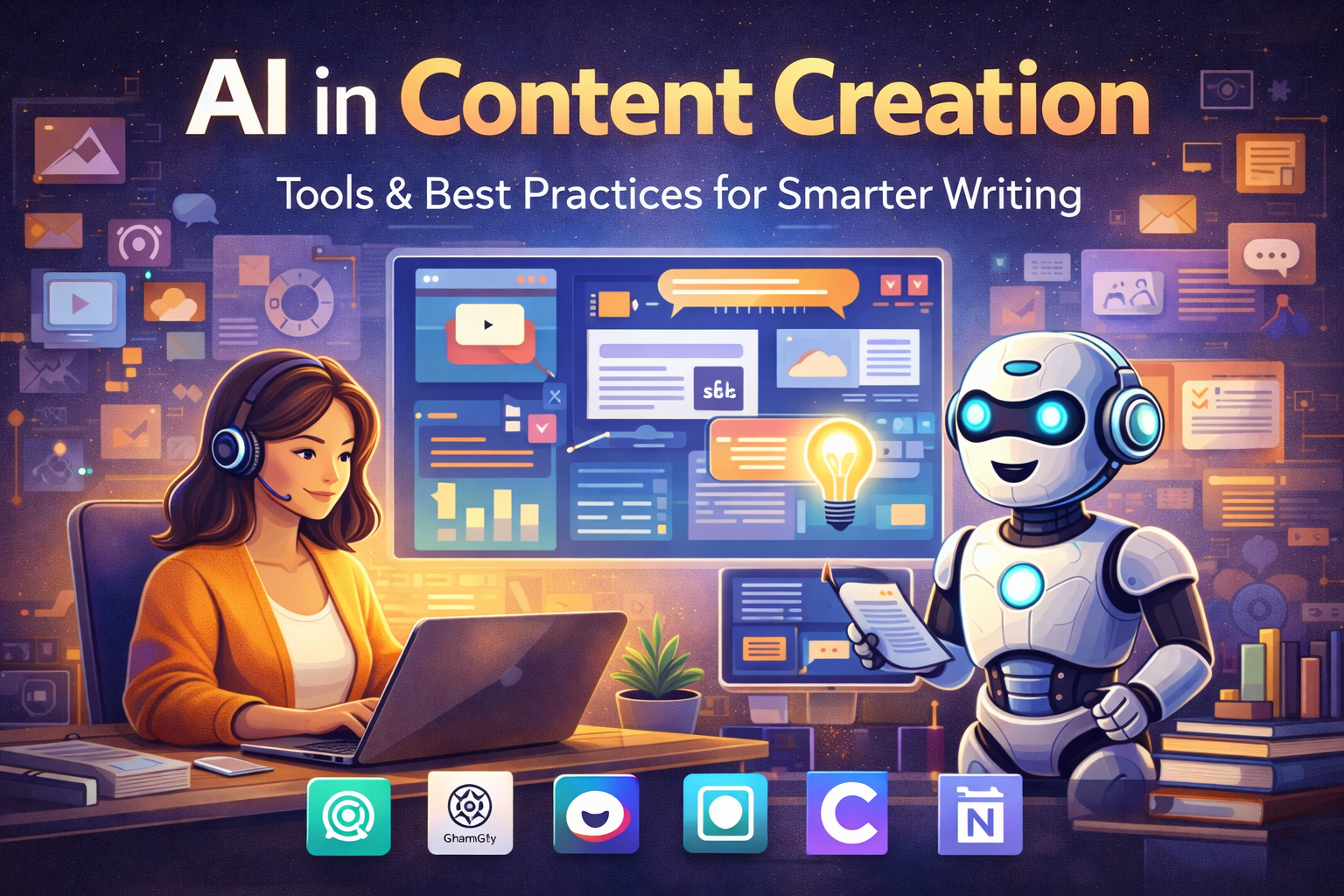
Explore AI in content creation for 2026 — tools, workflows, benefits, real use cases, and ethical best practices that help writers and marketers create better content faster.
Why Content Creation Needs a Smarter Approach
Content creators today face a smart, data-driven audience that expects relevance, clarity, and speed. Publishing more doesn’t guarantee better engagement — quality and insight do. That’s where AI in content creation comes in, helping writers, marketers, and businesses craft thoughtful content more efficiently without sacrificing originality.
Across AspirixWriters — where idea transformation meets meaningful expression — having a clear understanding of tools and workflows can make content creation not just faster but truly impactful.
What Is AI in Content Creation?
AI in content creation refers to using advanced machine learning and language models to assist in generating, editing, optimizing, or enhancing written and visual content. These tools analyze patterns in data, help brainstorm topics, draft text, refine language, and support strategy — always as an assistant, not a replacement for human insight.
Why AI in Content Creation Matters in 2026
Content isn’t just text — it’s strategy. Businesses, creators, and educators produce blogs, videos, scripts, social posts, and newsletters daily. AI tools help by:
- Saving time on drafting and editing
- Providing SEO-friendly suggestions and keyword insights
- Generating data-informed content ideas
- Supporting consistency across formats
Instead of writing more, creators can write better, focusing on connection, not chore.
How AI in Content Creation Works (Workflow Overview)
AI content tools typically follow these integrated steps:
- Input & Data Sources — topic keywords, audience signals, analytics data
- Pattern Recognition — language models identify likely structures, trends
- Draft Generation — creates initial text outlines or full drafts
- Optimization Suggestions — improves readability, SEO, tone
- Human Review & Refinement — editor reshapes AI output for voice and accuracy
This human-plus-AI process ensures quality, clarity, and ethical use.
Top Tools for AI in Content Creation (Tools Table)
| Tool Name | Primary Use | Best For | Official Website |
|---|---|---|---|
| ChatGPT (OpenAI) | Writing, research, ideation | Blogs, scripts, emails | https://openai.com |
| Claude (Anthropic) | Long-form writing, analysis | Research, academic & reports | https://www.anthropic.com/claude |
| Perplexity AI | AI search & research | Fact-checking, citations | https://www.perplexity.ai |
| Jasper AI | Marketing copy | Ads, landing pages | https://www.jasper.ai |
| Writesonic | Automated content | Blogs, social posts | https://writesonic.com |
| Grammarly | Editing & tone | Proofreading | https://www.grammarly.com |
| Canva AI | Visual + captions | Social graphics | https://www.canva.com |
| Surfer SEO | SEO optimization | Blog ranking | https://surferseo.com |
| Notion AI | Research management | Content planning | https://www.notion.so |
| Copy.ai | Creative copy | Captions, ads | https://www.copy.ai |
Real-World Use Cases
Across industries, creators use AI content tools to:
- Plan content calendars using trend analysis
- Create SEO-optimized blogs with topic suggestions
- Generate product descriptions at scale
- Produce scripts or email sequences for campaigns
- Edit and polish drafts for clarity and tone
For example, writers using AI can go from topic idea to structured first draft in a fraction of the usual time — then apply human judgment to refine meaning and accuracy.
Benefits of Using AI in Content Creation
- Productivity Boost: Spend less time typing and more on ideas
- Scalability: Produce more formats (blogs, videos, images, scripts)
- Consistency: Maintain brand voice with style guides
- SEO Support: Tools suggest keywords and structure
- Learning Aid: Helps less experienced writers improve faster
Challenges & Limitations (Balanced View)
To keep content trustworthy:
- AI relies on the input quality — poor prompts yield weak drafts
- Nuance and empathy aren’t automatic — human editorial input is essential
- Over-automation can feel repetitive — tailor for freshness
- Ethical concerns exist — user privacy and confirmation bias require care
Ethics guidelines like those from UNESCO emphasize transparency and fairness when deploying AI — principles that should guide content teams too.
Best Practices for Responsible AI in Content Creation
To get the best results:
- Combine AI with human insight — AI supports, humans shape
- Validate facts and sources before publishing
- Use reproducible workflows (prompt library + templates)
- Regularly audit outputs for bias and tone
- Maintain a clear editorial voice and brand identity
These practices help creators stay effective and trustworthy.
FREQUENTLY ASKED QUESTIONS (FAQs)
What is AI in content creation?
AI in content creation refers to software tools that analyze data and language patterns to help writers generate, optimize, and refine content more efficiently. It assists with brainstorming, drafting, and editing, allowing humans to focus on meaning and strategy.
Can AI replace human writers?
No. AI assists with tasks like drafting and idea generation, but human creativity, judgment, and ethical oversight remain essential for producing original, trustworthy content.
Which AI tools are best for blog writing?
Tools like ChatGPT, Jasper AI, and Surfer SEO help with blogging workflows — from topic research to SEO optimization and draft refinement — when combined with human editing.
Is AI in content creation safe for privacy?
Responsible use requires respecting user data and privacy. Tools should comply with privacy standards, and writers should avoid sharing sensitive data in prompts.
How do AI tools help SEO?
AI tools often offer keyword suggestions, readability checks, and topic structuring guidance. When paired with SEO strategy, they help content align with searcher intent and ranking factors.
Can AI tools improve quality writing?
Yes, they can enhance grammar, clarity, tone, and structure faster than manual editing alone — but should be paired with editorial review to ensure nuance and accuracy.
Conclusion: AI as a Creative Partner, Not a Substitute
AI in content creation is shaping how writers and teams work in 2026 — not by replacing the craft of writing, but by helping creators work more strategically and efficiently. When used with clear goals, ethical practices, and human oversight, AI tools enable content that’s thoughtful, relevant, and impactful.
As you explore tools and workflows, prioritize clarity, usefulness, and original thinking — the elements that make any content truly valuable.
References (Trusted & Verified)
- UNESCO – Ethics of Artificial Intelligence
https://www.unesco.org/en/artificial-intelligence - Google Search Central – Search Essentials
https://developers.google.com/search/docs/essentials - AspirixWriters – YouTube
Writing Services
Legal & Technical Writing Services
- Academic Writing
- Editing & Proofreading
- SME Writing Services
- SEO Blogwriting Services
- Creative & Ghostwriting
- Academic Writing
- AI Ethics & Future
- AI in Academic Research
- AI in Business & Marketing
- AI in Content Creation
- AI in Design & Development
- AI in Education/Teaching
- AI in Research
- AI Tools & Review
- Indian Laws
- Motivation
- SEO & Digital Marketing
- Writing & Content Creation

Top 10 Free AI Tools for PhD Students in 2026
Top 10 Free AI Tools for PhD Students in 2026 – A Step-by-Step Guide to…

7 Ways AI Is Revolutionizing Data Analysis in Academic Research
AI is revolutionizing data analysis in academic research by automating data cleaning, accelerating statistical analysis,…

Best AI Tools Every Researcher Must Know in 2026
Just Think About This…A professor pulled me aside last week. “I need to buy AI…
Best 10 AI Literature Review Tools for 2026: Save Hours on Research
Ever stared at a mountain of 500+ research papers, wondering where to even start? You’re…
AI Tools & Reviews: Complete Guide for Smart Business Decisions (2026)
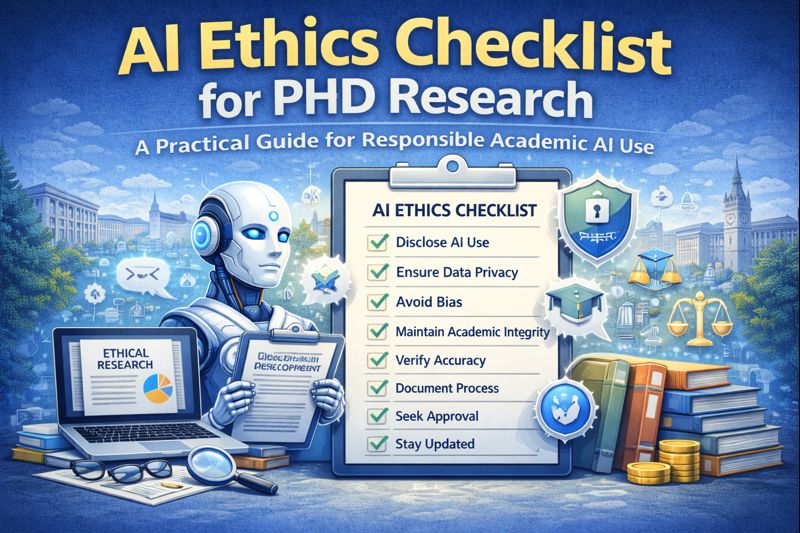
AI Ethics Checklist for PhD Research: A Practical Guide
A complete AI ethics checklist for PhD research. Learn how to use AI tools ethically,…

AI in Research: How Artificial Intelligence Is Transforming Academic Research 2026
AI in Research – Just Think About This… You’re buried under 5,000 research papers. Your…