
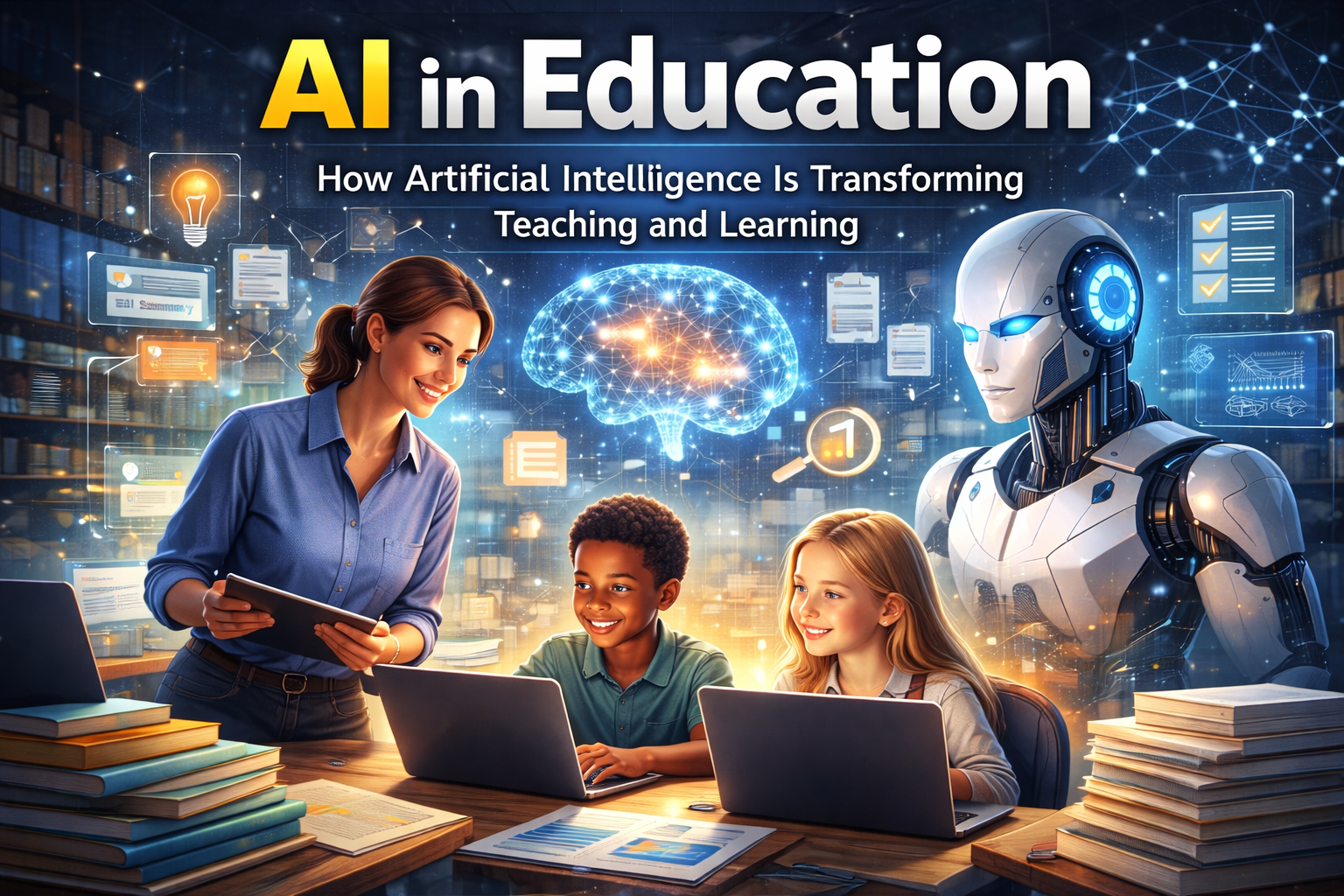
Education is undergoing one of its most important transformations ever.
AI in education is changing how teachers teach and students learn — and it’s happening now, not someday in the future.
From personalized learning paths to automated grading, AI is helping educators become more effective and students more engaged. But what does this really mean for classrooms, and how can schools adopt AI responsibly?
This guide answers that question with clear examples, practical steps, and real-world insights.
What Does “AI in Education” Actually Mean?
AI in education refers to the use of advanced artificial intelligence technologies to support, improve, and personalize teaching and learning processes. This includes tools that can
- tailor lessons to individual students,
- provide instant feedback,
- assist classroom management,
- and automate administrative tasks.
AI doesn’t replace human educators. Instead, it enhances human teaching by doing what computers do best:
analyzing data fast, detecting patterns, and providing real-time responses.
Why AI in Teaching Is Becoming Essential
Teachers today face real and growing challenges:
- Larger class sizes
- Diverse learning needs
- Limited planning time
- Increased administrative work
AI in education helps solve these by reducing workload and improving instructional quality. For example, adaptive learning platforms provide individualized content that adjusts to each student’s pace, helping those who struggle without holding back those who excel.
According to recent research, personalized learning driven by AI can improve student engagement and retention by meeting learners where they are rather than forcing them into a one-size-fits-all model. (Source: UNESCO)
Real Benefits of AI in Education
1. Personalized Learning for Every Student
One of the biggest advantages of AI in education is personalization. Teachers can use AI tools to create learning experiences that adapt in real time to student performance. Students no longer have to wait for feedback — AI systems help them improve instantly.
Education Week reports that adaptive learning platforms are helping struggling students catch up and advanced learners go further. (Source: Education Week)
2. Smarter Assessment and Feedback
Traditionally, grading and feedback take hours. AI tools can analyze assignments, provide detailed explanations, and free teachers to focus on higher-order instruction.
Studies have found that automated feedback systems improve clarity and student revision efforts. (Source: Brookings Institution)
3. Less Administrative Burden
Tasks like attendance, scheduling, and data reporting can be automated. This gives teachers more time for lesson planning and student mentoring.
A 2023 OECD report shows teachers spend up to 40% of their time on administrative work — time that could be redirected with AI tools. (Source: OECD)
4. More Inclusive, Accessible Classrooms
AI supports multiple learning needs with features like:
- Text-to-speech and speech-to-text tools
- Language translation
- Assistive technologies for special education
These make learning more accessible, helping students with disabilities or language challenges succeed.
Practical Examples of AI in Education
Adaptive Learning Platforms
Tools like AI-powered learning systems analyze student responses and suggest tailored exercises — a practical way of applying AI in education for daily learning.
Intelligent Tutoring Systems
AI tutors work one-on-one with students, providing guidance similar to human tutors but at scale.
AI-Assisted Lesson Planning
Teachers can generate lesson outlines and classroom activities based on student data, saving time and improving relevance.
Challenges and Ethical Considerations
While the promise of AI in education is real, it comes with responsibilities.
Data Privacy
Student information needs strong protection. Schools must follow strict guidelines on how data is collected, stored, and used.
Bias and Fairness
AI systems can reflect biased data if not trained carefully. Teachers must monitor outputs and ensure fairness in recommendations.
Professional Training
Teachers need training to use AI tools effectively. Without proper support, technology can become a burden rather than a benefit.
Organizations like UNESCO and the U.S. Department of Education are already publishing frameworks for ethical AI use in classrooms. (Sources: UNESCO, U.S. DOE)
How Teachers Can Start Using AI in Education (Step-by-Step)
You don’t need a tech degree to begin.
Step 1: Pick One Use Case
Start with a small task — like feedback on assignments or quiz generation.
Step 2: Try AI Tools That Focus on Teaching
Choose tools designed for educators, not just generic AI.
Step 3: Explain AI Use to Students
Transparency builds trust and helps students understand how AI supports learning.
Step 4: Review AI Feedback Manually
AI helps, but human judgment ensures quality and fairness.
The Future of AI in Teaching and Learning
The role of AI in education is not to replace teachers but to empower them. With better tools and thoughtful implementation, classrooms can become more adaptive, more inclusive, and more efficient.
Imagine a future where every student gets the support they need — and every teacher has time to do what they love most: inspire, mentor, and teach.
FAQ : AI in Education
What is AI in education?
AI in education refers to artificial intelligence technologies used to improve teaching, learning, and academic management.
Will AI replace teachers?
No. AI supports teachers by automating routine tasks and providing insights, but human educators are essential for mentoring, creativity, and social-emotional support.
Is AI safe to use in classrooms?
Yes, when proper data privacy and ethical guidelines are followed. Schools should ensure transparency and secure handling of student data.
Can AI improve student outcomes?
Yes. Research shows that personalized learning and timely feedback through AI can improve engagement and understanding.
Do teachers need technical skills for AI?
No. Many AI education tools are designed for ease of use and require no coding or advanced technical skill
Reference
- Education Week – Personalized Learning & AI
https://www.edweek.org/technology - Brookings Institution – AI in Assessment
https://www.brookings.edu/research - U.S. Department of Education – AI Ethics
https://www.ed.gov
- Academic Writing
- AI Ethics & Future
- AI in Academic Research
- AI in Business & Marketing
- AI in Content Creation
- AI in Design & Development
- AI in Education/Teaching
- AI in Research
- AI Tools & Review
- Indian Laws
- Motivation
- SEO & Digital Marketing
- Writing & Content Creation
7 Ways AI Is Revolutionizing Data Analysis in Academic Research
AI is revolutionizing data analysis in academic research by automating data cleaning, accelerating statistical analysis,…
AI Ethics Checklist for PhD Research: A Practical Guide
A complete AI ethics checklist for PhD research. Learn how to use AI tools ethically,…

AI in Research: How Artificial Intelligence Is Transforming Academic Research 2026
AI in Research – Just Think About This… You’re buried under 5,000 research papers. Your…
AI Tools & Reviews: Complete Guide for Smart Business Decisions (2026)
Best 10 AI Literature Review Tools for 2026: Save Hours on Research
Ever stared at a mountain of 500+ research papers, wondering where to even start? You’re…
Best AI Tools Every Researcher Must Know in 2026
Just Think About This…A professor pulled me aside last week. “I need to buy AI…
Top 10 Free AI Tools for PhD Students in 2026
Top 10 Free AI Tools for PhD Students in 2026 – A Step-by-Step Guide to…