
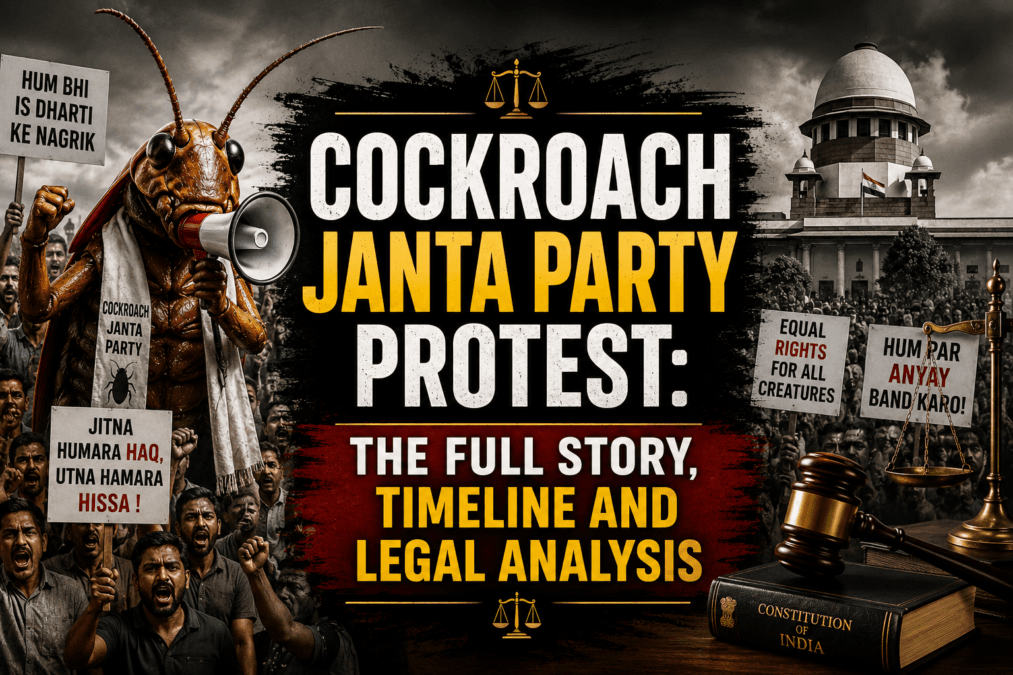
Cockroach Janta Party Protest: The Full Story, Timeline and Legal Analysis
Dr. Rekha Khandelwal Legal Researcher Published and updated: 25 July 2026
For more than a month, thousands of young Indians have camped at Jantar Mantar in New Delhi under a banner nobody expected: the “Cockroach Janta Party.” What began as an angry joke about a judge’s remark has grown into something bigger — several international outlets now rank it among the most sustained challenges to Prime Minister Narendra Modi’s government in years, evolving from a satirical protest into a nationwide challenge to the government.
Tear gas, baton charges, a 26-day hunger strike by veteran activist Sonam Wangchuk, and a government deadline that falls on the very day this article is being read — this is the story of the Cockroach Janta Party protest, and what Indian law actually says about it.
Key Takeaways
- Started after Chief Justice of India Surya Kant’s “cockroaches” remark on 15 May 2026.
- CJP is a satirical protest movement, not a registered political party.
- Main demand: resignation of Union Education Minister Dharmendra Pradhan over the NEET-UG paper leak.
- Sonam Wangchuk led a 26-day hunger strike, ending 23 July 2026.
- A 20 July march to Parliament turned violent; nearly 180 people were injured and six FIRs were filed.
- The government has opened talks and announced fast-track courts, but has not yet decided on the resignation demand.
- Legal issues in play: Article 19 (speech and assembly), the Bharatiya Nyaya Sanhita, and a pending Delhi High Court PIL on protester surveillance.
What Is the Cockroach Janta Party Protest?
The protest traces back to a Supreme Court hearing on 15 May 2026. During a contempt hearing about senior-advocate designations, Chief Justice of India Surya Kant criticised individuals he called “parasites” attacking the system, and went on to compare unemployed young people turning to social media and RTI activism to cockroaches.
A day later, the CJI issued a clarification saying a section of the media had misquoted him — a detail that itself fed the controversy, since protesters felt it didn’t fully retract the comparison. The following day, digital communications strategist Abhijeet Dipke, who had previously worked with the Aam Aadmi Party, launched a satirical “platform for all the cockroaches out there” on X. The Cockroach Janta Party (CJP) was born.
The first physical demonstration followed on 6 June 2026 at Jantar Mantar, New Delhi’s officially designated protest site (see our complete guide to protest law in India for how that designation works). Student organisations — the Students’ Federation of India (SFI), the All India Students Association (AISA), and the All India Students Federation (AISF) — joined the sit-in through June.
The core grievance is the 2026 NEET-UG (medical entrance exam) paper leak and alleged irregularities in CBSE’s on-screen marking process, alongside broader demands for exam-system reform. Organisers say more than 20 students died by suicide over these exam failures — an attributed claim from one outlet (Common Dreams), not independently confirmed by any official body.
Before Wangchuk’s hunger strike began, Education Minister Dharmendra Pradhan directly described the CJP as “the B-team of terrorists”. Some outlets translate the same remark as the “B-team of disruptive elements,” so minor wording varies even though the substance is corroborated.
On 28 June 2026, Ladakh-based activist Sonam Wangchuk joined and began an indefinite hunger strike, bringing the movement national and international attention.
Latest Updates (as of 25 July 2026)
- Government: Has moved from silence to active negotiation. Modi’s announcement of fast-track courts and new anti-paper-leak legislation is the government’s most concrete offer so far; CJP says it doesn’t meet their core demand.
- Police: Maintain that force on 20 July was used only to disperse a march that breached Parliament’s security cordon, and deny allegations of excessive force, including a pellet-gun claim. Al Jazeera reports no footage has surfaced of protester-initiated violence during the march itself, though police separately allege stone-pelting near Connaught Place — the basis for one of the six FIRs filed.
- Courts: A Public Interest Litigation (PIL), reportedly filed by former student-union president Aishe Ghosh, alleges Delhi Police installed a facial-recognition surveillance tower at Jantar Mantar. The Delhi High Court has reportedly admitted the matter for hearing. This detail comes from a single outlet in our research and should be independently confirmed.
- Politics: Congress and other opposition parties have criticised the police response; Rahul Gandhi’s detention and his public presentation of an allegedly injured protester (Sheikh Irshad Mansuri) became a flashpoint. The government has defended the police action while simultaneously opening talks — a dual-track response The Week describes as an unusual shift after the ruling party initially “took the movement lightly.”
- Reach: The protest has spread beyond Delhi to Mumbai, Hyderabad, Bengaluru and Ahmedabad, and remains one of the most-discussed topics on X, Instagram and YouTube, with Wangchuk’s own fast-ending post going viral.
Complete Timeline
| Date | Event |
| 15 May 2026 | CJI Surya Kant’s “cockroaches” remark during a Supreme Court hearing sparks outrage among students. |
| 16 May 2026 | Abhijeet Dipke launches the Cockroach Janta Party online as a satirical movement. |
| 6 June 2026 | First physical protest at Jantar Mantar, New Delhi. |
| 28 June 2026 | Sonam Wangchuk joins and begins an indefinite hunger strike. |
| 18–19 July 2026 | Wangchuk, roughly 20–26 days into his fast (day count varies by report), is taken to hospital. NPR and AP describe protesters as being “forcibly taken” by police, linked to a Delhi High Court dispute over his medical custody. Dipke begins his own hunger strike in solidarity. |
| 20 July 2026 | The “Sansad Chalo” march draws over 10,000 protesters toward Parliament. Police use tear gas and batons. Nearly 180 people are injured (118 security personnel, 60 protesters per Delhi Police; Al Jazeera cites Dipke’s figure of ~150 wounded protesters). 70 people are detained. |
| 21 July 2026 | CJP halts further street marches but continues the Jantar Mantar sit-in. Rahul Gandhi is detained near the PM’s residence; opposition MPs later protest inside Parliament. |
| 22 July 2026 | Delhi Police confirm six FIRs over the 20 July violence, invoking the Bharatiya Nyaya Sanhita, the Arms Act, and the Prevention of Damage to Public Property Act, while probing a possible “larger criminal conspiracy.” |
| 23 July 2026 | Wangchuk ends his fast after 26 days (not the 20–21 first estimated), in the presence of Union Ministers J.P. Nadda and Jitendra Singh. Dipke reportedly ends his own fast at Wangchuk’s request. CJP spokespersons hold a first round of talks with the government. |
| 24 July 2026 | Modi makes his first public comments since May: defends letting ~2 million students retake the exam, announces fast-track courts and new anti-leak legislation. A second round of talks is held; government asks for time until 25 July afternoon on the resignation demand, which CJP calls “non-negotiable.” Protests spread to Mumbai, Hyderabad, Bengaluru, Ahmedabad. |
| 25 July 2026 (today) | The government’s self-set deadline falls this afternoon. CJP reports no final decision yet, though an “in-principle” agreement on compensation and legal matters from Friday’s talks. Delhi Metro shuts 18 central stations; Delhi liquor shops close two hours early over the weekend. |
Who Is Involved?
- Abhijeet Dipke — CJP founder, its main organiser and public face.
- Sonam Wangchuk — joined later; his hunger strike became, in TIME’s words, the emotional centre of the protest.
- Saurav Das and Ashutosh Ranka — CJP’s national spokespersons, leading the government negotiations.
- SFI, AISA, AISF — allied student organisations, alongside independent students, professionals and families.
- Dharmendra Pradhan — Union Education Minister, whose resignation is the protest’s central, non-negotiable demand.
Why Is It Called the Cockroach Janta Party?
The name is not official government or Election Commission terminology — it’s a self-chosen, satirical brand that reworks the ruling Bharatiya Janata Party’s (“Indian People’s Party”) name into “Cockroach Janta Party” (“Cockroach People’s Party”), turning the CJI’s dismissive remark into a badge of identity. Dipke’s original call for members set eligibility as being “unemployed, lazy, chronically online, and able to rant professionally” — a deliberately self-mocking tone that stuck.
Important clarification: The CJP is not a registered political party. Its Election Commission of India (ECI) status is “Not Registered,” corroborated across multiple independent reports. This matters legally: under Section 29A of the Representation of the People Act, 1951, any body wishing to function as a political party must apply to the ECI within 30 days of formation, with a formal constitution and a declaration of allegiance to the Constitution, socialism, secularism and democracy. No report reviewed here indicates CJP has filed such an application — it functions purely as a protest movement and pressure group, not an election contestant.
Legal Analysis (India)
This section explains the law in simple terms. It is educational information, not legal advice.
The Constitutional Foundation
Article 19(1)(a) guarantees free speech and expression, including criticising the government or demanding a minister’s resignation. Article 19(1)(b) guarantees the right to assemble peaceably and without arms — the direct legal basis for a sit-in like Jantar Mantar’s. Article 21 guarantees the right to life and personal liberty, relevant here to how police handle a protester’s health, custody, or bodily safety.
These rights aren’t absolute, and the two restriction clauses differ in scope. Article 19(2) allows restrictions on speech for a wider set of reasons: sovereignty and integrity of India, security of the State, friendly relations with foreign States, public order, decency or morality, contempt of court, defamation, or incitement to an offence. Article 19(3) restricts assembly on narrower grounds — only sovereignty/integrity of India and public order. “Public order” is the ground most relevant to a street protest, and it’s the constitutional basis for prohibitory orders, barricading, and dispersal of a crowd that turns violent.
What Law Has Actually Been Invoked Here
Based on police sources reported by PTI, the six FIRs filed after the 20 July march invoke the Bharatiya Nyaya Sanhita (BNS), 2023 — India’s replacement for the old IPC, in force since mid-2024 (see our BNS vs IPC comparison). Reported sections include Section 223(b) (disobedience of a lawful order), Section 221 (obstructing a public servant), Section 132 (assault to deter a public servant), Section 121(1) (unlawful assembly), and Sections 189–192 (rioting and offences arising from unlawful assembly).
Provisions of the Arms Act and the Prevention of Damage to Public Property Act, 1984 were also invoked over alleged stone-pelting near Connaught Place. The Bharatiya Nagarik Suraksha Sanhita (BNSS), 2023 governs how police regulate public gatherings generally, though no source confirms a specific prohibitory order at Jantar Mantar itself; the site remains an active protest camp as of 25 July.
No arrests of CJP’s central leadership (Dipke, Das, or Ranka) have been reported as of this writing.
What the Courts Have Said
The Supreme Court has repeatedly held that peaceful protest is essential to a functioning democracy. Commentators have also drawn a parallel to the Court’s Shaheen Bagh-era ruling (Amit Sahni v. Commissioner of Police, 2020), which held that indefinite occupation of public space can unreasonably infringe on other citizens’ rights, and that authorities may regulate a protest’s time, place and manner.
The live Delhi High Court matter over the alleged surveillance tower is a fresh, unresolved test of how far police monitoring of protesters can go under Article 21’s privacy protections; the court has admitted the matter but hasn’t ruled on its merits.
Rights of Protesters in India
Understanding the right to protest in India starts from the Constitution, not any single event. Protest law in India draws a clear line between a peaceful, lawful demonstration and one that turns unlawful — and this case sits squarely on that line.
- No special “permission” is generally needed to protest at Jantar Mantar, a designated protest site, though organisers typically give advance intimation to police for coordination.
- Police can disperse an assembly that turns violent, blocks emergency routes, or continues after being declared unlawful — but force is expected to be proportionate, and disproportionate-force allegations (like the pellet-gun claim here) are themselves subject to legal challenge.
- Damage to property during a protest can attract criminal liability under the BNS and the Prevention of Damage to Public Property Act, separate from liability for unlawful assembly itself.
- Peaceful protest, including calling for a minister’s resignation, is constitutionally protected and not, by itself, a criminal offence.
Government and Political Response
The Union Government stayed largely silent through June and much of July even as the protest grew. That changed over 23–24 July: two rounds of talks were held between CJP spokespersons and Union Ministers J.P. Nadda and Jitendra Singh, and Modi issued his first public video statement, announcing fast-track courts and draft anti-paper-leak legislation. As of its self-set deadline (25 July afternoon), the government has not confirmed or denied Pradhan’s resignation.
Political reactions have split along expected lines. The ruling BJP was initially dismissive — Pradhan directly called CJP “the B-team of terrorists” before Wangchuk’s fast began, per corroborated reporting — but has since moved to direct negotiation. Pradhan’s first detailed public response, on 21 July, attacked the Congress party for “exploiting students” without any sign of resigning. Congress and other opposition parties have criticised the police crackdown, with Rahul Gandhi amplifying injury allegations and some opposition MPs staging a solidarity protest inside Parliament. Several international outlets, including France 24 and CNN as cited by Wikipedia’s tracking of the story, have called this among the largest anti-government demonstrations in India in recent years.
From Meme to Courtroom: How the Cockroach Janta Party Became India’s Latest Free Speech Battle
Fact Check: Viral Claims vs Verified Facts
| Claim | Status | Why |
| “Cockroach Janta Party is a registered political party.” | False | Its ECI status is “Not Registered.” It is a satirical protest movement. |
| “The protest is only about NEET.” | Misleading | NEET-UG’s paper leak is central, but CBSE on-screen marking issues and broader reform are also named demands. |
| “The government has agreed to remove Dharmendra Pradhan.” | Unverified as of 25 July | Talks and a same-day deadline are confirmed; no resignation decision had been reported at the time of writing. |
| “Wangchuk fasted for about three weeks before hospitalisation.” | Superseded | Early reports estimated 20–21 days; his fast, which continued afterward, is now confirmed at 26 days total before he broke it on 23 July. |
| “Police used pellet guns on protesters.” | Disputed | Alleged by disability-rights groups and Rahul Gandhi; Delhi Police explicitly deny it. |
| “No protester violence occurred on 20 July.” | Disputed | No footage of protester-initiated violence has surfaced from the march itself, but separate FIRs allege stone-pelting near Connaught Place the same day. |
Frequently Asked Questions
1. What is the Cockroach Janta Party (CJP)?
A youth-led, satirical protest movement founded by Abhijeet Dipke on 16 May 2026 — not a registered political party.
2. Why is it called the “Cockroach” protest?
It reclaims a dismissive remark by CJI Surya Kant, who compared unemployed young people to “cockroaches,” and plays on the ruling BJP’s name.
3. Where is the protest happening?
Primarily at Jantar Mantar, New Delhi, with sit-ins also spreading to Mumbai, Hyderabad, Bengaluru and Ahmedabad.
4. What do the protesters want?
Chiefly, Dharmendra Pradhan’s resignation, plus accountability for the NEET-UG paper leak and CBSE on-screen marking irregularities, and long-term exam-system reform.
5. Who is Sonam Wangchuk?
A Ladakh-based education and climate activist known for earlier Ladakh statehood campaigns. He joined on 28 June 2026 and fasted for 26 days, ending 23 July.
6. Was Wangchuk hospitalised by force?
Multiple outlets describe police as having “forcibly” taken him to hospital, linked to a Delhi High Court matter over his medical custody. Exact procedural details haven’t been independently verified here.
7. What happened during the “Sansad Chalo” march?
On 20 July, over 10,000 protesters tried to march toward Parliament; police used tear gas and batons. Nearly 180 injuries and 70 detentions were reported.
8. Have any FIRs been filed?
Yes — six, by 22 July, under the Bharatiya Nyaya Sanhita, the Arms Act, and the Prevention of Damage to Public Property Act.
9. Has any CJP leader been arrested?
No, as of 25 July 2026. The FIRs currently target unidentified persons.
10. Has the government responded?
Yes — after weeks of silence, Modi spoke publicly on 24 July, announcing fast-track courts and new legislation, and ministers held two rounds of talks with CJP.
12. Is the protest legal under Indian law?
Yes — peaceful assembly and free expression are protected under Articles 19(1)(a) and 19(1)(b), subject to reasonable restrictions under Articles 19(2) and 19(3).
Conclusion
The Cockroach Janta Party protest began as a satirical response to a judge’s offhand remark. Within about ten weeks, it has become one of the largest and most sustained protest movements against the Modi government in recent years.
Its core demand — Pradhan’s resignation — remains unmet as of this writing, even as the government has opened talks, announced legislative measures, and set itself a same-day deadline to respond. Serious, unresolved disputes remain over Wangchuk’s hospitalisation, allegations of disproportionate police force, and ongoing surveillance at the protest site, now the subject of active litigation.
Both sides have real legal standing: citizens have a constitutional right to peaceful assembly and dissent, and the State has the power to impose reasonable, narrowly-tailored restrictions to preserve public order. Treat any resolution of today’s deadline, and further developments, as requiring verification against live news sources.
About the Author
Dr. Rekha Khandelwal, PhD (Law) is a legal researcher, academic writer and the founder of AspirixWriters.
Sources
- NPR — “India’s youth-led Cockroach movement vows to continue protest after police crackdown” (21 July 2026) — https://www.npr.org/2026/07/21/g-s1-134722/indias-youth-led-cockroach-movement-vows-to-continue-protest-after-police-crackdown
- Al Jazeera — “India’s ‘cockroach’ protest movement halts marches after police violence” (21 July 2026) — https://www.aljazeera.com/news/2026/7/21/indias-cockroach-protest-movement-halts-marches-after-police-violence
- Al Jazeera — “India’s ‘Cockroach’ leaders hold talks with gov’t as protests continue” (24 July 2026) — https://www.aljazeera.com/news/2026/7/24/indias-cockroach-leaders-hold-talks-with-govt-as-protests-continue
- TIME — “What Is the Youth-Led ‘Cockroach Movement’ Staging Mass Protests in India?” (22 July 2026) — https://time.com/article/2026/07/22/india-cockroach-janta-party-protest-movement/
- AP via KPBS — “Indian activist Wangchuk ends 26-day hunger strike as ‘Cockroach’ protesters vow to press on” (23 July 2026) — https://www.kpbs.org/news/international/2026/07/23/indian-activist-wangchuk-ends-26-day-hunger-strike-as-cockroach-protesters-vow-to-press-on
- NBC News — “‘Cockroach’ protests spread across India as leading activist ends hunger strike” (24 July 2026) — https://www.nbcnews.com/world/asia/india-cockroach-protests-modi-exam-leaks-new-dehli-cjp-hunger-strike-rcna589017
- The Wire — “Responding to Protests Centring on Him, Pradhan Attacks Congress, Gives No Sign of Resignation” (22 July 2026) — https://m.thewire.in/article/politics/pradhan-first-response-weeks-protests-attacks-congress-no-sign-resignation
- The Week — “Will Dharmendra Pradhan be forced to resign? Inside the second CJP-Centre meeting” (24 July 2026) — https://www.theweek.in/news/india/2026/07/24/will-dharmendra-pradhan-be-forced-to-resign-inside-the-second-cjp-centre-meeting.html
- Zee News — “Former AAP leader’s Cockroach Janta Party makes a wave but can it get registered? Check ECI rule” (22 May 2026) — https://zeenews.india.com/india/former-aap-leaders-cockroach-janta-party-makes-a-wave-but-can-it-get-registered-check-eci-rule-3049507.html
- Wikipedia — “2026 Delhi Jantar Mantar protests” (continuously updated) — https://en.wikipedia.org/wiki/2026_Delhi_Jantar_Mantar_protests
Recommended
- What is Article 19? A Simple Guide to the Right to Protest in India
- NEET Exam Controversies Explained, in Plain Language
- BNS vs the Old IPC: What Changed for Protest-Related Offences
- Understanding PILs: How Ordinary Citizens Move the High Courts
- Student Protests vs Police Powers: What Indian Law Actually Says
Educational purposes disclaimer: This article is for general informational and educational purposes only and does not constitute legal advice. Facts about this ongoing, developing news story may change after publication; readers should verify current developments against live, authoritative news sources before relying on any specific claim herein.