
Last Updated: April 15, 2026
AI Ethics and Future: Complete Guide to Responsible AI in 2026
🔍 ON-PAGE SEO PACKAGE
SEO Title: AI Ethics and Future: Complete Guide to Responsible AI in 2026 (India + Global) Meta Description: A comprehensive guide to AI ethics in 2026 — bias, fairness, explainability, privacy, and responsible AI frameworks for researchers, developers, and policy analysts. URL Slug: /ai-ethics-future-complete-guide-responsible-ai-2026
⚠️ Disclaimer: This content is for educational and informational purposes only. It is based on publicly available research, policy documents, and academic literature. It does not constitute legal, technical, or professional advice.
🎯 Keyword Strategy (Low-Competition, High-Intent)
| Keyword | Volume (Approx.) | Difficulty | Type |
|---|---|---|---|
| fundamental principles of AI ethics frameworks 2026 | 200–400 | Low | Focus Keyword |
| ethical concerns in AI healthcare bias mitigation 2026 | 150–300 | Very Low | Primary Long-Tail |
| AI black box problem explainable solutions researchers | 200–400 | Low | Primary Long-Tail |
| bias discrimination AI training data fairness audits | 150–300 | Low | Secondary Long-Tail |
| privacy violations AI personal data consent models | 150–300 | Very Low | Secondary Long-Tail |
| responsible AI frameworks India 2026 | 100–250 | Very Low | Supporting Long-Tail |
| AI explainability XAI tools for researchers | 100–200 | Very Low | Supporting Long-Tail |
Table of Contents
- Why AI Ethics Can No Longer Be an Afterthought
- What Are Ethical Concerns in AI? (Simple Explanation)
- AI Bias and Fairness — From Healthcare to Society
- The AI Black Box Problem Explained
- Privacy, Data Protection, and the Consent Challenge
- AI Ethics Frameworks in 2026 — What They Say and What They Mean
- Responsible AI in India — Emerging Policies and Trends
- Practical Solutions for Building Ethical AI
- The Future of AI Ethics (2026–2030)
- ✅ Ethical AI Implementation Checklist
- ❓ FAQs
- Final Thoughts + Cluster Links
Why AI Ethics Can No Longer Be an Afterthought
We are living through a period in which AI systems are making decisions that affect people’s access to healthcare, employment, credit, education, and justice — often at scale, often automatically, and often without meaningful human review.
When an algorithm determines whether a loan application is approved, when a predictive model influences a patient’s treatment pathway, when a content recommendation system shapes what millions of people see and believe — these are not purely technical decisions. They are decisions with ethical weight. And the systems making them embed the values, assumptions, and blind spots of the people and data that built them.
The fundamental principles of AI ethics frameworks in 2026 reflect a growing global consensus: AI development cannot be separated from its social consequences. Bias, transparency, privacy, accountability, and human oversight are not optional features to be added later — they are foundational requirements for AI that functions fairly and sustainably.
This guide explains each of these concerns clearly, examines how they manifest in real-world contexts, surveys the frameworks being built to address them, and offers practical steps for researchers, developers, and organisations who want to build AI responsibly.
The ethical concerns in AI — from healthcare bias mitigation to the AI black box problem — are not abstract philosophical debates. They are practical challenges with real consequences for real people. Understanding them is the starting point for addressing them.
What Are Ethical Concerns in AI? (Simple Explanation)
AI ethics is the field concerned with ensuring that artificial intelligence systems are developed and used in ways that are fair, transparent, accountable, and respectful of human dignity and rights.
The core ethical concerns in AI can be grouped under five categories:
1. Bias and Discrimination AI systems trained on historical data can perpetuate and amplify existing social inequalities. When a hiring algorithm trained on past hiring decisions reflects historical preferences for certain demographic groups, it encodes discrimination into an automated process — often invisibly.
2. Lack of Transparency (The Black Box Problem) Many advanced AI systems — particularly deep learning models — cannot explain how they arrive at a decision. When a patient is denied coverage or a job application is rejected, the inability to understand the AI’s reasoning raises fundamental questions about accountability and the right to challenge automated decisions.
3. Privacy Violations AI systems frequently require large volumes of personal data to function. The collection, storage, processing, and use of this data creates significant privacy risks — particularly when data is repurposed beyond its original consent scope or when sensitive inferences (health status, political views, emotional state) are drawn from non-sensitive inputs.
4. Accountability Gaps When an AI system causes harm, who is responsible? The developer? The deployer? The organisation that provided the training data? Current legal and organisational frameworks often lack clear answers — creating accountability vacuums that make harm remediation difficult.
5. Safety and Control As AI systems become more capable and more autonomous, ensuring that humans maintain meaningful oversight and the ability to intervene becomes increasingly important and increasingly challenging.
📸 Visual Suggestion: A flow diagram showing “AI Decision → Embedded Bias → Discriminatory Outcome → Affected Individual” — a simple linear flow that makes the harm pathway immediately visible to non-technical readers.
AI Bias and Fairness — From Healthcare to Society
Bias in AI is not a rare edge case. Based on current research across multiple domains, it is a pervasive characteristic of AI systems trained on real-world data — because real-world data reflects real-world inequalities.
How Bias Enters AI Systems
Training data bias: If historical data reflects discriminatory patterns — loan approvals more common for certain groups, diagnostic outcomes different across demographics — a model trained on that data will reproduce those patterns.
Measurement bias: When the variables used to represent a concept are imperfect proxies that work differently across groups. Using zip code as a proxy for creditworthiness, for example, encodes geographic patterns that correlate strongly with race and socioeconomic status.
Feedback loop bias: When a biased AI system influences the data used to retrain it — reinforcing the original bias with each iteration.
Bias in Healthcare AI — Illustrative Concerns
The following examples are illustrative, based on patterns reported in academic research. They are not specific real-world incidents.
Diagnostic AI trained predominantly on data from one demographic group may perform less accurately for patients from underrepresented groups — potentially leading to lower diagnostic confidence precisely for those who already face healthcare access disparities.
Risk stratification algorithms used in health systems have in some documented research cases used healthcare cost as a proxy for health need — inadvertently disadvantaging groups who have historically received less healthcare despite having equivalent or greater needs.
Skin condition diagnostic AI trained primarily on lighter skin tones has shown lower accuracy for darker skin tones in multiple published research studies — a direct consequence of non-representative training data.
Bias and Discrimination in AI Training Data — Fairness Audits
Addressing bias and discrimination in AI training data requires systematic processes, not just good intentions. Fairness audits have emerged as a practical mechanism:
A fairness audit evaluates an AI system’s outputs across demographic groups to identify performance disparities. It asks: does the system produce meaningfully different error rates, false positive rates, or false negative rates across gender, race, age, or other relevant characteristics?
Tools used in fairness auditing include:
- IBM AI Fairness 360 — open-source toolkit for detecting and mitigating bias
- Google’s What-If Tool — visual interface for exploring model behaviour across data subsets
- Microsoft Fairlearn — Python library for fairness assessment and mitigation
Bias auditing is necessary but not sufficient. Identifying a disparity requires also understanding whether it reflects a genuine difference in the underlying phenomenon being measured, or an artefact of how the system was built — and only the latter is a bias problem requiring correction.
📸 Screenshot Suggestion: A comparison table showing AI outcomes — loan approval rates, diagnostic accuracy rates, or hiring recommendation rates — split across demographic groups before and after bias mitigation. Clearly labelled as illustrative. Purpose: makes the concept of fairness disparity immediately concrete and measurable.
The AI Black Box Problem Explained
When an AI system makes a decision, can you explain why?
For many of the most powerful AI systems in use today — deep neural networks, large language models, complex ensemble models — the honest answer is: not in a way most humans would find meaningful. The computation involves billions of weighted parameters interacting in ways that produce an output without a human-readable reasoning chain.
This is the AI black box problem: the inability to explain, in understandable terms, how an AI system arrived at a specific output.
Why Explainability Matters
For the person affected: The right to understand why a consequential decision was made about you — and the ability to challenge it — is a fundamental principle of fair treatment. An automated refusal of a loan or visa application without explanation may violate both legal rights and basic fairness.
For developers and researchers: Understanding why a model makes errors is essential for improving it. A model whose reasoning is opaque is a model whose failure modes are unpredictable.
For regulators: The EU AI Act specifically requires high-risk AI systems to be designed with human oversight in mind and to provide sufficient transparency for deployers to understand and monitor the system’s behaviour. Inexplicable black-box systems are structurally incompatible with this requirement.
Explainable AI (XAI) — The Research Response
Explainable AI (XAI) is a field of research and practice focused on making AI decision-making interpretable to humans. Several approaches have emerged:
LIME (Local Interpretable Model-Agnostic Explanations): Explains individual predictions by creating a simpler, interpretable model that approximates the complex model’s behaviour in the local neighbourhood of a specific input.
SHAP (SHapley Additive exPlanations): Uses game theory to assign each input feature a contribution value for a specific prediction — showing which features most influenced the outcome and in which direction.
Attention mechanisms visualisation: In transformer-based models, visualising which parts of the input the model “attended to” most provides a limited but useful window into its reasoning.
Concept-based explanations (TCAV): Tests how sensitive a model’s predictions are to high-level human-understandable concepts, rather than individual input features.
📸 Visual Suggestion: A two-panel diagram — left panel: “Black Box AI” (input goes in, output comes out, middle is opaque); right panel: “Explainable AI” (input goes in, feature contributions are visible, output with explanation comes out). Simple, high-contrast, immediately communicates the difference.
Important caveat: XAI tools provide approximations and interpretations of complex models — they do not reveal the complete “true reasoning” of a neural network. Researchers and practitioners should treat XAI outputs as useful diagnostics rather than definitive explanations.
Privacy, Data Protection, and the Consent Challenge
AI systems are hungry for data — and the scale and variety of data they require creates significant privacy challenges that existing consent frameworks were not designed to handle.
The Consent Problem
Traditional data consent models assume a relatively simple relationship: a person is told what data will be collected, for what purpose, and agrees. AI systems complicate this in several ways:
- Data is repurposed beyond its original collection context. Data collected for one purpose is often used to train AI models for completely different purposes — sometimes without users’ knowledge or meaningful consent.
- Sensitive inferences from non-sensitive data. AI systems can infer highly sensitive characteristics — health conditions, political views, emotional state, sexual orientation — from data that appears non-sensitive (browsing patterns, purchase history, typing speed). Consenting to share non-sensitive data does not constitute consenting to the sensitive inferences it enables.
- Aggregation effects. Individual data points that seem harmless when combined can reveal information that most people would consider deeply private. Re-identification of supposedly anonymised data from combined datasets is a well-documented research phenomenon.
GDPR and AI Data Practices
The EU’s General Data Protection Regulation provides the most comprehensive existing legal framework for data protection in AI contexts. Key provisions relevant to AI:
- Lawful basis for processing — AI training on personal data requires a legal basis under GDPR (consent, legitimate interests, contract necessity)
- Purpose limitation — data collected for one purpose cannot be used for a materially different purpose without a new legal basis
- Data minimisation — only data necessary for the stated purpose should be collected and processed
- Right to explanation — where automated decision-making produces legally or similarly significant effects, individuals have the right to meaningful explanation and human review
- Data Protection Impact Assessments (DPIAs) — required for high-risk processing, including many AI applications
Privacy-preserving AI techniques — including federated learning (training on decentralised data without centralising it), differential privacy (adding mathematical noise to protect individual records), and synthetic data generation — are active research areas that address privacy concerns while preserving model utility.
AI Ethics Frameworks in 2026 — What They Say and What They Mean
Multiple international organisations, governments, and corporations have published AI ethics principles and frameworks. While they vary in detail, most converge on five core pillars:
The Five Pillars of AI Ethics (Based on Current Research and Policy)
1. Fairness and Non-Discrimination AI systems should treat individuals and groups equitably and should not produce discriminatory outcomes. This requires active effort — fairness does not emerge automatically from technically neutral processes.
2. Transparency and Explainability AI systems should be understandable to the people affected by them and to those responsible for overseeing them. The level of explanation required should be proportionate to the impact of the decision.
3. Accountability Clear lines of responsibility should exist for AI systems and their outcomes. Developers, deployers, and organisations cannot disclaim responsibility by citing the AI system’s autonomy.
4. Privacy and Data Governance Personal data used in AI systems should be handled with respect for individuals’ rights — collected minimally, used for stated purposes, protected from misuse, and processed with appropriate consent.
5. Human Oversight and Control Humans should maintain meaningful control over AI systems, especially in high-stakes domains. This includes the ability to understand, monitor, intervene in, and if necessary override AI decisions.
Major Frameworks in Brief
| Framework | Organisation | Key Emphasis |
|---|---|---|
| Recommendation on the Ethics of AI | UNESCO | Human rights, sustainability, human dignity |
| Trustworthy AI Guidelines | EU High-Level Expert Group | 7 requirements including human agency, robustness, fairness |
| AI Principles | OECD | Inclusive growth, human-centred values, transparency |
| Responsible AI Standard | Microsoft | Fairness, reliability, privacy, inclusiveness, accountability |
| Model Behavior Policy | Various labs | Safety, honesty, helpfulness balance |
📸 Visual Suggestion: A pentagon infographic showing the five pillars — Fairness, Transparency, Accountability, Privacy, Human Oversight — with a brief descriptor and icon for each. Clean, shareable, suitable as a featured image or Pinterest pin.
Responsible AI in India — Emerging Policies and Trends
India’s engagement with AI ethics is developing rapidly, driven by the scale of AI deployment across the Indian economy and India’s growing role as both an AI producer and a major market for AI-powered services.
Current Policy Landscape
IndiaAI Mission (2024): The Government of India launched the IndiaAI Mission with a significant allocation for computing infrastructure, datasets, and AI applications. The mission includes a focus on “safe and trusted AI” as one of its pillars, acknowledging the importance of ethical frameworks alongside capability building.
Digital Personal Data Protection Act (DPDPA) 2023: India’s data protection legislation creates a legal framework for how personal data can be collected, processed, and used — directly relevant to AI training data practices. The DPDPA establishes consent requirements and data fiduciary responsibilities that AI developers in India must comply with.
NITI Aayog’s Responsible AI Principles: The NITI Aayog published responsible AI principles in 2021 covering safety, equality, privacy, transparency, accountability, protection and reinforcement of positive human values, environmental wellbeing, and rule of law. These principles align closely with international frameworks, positioning India for global AI collaboration.
Alignment with Global Frameworks: India is a signatory to the GPAI (Global Partnership on AI) and participates in international AI governance discussions. Indian AI developers and researchers working for global markets or international collaborators should be familiar with both Indian and international frameworks.
India-Specific Ethical Concerns
Language and representation: With over 22 official languages and hundreds of dialects, AI systems trained primarily on English data perform significantly less well for many Indian language speakers. This creates a representation and fairness gap with direct equity implications for rural and non-English-speaking populations.
Healthcare and agriculture AI at scale: India’s large-scale deployments of AI in healthcare (diagnostic tools in rural clinics) and agriculture (crop prediction, weather modelling) create ethical considerations around accuracy, accountability, and the consequences of errors for populations with limited recourse.
Deepfakes and misinformation: India’s complex political environment and rapidly growing social media penetration create significant risks from AI-generated misinformation — a concern that has drawn increasing policy attention.
Practical Solutions for Building Ethical AI
Understanding AI ethics challenges is the starting point. Building systems that address them requires practical, implementable approaches.
For Developers and Researchers
Diverse and representative training data: Before training any model, assess whether the training data represents the full range of people, contexts, and conditions the system will encounter. Documented gaps require documented mitigation strategies.
Fairness testing throughout the development lifecycle: Don’t audit for bias only at the end. Evaluate model performance across demographic groups at multiple stages of development — data selection, model training, validation, and deployment.
Documentation discipline: Maintain model cards (standardised documentation of a model’s intended use, performance characteristics, and limitations) and datasheets for datasets. These practices build transparency and make it easier to identify and address problems.
Adopt XAI tools proportionate to risk: For high-stakes applications, use explainability tools such as SHAP or LIME to understand and communicate how the model makes decisions. For lower-stakes applications, simpler interpretability may suffice.
Human oversight design: Explicitly design systems so that humans can understand, monitor, and override AI outputs — don’t treat human oversight as an afterthought.
For Organisations
Ethics review processes: Establish a structured process for reviewing AI systems before deployment — analogous to the institutional review boards that govern human subjects research.
Incident monitoring and response: Build systems to detect when AI is producing unexpected or harmful outputs, and establish clear escalation and response procedures.
Stakeholder engagement: Consult the communities most affected by an AI system in its design and evaluation — not only as an ethical obligation but as a practical source of relevant knowledge.
📸 Visual Suggestion: A checklist-style infographic — “Before You Deploy: 8 Questions for Responsible AI” — covering data representativeness, bias testing, explainability, privacy compliance, oversight design, incident monitoring, accountability, and stakeholder consultation.
The Future of AI Ethics (2026–2030)
Several trajectories are reshaping the AI ethics landscape over the next several years. These are based on current research directions and policy trends — not predictions or guarantees.
Regulatory maturation: The EU AI Act is in active implementation. Other jurisdictions — including the United Kingdom, Canada, Brazil, and India — are developing their own AI governance frameworks. The result will be a patchwork of national regulations that AI developers and deployers must navigate simultaneously.
Technical ethics embedding: AI ethics principles are moving from policy documents into technical standards and toolkits. The development of harmonized standards under the EU AI Act, IEEE’s AI ethics standards work, and ISO AI standards all represent efforts to translate ethical principles into engineering practice.
Governance of foundation models and GPAI: The governance of large foundation models — which underlie a growing proportion of AI applications — is emerging as a distinct challenge. How to attribute responsibility when harm arises from a model used by thousands of downstream applications is a question regulators and courts will increasingly grapple with.
AI in democratic processes: The use of AI in political advertising, content curation, and information environments is creating new pressures on democratic institutions. Ethical frameworks specifically addressing AI’s role in public discourse are developing rapidly.
Participatory AI governance: There is growing recognition that AI ethics cannot be determined exclusively by technologists and policymakers. Frameworks for involving affected communities — particularly marginalised groups most at risk of AI-driven harm — in governance decisions are gaining traction in research and policy.
AI and the environment: The energy consumption of large AI models is drawing increasing ethical scrutiny. Environmental sustainability is being incorporated into AI ethics frameworks with greater seriousness.
✅ Ethical AI Implementation Checklist
Use this as a starting-point reference for AI projects. Adapt based on your specific context and consult qualified experts for high-stakes applications.
Data and Fairness:
- [ ] Training data assessed for representativeness across relevant demographic groups
- [ ] Data provenance documented — sources, collection conditions, known limitations
- [ ] GDPR or applicable data protection law compliance confirmed
- [ ] Fairness metrics defined and measured across relevant demographic groups
- [ ] Bias mitigation strategies documented where disparities identified
Transparency and Explainability:
- [ ] Model card or equivalent documentation prepared
- [ ] Explainability approach appropriate to risk level implemented
- [ ] Users informed they are interacting with an AI system (where applicable)
- [ ] Explanation mechanism available for consequential decisions
Accountability and Oversight:
- [ ] Clear owner/responsible party identified for the AI system
- [ ] Human oversight mechanism designed and documented
- [ ] Override and intervention capability built in
- [ ] Ethics review or equivalent process completed before deployment
Privacy and Consent:
- [ ] Data minimisation principle applied
- [ ] Consent mechanism appropriate to the data and use case
- [ ] Data Protection Impact Assessment completed (where applicable)
- [ ] Retention and deletion policies documented
Incident Management:
- [ ] Incident monitoring process established
- [ ] Reporting procedure defined (internal and regulatory, where required)
- [ ] Review schedule set for ongoing ethical evaluation
❓ Frequently Asked Questions
Q1. What are the biggest ethical concerns in AI today? Based on current research and policy, the five most significant concerns are: bias and discrimination (AI systems reflecting and amplifying historical inequalities), lack of transparency (black box decision-making that cannot be explained or challenged), privacy violations (data collection and inference beyond consent), accountability gaps (unclear responsibility when AI causes harm), and insufficient human oversight in high-stakes decisions.
Q2. How can AI bias be reduced in practice? Bias reduction requires action at multiple stages: assembling representative training data, testing model performance across demographic groups throughout development, applying bias mitigation techniques (reweighting, adversarial debiasing, constrained optimisation), conducting independent fairness audits before deployment, and monitoring outcomes after deployment. No single technique eliminates bias — it requires ongoing, systematic attention.
Q3. What is the AI black box problem? The AI black box problem refers to the inability to explain, in human-understandable terms, how a complex AI system arrived at a specific output. This is particularly acute in deep neural networks, where billions of parameters interact in ways that produce a result without a readable reasoning chain. Explainable AI (XAI) research is developing tools — SHAP, LIME, attention visualisation — to address this, though these provide interpretations rather than complete explanations.
Q4. Is AI regulated in India? India has a developing AI regulatory landscape. The Digital Personal Data Protection Act 2023 (DPDPA) provides a data protection framework relevant to AI. The IndiaAI Mission includes responsible AI as a stated priority. NITI Aayog has published responsible AI principles. India participates in international AI governance bodies including GPAI. A comprehensive AI-specific regulatory framework equivalent to the EU AI Act has not yet been enacted, though policy development is active.
Q5. How do AI ethics frameworks translate into practice for researchers? For researchers, AI ethics frameworks translate into practical obligations including: maintaining documentation of datasets and model design decisions, conducting bias and fairness testing, applying data protection requirements (especially GDPR for EU-connected work), designing systems with human oversight capability, and engaging with institutional ethics review processes. The EU AI Act creates formal legal obligations for certain high-risk AI systems, and GPAI model obligations apply to large foundation models.
Final Thoughts
The question is not whether AI will continue to shape healthcare, education, employment, finance, and public life — it will. The question is whether it does so in ways that reflect our stated values: fairness, transparency, accountability, privacy, and human dignity.
The fundamental principles of AI ethics frameworks in 2026 represent hard-won consensus about what those values require in practice. They are neither naive nor purely idealistic — they reflect the accumulated learning from real-world AI deployments that caused real harm, and the regulatory and technical responses those harms prompted.
For researchers, developers, and organisations building AI systems today, ethics is not an optional layer to be added at the end of a project. It is a design requirement — embedded in data choices, model architecture, evaluation methodology, deployment design, and ongoing monitoring.
The good news is that the tools, frameworks, and practices for ethical AI are more developed, more accessible, and more practically implementable in 2026 than they have ever been. The path forward is clear — what it requires is the commitment to follow it.
“Compliance today builds trust tomorrow — and trust is what makes AI systems worth building.”
🔗 Explore Related Articles in This Cluster
- AI Ethics Frameworks 2026 — Deep dive into UNESCO, EU, and OECD principles
- AI Bias in Healthcare India — How bias manifests in medical AI and what to do about it
- AI Black Box Problem Explained — XAI tools and techniques for researchers
- Responsible AI Checklist — Step-by-step implementation guide
- EU AI Act Researcher Guide — Full compliance timeline and documentation requirements
- AI for Small Businesses in India — Practical tools and responsible deployment
Have a question about AI ethics, bias mitigation, or responsible AI practice? Drop it in the comments — every response is read and addressed.
References and Further Reading:
- UNESCO Recommendation on the Ethics of AI (2021): https://www.unesco.org/en/artificial-intelligence/recommendation-ethics
- EU High-Level Expert Group on AI — Ethics Guidelines for Trustworthy AI: https://digital-strategy.ec.europa.eu/en/library/ethics-guidelines-trustworthy-ai
- OECD AI Principles: https://oecd.ai/en/ai-principles
- NITI Aayog — Responsible AI for All: https://www.niti.gov.in/sites/default/files/2021-02/Responsible-AI-22022021.pdf
- IBM AI Fairness 360: https://aif360.mybluemix.net/
- Microsoft Fairlearn: https://fairlearn.org/
- SHAP (SHapley Additive exPlanations): https://shap.readthedocs.io/en/latest/
- India Digital Personal Data Protection Act 2023: https://www.meity.gov.in/writereaddata/files/Digital%20Personal%20Data%20Protection%20Act%202023.pdf
- EU AI Act Official Text: https://eur-lex.europa.eu/legal-content/EN/TXT/?uri=OJ:L_202401689
⚠️ Reminder: This article is educational and based on publicly available information as of 2025–2026. AI ethics policy and regulation evolve rapidly. Refer to official sources and qualified experts for compliance-specific guidance.
Artificial Intelligence is no longer a “future technology.”
It is already deciding who gets a job interview, which loan applications are approved, how diseases are diagnosed, and even what news or posts you see online.
That sounds impressive—but it also raises a challenging question:
Who is responsible when AI makes the wrong decision?
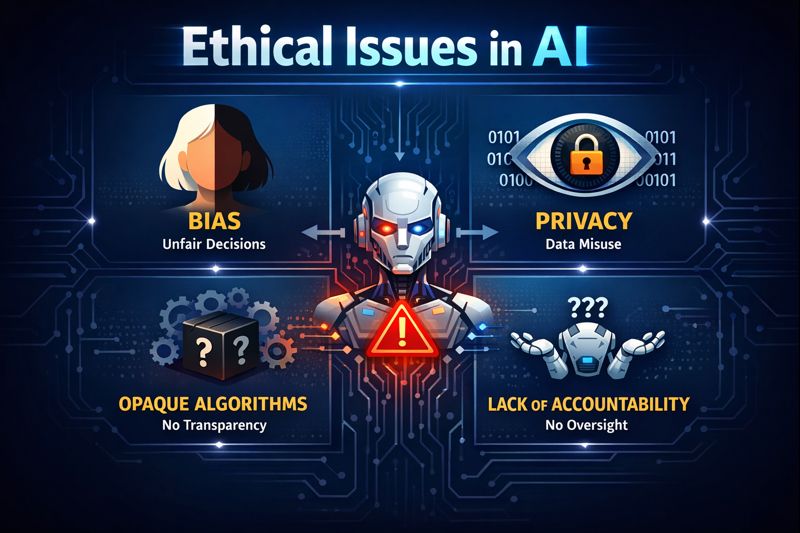
In 2026, this question is no longer theoretical. It affects real people, real businesses, and real lives. Let’s explore the ethical issues in AI in a clear, practical, and easy-to-understand way.
Why Ethical Issues in AI Matter More Than Ever
AI adoption has grown at record speed. By 2024, nearly 78% of companies worldwide were using AI, yet less than half of users trusted AI systems with their personal data.
At the same time:
- AI-related privacy and security incidents increased by over 50% in one year
- Lawsuits involving AI hiring tools reached real courts
- Governments introduced strict AI regulations with heavy penalties
This gap between rapid AI growth and public trust is exactly why AI ethics matters today.
What Are Ethical Issues in AI?
Ethical issues in AI refer to the moral and social problems that arise when artificial intelligence systems impact people’s rights, privacy, fairness, and safety. These issues include bias, lack of transparency, misuse of personal data, weak accountability, and harm caused by automated decisions.
The Five Biggest Ethical Issues in AI
1. Bias and Discrimination: When AI Learns Our Mistakes
AI systems learn from historical data.
The problem? Human history is biased.
If biased data is used to train AI, the system doesn’t fix discrimination—it automates and amplifies it.
Real-world examples:
- AI hiring tools rejecting candidates based on age, gender, or race
- Resume screeners showing near-zero selection rates for certain name groups
- Healthcare algorithms delivering worse outcomes for minority patients
In one major case, a U.S. court ruled that discrimination caused by AI is legally equivalent to discrimination by a human. That ruling changed everything.
Key takeaway: AI can scale inequality faster than humans if ethics are ignored.
2. Privacy Concerns: Your Data, Used Without Clear Consent
AI systems require massive amounts of data to function. Much of this data comes from:
- Online activity
- Public content scraping
- User behavior tracking
Often, people never explicitly agree to their data being used for AI training.
By 2026:
- Over 40% of organizations reported AI-related privacy incidents
- Governments introduced strict rules to limit facial recognition, data scraping, and surveillance AI
- Data protection and AI laws increased four-fold since 2016
Key takeaway: Traditional privacy rules are not enough for AI-driven systems.
3. The Black Box Problem: “Why Did the AI Decide This?”
Many advanced AI models work like a black box:
- They provide decisions
- But cannot clearly explain how they reached them
This becomes dangerous when AI:
- Rejects loan applications
- Screens job candidates
- Assesses criminal risk
- Influences medical decisions
In 2026, regulators now require explainable AI for high-risk applications. People have the right to understand decisions that affect their lives.
Key takeaway: If AI can’t explain itself, it shouldn’t decide your future.
4. Accountability Gaps: Who Is Responsible When AI Fails?
When an AI system causes harm, responsibility becomes blurry:
- Is it the developer?
- The company using the AI?
- The data provider?
- The algorithm itself?
Traditional governance models fail because AI systems constantly change and learn.
Leading organizations now use:
- Continuous monitoring
- Human oversight
- Real-time ethical risk assessment
This approach is called adaptive AI governance.
Key takeaway: Ethical AI needs ongoing human responsibility, not one-time policies.
5. Innovation vs Ethics: Do We Have to Choose?
For years, tech culture followed the idea of “move fast and break things.”
In AI, that approach has proven dangerous.
In 2026, a new mindset is emerging:
“Build fast—but verify and explain.”
Ethical challenges often conflict:
- Transparency vs privacy
- Fairness vs data minimization
- Speed vs safety
There is no perfect solution—only responsible trade-offs guided by human values.
Key takeaway: Ethical AI is not anti-innovation—it is sustainable innovation.
How Ethical AI Works (Step-by-Step)
- Define ethical risk level (low, medium, high impact)
- Audit training data for bias and imbalance
- Build explainability tools into AI models
- Test AI decisions on diverse groups
- Monitor real-world performance continuously
- Ensure human review for high-risk decisions
Benefits of Ethical AI
- Builds public trust
- Reduces legal and regulatory risk
- Improves fairness and inclusion
- Strengthens brand credibility
- Enables long-term innovation
Challenges and Limitations
- Ethical standards vary by culture and region
- Full transparency is technically difficult
- Trade-offs between accuracy and fairness
- High cost of audits and governance tools
- Rapidly changing regulations
Being ethical is harder—but ignoring ethics is far more expensive.
Best Practices for Ethical AI in 2026
- Use diverse and representative training data
- Conduct regular bias and privacy audits
- Document AI decisions clearly
- Keep humans involved in critical decisions
- Align AI systems with local and global laws
FAQs: Ethical Issues in AI
What are the main ethical issues in AI?
Ethical issues in AI include bias, discrimination, privacy violations, lack of transparency, accountability gaps, and misuse of automated decision-making. These problems arise when AI systems impact people without sufficient safeguards or human oversight.
Why is bias a serious ethical issue in AI?
AI bias occurs when systems learn from unfair or incomplete data. This can lead to discrimination in hiring, healthcare, finance, and law enforcement, affecting millions of people at scale without human awareness.
How does AI threaten data privacy?
AI often relies on large datasets collected from online behavior and public sources. Without strong safeguards, personal data can be misused, exposed, or used without informed consent.
What is explainable AI and why does it matter?
Explainable AI allows humans to understand how and why an AI system makes decisions. It is critical for trust, fairness, and legal compliance, especially in high-impact areas like hiring or credit approval.
What is explainable AI and why does it matter?
Explainable AI allows humans to understand how and why an AI system makes decisions. It is critical for trust, fairness, and legal compliance, especially in high-impact areas like hiring or credit approval.
Are governments regulating ethical issues in AI?
Yes. Governments worldwide have introduced strict AI laws focusing on transparency, privacy, and accountability. These regulations aim to protect individuals while allowing responsible innovation.
Conclusion: Why Ethical AI Is Everyone’s Responsibility
Ethical issues in AI are no longer optional discussions for researchers—they are real-world challenges shaping our future.
The goal is not to slow innovation, but to ensure AI:
- Respects human rights
- Works fairly
- Remains understandable
- Serves society, not harms it
The decisions made today will define how AI affects lives tomorrow.
Ethical AI isn’t about fear—it’s about responsibility.
References
- European Commission – EU Artificial Intelligence Act
https://digital-strategy.ec.europa.eu/en/policies/european-approach-artificial-intelligence - National Institute of Standards and Technology (NIST), USA
https://www.nist.gov/itl/ai-risk-management-framework - IEEE – Ethically Aligned Design
https://standards.ieee.org/industry-connections/ec/ - OpenAI – AI Safety and Governance
https://openai.com/safety
Best AI Tools for Business & Marketing 2026
- Academic Writing
- AI Governance
- AI in Business & Marketing
- AI in Content Creation
- AI in Research & Education
- AI In SEO
- AI Tools & Review
- Creative Writing & Storytelling
- General
- Income Tax
- Indian Laws
- Legal Drafting & Pleading
- Mutual Funds
- Trending
How to Optimize Content for AI Search and Zero-Click Results in 2026
How to Optimize Content for AI Search and Zero-Click Results You’re Ranking on Google –…

Low-Competition Keyword Research for Content Marketing (Step-by-Step)
low-competition keyword research for content marketing – One of the biggest mistakes content creators make…
Internal Linking Strategy for Content Marketing: Boost SEO Rankings
Internal Linking Strategy for Content Marketing The Simple Fix That Most Bloggers Completely Ignore A…
Search Intent Strategy in Content Marketing: Rank What Users Actually Want
Search Intent Strategy in Content Marketing The Real Reason Your Content Isn’t Ranking Let me…

Topic Cluster Strategy: How to Build Topical Authority — Complete Guide 2026
Topic Cluster Strategy Why Your Content Isn’t Ranking — Even When It Should Be Here’s…
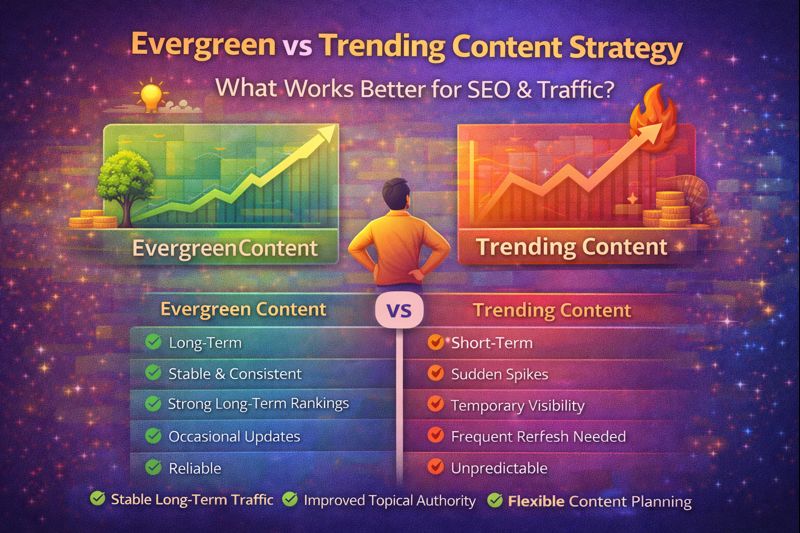
Evergreen vs Trending Content Strategy: What Actually Works Better for SEO?
Evergreen vs Trending Content Strategy Topic Cluster Strategy: How to Build Topical Authority — Complete…

What Is Generative SEO and How Content Marketers Can Use It in 2026
The Day Google Stopped Sending Me Traffic the Old Way Topic Cluster Strategy: How to…

Content Writing Tips for Beginners: How to Start Writing Like A Pro

Time Management for Writers: How to Make Your Writing Journey Productive

How to Create an SEO Content Strategy for Your Website (Step-by-Step Guide)
Why Most Blogs Never Get Traffic (And What’s Actually Missing) Here’s something I’ve noticed about…

Step-by-Step Guide to Writing an SEO-Optimised Blog writing That Ranks on Google (2026)
SEO-Optimised Blog That Ranks on Google My First Blog Got Zero Traffic – Here’s What…

Creative Writing & Storytelling: Complete Guide to Writing Powerful Stories in 2026
Creative Writing & Storytelling Every Writer Starts Here – With a Blank Page and a…