
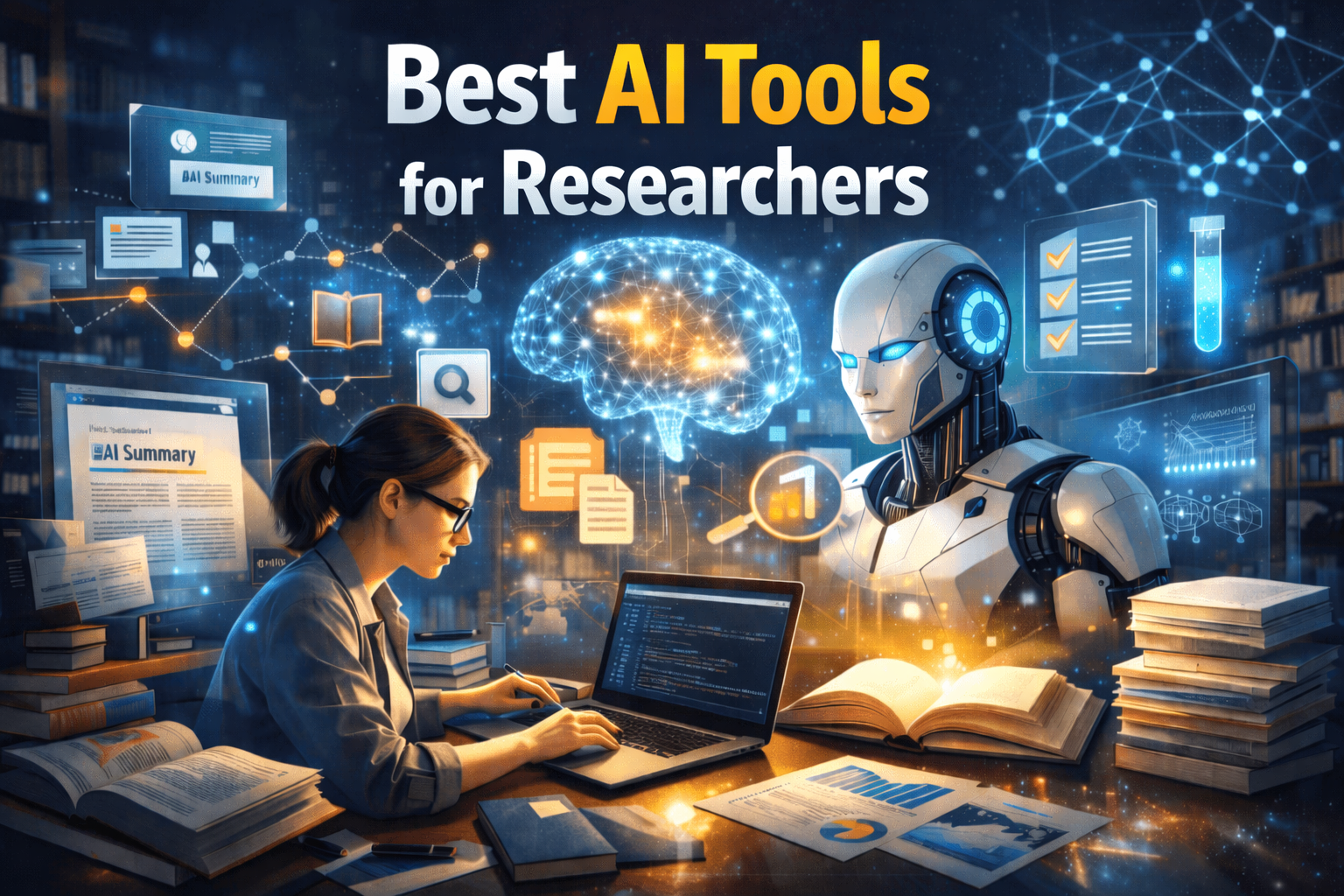
Last Updated: April 4, 2026
Just Think About This…
A professor pulled me aside last week. “I need to buy AI software for my lab,” he said. “What’s it going to cost me?”
I smiled. “The best AI tools? They’re completely free.”
He didn’t believe me. Until I showed him.
Let me show you too.
The Best AI Tools That Are Actually Changing Research
Table for Best AI Tools Every Researcher Must Know in 2026
| Best AI Tools Every Researcher Must Know in 2026 | |||||
| Best AI Tool | Best For | What It Does (Human-Friendly) | Cost | Verified Strength | Time Saved |
| GPT-4 / Claude | Writing, explaining, reviewing | Reads papers, summarizes research, explains complex concepts, assists in academic writing | $20/month / API | Peer-reviewed studies (BioData Mining, JAMIA Open, Oxford journals) | 40–50% |
| Semantic Scholar | Literature search | AI search engine with TLDR summaries & citation context across 200M+ papers | Free | Built by Allen Institute for AI (S2ORC corpus) | 30–40% |
| Consensus | Evidence-based answers | Tells what the overall research consensus says, not just one paper | Free (basic) | Uses GPT-4 + research synthesis algorithms | 50–60% |
| Google Colab | ML & data analysis | Free cloud notebooks with GPU—no costly hardware needed | Free / $10 Pro | Cited in 10,000+ research papers | 70–80% |
| AlphaFold | Protein structure | Predicts protein structures with near-experimental accuracy | Free | Nature 2021; Nobel Prize in Chemistry 2024 | 95%+ |
| Elicit | Research Q&A | Answers research questions by reading & combining multiple papers | Free tier | Featured in Nature (2023) | 40–60% |
| SciSpace | Paper understanding | Breaks down complex papers into simple explanations & section-wise answers | Free / Paid | Widely used by students & researchers | 30–50% |
| Orange Data Mining | No-code ML analysis | Drag-and-drop machine learning—no Python required | Free, open-source | Published in JMLR; cited in 2,500+ papers | 40–60% |
| H2O.ai AutoML | Automated ML modeling | Tests hundreds of ML models automatically and selects the best one | Free (open-source) | ICML 2020 AutoML research | 60–80% |
| Research Rabbit | Literature discovery | Visual citation maps to discover hidden but relevant research | Free | 100,000+ researchers (2024) | 50–70% |
| Perplexity AI | Research + real-time answers | AI search engine that gives cited, up-to-date answers from multiple sources | Free / Pro | Widely used for academic fact-checking | 30–50% |
| Grammarly | Academic writing quality | Grammar, clarity, tone, plagiarism suggestions | Free / Premium | Used by millions of researchers & journals | 25–40% |
| Zotero | Reference management | References collect, organize, cite automatically | Free (open-source) | Standard academic citation tool | 20–30% |
| Mendeley | Reference & collaboration | PDF annotation + citation + research collaboration | Free (basic) | Elsevier-supported platform | 20–30% |
| Connected Papers | Research mapping | A visual graph that shows key papers related to a single research paper | Free (limited) | Widely cited for literature exploration | 40–60% |
| Scite.ai | Smart citations | Shows whether citations support or contradict a paper | Free / Paid | Trusted for evidence-based citation analysis | 30–50% |
How to Get Started with AI Tools for Research

Decide Your Goal First
Managing references → Zotero, Mendeley
Think about what you want help with:
Understanding complex papers → GPT-4, SciSpace, Explainpaper
Finding related research & citations → Semantic Scholar, Research Rabbit, Connected Papers
Analyzing data or running models → Google Colab, Orange Data Mining, H2O.ai AutoML
Writing and polishing text → Grammarly, GPT-4
These tools improve constantly. Watch tutorials, read updates, and experiment with new features.
Start Small
Many tools are free or have trial versions. Begin there to get a feel. Example: Take one paper and run it through Semantic Scholar or GPT-4 to see the summary.
Focus on One Tool at a Time
- Trying all tools at once can be overwhelming.
- Recommended approach:
Step 1: Map relevant papers using Research Rabbit.
Step 2: Summarize top papers with GPT-4 or SciSpace.
Step 3: Organize references using Zotero or Mendeley.
Experiment and Compare
Test multiple tools for the same task to find what fits your style best. Example: Compare TLDR summaries from Semantic Scholar vs GPT-4.
Build a Workflow Gradually
Once comfortable, combine tools: Discover → Summarize → Write → Cite This makes research faster and more organized.
Track Your Progress
Keep note of how much time you save and how clear your understanding becomes.
This motivates you to explore advanced features later, like Colab GPUs or H2O AutoML.
Keep Learning
- AI In Research : How Artificial Intelligence Is Transforming Academic Research 2026
- Top 10 Free AI Tools for PhD Students in 2026
- AI Ethics Checklist for PhD Research: A Practical Guide
- Best 10 AI Literature Review Tools for 2026: Save Hours on Research
- 7 Ways AI Is Revolutionizing Data Analysis in Academic Research
References
- Liu et al. (2024) BioData Mining 17:16 available at https://biodatamining.biomedcentral.com/articles/10.1186/s13040-024-00363-6
- Reddy et al. (2024) JAMIA Open 7(3):ooae060 [PMC11221943] available at https://academic.oup.com/jamiaopen/article/7/3/ooae060/7711959
- Atkinson et al. (2025) JNCI 117(4):809-811 [PubMed 39898790] available at https://academic.oup.com/jnci/article/117/4/809/7602464
- Liao et al. (2024) PubMed 39851923 [web:87] available at https://pubmed.ncbi.nlm.nih.gov/39851923/
- Lo et al. (2020) ACL 2020.acl-main.447 [DOI:10.18653/v1/2020.acl-main.447] available at https://aclanthology.org/2020.acl-main.447/
- Google Colab FAQ (2024) research.google.com available at https://research.google.com/colaboratory/faq.html
- Nobel Prize Chemistry 2024 (Hassabis/Jumper) available at https://www.nobelprize.org/prizes/chemistry/2024/summary/
- Jumper et al. (2021) Nature 596:583-589 [DOI:10.1038/s41586-021-03819-2] available at https://www.nature.com/articles/s41586-021-03819-2
- Van Noorden (2023) Nature 620:448-450 available at https://www.nature.com/articles/d41586-023-02421-y [10] Ji et al. (2023) ACM CSUR 55(12):1-38 available at https://dl.acm.org/doi/10.1145/3571730
- Alkaissi & McFarlane (2023) Cureus 15(2):e35179 available at https://pubmed.ncbi.nlm.nih.gov/36819029/
Frequently Asked Questions (FAQs)
What are Best AI tools for researchers?
Best AI tools for researchers are intelligent software applications that help with tasks such as literature review, data analysis, academic writing, citation management, and experiment design. They are widely used in 2026 to make research more efficient and accurate.
Why should researchers use Best AI tools in 2026?
With the rapid growth of academic publications and data, Best AI tools help researchers save time, manage complex information, and focus more on critical thinking and innovation rather than repetitive work.
Which research tasks can AI tools support?
AI tools can assist with discovering relevant studies, summarizing papers, analyzing datasets, generating code, managing references, checking plagiarism, and improving the clarity of academic writing.
Are AI tools allowed in academic research?
Yes, most institutions and journals allow AI tools when they are used responsibly. Researchers are expected to disclose AI assistance, verify results, and follow ethical and academic guidelines.
Can AI tools replace human researchers?
No. AI tools are designed to support researchers, not replace them. Human expertise, judgment, creativity, and ethical decision-making remain central to the research process.
How do AI tools improve literature reviews?
AI tools can quickly scan large volumes of academic papers, identify relevant research, highlight key findings, and summarize complex topics, making literature reviews faster and more comprehensive.
Are AI tools reliable for data analysis?
AI tools can be reliable when used correctly, but researchers must understand the methods used, check for bias, and validate results before drawing conclusions or publishing findings.
What ethical concerns are linked to AI tools in research?
Ethical concerns include data privacy, algorithmic bias, authorship transparency, and accountability. Responsible use of AI tools requires clear guidelines and human oversight.
Which research fields benefit most from AI tools?
Data-intensive fields such as healthcare, life sciences, engineering, social sciences, and computer science benefit greatly, although AI tools are now influencing nearly all academic disciplines.
How can researchers choose the best AI tools?
Researchers should select Best AI tools based on their field, research goals, data needs, and institutional policies. Testing tools and learning from peer recommendations can help identify the most suitable options.
About the Author
Dr. Rekha Khandelwal is an academic content writer and AI prompt engineer specializing in research writing and AI-powered tools. She helps students and researchers simplify complex academic work through practical, technology-driven solutions.
Author Profile Dr. Rekha Khandelwal | Academic Writer, Legal Technical Writer, AI Expert & Author | AspirixWriters
- Academic Writing
- AI in Business & Marketing
- AI in Content Creation
- AI in Research
- AI in Research & Education
- AI Tools & Review
- Finance
- Indian Laws
- SEO & Digital Marketing
- Writing & Content Creation

7 Ways AI Is Revolutionizing Data Analysis in Academic Research
Act as an expert academic content writer, data analysis mentor, and SEO strategist. Create a…
AI Ethics and Future: Complete Guide to Responsible AI in 2026
AI Ethics and Future Why AI Ethics Matters More Than Ever Think about the last…
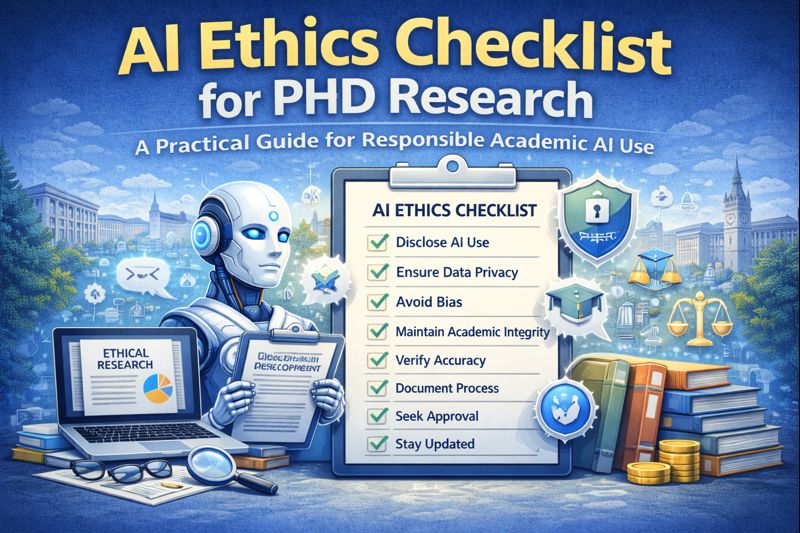
AI Ethics Checklist for PhD Research: A Practical Guide
A complete AI ethics checklist for PhD research. Learn how to use AI tools ethically,…

AI Research Revolution 2026: Complete PhD Workflow Guide
AI Research Revolution 2026 The complete AI PhD research workflow 2026 is changing how researchers…
Best 10 AI Literature Review Tools for 2026: Save Hours on Research
Ever stared at a mountain of 500+ research papers, wondering where to even start? You’re…
Best AI Tools Every Researcher Must Know in 2026
Just Think About This…A professor pulled me aside last week. “I need to buy AI…
EU AI Act: Complete Researcher-Friendly Guide (Compliance Timeline to 2026)
What Is the EU AI Act? (In Simple) Imagine you build a robot that helps…
Top 10 Free AI Tools for PhD Students in 2026
Top 10 Free AI Tools for PhD Students in 2026 – A Step-by-Step Guide to…