

Last Updated: April 20, 2026
Research Paradigms
Module 3: Research Methodologies
From Concept to Submission Series | 2026
Academic Writing Mastery: The Complete 2026 Guide To Research Papers, Thesis & Dissertation Writing
Module 1 (Complete Guide)- The Complete Guide To Research Paper Structure: IMRAD Format, Thesis Organization & Academic Writing (2026)
Module 2 (Complete Guide) –The Academic Writing Process: Complete Guide from First Draft to Submission (2026)
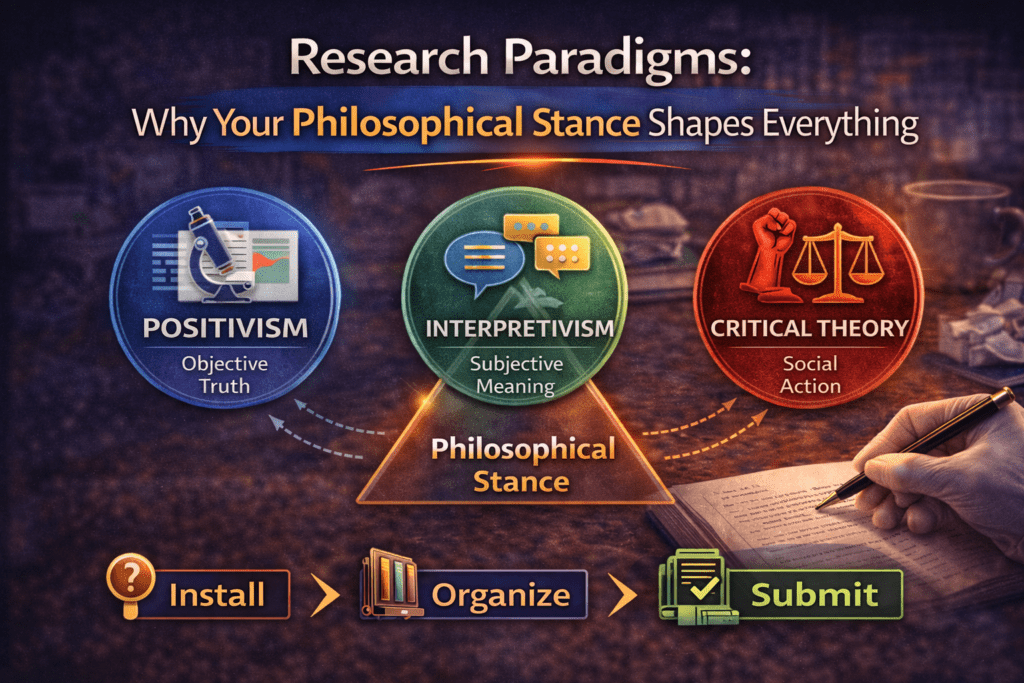
Research Paradigms: Why Your Philosophical Stance Shapes Everything
The module overview introduced positivism and interpretivism in two paragraphs. This post goes deeper: what the four main paradigms actually claim, how each shapes specific methodological decisions, the practical consequences of paradigm mismatch, and how to write your paradigm discussion in a thesis in a way that satisfies examiners without becoming a philosophy lecture.
Why Paradigms Are Not Just Abstract Philosophy
Many research methods courses introduce paradigms and then move quickly to practical methods, leaving students with the impression that paradigm discussions are academic throat-clearing — something to mention in the methodology chapter to satisfy examiners, but not genuinely connected to the research they are doing.
This impression is wrong, and it produces a specific, identifiable error: methodology chapters where the paradigm discussion and the methods description exist in separate compartments, with no visible connection between them. A researcher who writes “this study adopts an interpretivist paradigm” and then describes a survey methodology has a paradigm mismatch — and examiners know immediately that the researcher does not understand why it matters.
Your paradigm is not a label you attach to your work. It is a set of assumptions about what knowledge is and how it is produced — assumptions that should be visible in every methodological decision you make, from your research question to your sampling strategy to the way you report your findings.
The Four Main Paradigms
Positivism
Positivism holds that there is an objective reality that exists independently of the researcher and can be studied through systematic, value-free observation. Knowledge is built by testing hypotheses against empirical evidence. The researcher’s role is to observe without influencing — to be a neutral instrument of measurement.
The methodological consequences are specific: quantitative methods, random sampling, controlled conditions, statistical analysis, replication as the test of validity. If the same study produces the same results when repeated by a different researcher in a different context, the finding is trustworthy.
Paradigm-consistent research question: “Does peer mentoring frequency predict first-year retention when socioeconomic status, prior achievement, and gender are controlled?” Why it fits: The question assumes retention is an objective, measurable outcome; that the relationship between mentoring and retention is stable enough to be quantified; and that confounding variables can be identified and statistically controlled.
Positivism has been dominant in natural sciences and remains influential in psychology, economics, and much quantitative social science. Its critics argue that human behaviour cannot be studied the same way physical phenomena can — that meaning, context, and interpretation are irreducibly part of social reality and cannot be factored out of the analysis.
Interpretivism (Constructivism)
Interpretivism holds that social reality is constructed through meaning — that what people do, think, and experience cannot be understood apart from the meanings they assign to their actions and situations. There is no single objective social reality; there are multiple realities, differently experienced and interpreted by different people.
The methodological consequences are equally specific: qualitative methods, purposive sampling, in-depth engagement with small numbers of participants, interpretive analysis, thick description rather than statistical generalisation. The researcher is not a neutral observer — they bring their own perspective to the interpretation, and reflexivity (acknowledging and accounting for this) is a methodological requirement, not an optional extra.
Paradigm-consistent research question: “How do first-generation students experience peer mentoring as they navigate government college culture in their first year?” Why it fits: The question is about experience and meaning, not measurement. It assumes the students’ interpretations of their situation are the primary data. It does not assume a single correct answer — different students may experience mentoring differently, and those differences are informative rather than problematic.
Critical Realism
Critical realism occupies a position between positivism and interpretivism that many researchers find more intellectually defensible than either extreme. It holds that an objective reality exists — but that our access to it is always mediated through concepts, theories, and social structures that shape what we can observe and know.
Crucially, critical realism distinguishes between the empirical level (what we observe), the actual level (events that occur whether or not we observe them), and the real level (the underlying mechanisms and structures that generate events). Research should aim to identify these generative mechanisms — not just describe patterns but explain the processes that produce them.
Critical realism justifies mixed methods naturally: quantitative methods can identify patterns at the empirical level; qualitative methods can illuminate the mechanisms and meanings at the real level. This is why critical realism has become one of the most commonly cited paradigms in mixed methods theses — it provides a coherent philosophical rationale for combining approaches that neither positivism nor interpretivism can straightforwardly supply.
Paradigm-consistent research question: “What mechanisms explain the relationship between peer mentoring and first-year retention in Indian government colleges, and under what conditions do those mechanisms operate?” Why it fits: The question assumes a real mechanism exists (peer mentoring affects retention through some process), that this mechanism operates differently in different contexts, and that understanding it requires both measuring the pattern and investigating the process.
Pragmatism
Pragmatism holds that the choice of methods should be driven by the research question — not by allegiance to a philosophical paradigm. Knowledge is judged by its practical consequences: what works to answer the question at hand?
Pragmatism is the philosophical home of mixed methods research as articulated by Creswell and others. It removes the apparent contradiction between quantitative and qualitative approaches by treating both as tools in service of a research question, rather than as expressions of incompatible worldviews.
The limitation of pragmatism as a paradigm is that it can become a way of avoiding the harder philosophical questions — “we used both methods because the question required it” without explaining why the findings from each method should be trusted or how they should be combined. Pragmatism is most defensible when it is explicit about what it is choosing not to resolve, rather than treating philosophical questions as irrelevant.
How Paradigm Choice Changes Specific Methodological Decisions
The table below shows how the same broad research topic — peer mentoring and student retention — generates different research questions, methods, and validity criteria depending on the paradigm.
| Paradigm | Research question and method |
| Positivism | Does peer mentoring frequency predict retention? → Quantitative survey, random sampling, regression analysis, statistical validity |
| Interpretivism | How do students experience peer mentoring? → Semi-structured interviews, purposive sampling, thematic analysis, credibility through member checking |
| Critical realism | What mechanisms link peer mentoring to retention, and in what conditions? → Sequential mixed methods: survey to identify pattern, interviews to explain mechanism |
| Pragmatism | What combination of mentor characteristics and contact frequency produces the best retention outcomes? → Whatever methods best answer the question, justified by fit rather than paradigm |
These are not just different methods for studying the same thing — they are different conceptions of what there is to know and what counts as knowing it. A positivist finding (mentoring frequency predicts retention, β = .34, p < .001) and an interpretivist finding (students experienced mentors as navigational guides who provided a sense of institutional belonging) are both valid findings, but they are answers to different questions and cannot be directly compared or combined without a framework for integration.
Paradigm Mismatch: The Most Common Methodology Chapter Error
Paradigm mismatch occurs when a researcher states one paradigm but describes methods that belong to a different one. It is the clearest signal to an examiner that the methodology chapter has been written to satisfy a requirement rather than to reflect genuine understanding.
The most common mismatches:
- Interpretivist paradigm + survey methodology. Surveys measure frequency and distribution. They cannot capture the meanings and interpretations that interpretivism is concerned with. If you claim an interpretivist stance, your methods must be designed to access meaning — interviews, observations, document analysis.
- Positivist paradigm + small convenience sample. Positivism claims generalisability through rigorous sampling. A convenience sample of twenty students from one department cannot support the generalising claims that a positivist framing implies.
- Critical realist paradigm with no mechanism identified. Critical realism requires identifying the generative mechanism — the process through which cause produces effect. A study that measures correlation without investigating mechanism has not delivered what its critical realist framing promised.
The fix for paradigm mismatch is not to change the methods — it is to align the paradigm statement with the methods you are actually using, and then to ensure the methods are appropriate for the research question. Sometimes this means revising the question; sometimes it means revising the methods; sometimes it means adopting a paradigm you had not considered.
Writing the Paradigm Discussion in Your Thesis
A thesis methodology chapter is expected to include a paradigm discussion. Most supervisors mention this; very few explain what it should contain and how long it should be. The following is the standard that satisfies examiners without becoming a philosophy dissertation.
Two to three paragraphs is usually sufficient. The paragraphs should do three things in sequence:
- Name your paradigm and state its core claim. “This study operates within a critical realist paradigm, which holds that an objective social reality exists but that our access to it is always mediated through conceptual frameworks and that the goal of research is to identify the generative mechanisms underlying observable patterns (Bhaskar, 1978; Archer, 1995).”
- Connect the paradigm to your research question. “This paradigm suits the present research because the question concerns not only whether peer mentoring is associated with retention outcomes, but what process connects them and under what institutional conditions that process operates — questions that require both measurement and interpretive inquiry.”
- Draw the implication for your methods. “A critical realist stance justifies the mixed methods design: the survey phase identifies the empirical pattern; the interview phase investigates the real-level mechanisms through which mentoring produces its effects.”
Three paragraphs, three jobs. This tells an examiner that you understand your paradigm, that you chose it deliberately, and that it connects logically to what you did. It does not require a chapter-length treatment of Kuhn, Popper, and Feyerabend.
FAQs
Q: What is positivism in research?
Positivism holds that reality exists independently of the observer and can be measured objectively. Knowledge is produced by testing hypotheses against observable data. Quantitative methods — surveys, experiments, statistical analysis — align with positivism. A positivist researcher aims for objectivity, replicability, and generalisability. Most natural science and much social science research operates within a positivist or post-positivist paradigm. Post-positivism acknowledges that perfect objectivity is impossible but maintains that bias can be controlled through rigorous methodology.
Q: What is interpretivism in research?
Interpretivism holds that reality is socially constructed — there is no single objective truth, only meanings that people make in context. Knowledge is produced by understanding how participants make sense of their experiences. Qualitative methods — interviews, ethnography, thematic analysis — align with interpretivism. An interpretivist researcher acknowledges their own positionality and its influence on data collection and analysis. Findings are described as transferable rather than generalisable, because context determines meaning.
Q: What is critical realism in research?
Critical realism holds that an objective reality exists but can only be accessed imperfectly through observation. It distinguishes between the real (underlying mechanisms), the actual (events that occur whether observed or not), and the empirical (what is observed and experienced). Critical realism supports mixed methods — quantitative data identifies patterns; qualitative data explains mechanisms. It is particularly useful in social science research on complex phenomena where observable outcomes have multiple interacting causes.
Q: How do you choose a research paradigm for your thesis?
Your paradigm is shaped by your research question and your beliefs about knowledge and reality. If you believe there is an objective reality measurable through data, positivism or post-positivism fits. If you believe reality is constructed through social interaction and interpretation, interpretivism fits. If you believe both objective structures and subjective meanings matter, critical realism or pragmatism fits. Do not choose a paradigm because it sounds sophisticated — choose the one that accurately describes your assumptions about how knowledge is produced.
Q: What is the difference between ontology and epistemology in research?
Ontology is the branch of philosophy concerned with the nature of reality: does an objective reality exist independently of our perception? Epistemology is concerned with the nature of knowledge: how do we know what we know, and what counts as valid knowledge? In research, ontology shapes what you believe you can study; epistemology shapes how you believe you can study it. A positivist ontology (objective reality exists) leads to a positivist epistemology (objective measurement produces knowledge). These positions must be consistent with your methodology.
Author
Dr. Rekha Khandelwal, a legal scholar and academic writing expert, is the founder of AspirixWriters. She has extensive experience in guiding students and researchers in writing research papers, theses, and dissertations with clarity and originality. Her work focuses on ethical AI-assisted writing, structured research, and making academic writing simple and effective for learners worldwide.
Author Profile Dr. Rekha Khandelwal | Academic Writer, Legal Technical Writer, AI Expert & Author | AspirixWriters
References
- Creswell, J. W., & Creswell, J. D. (2022). Research Design: Qualitative, Quantitative, and Mixed Methods Approaches (6th ed.). Sage.
- Saunders, M., Lewis, P., & Thornhill, A. (2019). Research Methods for Business Students (8th ed.). Pearson.
- Bhaskar, R. (1978). A Realist Theory of Science. Harvester Press.
- Denzin, N. K., & Lincoln, Y. S. (Eds.). (2018). The SAGE Handbook of Qualitative Research (5th ed.). Sage.
- Clark, T., Foster, L., Sloan, L., & Bryman, A. (2021). Bryman’s Social Research Methods (6th ed.). Oxford University Press.
Next — Quantitative Research Design: From Hypothesis to Valid Results
Next in Series:
- Complete Guide: Data Analysis and Results Presentation: Complete Guide for Quantitative, Qualitative & Legal Research (2026) (Module 4)
- Complete Guide: Organization and Academic Tone: Complete Guide to Professional Scholarly Writing (2026) (Module 5)
- Complete Guide: Peer Review and Publication: Complete Guide from Submission to Acceptance (2026) (Module 6)
- Complete Guide: AI Tools in Academic Research: Opportunities, Ethics, and Best Practices (2026) (Module 7)
- Complete Guide: Grant Writing and Research Funding: Complete Guide to Finding Money for Your Research (2026) (Module 8)
- Complete Guide: Academic Career Development: Complete Guide to Building Your Professional Life in Research (2026) (Module 9)
- Complete Guide: Research Ethics and the IRB Process: Complete Guide to Doing Research Responsibly (2026) (Module 10)
No post found!