Last Updated: March 21, 2026
Cluster Post 5 | Module 7: AI Tools in Academic Research — Opportunities, Ethics, and Best Practices
From Concept to Submission Series | 2026
Academic Writing Mastery: The Complete 2026 Guide To Research Papers, Thesis & Dissertation Writing
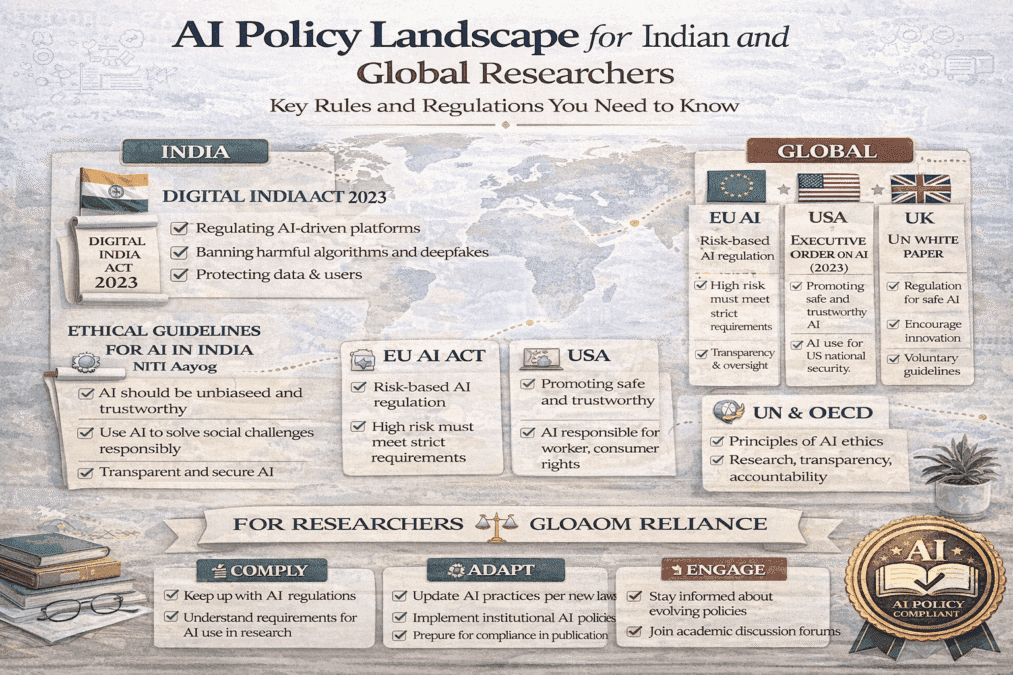
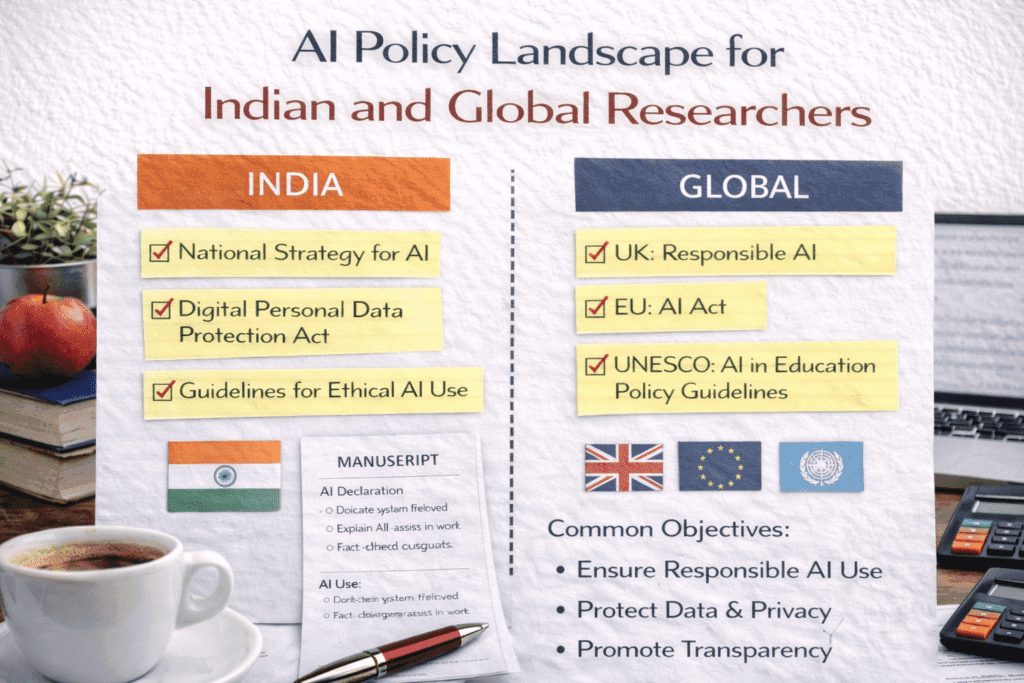
AI Policy Landscape for Indian and Global Researchers
The module overview summarises institutional and journal policies. This post goes deeper: the UGC 2025 guidelines in detail, what major global universities and regulators have enacted, leading journal policies across disciplines, how to navigate conflicting policies, and the practical strategies for researchers whose institutions have no formal policy yet.
Why Policy Knowledge Matters Practically
AI policy in academia is not stable. It changes at the institutional, journal, and national regulatory level on a timescale of months. Researchers who do not monitor relevant policies risk violating rules that were updated since they last checked — or unnecessarily restricting their AI use because they are following outdated guidance.
The two-level principle: always follow the more restrictive of (a) your institution’s policy and (b) the journal or conference’s policy. When policies conflict, choose the more restrictive. When no institutional policy exists, follow the principle of full transparency and general academic integrity standards — absence of policy does not mean absence of obligation.
India: UGC 2025 Guidelines
The University Grants Commission released comprehensive AI guidelines for higher education research in 2025. These are the governing framework for Indian universities and the baseline that institutional policies must meet or exceed.
Core principles of the UGC 2025 guidelines
- Transparency: All AI tool use that contributes to the final work product must be disclosed. The guidelines require researchers to identify the tool, the task, and how the output was verified or modified.
- Human oversight: Researchers must maintain meaningful oversight of all AI-assisted work. This means the researcher must understand and be able to explain every element of the submitted work, regardless of whether AI assisted in producing it.
- Attribution: AI tools cannot be listed as authors. Attribution of intellectual work remains with the human researchers. Where AI contributed substantially to a specific section, this must be disclosed in the methods or acknowledgements, not attributed through authorship.
- Ethical boundaries: AI use is prohibited for tasks where its use would compromise research integrity: fabricating data, generating false citations, misrepresenting methodology, or producing content the researcher cannot verify and defend.
- AI literacy: The UGC guidelines place an obligation on institutions to develop AI literacy among researchers. Researchers are expected to understand the tools they use, including their limitations and failure modes.
What the UGC guidelines do not specify
The UGC guidelines establish principles, not rules for specific use cases. They do not specify which tools are permitted, what percentage of AI-assisted text is acceptable, or how disclosure should be formatted. These details are left to institutions. This means that two researchers at different Indian universities may face different specific requirements while both complying with the UGC framework.
Practical implication: check your own institution’s AI policy — which should implement the UGC guidelines with institution-specific rules. If no institution-specific policy exists, the UGC principles apply directly and should guide your practice.
INAE Ethics Framework 2025
The Indian National Academy of Engineering released a complementary ethics framework specifically for Indian researchers in 2025. While focused on STEM and engineering contexts, its principles apply broadly. The INAE framework emphasises: reproducibility (AI-assisted analysis must be documented sufficiently to allow reproduction), intellectual contribution (the researcher must make identifiable intellectual contributions that cannot be attributed to AI), and data governance (AI tools processing research data must comply with data protection requirements).
Global University Policies: Major Institutions
| Institution / Region | Policy approach (as of early 2026) |
| UK universities (general) | Most UK universities follow guidance from QAA (Quality Assurance Agency) and their own academic integrity frameworks. The dominant model: disclosure required for all AI use contributing to submitted work; AI-generated content treated as equivalent to unattributed quotation if undisclosed. Russell Group universities have institution-specific policies that vary from permissive-with-disclosure to task-specific restrictions. |
| US universities (general) | Highly variable. Some Ivy League institutions have adopted detailed AI policies with specific permitted/prohibited task lists. Many state universities are still developing policies. The dominant emerging model is context-specific: AI permitted for certain assignment types with disclosure, prohibited for others. Graduate research policies tend to be more permissive than undergraduate course assignment policies. |
| Australian universities | Universities Australia issued joint guidance in 2024 establishing disclosure as the baseline requirement. Most Go8 universities have added institution-specific layers. The Australian model tends toward transparency and literacy rather than prohibition. |
| European universities | Significantly influenced by the EU AI Act (2024), which exempts fundamental research from many requirements but mandates transparency. Most European universities now require disclosure and emphasise the European research integrity framework (ALLEA). German universities have developed particularly detailed guidance given the AI Act’s implementation context. |
| Canadian universities | Universities Canada guidance emphasises academic integrity principles applied to AI. Most major research universities (Toronto, McGill, UBC) have adopted disclosure-based frameworks similar to the Australian model. |
| Singapore (NUS, NTU) | Among the most developed AI policies in Asia. Both NUS and NTU have detailed, regularly updated AI policies that distinguish between permitted uses (research assistance, writing improvement, coding) and prohibited uses (generating research content, data fabrication), with mandatory disclosure throughout. |
Global Journal Policies: Discipline by Discipline
Natural sciences and medicine
Nature Portfolio: AI tools may be used to improve readability and language only. AI tools cannot be listed as authors. Use must be disclosed in the Methods or Acknowledgements section. This policy covers Nature, Nature Medicine, Nature Communications, and all Nature-branded journals.
Science family: Similar to Nature — AI acceptable for language editing, not for generating scientific content. Authors must declare AI use in the cover letter and in the paper.
PLOS journals: Permits AI for language editing and formatting. Prohibits AI-generated images, figures, or data. Requires a statement in the Methods or Author Contributions. PLOS is notable for its commitment to open disclosure requirements.
Elsevier: All Elsevier journals now require AI disclosure. The specific policy: AI tools may be used to improve readability, grammar, or language. AI tools may not be used to create figures, tables, or scientific content without disclosure. AI tools cannot be authors. Disclosure goes in the manuscript acknowledgements.
Social sciences
American Psychological Association (APA) journals: APA updated its author guidelines in 2024 to require disclosure of AI tool use that contributes to the final manuscript, with specific language recommended for the Methods section. AI cannot be listed as an author.
Wiley social science journals: Require disclosure of any AI use. The policy distinguishes between editing assistance (lower disclosure requirement) and content generation (higher disclosure requirement).
SAGE social science journals: Disclosure required. SAGE has published guidance noting that authors are fully responsible for the accuracy and integrity of AI-assisted work. Particularly strong guidance on the use of AI in qualitative research, noting that AI-assisted coding requires explicit disclosure of the coding process.
Law and humanities
Law journals (international): Most major international law journals — Oxford, Cambridge, Harvard, Yale, Michigan, Columbia — have adopted disclosure requirements that align with their institutional policies. Common across these: AI for editing and writing assistance is acceptable with disclosure; AI for generating legal analysis or argument is treated as the equivalent of undisclosed ghost-writing if not acknowledged.
Humanities journals: The Modern Language Association (MLA) released guidance in 2024 recommending disclosure of AI use in humanities research. Given that writing is often the primary intellectual product in humanities, most humanities journals take a conservative approach — AI for language polishing is generally accepted with disclosure, but AI-generated interpretation or analysis is treated as academic misconduct.
Navigating the Policy Landscape Practically
When your institution has no AI policy
Many Indian universities, particularly those not among the NLUs or central universities, have not yet developed institution-specific AI policies. In this situation:
- Apply UGC 2025 principles directly: Transparency, human oversight, attribution, and ethical limits are the governing framework.
- Follow the most restrictive applicable policy: If you are submitting to a journal, follow the journal’s policy. If you are submitting a conference paper, follow the conference’s policy. Your thesis should follow whatever is most conservative among these.
- Consult your supervisor: Your supervisor’s guidance is authoritative at the institutional level in the absence of formal policy. Document this guidance in writing.
- Use full transparency as the default: When in doubt, disclose. No researcher has been penalised for disclosing appropriate AI use. Researchers have been penalised for non-disclosure.
When policies conflict
The most common conflict is between a permissive institutional policy and a restrictive journal policy. The rule: follow the more restrictive. If your institution permits AI writing assistance without disclosure but your target journal requires disclosure, disclose.
A rarer conflict: a restrictive institutional policy and a permissive journal. If your institution prohibits AI use in thesis research but the journal you are targeting requires only disclosure, your thesis work must comply with the institutional policy — and the article derived from it should reflect the same constraints.
Policies change: how to stay current
- Check journal AI policies at submission, not at drafting: Policies updated between when you wrote the paper and when you submit it may impose different requirements. Always check the current policy.
- Monitor your institution’s research integrity office: This is where policy updates are announced. Subscribe to any newsletter or policy update emails from your research office or library.
- Check UGC notices: The UGC periodically issues updated guidance. ugc.gov.in is the authoritative source.
- For international journals: Most journals include their AI policy in the ‘Author Guidelines’ or ‘Submission Requirements’ section. If no AI policy is stated, email the editorial office and ask before submitting.
Legal Research and Writing: Complete Guide for Law Students and Legal Researchers
FAQs
Q: What is UGC’s policy on AI in Indian higher education?
UGC issued guidelines on AI use in higher education in 2023, recognising AI as a tool that can enhance learning and research when used responsibly. The guidelines emphasise: disclosure of AI use; maintaining academic integrity; developing AI literacy among students and faculty; and ensuring AI does not replace the critical thinking and analytical skills that higher education is designed to develop. Specific implementation is left to institutions. Most NLUs are developing their own AI academic integrity policies — check your institution’s current policy, as these are being updated rapidly.
Q: What are the major journal publishers’ policies on AI in research?
As of 2026, all major publishers have AI policies: Nature and Springer Nature require disclosure of AI use in writing and prohibit AI authorship. Elsevier requires an AI statement in the cover letter and manuscript. Wiley requires disclosure in the methods or acknowledgements. Taylor & Francis requires a declaration of AI use. The common elements: AI cannot be an author; AI use must be disclosed; authors take full responsibility for all content. Individual journals may have additional requirements — check the specific journal’s author guidelines, not just the publisher-level policy.
Q: How is AI changing academic peer review?
AI is being used by reviewers to assist with peer review — checking grammar, summarising papers, and identifying methodological issues. Some journals explicitly prohibit reviewers from using AI to review manuscripts because confidential submissions should not be entered into third-party AI systems. Publishers are developing AI-assisted desk review tools to screen submissions for basic quality issues. The peer review process itself is under pressure: AI makes it easier to submit more papers, increasing the review burden, while also making it easier to produce papers that look polished but lack original contribution.
Q: Can Indian PhD students use AI for their thesis?
Indian PhD students can use AI for specific permitted tasks: improving prose clarity, checking grammar, generating outlines, mapping literature, and reference formatting — subject to disclosure requirements and their institution’s AI policy. They should not use AI to write thesis chapters, generate research findings, produce analysis, or create citations without verification. Most NLU thesis regulations predate widespread AI use; institutions are updating policies rapidly. Before using any AI tool for thesis work, check your institution’s current AI policy and discuss with your supervisor what is permitted.
References
- UGC Guidelines for AI Use in Higher Education Research (2025). ugc.gov.in
- Nature Portfolio AI policy. nature.com/nature-portfolio/editorial-policies
- Elsevier AI author tools policy. elsevier.com/about/policies-and-standards
- EU AI Act research provisions (2024). eur-lex.europa.eu
- MLA Guidance on Artificial Intelligence Tools (2024). mla.org
- APA AI Author Guidelines Update (2024). apa.org
End of Module 7 Cluster Posts — all 5 complete.
- Module 1 Overview The Complete Guide to Research Paper and Thesis Structure
- Module 2 Overview The Academic Writing Process: Complete Guide from First Draft to Submission (2026)
- Module 3 Overview Research Methodologies: Complete Guide to Quantitative, Qualitative, Mixed Methods & Legal Research (2026)
- Module 4 Overview Data Analysis and Results Presentation: Complete Guide for Quantitative, Qualitative & Legal Research (2026)
- Module 5 Overview Organization and Academic Tone: Complete Guide to Professional Scholarly Writing (2026)
- Module 6 Overview Peer Review and Publication: Complete Guide from Submission to Acceptance (2026)
- Module 7 Overview AI Tools in Academic Research: Opportunities, Ethics, and Best Practices (2026)
Next in Series
- Module 8 Overview Grant Writing and Research Funding: Complete Guide to Finding Money for Your Research (2026)
- Module 9 Overview Academic Career Development: Complete Guide to Building Your Professional Life in Research (2026)
- Module 10 Overview Research Ethics and the IRB Process: Complete Guide to Doing Research Responsibly (2026)
No post found!