Last Updated: March 31, 2026
Preparing a Submission Ready Document
Module 2: The Academic Writing Process
From Concept to Submission Series
Academic Writing Mastery: The Complete 2026 Guide To Research Papers, Thesis & Dissertation Writing
← Back to Complete Guide: The Academic Writing Process
Preparing a Submission Ready Document
You have written the paper. You have revised it. You believe it is ready. This post covers the stage that most researchers underestimate — the gap between a finished draft and a submission-ready document.
That gap is real, and it costs researchers time they cannot afford. Manuscripts returned at the editorial desk for formatting violations, cover letters that misrepresent the paper, missing declarations that trigger automatic desk rejection, wrong file formats, incorrect word counts — all of these happen routinely to experienced researchers, not only to first-time submitters.
This post walks through every element of the submission package: the manuscript itself, the cover letter, the required declarations, the supplementary materials, and the submission system. It covers what each element must contain, what commonly goes wrong, and how submission requirements differ across journal types, including Indian journals.
Before You Open the Submission System: Read the Author Guidelines
This instruction sounds obvious. It is not followed often enough.
Every journal has author guidelines — sometimes called ‘Instructions for Authors,’ ‘Submission Guidelines,’ or ‘Author Information.’ These guidelines specify everything: word limits, reference style, file format, abstract structure, figure resolution, cover letter requirements, ethical declarations, and the specific submission system the journal uses.
Read the author guidelines for your specific target journal before you format anything. Guidelines vary enormously between journals, even within the same publisher. A Sage journal and a Taylor & Francis journal may have completely different requirements for the same discipline. A journal that switched from APA 6th to APA 7th edition two years ago still has researchers submitting in the old format.
The author guidelines are the authoritative source. Not what you remember from a previous submission to a different journal. Not what your supervisor did five years ago. The current guidelines, read on the day you prepare the submission.
What to record before you start formatting
| Item to check | Where to find it |
| Word limit (total, and per section) | Author guidelines — often separate limits for abstract, main text, references |
| Reference style and edition | Author guidelines — note the edition (APA 7th, not APA 6th; Bluebook 21st, not 20th) |
| File format required | Author guidelines — .docx, .tex, .pdf, or a combination |
| Figure and table requirements | Author guidelines — resolution (300 dpi minimum), file format (TIFF, EPS, PNG), placement |
| Blinding requirements | Author guidelines — double-blind journals require author details removed from manuscript |
| Cover letter requirements | Author guidelines — some journals specify exact content; others leave it open |
| Required declarations | Author guidelines — ethics approval, conflicts of interest, funding, author contributions |
| Submission system | Author guidelines or journal homepage — ScholarOne, Editorial Manager, OJS, or email |
Formatting the Manuscript
Manuscript formatting has two purposes: it makes the paper legible for peer reviewers, and it signals to editors that you are familiar with the conventions of scholarly publishing. A manuscript with inconsistent heading levels, missing page numbers, or a reference list that does not match the stated style tells an editor, before they have read a word of content, that the submission was not carefully prepared.
The standard elements every manuscript needs
- Title page: Full title, all author names and affiliations, corresponding author contact details, word count, and — for double-blind journals — this page is kept separate from the blinded manuscript.
- Abstract: Within the word limit specified, in the format required (structured or unstructured). Keywords on a separate line below the abstract, in the number specified (usually 5–8).
- Main text: In the structure required by the journal — IMRAD for empirical papers, or the journal’s stated structure. Headings at the correct level. No author-identifying information in a double-blind submission.
- Acknowledgements: Funding sources, institutional support, individuals who contributed but do not meet authorship criteria. Remove from blinded manuscript.
- Declarations: Ethics approval, conflicts of interest, data availability, author contributions — in the format and order the journal specifies.
- References: In the exact style and edition the journal requires. Every in-text citation must appear in the reference list. Every reference list entry must correspond to an in-text citation.
- Tables and figures: At the end of the document or as separate files, depending on journal requirements. Each with a title and, for figures, a legend. Numbered in the order they appear in the text.
Double-blind submissions: what to remove
Double-blind peer review means reviewers do not know who wrote the paper. This requires active removal of identifying information from the manuscript file — it does not happen automatically.
Remove or anonymise:
- Author names, affiliations, and contact details from the title page — submit as a separate file
- Acknowledgements section — either remove entirely or replace with ‘Acknowledgements removed for blind review’
- Self-citations: Replace ‘As I argued in Khandelwal (2023)…’ with ‘As argued in [Author] (2023)…’ or ‘As argued in a previous study (details removed for blind review)…’
- Institutional identifiers in the methods section — ‘at a large public university in Rajasthan’ rather than the institution name
- File metadata — check the document properties (File > Properties in Word) and remove author name from the metadata before saving
Word count: what is included and what is not
Word count limits almost always exclude the abstract, references, tables, and figure legends. They count the main text only. Confirm this in the author guidelines before trimming — some journals count everything, and some count the abstract separately within its own limit.
If you are over the word limit, the revision sequence is: first cut the discussion (most over-written section), then the introduction, then the methods. Do not cut the results section — that is the evidence. Do not cut literature that is directly essential to your argument.
The Cover Letter
The cover letter is the first thing an editor reads. It determines whether the manuscript gets assigned to a handling editor or returned at the desk. Most researchers write cover letters that do not do this job well.
The cover letter is not a summary of the paper. The editor will read the abstract for that. The cover letter makes a case for why this paper belongs in this journal — at this time, for this readership.
What an effective cover letter contains
- The title and manuscript type (research article, review, letter, etc.) in the opening line. Editors handle dozens of submissions; make it immediately clear what you are submitting.
- The core argument in two to three sentences. Not a summary of every finding — the single most important claim the paper makes and why it matters.
- The fit with the journal. One or two sentences explaining specifically why this paper belongs in this journal. Reference the journal’s stated scope, a recent thematic issue, or a published paper the current work extends or responds to. Generic statements (‘your journal publishes work on X’) are less effective than specific ones (‘this paper responds directly to the debate initiated by Smith and Jones in your 2024 special issue on…’).
- Confirmation of compliance. That the manuscript has not been previously published and is not under consideration elsewhere. That all authors have approved the submission. That ethical requirements have been met (if applicable).
- Suggested reviewers (if invited). Many journals ask for three to five suggested reviewers. Suggest researchers who are active in the area, have no conflicts of interest with the authors, and are at institutions that give them credibility with the editor. Do not suggest your supervisor, close collaborators, or anyone who has read a draft of the paper.
- Excluded reviewers (if applicable). You can request that specific individuals not review the paper, typically due to a known conflict of interest. This is legitimate and editors take it seriously.
Cover letter: worked example
Dear Editor, I am submitting for your consideration a research article titled ‘Peer Mentoring and First-Year Retention in Indian Government Colleges: A Quasi-Experimental Study,’ which I believe is well-suited to the Journal of Higher Education Research. The paper reports a quasi-experimental study of 450 first-year students across three government colleges in Rajasthan. It finds that structured peer mentoring significantly predicted retention (82% vs 71% in the control group), and identifies institutional knowledge transmission — rather than social support — as the primary mechanism. This finding challenges the dominant social integration framing in retention research and has direct implications for low-cost intervention design at resource-constrained institutions. The paper speaks directly to your journal’s interest in equity-focused higher education research in the Global South, and specifically extends the methodological framework used by Sharma and Patel (2022) published in your journal, by introducing a quasi-experimental design and qualitative follow-up that their survey-based work could not provide. This manuscript has not been previously published and is not under consideration elsewhere. Ethical approval was obtained from the institutional review boards of all three participating colleges. All authors have approved the submission. I suggest the following reviewers: [names and institutional affiliations]. I request that [name] be excluded as a reviewer due to a prior collaborative relationship. Thank you for considering this submission. Sincerely, [Name], [Affiliation], [Email]
Notice what this letter does: it states the title and type in the first sentence, gives the core finding specifically (not vaguely), names a published paper in the journal to establish fit, and covers the required declarations concisely. The entire letter is under 300 words.
Required Declarations
Most journals now require explicit declarations alongside the manuscript. Missing or incomplete declarations are among the most common reasons for desk rejection. These are not bureaucratic formalities — they are part of the scholarly record.
Ethics approval statement
If your research involved human participants, animal subjects, or secondary data with privacy implications, an ethics approval statement is required. It must state the name of the approving body and the approval reference number.
Ethical approval for this study was obtained from the Institutional Ethics Committee of [Institution Name] (Approval Reference: IEC/2024/117). All participants provided written informed consent prior to participation.
If your research did not require ethics approval — for example, a theoretical paper or a study using publicly available data with no privacy implications — state this explicitly: ‘This study did not involve human participants and ethics approval was not required.’ Do not leave the field blank.
For Indian researchers: ICMR-registered studies should include the ICMR registration number. Studies at institutions affiliated with UGC-recognised universities should reference the institutional ethics committee approval, not only the supervisor’s approval.
Conflict of interest declaration
Declare any financial or personal relationships that could be perceived as influencing the research. This includes funding from organisations with a stake in the findings, employment relationships, stock ownership, consultancy arrangements, and personal relationships with people who could benefit from the research outcomes.
The authors declare no conflicts of interest. This research received no external funding.
Dr [Name] has received consulting fees from [Organisation], which funded the data collection for this study. The funder had no role in study design, data analysis, or the decision to publish. All other authors declare no conflicts of interest.
Funding declaration
Name every funding source, grant number, and the funder’s role in the research. Funders who had no role in design, analysis, or publication should be stated as such. This is required even when the funding is institutional (SERB, ICSSR, UGC, DST).
This research was supported by the Indian Council of Social Science Research (ICSSR) under Grant No. [number]. The funder had no role in study design, data collection, analysis, interpretation, or the decision to submit for publication.
Author contributions (CRediT)
The CRediT (Contributor Roles Taxonomy) system is now standard at most international journals. It requires each author’s contribution to be specified using defined roles.
| CRediT role | What it covers |
| Conceptualisation | Ideas; formulation of research question and goals |
| Methodology | Design and development of the research method |
| Formal analysis | Application of statistical, mathematical, or computational techniques |
| Investigation | Data collection and evidence gathering |
| Data curation | Management, annotation, and maintenance of data |
| Writing – original draft | Preparation of the initial draft |
| Writing – review & editing | Revision, critique, and commentary |
| Supervision | Oversight and leadership of the research team |
| Funding acquisition | Acquisition of financial support for the project |
Every author must have at least one CRediT role. Authorship requires contribution to conception or design, or data acquisition, analysis, or interpretation — plus participation in drafting or revising the manuscript. Individuals who do not meet these criteria should appear in the Acknowledgements, not the author list.
Data availability statement
Many journals now require a data availability statement specifying whether the research data is available, where it is deposited, and under what conditions it can be accessed.
- Open data: ‘The dataset generated and analysed in this study is available in the [Repository Name] repository, [DOI or URL].’ Zenodo, Figshare, OSF, and institutional repositories are common.
- Restricted data: ‘The data that support the findings of this study are not publicly available due to [participant confidentiality / institutional restrictions] but are available from the corresponding author on reasonable request subject to [conditions].
- No new data: ‘This study did not generate or analyse new datasets. All data supporting the conclusions are contained within the manuscript.’
Supplementary Materials
Supplementary materials are files submitted alongside the manuscript but not typeset as part of the main paper. They allow you to provide supporting detail — data tables, extended methodology, additional analyses, interview guides, survey instruments — without exceeding the word limit of the main text.
What goes in supplementary materials
- Extended data tables too large for the main paper (full regression output, complete coding frameworks, full descriptive statistics for all variables).
- Research instruments (interview guides, survey questionnaires, coding manuals) — required for replication and often requested by reviewers.
- Additional analyses not central to the main argument but relevant to robustness (sensitivity analyses, alternative model specifications, subgroup analyses).
- PRISMA checklist or CONSORT flow diagram for systematic reviews and clinical trials — submitted as supplementary files.
- Extended case descriptions or participant profiles in qualitative research.
Labelling and referencing supplementary materials
Label supplementary files consistently: Supplementary Table S1, Supplementary Figure S1, Supplementary Appendix A. Every supplementary file must be referenced in the main text at the point where the information becomes relevant. Do not include supplementary material that is not referenced in the text — reviewers will note the absence.
Check whether the journal accepts supplementary files. Some journals — particularly in law and humanities — do not publish supplementary material and expect all supporting information in footnotes or appendices within the main document.
Submission Systems: ScholarOne, Editorial Manager, and OJS
Most journals use one of three submission systems. Each works differently, and encountering one for the first time during an actual submission creates unnecessary stress. Understanding the system before you begin saves significant time.
ScholarOne Manuscripts
ScholarOne (also called Manuscript Central) is used by many Wiley, Taylor & Francis, and SAGE journals. The submission process has multiple steps, each of which must be completed before moving to the next:
- Account creation and login — create your account at the journal’s ScholarOne portal, not a central account
- Manuscript information — title, abstract, keywords, manuscript type, manuscript category
- Authors — all authors entered with ORCID iDs (required by most journals using ScholarOne)
- File upload — main manuscript, title page (separate for blind review), figures, tables, supplementary files — each uploaded to the correct file category
- Review and HTML proof — ScholarOne generates a merged PDF for your review before submission; check it carefully
- Submit — final confirmation; you will receive an acknowledgement email with a manuscript ID
Editorial Manager
Editorial Manager is used by Springer, Elsevier, and many society journals. The interface differs from ScholarOne but the logic is similar: step-by-step completion with a PDF proof before final submission. One difference: Editorial Manager allows authors to suggest and exclude reviewers at the submission stage, which is displayed prominently in the interface.
Elsevier journals using Editorial Manager increasingly require authors to complete an ethics and originality questionnaire during submission. This cannot be skipped — answer every question accurately.
OJS (Open Journal Systems)
OJS is open-source software used by many Indian journals, university presses, and open-access journals globally. The interface is less standardised than ScholarOne or Editorial Manager because each journal configures it differently. The submission process typically involves five steps: start, upload submission, enter metadata, upload supplementary files, and confirm.
Several major Indian journals use OJS: many UGC-CARE listed journals, INFLIBNET-hosted journals, and NLU law reviews. If you are submitting to an Indian journal, check whether it uses OJS and create an account before your submission deadline — OJS account approval is sometimes manual and can take a day or two.
Email submissions
Some journals — particularly smaller Indian journals, humanities journals, and law reviews — still accept submissions by email. For email submissions:
- Use the subject line format specified in the guidelines (usually: ‘Manuscript Submission: [Title]’)
- Attach all files as specified — manuscript, cover letter, and any required forms as separate attachments
- Name files clearly: AuthorSurname_Title_Manuscript.docx, AuthorSurname_Title_CoverLetter.docx
- Request a read receipt or follow up after five working days if you do not receive an acknowledgement
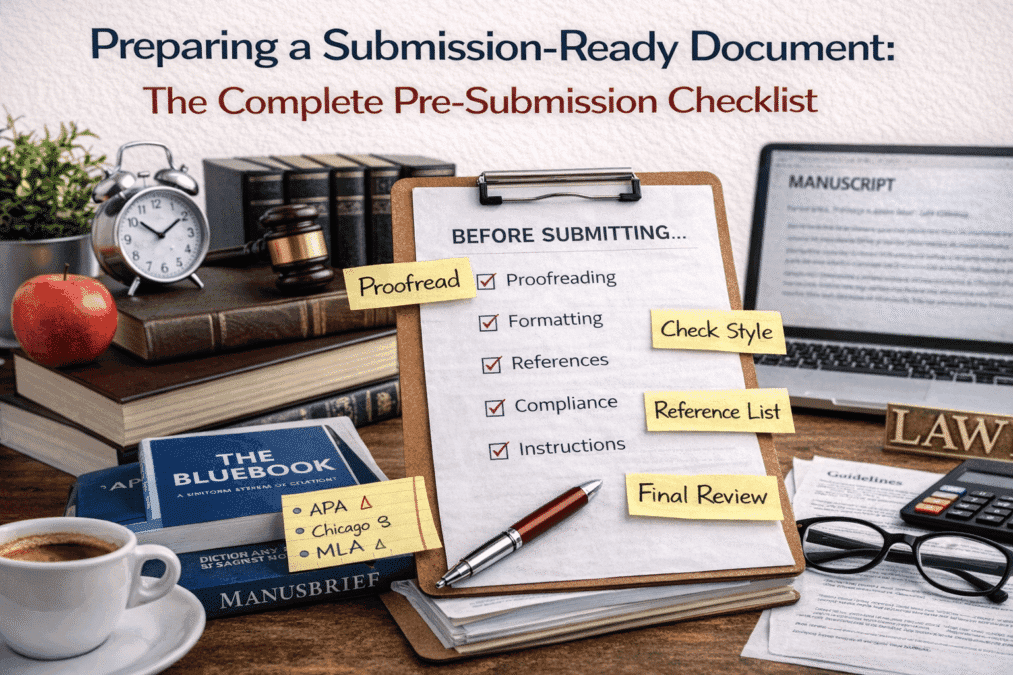
The Final Pre-Submission Checklist
Run through this checklist on the day of submission, after all files are prepared but before you open the submission system. Each item corresponds to a documented desk rejection reason.
Manuscript file
- Word count is within the stated limit — counted as specified (main text only, or total, as the guidelines require)
- Reference style matches the journal’s requirements exactly — including edition (APA 7th, not 6th; Bluebook 21st, not 20th)
- Every in-text citation appears in the reference list; every reference list entry has a corresponding in-text citation
- Abstract is within the word limit and in the correct format (structured or unstructured as required)
- Correct number of keywords provided
- For double-blind: all author-identifying information removed from manuscript file and file metadata
- Headings use the correct hierarchy and formatting as specified
- Tables and figures are numbered in order and each is referenced in the text
- File is saved in the required format (.docx, .pdf, or .tex)
Cover letter
- Addressed to the correct editor (check the current editor-in-chief; editorial boards change)
- States the title and manuscript type
- Makes the case for fit with the journal specifically
- Confirms the manuscript is not under simultaneous consideration elsewhere
- Includes suggested and excluded reviewers if the journal requests them
Declarations
- Ethics approval statement included with committee name and reference number, or explicit statement that ethics approval was not required
- Conflict of interest declaration complete for all authors
- Funding sources named with grant numbers
- Author contributions specified in CRediT format if required
- Data availability statement included
Supplementary materials
- All supplementary files referenced in the main text
- Files labelled consistently (Table S1, Figure S1, Appendix A)
- Files in the correct format for the journal’s system
Before clicking submit
- Read the ScholarOne / Editorial Manager / OJS PDF proof in full — the merged PDF often reveals formatting problems not visible in the source file
- Check that author names and affiliations are correct in the system fields — these appear in the published paper and are separate from the manuscript file
- Confirm ORCID iDs are linked for all authors if the journal requires them
After Submission: What Happens Next
Understanding what happens after you click submit prevents the anxiety of waiting and helps you respond appropriately when you hear back.
The editorial workflow
| Stage | What is happening |
| Desk review (1–7 days) | The editor checks whether the submission meets basic requirements: scope, format, completeness of declarations. Papers rejected at this stage have not been sent to reviewers. If rejected, you can resubmit elsewhere immediately. |
| Assignment to handling editor (1–2 weeks) | At journals with large editorial boards, the editor-in-chief assigns the paper to a handling editor with expertise in the area. At smaller journals, the editor-in-chief handles it directly. |
| Reviewer invitation and review (4–12 weeks) | The handling editor invites reviewers. Reviewer availability varies enormously — some journals struggle to find reviewers and the process takes months. You will typically not hear anything during this period. |
| Editorial decision | The editor receives reviewer reports and makes a decision: accept, major revision, minor revision, or reject. Most papers receive requests for revision at this stage. |
| Revision and resubmission | You address the reviewers’ comments and resubmit with a response letter. Module 6 covers this process in detail. |
Typical timescales by discipline
Time-to-first-decision varies by field. These are general ranges — individual journals vary considerably:
- Medical and health journals: 4–8 weeks for desk decisions; 8–16 weeks for peer review decisions
- Social sciences and education: 6–12 weeks for first decision
- Humanities and law: 8–16 weeks; some law reviews take longer, especially student-edited reviews in India
- UGC-CARE listed Indian journals: Highly variable — 2 weeks to 6 months. Check the journal’s published turnaround statistics if available.
If you have not heard within twice the journal’s stated review time, it is appropriate to send a polite enquiry to the editorial office. Do not withdraw a submission because the wait feels long — long waits are normal and do not predict rejection.
For Law Students
Legal Writing Process And Citation: A Complete Guide For Law Students And Legal Researchers
FAQs
Q: What is a submission-ready research paper?
A submission-ready paper meets every technical requirement of the target journal: word count within limits, correct citation style, abstract in specified format, anonymised for blind review if required, figures and tables in correct format, declarations (ethics, conflicts of interest, funding, CRediT author contributions) complete, and cover letter attached. Technical non-compliance is grounds for desk rejection before peer review. Check the journal’s author guidelines against a pre-submission checklist every time, even for journals you have submitted to before.
Q: How do you write a cover letter for a journal submission?
A cover letter for journal submission should be 3–4 paragraphs: (1) state the manuscript title and summarise the argument in one sentence; (2) explain why this journal is the right venue — name the journal’s scope and connect it to your paper’s contribution; (3) state that the paper is original, not under consideration elsewhere, and declare any ethical issues or conflicts of interest; (4) provide your contact details. Do not repeat the abstract. Keep it under 400 words.
Q: What declarations are required when submitting a research paper?
Most journals require: ethics approval statement (IRB/IEC reference number or confirmation that ethical approval was not required); conflict of interest declaration; funding acknowledgement; data availability statement (where the data can be accessed); and CRediT author contribution statement (specifying each author’s role: conceptualisation, methodology, data collection, analysis, writing). Omitting required declarations causes administrative rejection. Check the journal’s specific requirements — they vary by publisher and discipline.
Q: How do you anonymise a research paper for blind peer review?
Remove: author names and affiliations from the manuscript (keep only on the title page submitted separately); acknowledgements; self-citations in the text (‘as I argued in Smith, 2021’ → ‘as argued in [Author, 2021]’); institutional-specific examples that identify your location; and file metadata (check document properties in Word/PDF). Do not remove self-citations from the reference list — move them to the reference list with ‘Author’ replacing your name. Incomplete anonymisation can identify the author to reviewers.
Q: What is a CRediT author contribution statement?
CRediT (Contributor Roles Taxonomy) is a standardised system for specifying each author’s contribution to a research paper across 14 roles: Conceptualisation, Methodology, Software, Validation, Formal Analysis, Investigation, Resources, Data Curation, Writing – Original Draft, Writing – Review & Editing, Visualisation, Supervision, Project Administration, and Funding Acquisition. Most major publishers now require CRediT statements. Each author’s roles are listed; roles not applicable to the paper are omitted. It addresses ghost authorship and ensures transparent credit for all contributors.
Author
Dr. Rekha Khandelwal, a legal scholar and academic writing expert, is the founder of AspirixWriters. She has extensive experience in guiding students and researchers in writing research papers, theses, and dissertations with clarity and originality. Her work focuses on ethical AI-assisted writing, structured research, and making academic writing simple and effective for learners worldwide.
Author Profile Dr. Rekha Khandelwal | Academic Writer, Legal Technical Writer, AI Expert & Author | AspirixWriters
References
- Belcher, W. L. (2019). Writing Your Journal Article in Twelve Weeks (2nd ed.). University of Chicago Press.
- CRediT — Contributor Roles Taxonomy. credit.niso.org
- COPE (Committee on Publication Ethics) — Guidelines for Authors. publicationethics.org
- ICMR (2017). National Ethical Guidelines for Biomedical and Health Research Involving Human Participants. Indian Council of Medical Research.
- NUJS Law Review — Author Guidelines. nujslawreview.org
- NLSIR Author Guidelines — nlsirlawreview.org
- UGC-CARE List of Journals — ugccare.unipune.ac.in
← Previous— Reference Management: Zotero and Mendeley from Setup to Submission
Next – Legal Writing Process And Citation: A Complete Guide For Law Students And Legal Researchers
← Back to Complete Guide: The Academic Writing Process
Next in Series:
- Complete Guide: Research Methodologies: Complete Guide to Quantitative, Qualitative, Mixed Methods & Legal Research (2026) (Module 3)
- Complete Guide: Data Analysis and Results Presentation: Complete Guide for Quantitative, Qualitative & Legal Research (2026) (Module 4)
- Complete Guide: Organization and Academic Tone: Complete Guide to Professional Scholarly Writing (2026) (Module 5)
- Complete Guide: Peer Review and Publication: Complete Guide from Submission to Acceptance (2026) (Module 6)
- Complete Guide: AI Tools in Academic Research: Opportunities, Ethics, and Best Practices (2026) (Module 7)
- Complete Guide: Grant Writing and Research Funding: Complete Guide to Finding Money for Your Research (2026) (Module 8)
- Complete Guide: Academic Career Development: Complete Guide to Building Your Professional Life in Research (2026) (Module 9)
- Complete Guide: Research Ethics and the IRB Process: Complete Guide to Doing Research Responsibly (2026) (Module 10)
No post found!