Last Updated: May 11, 2026
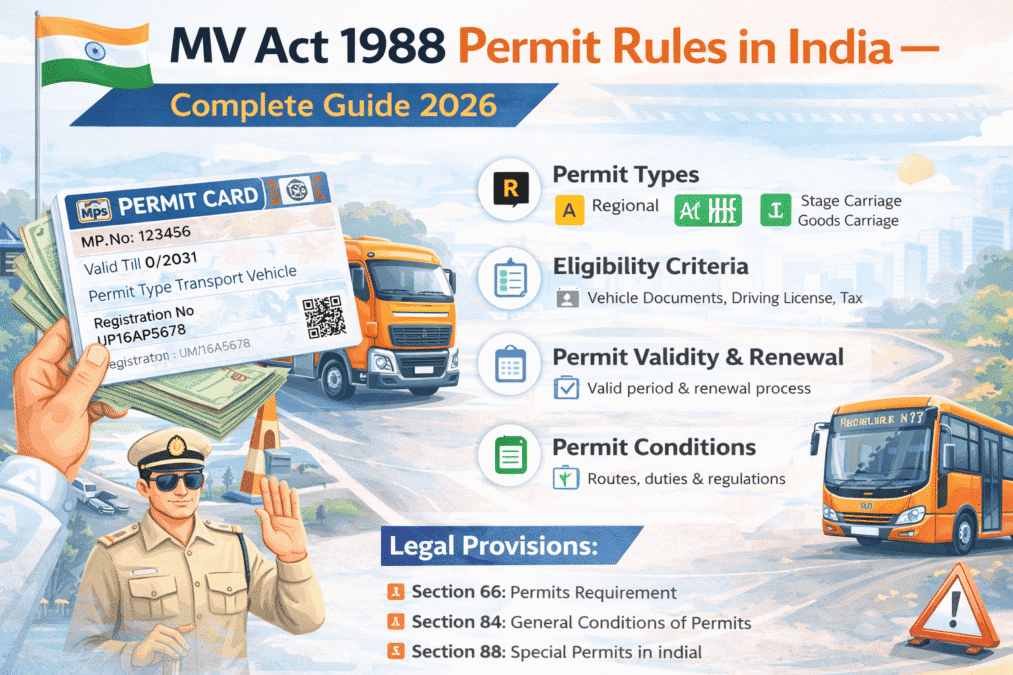
MV Act 1988 permit rules India MVA-05 -Part of Motor Vehicles Act 1988 India: Complete Guide
The Problem Every Truck Owner Has Faced
Rajan owns a goods truck in Rajasthan. He gets a lucrative contract to deliver goods from Jaipur to Pune. He has a valid RC, valid insurance, and a licensed driver. He thinks he is all set.
At a checkpost near the state border, enforcement officers stop him. They ask for the National Permit for his vehicle. Rajan has never heard of it. His truck is seized on the spot. He misses the delivery deadline, loses the contract, and pays a fine of Rs. 10,000 to get the vehicle released.
Rajan’s mistake is one of the most common — and costly — in Indian road transport. Under the Motor Vehicles Act, 1988, operating a commercial transport vehicle without the correct permit is a serious legal offence, regardless of how many other documents you have in order.
This guide explains every type of permit under the MV Act, how to apply, what Section 66 and Section 88 mean in practice, the latest 2026 updates, and exactly how to avoid Rajan’s expensive mistake.
← Previous: Vehicle Registration Rules in India(MVA-04) | ↑ Pillar: MVAMotor Vehicles Act 1988 India: Complete Guide | → Next: Traffic Rules and Penalties in India 2026 (MVA-07)
Download the free MACT Claim Filing Checklist PDF 2026
MACT Claim Filing Checklis
What Is a Permit Under the Motor Vehicles Act, 1988?
A permit is a legal document issued by a State Transport Authority (STA) or Regional Transport Authority (RTA) that authorises a motor vehicle to be used as a transport vehicle — to carry passengers or goods commercially. Without a valid permit, no transport vehicle can legally operate on Indian roads. Permits are governed by Chapter V (Sections 66–96) of the Motor Vehicles Act, 1988.
A permit does not just give you permission to drive — it specifies the route or area in which the vehicle can operate, the type of goods or number of passengers it can carry, and any conditions attached to its commercial operation. A permit for a goods vehicle in Rajasthan does not automatically allow operation in Maharashtra — unless it is a National Permit.
Key entities involved in the permit system: the Regional Transport Authority (RTA) at the district level, the State Transport Authority (STA) at the state level, and the MoRTH (Ministry of Road Transport and Highways) at the national policy level. Applications and renewals are processed through the Parivahan portal (parivahan.gov.in).
Section 66 Explained — Why Permits Are Mandatory
Direct Answer: What does Section 66 of the Motor Vehicles Act say? Section 66 of the MV Act, 1988 states that no owner of a motor vehicle shall use or permit the use of the vehicle as a transport vehicle in any public place whether or not such vehicle is actually carrying any passengers or goods, unless the vehicle has a valid permit issued by a State or Regional Transport Authority. The vehicle does not have to be loaded — even an empty bus or truck without a permit is in violation.
Two important aspects of Section 66 often catch operators off guard. First, the vehicle does not need to be carrying goods or passengers to require a permit — the mere use of the vehicle as a transport vehicle in a public place is enough. Second, the permit must be specific to the type of transport operation — a stage carriage permit for buses, a goods carriage permit for trucks, and so on. Using one type of permit for a different operation is equally an offence.
Practical Note: If you own an Ola or Uber cab, your vehicle needs an aggregator licence for the platform AND a contract carriage permit for the vehicle. Section 93 (2019 Amendment, operative from April 2022) governs aggregator licensing. The vehicle-level permit requirement under Section 66 remains unchanged — both are needed simultaneously.
Download the free MACT Claim Filing Checklist PDF 2026
Types of Permits Under MV Act 1988 — Complete Table
India’s Motor Vehicles Act recognises seven main categories of permits for transport vehicles. Each has a different purpose, issuing authority, and operational scope:
| Permit Type | Sec | Who Needs It | Where Valid | Validity |
| Stage Carriage Permit | Sec 72 | Public bus operators on fixed routes | Specified route (state or inter-state) | 5 years |
| Contract Carriage Permit | Sec 74 | Taxis, tourist vehicles, charter buses (Ola/Uber) | Any route (no fixed stops) | 5 years |
| Goods Carriage Permit | Sec 79 | Trucks, lorries, goods transport owners | Within state (or national) | 5 years |
| National Permit | Sec 88 | Trucks/goods vehicles operating across states | Entire India (multiple states) | 5 years (renewable) |
| All-India Tourist Permit | Sec 88 | Tourist vehicles moving across state borders | All India | 1–5 years |
| Temporary Permit | Sec 87 | For occasional/special transport need | Specified route/area only | Max 4 months (not renewable) |
| Aggregator Permit/Licence | Sec 93 (2019) | App-based cab platforms (Ola, Uber, Rapido) | State-specific | As prescribed by State Govt |
What Is the Difference Between Stage Carriage and Contract Carriage permit?
A stage carriage is a vehicle that carries passengers at separate fares on a fixed route with defined stops — like a public bus (Section 2(40)). A contract carriage carries a group of passengers under a single contract for an agreed fare, with no fixed route or stops — like a taxi, tourist bus, or Ola/Uber cab (Section 2(7)). Stage carriage permits allow the vehicle to pick up and drop passengers at any point along the route. Contract carriage permits do not allow this — the vehicle operates under a private hire arrangement only.
| Feature | Stage Carriage | Contract Carriage |
| Section | Sec 2(40) + Sec 72 | Sec 2(7) + Sec 74 |
| Example | City bus, state transport bus | Taxi, Ola/Uber, tourist coach |
| Fare structure | Separate fares per passenger | Single contract fare for the trip |
| Route | Fixed — with defined stops | Flexible — no fixed stops |
| Pick up anyone? | Yes — at designated stops | No — only pre-booked passengers |
| Permit issuing authority | STA / RTA | STA / RTA |
| Validity | 5 years | 5 years |
What is Section 88 of the Motor Vehicles Act 1988?
Section 88 — National Permit for Transport Vehicles Explained
Section 88 of the Motor Vehicles Act, 1988 governs the National Permit — a special permit that allows a goods vehicle or tourist vehicle to operate across multiple states in India without needing separate permits from each state. A National Permit is issued by any State Transport Authority but is valid throughout India (or in a group of states specified in the permit). The vehicle owner pays a fee to each state the vehicle wishes to operate in — but the permit itself is a single document.
Who Needs a National Permit?
- Truck owners / transporters moving goods across state borders (e.g., Delhi to Chennai, Mumbai to Kolkata).
- All-India tourist vehicle operators (buses and cabs taking tourists across states).
- Heavy goods carriers operating national-level logistics routes.
National Permit — Key Facts
| Feature | Details |
| Governing Section | Section 88, Motor Vehicles Act, 1988 |
| Who issues | Any State Transport Authority (STA) — valid nationally |
| Validity | 5 years (renewable) |
| Additional fee required | Yes — ‘entry fee’ or ‘authorization fee’ to each state where vehicle operates |
| Online application | Parivahan portal — parivahan.gov.in/parivahanseva → Permits → National Permit |
| Exemption | Does NOT exempt from compliance with state-specific rules on weight, speed, toll |
How to Apply for a Transport Permit Online in India — Step by Step (Parivahan Portal)
The Parivahan portal (parivahan.gov.in), operated by NIC under MoRTH, is the single national platform for all transport permit applications. Here is the complete process:
| 1 | Visit Parivahan Portal Go to parivahan.gov.in/parivahanseva → Click ‘Online Services’ → ‘Permit Services’ under the Vehicles section → Select your State → Choose the type of permit you need (Goods/Stage/Contract/National). |
| 2 | Register / Login Create an account or log in with your registered mobile number. Link your vehicle’s registration number (from the Vahan database) to your account. |
| 3 | Fill Application Form Complete the online application: vehicle details (RC number, engine/chassis number), operator details, proposed route or area of operation, type of goods or passenger capacity, and insurance details. |
| 4 | Upload Documents Upload all required documents (see checklist below). Valid Fitness Certificate (FC) — mandatory for transport vehicles, All documents must be scanned in the prescribed format — PDF or JPEG, under the file size limit. |
| 5 | Pay Permit Fee Pay the permit application fee online through the portal. Fee varies by permit type and state — National Permit ~₹3,500 + state authorization fees, varies by permit type, vehicle class, and duration. For National Permit, separate authorisation fees apply per state. |
| 6 | Hearing and Approval After submission, the RTA schedules a hearing. For National Permits and Stage Carriage Permits, a public hearing may be required. Once approved, the permit is issued digitally and available on the Parivahan portal. |
Documents Checklist for Transport Permit Application 2026
| Document | Goods Permit | Stage Carriage | National Permit |
| Valid Registration Certificate (RC) | Mandatory | Mandatory | Mandatory |
| Valid Insurance Certificate (3rd party minimum) | Mandatory | Mandatory | Mandatory |
| Valid Pollution Under Control (PUC) Certificate | Mandatory | Mandatory | Mandatory |
| Certificate of Fitness (Form 38 / Section 56) | Mandatory | Mandatory | Mandatory |
| Valid Driving Licence of driver (appropriate class) | Required | Required | Required |
| Aadhaar / Identity proof of operator/owner | Mandatory | Mandatory | Mandatory |
| Address proof of operator | Mandatory | Mandatory | Mandatory |
| Proposed route / area of operation (written description) | Required | Required | All India scope |
| Tax clearance certificate (road tax paid) | Required | Required | Required |
| Previous permit copy (for renewal applications) | If renewing | If renewing | If renewing |
Permit Renewal and Cancellation — What You Must Know
Renewal Rules
All transport permits under the Motor Vehicles Act have a standard validity of 5 years (except Temporary Permits — 4 months). Renewal applications should be filed at least 2 months before the permit expires through the Parivahan portal. Renewal requires: a fresh Certificate of Fitness, updated insurance, updated PUC certificate, and payment of renewal fees. If a permit expires and you continue operating, Section 192A penalties apply immediately.
Cancellation and Suspension
A State or Regional Transport Authority can suspend or cancel a permit for: violations of permit conditions (overloading, wrong route, expired documents), breach of safety standards, conviction of the operator for a serious offence, or failure to pay applicable taxes and fees. An opportunity of being heard must be given before cancellation. Appeals against cancellation lie to the prescribed appellate authority under Section 95 of the Act.
Download the free MACT Claim Filing Checklist PDF 2026
Penalties for Operating Without a Permit — Section 192A
What is the penalty for driving a transport vehicle without a permit in India?
Under Section 192A of the Motor Vehicles Act, 1988 as amended by the 2019 Amendment, operating a transport vehicle without a valid permit attracts a fine of Rs. 10,000 for the first offence. For a second or subsequent offence, the fine is Rs. 10,000 plus imprisonment of up to 1 year. The vehicle can also be seized and detained until the permit is produced or the fine is paid.
| Offence | Section | Fine (2019 Amendment) | Additional Action |
| Operating transport vehicle without permit | Sec 192A | Rs. 10,000 (1st offence) | Vehicle seized |
| Operating without permit — repeat offence | Sec 192A | Rs. 10,000 + up to 1 year jail | Vehicle seized; permit may be cancelled |
| Using stage carriage permit for contract carriage | Sec 66 | Rs. 10,000 | Permit may be suspended |
| Operating beyond permitted route/area | Sec 66 | Up to Rs. 10,000 | Permit conditions violated |
| Allowing unlicensed person to operate vehicle | Sec 180 | Rs. 5,000 | Owner liable in addition to driver |
Latest Updates 2026 — Transport Permit Rules
Latest Update 2026: Section 93 (Aggregator Licensing) — operative from April 2022 per Gazette S.O. 859(E) — requires all app-based cab platforms (Ola, Uber, Rapido) to hold State Government licences. Individual cab vehicles still need their own contract carriage permits.
No major changes to Sections 66–88 in 2025–26. CMVR 4th Amendment (2023–24) introduced minor procedural updates to permit application forms on the Parivahan portal. Proposed 61-point MV Act amendment (Parliament, 2026) may bring uniformity in permit fee structures across states — watch MoRTH notifications at morth.nic.in.
5 Common Mistakes Operators Make About Transport Permits
- Mistake 1 — ‘My goods vehicle has a permit for Rajasthan so I can go to Maharashtra.’ Wrong. A state-level goods carriage permit is valid only in the issuing state and on routes specified. To cross state borders, you need a National Permit under Section 88 with authorisation fees paid for each state of operation.
- Mistake 2 — ‘My contract carriage permit covers city taxi work and inter-city tours equally.’ Not necessarily. Some contract carriage permits specify operational areas or vehicle types. Always read your permit conditions carefully — operating outside the specified area is a Section 66 violation.
- Mistake 3 — ‘The Temporary Permit can be renewed after 4 months.’ A Temporary Permit under Section 87 cannot be renewed. It is valid for a maximum of 4 months. If you need to continue beyond that, you must apply for a regular permit.
- Mistake 4 — ‘Once I have a National Permit, I do not need to pay anything extra to enter other states.’ Incorrect. A National Permit allows cross-state operation but requires payment of an authorisation fee to each state the vehicle enters. These fees are separate from the permit itself and must be kept current.
- Mistake 5 — ‘I applied for the permit but have not received the physical copy yet — I can still operate.’ No. You cannot operate a transport vehicle without an effective permit in hand (physical or digital on the Parivahan portal). Operating while the permit is ‘pending’ is treated as operating without a permit under Section 192A.
Summary — MV Act Permit Rules in 8 Quick Points
Quick Revision:
- 1. Section 66: Every transport vehicle needs a valid permit before operating commercially. No permit = offence, even if the vehicle is empty.
- 2. Seven permit types: Stage carriage, contract carriage, goods carriage, national permit, all-India tourist, temporary, and aggregator licence (2019).
- 3. Section 88: National Permit allows operation across all states. Authorisation fee must be paid to each state.
- 4. Stage carriage = public bus on fixed route at separate fares. Contract carriage = private hire with no fixed stops (taxi, Ola, Uber).
- 5. Validity: Most permits valid 5 years. Temporary permit: maximum 4 months, not renewable.
- 6. Penalty: Rs. 10,000 under Section 192A for operating without a permit. Vehicle can be seized.
- 7. Apply online: Parivahan portal — parivahan.gov.in/parivahanseva → Permits section.
- 8. Aggregator licensing (Section 93, 2019 Amendment): Operative from April 2022. Platforms like Ola and Uber need a state-level licence in addition to the vehicle-level permit.
Download the free MACT Claim Filing Checklist PDF 2026
FAQ — MV Act Permit Rules India (People Also Ask)
Q1. What is a permit under the Motor Vehicles Act and who needs it?
A permit under the Motor Vehicles Act, 1988 is a legal authorisation issued by the State or Regional Transport Authority under Section 66, allowing a motor vehicle to be used as a transport vehicle commercially.
Every owner or operator of a transport vehicle — including buses, trucks, taxis, auto-rickshaws, tourist vehicles, and app-based cab operators — needs a valid permit. Private vehicles used only for personal travel do not need a permit.
Q2. How to apply for a national permit online in India?
To apply for a National Permit online in India:
(1) Visit parivahan.gov.in/parivahanseva;
(2) Log in with your registered mobile number linked to your vehicle;
(3) Go to Permits → National Permit;
(4) Fill in vehicle details, operator information, and proposed routes;
(5) Upload RC, insurance, Certificate of Fitness, PUC certificate, and identity proof; (6) Pay the permit application fee and state-specific authorisation fees online;
(7) The RTA processes the application and issues the permit digitally. Governed by Section 88, Motor Vehicles Act, 1988.
Q3. What is Section 88 of the Motor Vehicles Act?
Section 88 of the Motor Vehicles Act, 1988 governs the National Permit — a single permit that allows a goods vehicle or tourist vehicle to operate across multiple states in India.
Instead of obtaining separate permits from each state, the operator holds one National Permit and pays an authorisation fee to each state the vehicle operates in.
The National Permit is valid for 5 years and is renewable. It is the most important permit for inter-state goods transporters and all-India tourist operators.
Q4. What is the fine for operating a vehicle without a permit in India?
Under Section 192A of the Motor Vehicles Act, 1988 as amended by the 2019 Amendment, operating a transport vehicle without a valid permit attracts a fine of Rs. 10,000 for the first offence. For repeat offences, the fine is Rs. 10,000 plus imprisonment of up to 1 year.
The vehicle can be seized and detained until the permit is produced or the fine paid. Operating on an expired permit carries the same penalty as operating without a permit.
Q5. What is the difference between contract carriage and stage carriage under MV Act?
A stage carriage (Section 2(40)) is a motor vehicle that carries passengers at separate individual fares on a fixed route with designated stops — for example, a public city bus or state transport bus. A contract carriage (Section 2(7)) carries passengers under a single contract for an agreed fare with no fixed route or designated stops — for example, a taxi, Ola/Uber cab, or chartered tourist bus.
Stage carriage permits are issued under Section 72. Contract carriage permits are issued under Section 74. The two are not interchangeable — using a contract carriage on a stage carriage route is an offence.
Q6. How long is a transport permit valid under the Motor Vehicles Act?
Most transport permits under the Motor Vehicles Act, 1988 — including stage carriage, contract carriage, goods carriage, and national permits — are valid for 5 years from the date of issue. Temporary Permits under Section 87 are valid for a maximum of 4 months and cannot be renewed.
Renewal applications for regular permits must be filed at least 2 months before expiry through the Parivahan portal (parivahan.gov.in). Operating with an expired permit carries the same penalty as operating without a permit under Section 192A.
Q7. Does an Ola or Uber driver need a permit under MV Act?
Yes — in two ways. First, the vehicle used as an Ola/Uber cab requires a contract carriage permit under Section 74 of the Motor Vehicles Act, 1988. Second, since the 2019 Amendment (Section 93, operative from April 2022), the aggregator platform (Ola/Uber/Rapido) must also obtain a separate aggregator licence from the State Government.
The vehicle also needs a transport endorsement (LMV-TR) on the driver’s driving licence. All three — vehicle permit, aggregator licence, and LMV-TR DL — are required simultaneously for legal operation.
Continue Reading — Motor Vehicles Act Series on AspirixWriters.com
- Vehicle Registration Rules in India (MVA-04)
- Motor Vehicles Act 1988 — Complete Legal Guide
- Traffic Rules and Penalties in India 2026 (MVA-07)
- Driving Licence Rules in India:(MVA-03)
- Motor Insurance & Third Party Law in India (MVA-08)
Disclaimer: This article is for educational and informational purposes only. It does not constitute legal advice. All provisions are based on the Motor Vehicles Act, 1988 (Chapter V, Sections 66–96) and the Motor Vehicles (Amendment) Act, 2019 as on April 2026. Official text: indiacode.nic.in. Permit applications: parivahan.gov.in. For specific transport legal issues, consult a qualified advocate.
Reference:
Section 88, Motor Vehicles Act, 1988; indiacode.nic.in. Bare Act PDF – India Code
MoRTH; Parivahan portal; PIB.
About Author
Dr. Rekha Khandelwal is a Ph.D. in Law, legal researcher, and founder of AspirixWriters.com. She specializes in simplifying Indian laws and academic concepts into clear, practical knowledge for students, aspirants, and the general public.
Dr. Rekha Khandelwal | Academic Writer, Legal Technical Writer, AI Expert & Author | AspirixWriters
Free MACT Claim Filing Checklist PDF 2026
MACT Claim Filing Checklist Part of Motor Vehicles Act 1988 India: Complete Guide Road accidents…
Motor Vehicles (Amendment) Act, 2019 Explained — Key Changes, Penalties & Latest Updates 2026
Motor Vehicles Amendment Act 2019 — Complete Guide (MVA-11) Part of Motor Vehicles Act 1988…

Good Samaritan Law in India — Section 134A MV Act Explained Simply (2026)
Good Samaritan Law India — Section 134A (MVA-10) Part of Motor Vehicles Act 1988 India:…

MACT Claims in India: Step-by-Step Process, Compensation & Rules (2026 Guide)
MACT Claim in India 2026 – MVA-09 Part of Motor Vehicles Act 1988 India: Complete…

Motor Insurance & Third Party Law in India : MV Act 1988 Complete Guide 2026
Motor Insurance & Third Party Law India -MVA-08 ← Previous: Traffic Rules & Fines (MVA-07)…
Traffic Rules and Penalties in India 2026 — Complete Guide (Challan, Fines & Sections)
Traffic Rules and Penalties in India 2026 MVA-07: Part of MVA Complete Guide ← Previous:…