
The EU AI Act Explained
Reviewed Against: Regulation (EU) 2024/1689 and official European Commission guidance.
A founder in Berlin spends eighteen months building an AI-powered hiring tool. It works. Investors like it. Then, three weeks before launch, her lawyer sends one email: “Have we classified this under the AI Act yet?” She hasn’t. Nobody on the team has. The product now needs a risk management system, a technical documentation file, human oversight controls, and a conformity assessment — none of which were budgeted for, and none of which can be skipped if the tool is going to be sold to employers in the European Union.
This scenario is playing out across thousands of companies right now, not because the EU AI Act is obscure, but because it is genuinely new. There is no prior playbook for regulating algorithms the way we regulate machinery or medicine. If you build, sell, or simply use AI tools that touch people in the EU — employees, customers, patients, job applicants — this law already applies to parts of your business, whether or not your company has ever opened an EU office.
This guide explains what the EU AI Act actually requires, in simple, with the article numbers preserved so your legal and compliance teams can verify every claim against the original text.
Quick Answer
If your AI system is offered to, or used by, people in the EU, the EU AI Act may apply even if your company is based outside Europe. Your first step is to determine your role (provider or deployer) and classify your system’s risk tier. Everything else — documentation, oversight, transparency — follows from that classification.
Official Sources Used in This Guide
- Regulation (EU) 2024/1689 (the EU AI Act)
- European Commission — AI Act policy pages and guidance
- European AI Office — implementation materials and codes of practice
- Official recitals and explanatory notes accompanying the Regulation
Why This Problem Matters
Regulation (EU) 2024/1689 — universally known as the EU AI Act — is the world’s first comprehensive, horizontal law regulating artificial intelligence across every sector (European Parliament and Council of the European Union, 2024). It entered into force on 1 August 2024, and its obligations are now phasing in on a staggered timeline that runs through August 2027 (European Parliament and Council of the European Union, 2024, Art. 113).
It matters for three reasons:
- It reaches beyond the EU’s borders. Article 2(1) applies the Regulation to providers and deployers located outside the Union whenever the output of their AI system is used inside it — the same extraterritorial design the GDPR made famous (Smuha, 2024).
- The fines are calculated on global revenue, not EU revenue. The steepest tier reaches €35 million or 7% of total worldwide annual turnover, whichever is higher (European Parliament and Council of the European Union, 2024, Art. 99(3)).
- Compliance takes months to build, not days. Risk classification, technical documentation, human oversight design, and conformity assessment are structural changes to how a product is built — they cannot be retrofitted the week before a launch.
My Startup Uses ChatGPT. Do I Really Need an AI Policy? (2026 Guide)
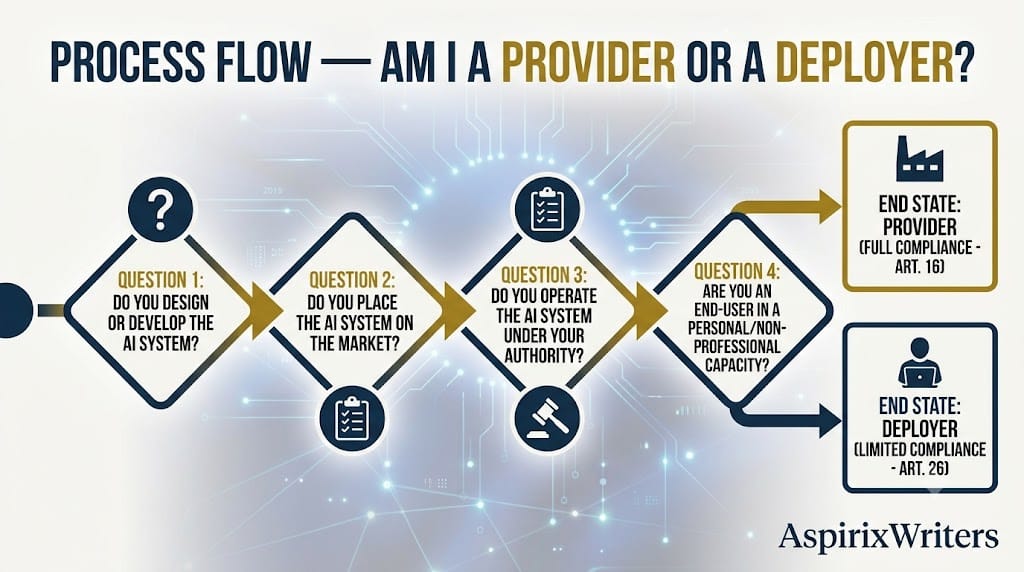
The Regulation assigns different duties to different roles, and most organisations are surprised to learn which role they occupy:
- Providers — anyone who develops an AI system or general-purpose AI (GPAI) model, or has one developed, and places it on the market under their own name (Art. 3(3)).
- Deployers — anyone using an AI system under their own authority in a professional context, even if they bought it off the shelf (Art. 3(4)).
- Importers and distributors — anyone bringing a non-EU AI product into the EU market or making it available within it (Art. 23–24).
- Product manufacturers — companies embedding AI as a safety component inside a regulated product, such as a medical device or a machine (Art. 25(3)).
- Affected persons — the employees, customers, or citizens whose lives are shaped by an AI system’s output, and who now hold a right to an explanation of certain decisions (Art. 86).
A single company frequently holds more than one of these roles. A business that fine-tunes a vendor’s AI model and changes its intended purpose can convert itself from a deployer into a provider overnight, taking on the full provider obligation set under Article 25(1).
What Happens If You Ignore It
Non-compliance is not a paperwork problem — it is a market-access problem. An AI system that fails to meet its obligations can be withdrawn from the EU market by national authorities under the corrective-action powers in the Regulation, in addition to the administrative fines described above. For a scaling startup, a market withdrawal during a funding round or an enterprise sales cycle can be more damaging than the fine itself.
What the Law Actually Requires: The Risk-Based Structure
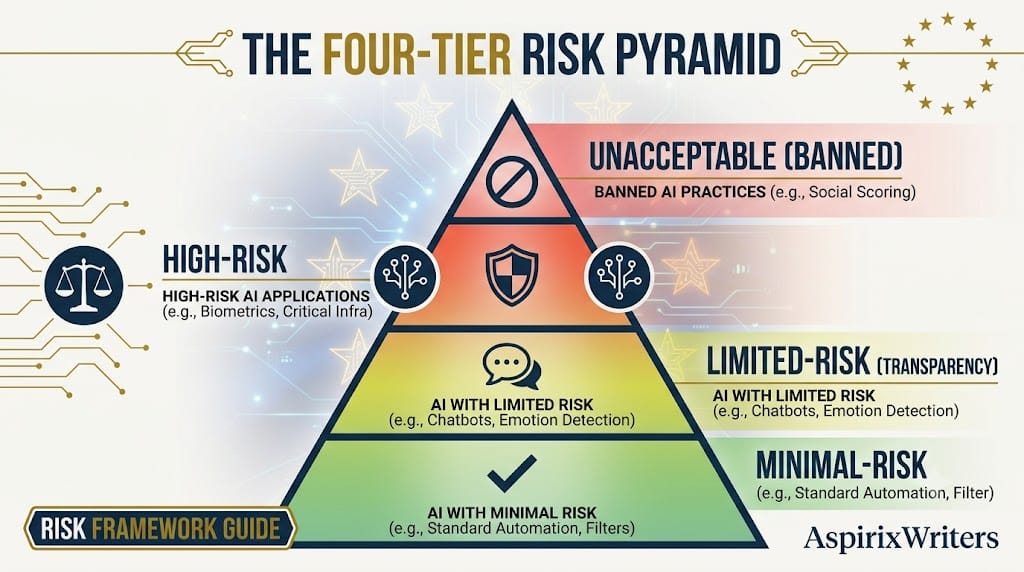
The single most important idea in the entire Regulation is this: the AI Act does not regulate “AI.” It regulates AI systems according to the risk they pose to people. Every obligation in the Regulation flows from where a system lands on a four-tier pyramid.
| Risk Tier | Regulatory Treatment | Example |
| Unacceptable risk | Banned outright (Art. 5) | Untargeted scraping of facial images to build a recognition database |
| High risk | Full requirement set before and after market entry (Art. 6–49) | AI used in recruitment, credit scoring, or as a safety component of a medical device |
| Limited risk | Transparency obligations only (Art. 50) | A customer-service chatbot, or a synthetic-voice generator |
| Minimal risk | No mandatory obligations; voluntary codes encouraged (Art. 95) | An AI-powered spam filter or a video game non-player character engine |
Prohibited Practices: The Absolute Red Lines
Article 5 bans eight categories of AI practice outright, including systems that manipulate people below their conscious awareness, exploit the vulnerabilities of children or people in financial distress, run social-scoring schemes, scrape the internet to build facial recognition databases, or infer emotions in the workplace or classroom (European Parliament and Council of the European Union, 2024, Art. 5). These prohibitions became applicable on 2 February 2025 and carry the Regulation’s highest fine tier.
High-Risk AI: Where Most Compliance Work Happens
A system becomes high-risk through one of two routes under Article 6: either it is a safety component of a product already regulated under EU product-safety law (medical devices, machinery, lifts), or it falls within a listed use case in Annex III — such as employment, credit scoring, law enforcement, migration, or access to essential public services — and poses a significant risk to health, safety, or fundamental rights.
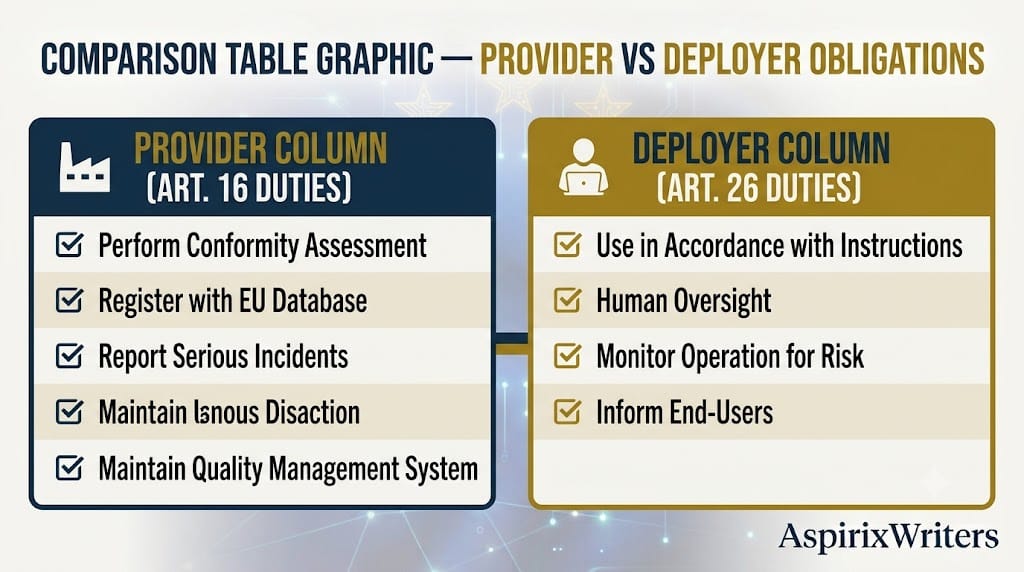
Once a system is high-risk, its provider must build in seven structural requirements before it ever reaches the market:
- Risk management system (Art. 9) — a continuous process to identify and mitigate risk across the system’s life.
- Data governance (Art. 10) — training data must be relevant, representative, and checked for bias.
- Technical documentation (Art. 11) — evidence the system meets every requirement.
- Record-keeping (Art. 12) — automatic logging for traceability.
- Transparency for deployers (Art. 13) — clear instructions on capability and limitations.
- Human oversight (Art. 14) — a real, effective ability for a person to intervene or halt the system.
- Accuracy, robustness & cybersecurity (Art. 15).
Deployers of a high-risk system carry a separate, parallel duty set under Article 26: using the system as instructed, assigning trained personnel to oversee it, monitoring its operation, and keeping logs for at least six months.
General-Purpose AI Models: A Separate Regime
Foundation models — the large language and multimodal models that power downstream products — are governed by their own chapter (Chapter V), independent of the high-risk framework. Every GPAI provider must maintain technical documentation, share integration information with downstream developers, publish a summary of training content, and maintain a copyright compliance policy (Art. 53). Models whose training compute exceeds 10^25 floating point operations are presumed to carry “systemic risk,” triggering additional obligations: adversarial testing, systemic risk mitigation, incident reporting to the AI Office, and enhanced cybersecurity (Art. 51, 55).
Transparency: The Rule Almost Everyone Forgets
Article 50 applies regardless of risk tier. If your AI system talks to people, it must make clear they are talking to a machine. If it generates synthetic audio, image, video, or text, that output must be machine-detectable as AI-generated. If it produces a “deepfake,” the deployer must disclose that the content is artificially created. This is frequently the very first AI Act obligation a business encounters, because chatbots and content generators are common yet rarely classified as high-risk.
AspirixWriters Insight
Successful AI governance begins with classifying systems before writing policies. Most compliance failures occur because organisations try to document AI after deployment instead of designing governance from the start.
AspirixWriters Framework: The Four-Question Risk Screen
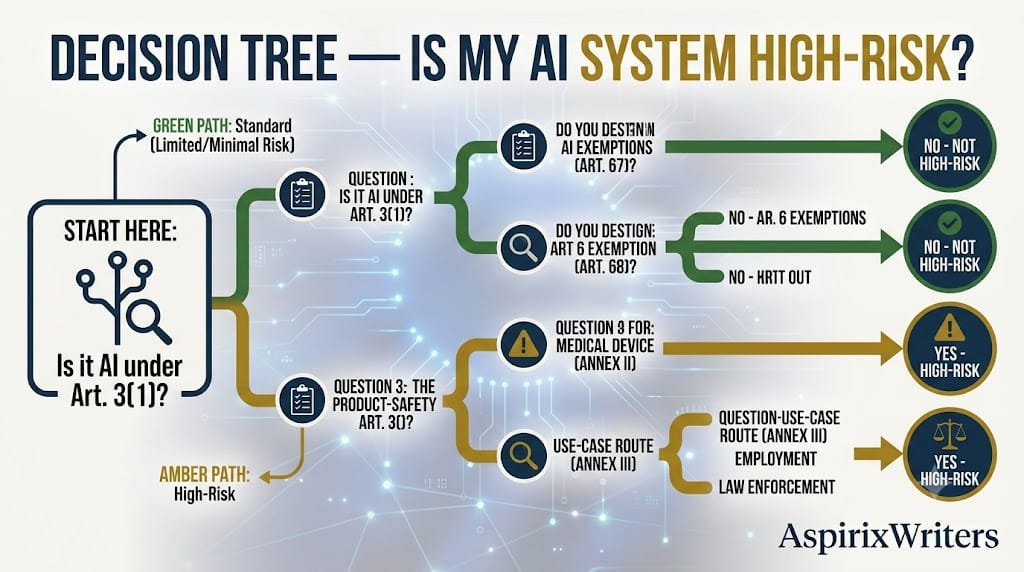
Before classifying any AI system your organisation builds or uses, ask these four questions in order:
- Is it covered by existing EU product-safety law (medical devices, machinery, toys, lifts)? If yes, it is very likely high-risk via the product-safety route.
- Does it fall within an Annex III use case — employment, credit, law enforcement, essential services, migration, education, or the administration of justice?
- Does it materially influence an outcome for a real person — a hiring decision, a loan, a medical triage, an eligibility determination?
- Does the narrow-task exception in Article 6(3) genuinely apply, or is that a convenient assumption your team hasn’t stress-tested? (This exception covers systems performing purely preparatory, procedural, or pattern-detection tasks that don’t replace human judgement.)
A “no” to questions 1 and 2 generally places a system in limited or minimal risk. A “yes” to either, combined with a “yes” to question 3, points toward high-risk — and toward the full compliance programme described above.
How to Check Is Your AI System High-Risk Under the EU AI Act (2026)
Step-by-Step Implementation
- Inventory every AI system your organisation builds, buys, or uses — including AI embedded inside third-party software you didn’t realise had a model in it.
- Map your role for each system: provider, deployer, importer, distributor, or authorised representative.
- Classify risk using the Four-Question Screen above.
- Run a gap analysis against Articles 9–15 (providers) or Article 26 (deployers) for anything high-risk.
- Build the documentation trail: technical file, logs, quality management processes.
- Design human oversight with named, trained people who have real authority to intervene.
- Add the transparency layer — Article 50 disclosures — to any system that talks to people or generates synthetic content, regardless of risk tier.
- Set a governance cadence so classifications and documentation stay current as systems change.
- Write an incident response plan for detecting and reporting serious incidents.
- Track your deadlines against the staggered timeline below — a mismatched date is one of the most common public errors in AI Act commentary.
Implementation Timeline
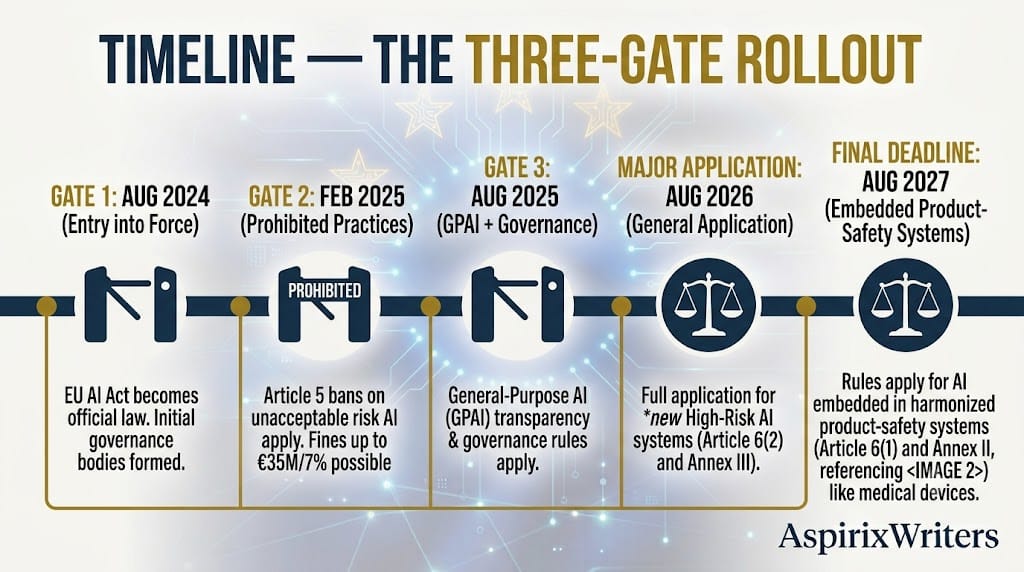
| Date | What Becomes Applicable |
| 1 August 2024 | Regulation enters into force |
| 2 February 2025 | General provisions and prohibited practices (Art. 5) apply |
| 2 August 2025 | GPAI obligations, governance structure, and penalty rules apply |
| 2 August 2026 | General application, including most high-risk (Annex III) and transparency obligations |
| 2 August 2027 | High-risk obligations for AI embedded in already-regulated products (the Annex I route) |
Business Examples
Recruitment screening tool. A staffing agency uses vendor software that ranks CVs with machine learning. Employment is an Annex III use case, so the tool is very likely high-risk. The vendor carries provider duties; the agency carries deployer duties, including human review before any candidate is rejected on the tool’s recommendation alone.
Customer service chatbot. An online retailer’s chatbot isn’t high-risk, but Article 50(1) still requires customers to be told they’re speaking with an AI system, unless that’s already obvious.
Medical imaging AI. Software flagging anomalies in X-rays, marketed as a Class IIa medical device, is automatically high-risk under the product-safety route (Art. 6(1)) — independent of whether it also appears in Annex III.
General-purpose language model. A foundation model exceeding 10^25 FLOPs in training compute is presumed to carry systemic risk, triggering adversarial testing and incident reporting duties on top of baseline GPAI obligations.
Does the EU AI Act Apply to Indian Companies? A Complete Compliance Guide (2026)
Common Mistakes to Avoid
- Treating the AI Act as a one-time audit instead of a continuous risk-management obligation.
- Assuming “we just use a vendor’s tool” removes all deployer duties — it does not (Art. 26).
- Classifying by technology label (“it’s just a chatbot”) instead of by function and context of use.
- Skipping transparency obligations because a system isn’t high-risk.
- Confusing GDPR compliance with AI Act compliance — the two regimes overlap but are legally distinct.
- Citing “the AI Act deadline” as one single date, when the Regulation actually phases in across three separate gates.
Checklist: Is Your Organisation Ready?
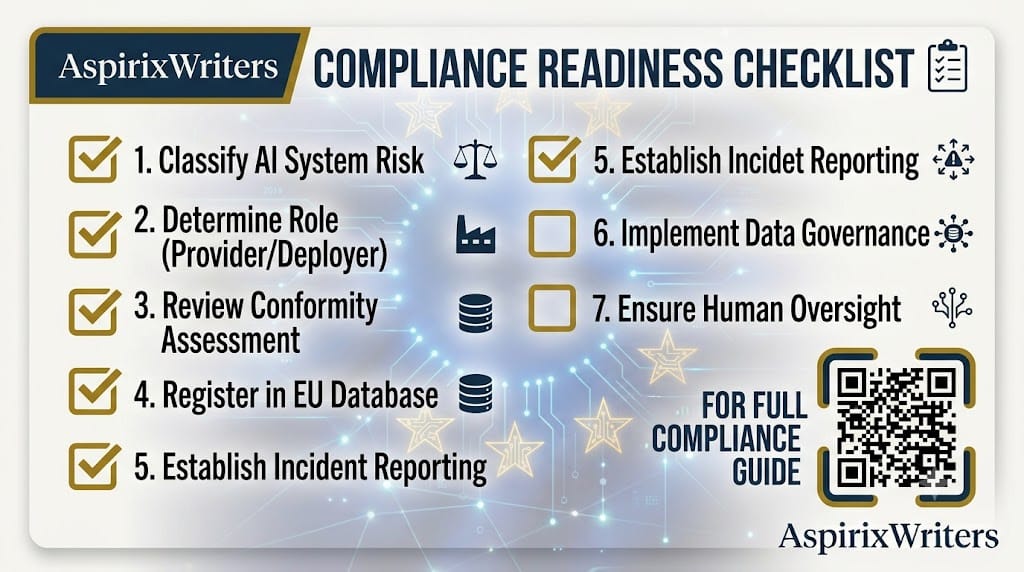
- [ ] AI system inventory maintained and current
- [ ] Role identified for each system (provider / deployer / importer / distributor)
- [ ] Risk tier assigned using a documented methodology
- [ ] Technical documentation and logging in place for high-risk systems
- [ ] Human oversight assigned to named, trained personnel
- [ ] Article 50 transparency disclosures implemented site-wide
- [ ] Incident reporting process defined
- [ ] Deadlines mapped against your specific systems’ applicable dates
Key Takeaways
- The EU AI Act regulates AI by risk tier, not by technology type — classification is the foundation of every other obligation.
- It applies extraterritorially: EU establishment is not required for the law to reach you.
- Providers and deployers carry separate, parallel obligation sets — know which one you are for every system you touch.
- Transparency duties apply broadly, even to systems that are not high-risk.
- The rollout is staggered across three gates, from February 2025 through August 2027.
- Fines scale with global turnover, making early classification cheaper than late remediation.
Conclusion
The EU AI Act rewards organisations that treat AI governance as infrastructure, not paperwork. The businesses that will move fastest through 2026 and 2027 are the ones that classify their systems now, build documentation as a by-product of normal development, and design human oversight into the product rather than bolting it on afterward. The founder in our opening scenario didn’t fail because her hiring tool was unsafe — she failed because classification came last, instead of first.
Frequently Asked Questions
Does the AI Act apply to companies outside the EU?
Yes — wherever the output of the AI system is used within the Union, regardless of where the provider or deployer is established (Art. 2(1)).
Is a tool like ChatGPT automatically high-risk?
No. General-purpose AI models are governed by their own chapter (Chapter V), separate from the high-risk regime, unless integrated into a system that itself meets the Article 6 criteria.
What’s the difference between a provider and a deployer?
A provider develops and places an AI system on the market under its own name (Art. 3(3)); a deployer uses an existing system under its own authority without having developed it (Art. 3(4)).
Can open-source AI ignore the Regulation?
No. Certain documentation duties are relaxed for genuinely open, freely licensed models, but prohibited practices, transparency rules, and high-risk requirements still apply in full (Art. 2(12), Art. 53(2)).
What’s the maximum fine?
Up to €35,000,000 or 7% of total worldwide annual turnover, whichever is higher, for breaches of the prohibited practices in Article 5 (Art. 99(3)).
- What Is a “High-Risk AI System” Under the EU AI Act? (Deep dive on Article 6 and Annex III)
- Provider vs Deployer: Who Is Responsible for AI Act Compliance?
- General-Purpose AI Models Explained: Systemic Risk and the 10^25 FLOP Threshold
- EU AI Act Penalties: A Full Breakdown of Fines and Enforcement
- EU AI Act vs GDPR: How the Two Regulations Interact
References
European Parliament and Council of the European Union. (2024). Regulation (EU) 2024/1689 of the European Parliament and of the Council of 13 June 2024 laying down harmonised rules on artificial intelligence (Artificial Intelligence Act). Official Journal of the European Union, L 1689.
Smuha, N. A. (2024). Introductory note to Regulation 2024/1689 of the European Parliament and Council of June 13, 2024 (EU Artificial Intelligence Act). International Legal Materials, 64.
European Commission. (2024). AI Act: Shaping Europe’s digital future [Policy overview and implementation guidance]. Directorate-General for Communications Networks, Content and Technology. European AI Office.
About the Author
Dr. Rekha Khandelwal is the Founder of AspirixWriters, where she writes about AI Governance, AI Regulation, AI Compliance, and emerging technology law. Her work focuses on transforming complex legal and policy developments into practical guidance for startups, businesses, researchers, and professionals. Through AspirixWriters, she aims to build a trusted knowledge platform that helps readers understand global AI governance frameworks, regulatory obligations, and responsible AI practices in a clear and evidence-based manner. Explore more AI Governance guides, compliance resources, and practical toolkits at AspirixWriters.
This article is an AspirixWriters editorial product, prepared for general informational purposes. It is not legal advice. Always verify specific obligations against the official Regulation before making compliance decisions.