
What to Do If Your Fundamental Rights Are Violated in India
If a government official has denied you something you were legally entitled to, if the police have detained you without following procedure, or if a public authority has simply refused to act — you may be dealing with a Fundamental Rights violation. The good news is that the Constitution of India doesn’t just promise you rights; it builds in a direct, enforceable way to get them back.
This guide walks through exactly where to go, what to file, what it costs, and what mistakes commonly get petitions thrown out.
1. Why This Right Exists: Article 32, “The Heart and Soul” of the Constitution
Fundamental Rights would mean very little if there were no way to enforce them. That is the specific problem solved by the right to move the Supreme Court for enforcement of Fundamental Rights, including through writs (Article 32, Constitution of India). Dr. B.R. Ambedkar, one of the principal architects of the Constitution, is widely credited with calling this the most important article in the entire document — the provision without which the rest of the Constitution would be unenforceable.
A few things make this right unusually powerful:
- Article 32 is itself a Fundamental Right. The jurisdiction it creates is mandatory, not discretionary, in the sense that the Constitution guarantees you the right to move the Supreme Court for enforcement of Part III rights — the Court cannot say this right doesn’t exist (Article 32, Constitution of India). In practice, though, the Supreme Court often exercises its discretion to direct a petitioner to first approach the High Court under Article 226 where that route is more appropriate or convenient — so “mandatory jurisdiction” means the right to petition is guaranteed, not that the Supreme Court must always be the one to hear the merits first.
- It can’t be watered down. The Supreme Court has held this right to be part of the “basic structure” of the Constitution, meaning it cannot be removed or diluted even through a constitutional amendment (Kesavananda Bharati v. State of Kerala).
- It can only be paused in a genuine national emergency. The right to move the Supreme Court may be suspended only as the Constitution itself permits, primarily during a National Emergency (Article 32(4) read with Article 359, Constitution of India).
2. Supreme Court or High Court? Article 32 vs. Article 226
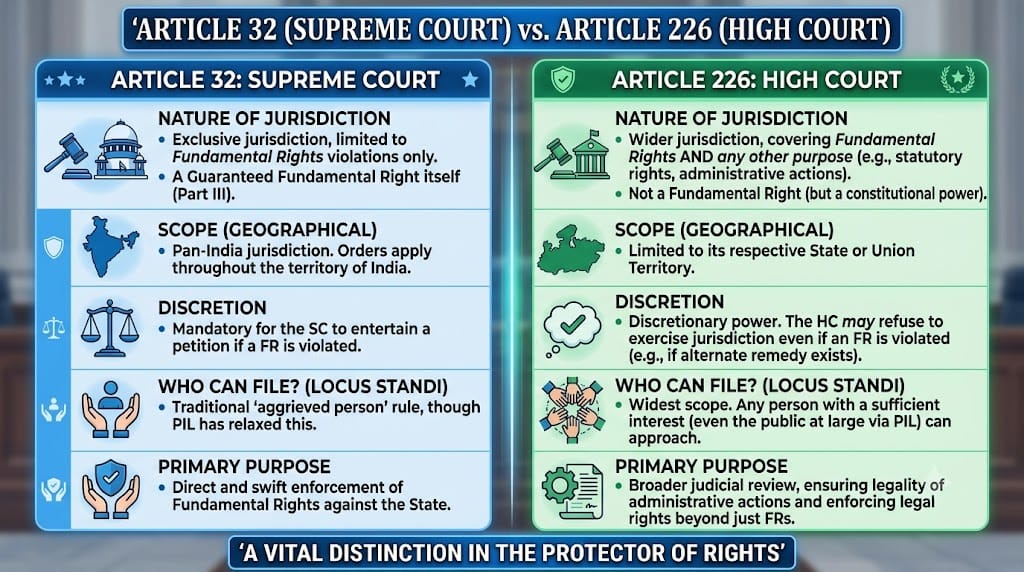
You actually have two doors, not one — and knowing which to knock on saves you time and money.
| Article 32 (Supreme Court) | Article 226 (High Court) | |
| Who can you approach | Supreme Court of India, directly | The High Court of your state |
| What it covers | Only Fundamental Rights (Part III) | Fundamental Rights and any other legal right or public duty |
| Jurisdiction | All-India | Limited to the High Court’s territory, with some exceptions for cause of action (Article 226(2), Constitution of India) |
| Nature of the power | A Fundamental Right in itself — mandatory | A discretionary constitutional power the Court may decline to exercise |
The practical difference matters. Article 226 lets a High Court intervene even where no Fundamental Right is obviously breached, so long as a public authority has failed a legal duty — this “any other purpose” clause is why the majority of writ petitions in India, covering service disputes, tax matters, tenders, land acquisition, and licensing, are filed under Article 226 rather than Article 32 (Article 226(1), Constitution of India).
In short: if your issue is squarely a Fundamental Rights violation and you want India’s highest constitutional forum, Article 32 is built for you — though note that High Courts are often faster in practice, simply because they carry a lighter docket than the Supreme Court. If it’s a mixed grievance against a public authority — even without a clean Fundamental Rights angle — Article 226 usually gives you more room.
One structural point worth knowing: Article 32(3) allows Parliament, by law, to empower “any other court to exercise within the local limits of its jurisdiction all or any of the powers exercisable by the Supreme Court” under Article 32(2) — but this power explicitly cannot be extended to the High Courts, since Article 226 already gives them independent writ jurisdiction. In practice, this clause is rarely invoked, since High Courts already have their own robust writ powers under Article 226. The High Court’s writ power is additionally expressed as being without prejudice to the Supreme Court’s own power under Article 32(2) (Article 226(4), Constitution of India).
3. The Five Writs — What Each One Actually Does
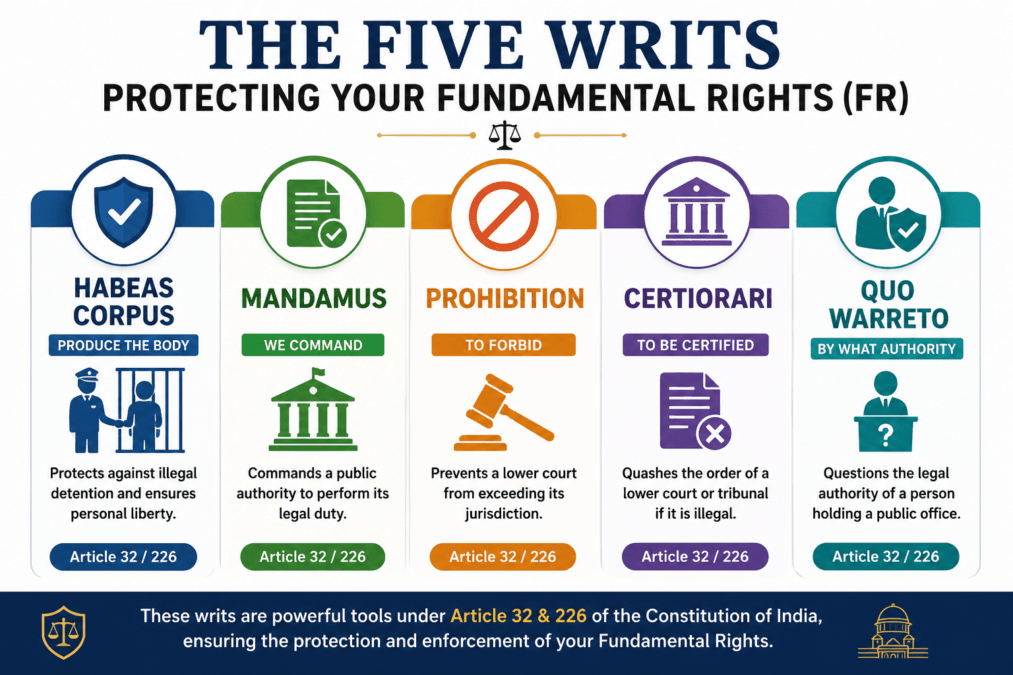
“Writ petition” is often used as a catch-all term, but a writ petition actually asks the court to issue one of five specific instruments recognised under Articles 32 and 226 (Articles 32(2) and 226(1), Constitution of India). Knowing which one fits your situation shapes how the petition should be drafted.
| Writ | Meaning | Used When |
| Habeas Corpus | “You may have the body” | Available in cases of unlawful detention or violation of personal liberty — the court orders the detained person to be produced and examines whether the detention has legal justification (Article 32(2) / Article 226(1), Constitution of India). |
| Mandamus | “We command” | A command issued by the court to a public official directing them to perform an official duty they have failed or refused to perform (Article 32(2) / Article 226(1), Constitution of India). |
| Prohibition | Stop before it happens | Issued by a higher court to a lower court or tribunal to stop it from exceeding its jurisdiction — it directs inactivity, unlike mandamus, which directs action (Article 32(2) / Article 226(1), Constitution of India). |
| Certiorari | Quash after it happens | Issued to transfer a case to itself or to quash an order already passed by a lower court or tribunal, typically for excess or lack of jurisdiction (Article 32(2) / Article 226(1), Constitution of India). |
| Quo Warranto | “By what authority?” | Used to inquire into the legality of a person’s claim to hold a public office, preventing unauthorised persons from occupying public positions (Article 32(2) / Article 226(1), Constitution of India). |
Standing (who is allowed to file) varies by writ. Habeas corpus and quo warranto are the most open — almost anyone can file these in the public interest or on behalf of a detained person — while mandamus generally requires the petitioner to show a personal legal right to the duty being demanded, and certiorari or prohibition generally require the petitioner to show they were a party affected by the lower body’s proceedings. For mandamus specifically, courts generally expect the petitioner to show that the authority had a real opportunity to perform its duty but failed or refused to do so — this doesn’t always require a single formal written demand, but going to court without giving the authority any chance to act first weakens the petition considerably.
4. Step-by-Step: How to Actually Approach the Court
Step 1 — Confirm it’s genuinely a rights violation. Article 32 is reserved specifically for Part III Fundamental Rights violations (Article 32(1), Constitution of India). If your issue is a private contractual dispute or doesn’t involve a public authority at all, a writ petition is usually the wrong tool — ordinary civil litigation is.
Step 2 — Gather your evidence. Documentation of the violation (orders, notices, correspondence, ID proof, and — where relevant — dates and witnesses) matters far more than eloquence. Courts move quickly when the paper trail is clean.
Step 3 — Decide: Supreme Court or High Court. Use the comparison in Section 2. When in doubt, most lawyers recommend starting at the High Court under Article 226 — it’s faster to access, and an unsatisfactory outcome can still be appealed upward.
Step 4 — Engage a lawyer, or file in person. You are not required to have a lawyer for a writ petition. The Supreme Court Rules, 2013 (framed under Article 145 of the Constitution) expressly provide for party-in-person filings, and the Supreme Court Registry accepts such petitions through its filing counter, consistent with the “appropriate proceedings” language of Article 32(1) itself. That said, for anything beyond the simplest matter, professional drafting materially improves your odds, because the petition must correctly frame the constitutional provision, the facts, and the relief sought.
Step 5 — Pay the court fee (or apply for a fee waiver). Court fees for writ petitions vary depending on which court you approach and the applicable court-fee rules in that state — the Supreme Court, each High Court, and each state charge differently, so don’t assume a single “standard” figure. A fee waiver is available for petitioners who cannot afford it. If your income falls within the applicable limit, you likely also qualify for free legal representation (see Section 12) under the Legal Services Authorities Act, 1987.
Step 6 — File and track the case. Filing is done at the relevant court’s registry. Case status can subsequently be tracked online through the eCourts Services Portal, which covers District Court, High Court, and case-status information nationwide.
Step 7 — Attend hearings and respond to court directions. Writ proceedings tend to move faster than regular civil suits, especially where personal liberty (habeas corpus) is involved, but expect the court to call for further affidavits or documents as the matter proceeds.
5. When It’s Bigger Than You: Public Interest Litigation (PIL)
Sometimes a rights violation isn’t just personal — it affects a whole community: unsafe working conditions, environmental harm, or denial of a public service to a class of people. This is what Public Interest Litigation exists for.
A PIL is simply a writ petition filed in the High Court (Article 226, Constitution of India) or the Supreme Court (Article 32, Constitution of India) for the public good rather than a personal grievance. A major change came with the Supreme Court’s decision in S.P. Gupta v. Union of India (1981). Before this case, only the person whose rights were affected could approach the court. The Supreme Court made justice more accessible by allowing any public-spirited person or organization, acting honestly and in the public interest, to file a writ petition on behalf of people who cannot approach the court themselves because of poverty, disability, or other disadvantages. This decision laid the foundation for Public Interest Litigation (PIL) in India.
Courts, however, are careful to prevent misuse of PILs. The Supreme Court has issued guidelines to ensure that Public Interest Litigations are filed only for genuine public causes and not for private, political, or publicity-driven motives. Courts regularly dismiss PILs that are actually personal grievances in disguise, and in some cases, they may impose costs on those who file frivolous or misleading petitions (State of Uttaranchal v. Balwant Singh Chaufal, 2010). Some High Courts also have their own Public Interest Litigation Rules, so it is advisable to check the rules of the relevant High Court before filing a PIL.
6. What It Costs — and Free Legal Aid
Money should not be the reason a genuine rights violation goes unaddressed. India’s legal system has a specific mechanism for this.
Eligibility for free legal aid (NALSA): Anyone with an annual income below the limit set by their state government (for cases outside the Supreme Court), or below ₹5 lakh (for cases before the Supreme Court), qualifies for free legal aid — along with categories such as women, children, members of Scheduled Castes and Scheduled Tribes, persons with disabilities, and victims of trafficking or mass disaster, regardless of income (Section 12, Legal Services Authorities Act, 1987).
How to apply: An application can be made in writing on a simple sheet of paper stating your name, address, employment status, income, and the case for which aid is required, submitted physically or by post, or filed online through NALSA’s website, which accepts applications at any time. Oral applications are also accepted, with a paralegal volunteer or officer at the nearest Legal Services Authority assisting in filling out the form (NALSA (Free and Competent Legal Services) Regulations, 2010).
What it covers: Once an applicant meets the Section 12 criteria and the concerned authority is satisfied there is a genuine case, there is no restriction on the type of matter that qualifies for legal aid (Section 13, Legal Services Authorities Act, 1987). Where an application is approved, the applicant is not required to pay at any stage — either during the application process or while being represented by the assigned advocate.
7. Common Mistakes That Get Petitions Dismissed
- Skipping the alternate remedy. Where a statutory appeal or departmental remedy already exists, courts often expect it to be exhausted first before invoking writ jurisdiction, unless the case involves a clear Fundamental Rights breach.
- Treating a private dispute as a “rights violation.” Writ jurisdiction runs against the State and public authorities — and, in limited cases, private entities discharging public functions or duties — but not against private individuals or companies in an ordinary commercial dispute.
- Ignoring delay. Courts apply the Doctrine of Delay and Laches (see FAQ below) — waiting too long to challenge a violation can sink an otherwise valid petition on that ground alone.
- No formal demand before mandamus. As noted in Section 3, mandamus petitions usually need a prior request to the authority that was refused or ignored.
- Dressing up a personal grievance as a PIL. This gets rejected quickly, and in some cases penalised under the Supreme Court’s own guidelines against misuse of PIL.
8. Frequently Asked Questions
Can I file a writ petition without a lawyer?
Yes. Petitioner-in-person filings are allowed in both the High Courts and the Supreme Court, though professional drafting is strongly advisable for anything beyond a simple, clear-cut matter.
Which court should I approach first — High Court or Supreme Court?
For most cases, start with the High Court under Article 226; it’s more accessible, and an adverse order can be appealed further. Reserve a direct Supreme Court filing under Article 32 for matters where the Fundamental Rights violation is clear-cut and urgent, such as unlawful detention.
Is there a time limit to file a writ petition?
The Constitution does not fix a strict limitation period for writ petitions the way ordinary civil suits have one under the Limitation Act, 1963. Instead, courts apply what’s called the Doctrine of Delay and Laches — if you sit on a genuine violation for too long without a reasonable explanation, a court can refuse relief purely on that ground, even if your underlying claim is otherwise valid. There’s no fixed number of days; courts weigh the length of the delay against how reasonable your explanation is. The practical takeaway is the same either way: act as soon as possible.
Can a writ be filed against a private company?
Generally no — writs run primarily against the State and public authorities (Article 12, Constitution of India, defining “the State” for Part III purposes). But this isn’t an absolute rule: courts have extended writ jurisdiction to private bodies that perform public functions or discharge public duties — for example, a private entity running a statutory monopoly, or one substantially funded and controlled by the government. For an ordinary private company in a purely commercial dispute, though, civil or consumer remedies are the right route, not a writ petition.
Do I have to pay court fees to file a PIL?
Court fees for PILs are kept deliberately low, and applicants who genuinely cannot afford them can apply for a fee waiver at the time of filing.
9. Landmark Judgments That Shaped This Right
Article 32 and Article 226 aren’t static text — decades of Supreme Court rulings have shaped how they actually work in practice. A few are worth knowing:
- Romesh Thappar v. State of Madras (1950) — One of the earliest Article 32 cases, decided just months after the Constitution came into force. The Court struck down a state ban on a political journal and confirmed that a petitioner can approach the Supreme Court directly under Article 32, without first going through the High Court. This case also directly led to the First Constitutional Amendment (1951), which expanded the permissible grounds for restricting free speech under Article 19(2).
- Kharak Singh v. State of U.P. (1963) — An early case on police surveillance and domiciliary visits, which first opened the debate on whether the Constitution protects a right to privacy. The majority didn’t recognise privacy as a standalone right at the time, but a powerful dissent by Justice Subba Rao helped lay the groundwork for later recognition.
- Maneka Gandhi v. Union of India (1978) — A foundational case that transformed Article 21 (right to life and personal liberty). It held that any procedure depriving someone of liberty must be fair, just, and reasonable — not merely “procedure established by law” in a technical sense — and read Articles 14, 19, and 21 together as an interconnected “golden triangle” of rights.
- ADM Jabalpur v. Shivkant Shukla (1976) — A now-discredited ruling where the Supreme Court held that the right to move courts for habeas corpus could itself be suspended during a National Emergency. This decision was widely criticised and was later explicitly overruled by the Supreme Court in K.S. Puttaswamy v. Union of India (2017), which held that Article 21 rights are inalienable even during an Emergency.
- Bandhua Mukti Morcha v. Union of India (1984) — A PIL brought on behalf of bonded labourers, decided under Article 32. This case is a good example of the Court’s “epistolary jurisdiction” — treating even a letter alleging a rights violation as a valid petition — and of Article 21 being read to include the right to live with basic human dignity.
- Olga Tellis v. Bombay Municipal Corporation (1985) — Filed on behalf of pavement dwellers facing eviction, this case held that the right to life under Article 21 includes the right to livelihood, since deprivation of livelihood can be as damaging as deprivation of life itself.
- Daryao v. State of U.P. (1961) — Established that if a petitioner’s Article 226 petition is dismissed by a High Court on the merits, the same claim generally cannot be relitigated through a fresh Article 32 petition — an application of the principle of res judicata to writ jurisdiction.
Official References
Primary legal texts:
- Constitution of India — Article 32 (Right to Constitutional Remedies) and Article 226 (Power of High Courts to Issue Certain Writs), via India Code and constitutionofindia.net
- Legal Services Authorities Act, 1987 — Sections 12 and 13, via India Code
- Limitation Act, 1963 (for context on the Doctrine of Delay and Laches as applied to writ petitions)
- Supreme Court Rules, 2013, framed under Article 145 of the Constitution
Government and judicial bodies:
- Supreme Court of India
- Department of Justice, Ministry of Law & Justice — for the broader judicial system and Legal Services Authorities network
- Legislative Department, Ministry of Law & Justice — for tracking constitutional amendments
- National Legal Services Authority (NALSA) — Legal Aid eligibility and application process
- eCourts Services Portal — case filing and status tracking
- How to File a Consumer Complaint in India Step-by-Step Guide (2026)
- How to Classify Your AI System Under the EU AI Act (Guide)
- How to File an RTI
- How Can a Woman Claim Compensation Under Domestic Violence Law
- A dedicated NALSA/free legal aid explainer, if not already planned as its own cluster piece
About the Author
Dr. Rekha Khandelwal is a Ph.D. in Law and a Legal Specialist, Consultant, Researcher, and Author. She provides research-backed legal insights, AI governance guidance, and educational content to help individuals, students, and professionals better understand the law.
Disclaimer
The content on AspirixWriters is provided for educational and informational purposes only and does not constitute legal advice. Some content may be prepared with AI-assisted tools; however, every article is reviewed and approved by Dr. Rekha Khandelwal. For advice on specific legal matters, please consult …..
Need Professional Assistance?
For legal research, legal writing, AI governance, compliance, or consultancy services, you may contact Dr. Rekha Khandelwal through AspirixWriters.
Facing Domestic Violence in India? Here’s How to Get Protection and Claim Compensation
Facing Domestic Violence in India? Legal Specialist, Consultant & Researcher, AspirixWriters If you are in immediate physical danger, please contact the police (112) or…

How to Check If a Property Has a Clear Title Before Buying in India
How to Check If a Property Has a Clear Title Before Buying in India Legal Specialist, Consultant & Researcher, AspirixWriters Buying property without checking…

Got Cheated While Shopping Online? Here’s Exactly What You Can Do (Simple Guide)
— Legal Specialist, Consultant & Researcher, AspirixWriters | Reviewed & Approved Got Cheated While Shopping Online? You ordered something online. Maybe it never arrived….