
Last Updated: August 7, 2026
Facing Domestic Violence in India?
Legal Specialist, Consultant & Researcher, AspirixWriters
If you are in immediate physical danger, please contact the police (112) or a domestic violence helpline before anything else. The information below is for understanding your legal options — it isn’t a substitute for urgent help.
National Commission for Women Helpline: 14490 Women Helpline (All India): 181
The law in India recognises that domestic violence isn’t only physical — and it gives a woman a specific, relatively fast legal route to protection, a place to live, financial support, and compensation, separate from (and in addition to) any criminal case. This guide explains how it works.
How to Check If a Property Has a Clear Title Before Buying in India
1. The Law: Protection of Women from Domestic Violence Act, 2005
The Protection of Women from Domestic Violence Act, 2005 (PWDVA), commonly called the Domestic Violence (DV) Act, was enacted to provide women with a faster and more accessible civil remedy against domestic violence within the family. It operates independently of criminal proceedings, meaning that a woman may also pursue a separate criminal complaint where appropriate.
What counts as “domestic violence” under this law? It’s defined broadly, and includes:
- Physical abuse
- Sexual abuse
- Verbal and emotional abuse
- Economic abuse — for example, being denied money for household needs, or being stopped from working
- Threats of any of the above
Who can you file against? The law is not limited to a husband. A complaint can be filed against any relative in a “domestic relationship” — which can include in-laws and other family members living in the same household. Courts have also clarified that “respondent” under the Act is not restricted to an adult male; remedies can, in appropriate cases, be sought even against a female relative.
Where you were living matters too. The concept of a “shared household” under the Act covers any household where the woman lives, or has lived, in a domestic relationship — whether she owns it, rents it, or it belongs to the respondent’s family. Importantly, this protection can still apply even if she has since been forced out of that household.
Employer Not Paying Your Salary in India? Here’s How to Get It
2. Who Can Help You File — You Don’t Have to Do This Alone
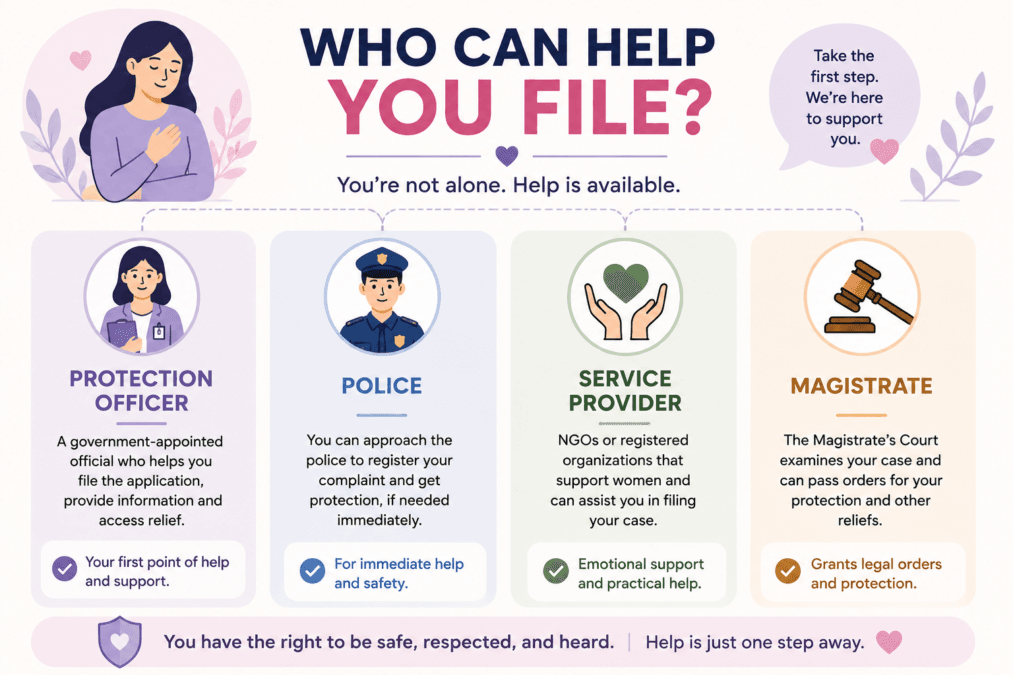
You have several starting points, and you’re free to use whichever feels most accessible:
- A Protection Officer — appointed by the state government specifically to help under this Act. They can assist you in filing the complaint, connect you with medical help, legal aid, counselling, and shelter, and prepare what’s called a “Domestic Incident Report” for the Magistrate.
- The police — if a police officer receives a complaint of domestic violence, or is present when it happens, they are legally required to inform you of your rights under this Act.
- A registered service provider — voluntary organisations registered with the state government that offer legal, medical, or other assistance can also record your complaint and forward it to the Magistrate and Protection Officer on your behalf.
- A Magistrate directly — you (or someone on your behalf) can apply straight to the Magistrate’s court.
You are legally entitled to be informed of all of this — the right to a protection order, monetary relief, a custody order, a residence order, or a compensation order; the availability of Protection Officers and service providers; your right to free legal aid; and your right to also file a criminal complaint — by whichever of the above you approach first.
3. What Relief Can the Magistrate Actually Give You?
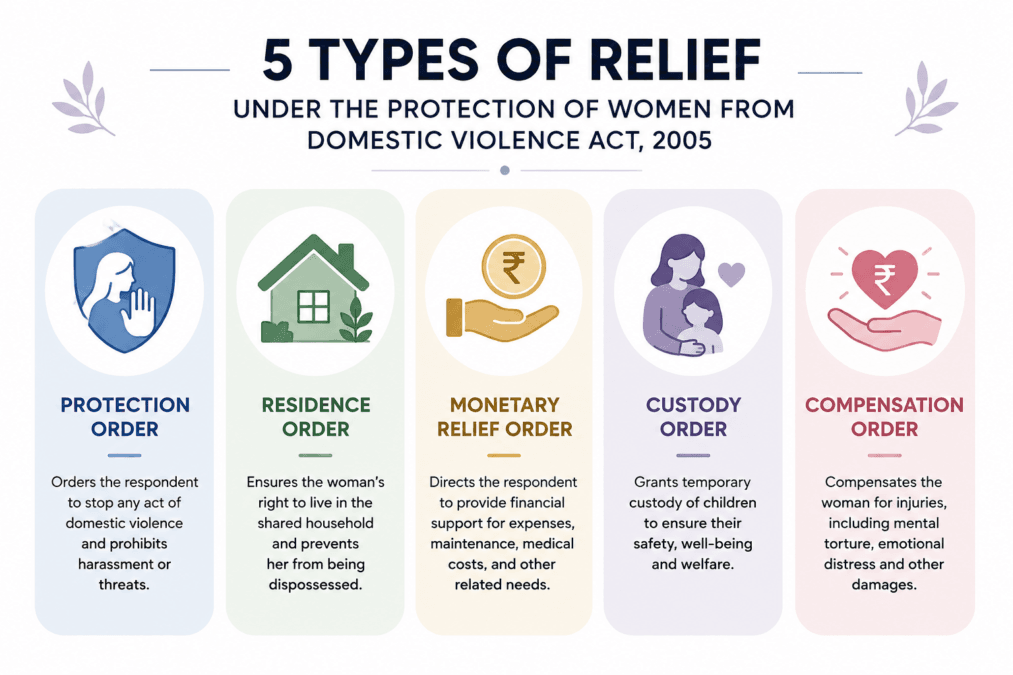
This is the part many women don’t realise: the Act gives a Magistrate the power to grant several different kinds of relief, and you can ask for more than one at the same time.
| Type of order | What it does |
| Protection order | Stops the respondent from committing further acts of violence, contacting you, or aiding others to do so |
| Residence order | Protects your right to stay in the shared household, or arranges alternative accommodation |
| Monetary relief | Covers loss of earnings, medical expenses, property damage, and maintenance for you and your children |
| Custody order | Determines temporary custody of any children involved |
| Compensation order | Under Section 22, specifically compensates you for injury, including mental torture and emotional distress caused |
You can apply for one or several of these together in a single application to the Magistrate — you don’t need to choose just one.
4. Step-by-Step: How to File
Step 1 — Reach out to a Protection Officer, the police, or a service provider (or go directly to a Magistrate, if you prefer). Explain what has happened; you do not need to have already decided exactly what relief you want.
Step 2 — A Domestic Incident Report is prepared. Whoever you approach records the details of the incident and forwards it to the local Magistrate and the Protection Officer.
Step 3 — An application is made to the Magistrate, either by you directly or through the Protection Officer or a person acting on your behalf.
Step 4 — The Magistrate hears the matter and, if satisfied that domestic violence has occurred or is likely to occur, can pass any combination of the orders described above.
Good faith is protected. If you report in good faith, you cannot be held legally liable even if some detail in your report later turns out to be inaccurate.
5. Free Legal Aid — You May Not Need to Pay for a Lawyer
Under the Legal Services Authorities Act, 1987, you have a specific right to free legal services in connection with a domestic violence complaint. This is worth acting on early — a Protection Officer or the local Legal Services Authority can connect you with a free lawyer to help draft and pursue your application.
6. The Separate Criminal Route: Section 85, Bharatiya Nyaya Sanhita (Formerly Section 498A, IPC)
The DV Act’s civil remedies (protection, residence, compensation) are separate from — and can be pursued alongside — a criminal complaint. If you are a married woman facing cruelty from your husband or his relatives, you can also file a criminal complaint.
Important update: This offence was previously known as Section 498A of the Indian Penal Code. Since 1 July 2024, it has been renumbered as Section 85 of the Bharatiya Nyaya Sanhita, 2023 (BNS), following India’s new criminal law codes replacing the IPC. The substance of the law — the definition of cruelty, the punishment (imprisonment up to 3 years, plus fine), and its status as a cognizable, non-bailable offence — has carried over largely unchanged. If you’ve seen older material referring to “498A,” know that it’s the same protection, just under a new section number.
Some states now also require a preliminary screening by a Family Welfare Committee before an arrest is made under this provision, following Supreme Court guidance aimed at preventing premature arrests while still preserving the protection itself — this procedural detail can vary, so it’s worth confirming current practice with a lawyer or your local Legal Services Authority.
explore more
- Money Stolen Online? Here’s Exactly How to Report Cyber Fraud in India (Step by Step)
- Got Cheated While Shopping Online? Here’s Exactly What You Can Do (Simple Guide)
7. Frequently Asked Questions
Do I have to file the criminal complaint and the DV Act application together?
No. They’re separate legal routes. Many women pursue only the DV Act’s civil remedies (protection, residence, compensation) without filing a criminal complaint, and vice versa — though you’re free to pursue both if your situation calls for it.
Can I get a residence order even if the house isn’t in my name?
Yes. The Act’s protection covers the “shared household” concept regardless of whose name the property is legally in — including situations where you’ve already been forced to leave.
Is there a cost to file under this Act?
The process itself doesn’t require the kind of court fees associated with a full civil suit, and you’re separately entitled to free legal aid if you qualify — reach out to a Protection Officer or your District Legal Services Authority to access this.
What if I don’t want to involve the police?
You can go directly to a Protection Officer, a registered service provider, or a Magistrate — involving the police isn’t a mandatory first step for a DV Act application.
Can male family members other than the husband be named in the complaint?
Yes — the Act covers any respondent in a domestic relationship with you, which can include in-laws and other relatives sharing the household, not just the husband.
About the Author
Dr. Rekha Khandelwal is a Legal Specialist, Consultant, Researcher, and Author. She provides research-backed legal insights, AI governance guidance, and educational content to help individuals, students, and professionals better understand the law.
Disclaimer
The content on AspirixWriters is provided for educational and informational purposes only and does not constitute legal advice. For advice on specific legal matters, please consult ………
Need Professional Assistance?
For legal research, legal writing, AI governance, compliance, or consultancy services, you may contact Dr. Rekha Khandelwal through AspirixWriters.
Official References
- Protection of Women from Domestic Violence Act, 2005, via India Code
- Bharatiya Nyaya Sanhita, 2023 — Section 85 (formerly Section 498A, Indian Penal Code, 1860)
- Legal Services Authorities Act, 1987 — right to free legal aid
- National Legal Services Authority (NALSA) — for free legal aid eligibility and application
- Women Helpline (All India): 181
Facing Domestic Violence in India? Here’s How to Get Protection and Claim Compensation
Facing Domestic Violence in India? Legal Specialist, Consultant & Researcher, AspirixWriters If you are in…

How to Check If a Property Has a Clear Title Before Buying in India
How to Check If a Property Has a Clear Title Before Buying in India Legal…

Got Cheated While Shopping Online? Here’s Exactly What You Can Do (Simple Guide)
— Legal Specialist, Consultant & Researcher, AspirixWriters | Reviewed & Approved Got Cheated While Shopping…