
Salient Features of the Indian Constitution
Subject: Constitutional Law | Module: Constitutional Foundations |
1. Introduction
Before studying individual Articles, every LL.B. student needs a bird’s-eye view of what kind of constitutional document India adopted. This note surveys the defining characteristics of the Constitution of India — its length, its blend of rigidity and flexibility, its federal structure with a unitary tilt, and the institutional guarantees (Fundamental Rights, independent judiciary, single citizenship, and more) that together shape Indian constitutionalism. Several of these “salient features” — federalism, secularism, judicial review, and the parliamentary system — later became foundational to the Basic Structure Doctrine, so a firm grasp of this topic supports almost every later module in Constitutional Law.
2. Meaning
“Salient features” refers to the distinctive structural and philosophical characteristics that mark out the Constitution of India from other constitutions of the world — some borrowed and adapted (see the Introduction to the Constitution note), others uniquely Indian in application.
3. Legal and Statutory Framework
There is no single Article titled “Salient Features” — this is an academic organising topic drawn from the Constitution as a whole. Relevant anchoring provisions include: the Preamble; Article 1 (Union of States); Articles 12–35 (Fundamental Rights); Part IV (Directive Principles, Articles 36–51); Part IVA (Fundamental Duties, Article 51A); Part XI–XII (distribution of powers); Article 124 and Article 214 (independent judiciary); Article 368 (amendment procedure); Part XVIII (Emergency provisions).
4. Essential Features
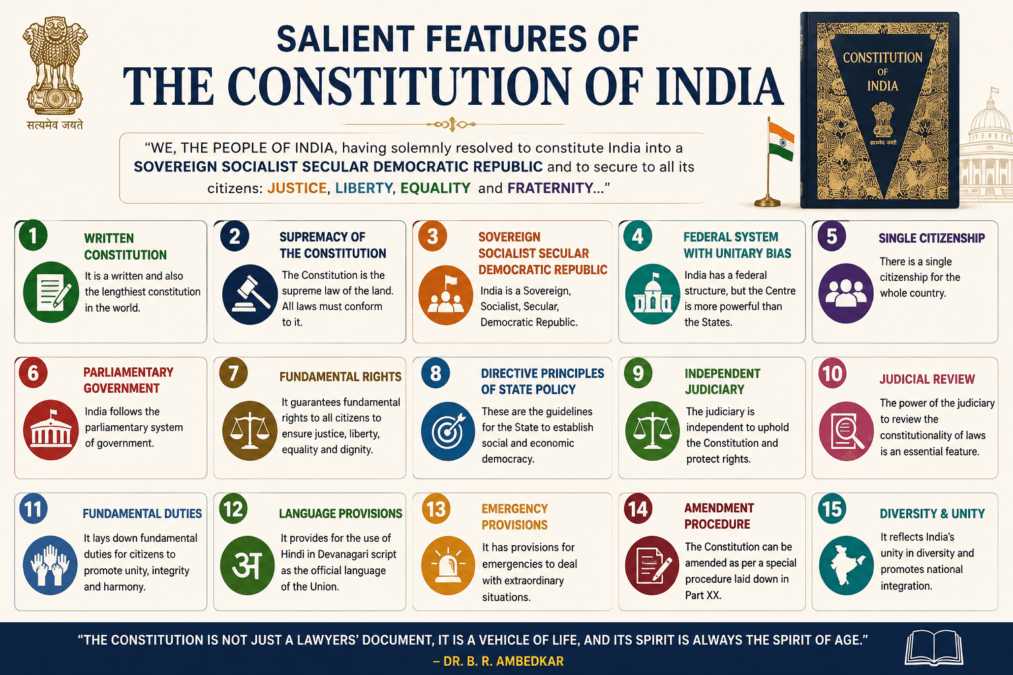
4.1 Lengthiest Written Constitution in the World
The Constitution of India, as originally adopted (26 January 1950), contained 395 Articles, 22 Parts, and 8 Schedules.
The official text of the Constitution, as published by the Legislative Department, Ministry of Law and Justice (The Constitution of India, as on 1st May 2024, incorporating amendments up to the Constitution (One Hundred and Sixth Amendment) Act, 2023), still runs its Article numbering from Article 1 to Article 395 — the same range as at commencement. New provisions have been accommodated without renumbering the existing text, by inserting alphabetic suffixes onto the nearest existing Article number (for example, Article 21A — Right to Education, inserted by the 86th Amendment, 2002
The Constitution of India originally contained 395 Articles at the time of its commencement on 26 January 1950. Through subsequent constitutional amendments, numerous new Articles have been inserted. Today, the Constitution is commonly stated to contain 448 Articles when the inserted lettered provisions (such as Articles 21A, 243A and 371H) are counted separately.
Either way, no country has a longer written constitution than India’s — compare this to the US Constitution, which has just 7 Articles.
4.2 Blend of Rigidity and Flexibility
Some parts of the Constitution are easy to change; others are hard. Article 368 sets up three levels of difficulty:
- Ordinary law, simple majority (outside Article 368): A few matters — like creating a new State — can be changed by an ordinary law, passed the same way as any other law in Parliament. Example: When Telangana was carved out of Andhra Pradesh in 2014, Parliament didn’t need to go through the special Article 368 procedure at all — an ordinary Act (under Article 3) did the job.
- Special majority (under Article 368): Most of the Constitution needs a special majority — two-thirds of members present and voting, and a majority of the total membership, in each House. Example: Adding a new Fundamental Right generally needs this level of approval.
- Special majority plus State ratification (under Article 368): Anything touching the federal structure — like how the Supreme Court is constituted, or how legislative power is divided — additionally needs approval from at least half the State Legislatures, because it affects the States directly and they get a say.
This graded scheme is why the Constitution isn’t like the almost-impossible-to-amend US Constitution, nor as easily changeable as an ordinary British Act of Parliament — it’s a deliberate middle path.
4.3 Quasi-Federal Structure (Federal in Form, Unitary in Spirit)
In a genuinely federal country like the USA, the States and the Centre are more like equal partners — each has its own constitution, its own courts, sometimes even separate citizenship. The Constitution of India distributes powers between the Union and the States through three lists in the Seventh Schedule (Union, State and Concurrent Lists), and each level has its own executive, legislature and (largely) judiciary jurisdiction on its subjects. However, several features tilt the balance toward the Centre:
- One judiciary Single, integrated judiciary rather than separate federal/state court systems.
- One citizenship — Single citizenship (no separate State citizenship).
- Parliament’s residuary power (Article 248) — Parliament additionally holds the residuary power to legislate on any matter not enumerated in any of the three Lists
- Emergency powers Emergency provisions (Articles 352, 356, 360) allow the Centre to override State autonomy.
- Governor as a Centre-appointed link at the State level.
Because of this mix, Indian federalism is often described as “quasi-federal” or “federal in form, unitary in spirit.” In S.R. Bommai v. Union of India (1994), a 9-judge bench of the Supreme Court held that federalism and secularism are Basic Structure features, and placed important judicially enforceable checks on the Centre’s use of Article 356 (President’s Rule) to dismiss State governments. the government’s majority now has to be tested on the floor of the Assembly, not just decided by the Governor’s opinion.
4.4 Parliamentary Form of Government
India follows the Parliamentary (Westminster) system, borrowed from the UK — not the Presidential system used in the USA.
- The President (Union) / Governor (State) is the nominal/constitutional head of the executive.
- Real executive power lies with the Council of Ministers, headed by the Prime Minister/Chief Minister, which is collectively responsible to the elected legislature (Lok Sabha/Legislative Assembly).
- The executive is drawn from, and accountable to, the legislature — a defining feature distinguishing it from the separation-of-executive-and-legislature model in the USA.
4.5 Fundamental Rights (Part III)
These are justiciable rights — meaning if the government violates one, a citizen doesn’t just have a complaint; they have a court remedy. Article 32 guarantees the right to move the Supreme Court directly for enforcement of Fundamental Rights (Dr. Ambedkar called this the “heart and soul” of the Constitution). Article 226 empowers High Courts to issue similar writs — and their power is actually a bit wider, since it covers “any other purpose” too, not just Fundamental Rights, meaning you can approach a High Court even for some non-Fundamental-Right legal wrongs. Fundamental Rights are not absolute — most are subject to reasonable restrictions specified within the Articles themselves.
4.6 Directive Principles of State Policy (Part IV)
These are non-justiciable — you cannot drag the government to court for not following them — but Article 37 declares them “fundamental in the governance of the country,” meaning the State is expected to apply them when making laws and policies.
Example: Article 39A directs the State to provide free legal aid so that justice isn’t denied to anyone due to poverty — you can’t sue the government for insufficient legal aid, but this principle has shaped actual legislation like the Legal Services Authorities Act, 1987.
4.7 Fundamental Duties (Part IVA, Article 51A)
Added by the 42nd Amendment, 1976, on the recommendation of the Swaran Singh Committee (originally 10 duties — things like respecting the Constitution and protecting the environment; an 11th was added by the 86th Amendment, 2002 — the duty of parents/guardians to provide educational opportunities to their children).
4.8 Independent and Integrated Judiciary
Unlike some federations with separate federal and state court systems, India has one single, integrated judiciary — Supreme Court at the top, High Courts below, then subordinate courts — and this one system applies both Union and State law.
Judges of the Supreme Court and High Courts are appointed through the collegium system — a practice evolved through the Second and Third Judges Cases, where senior judges themselves recommend who should be appointed, rather than the executive deciding alone. Parliament tried to change this by creating the NJAC (National Judicial Appointments Commission, inserted as Article 124A by the 99th Amendment, 2014), which would have given the executive a direct say in appointing judges. But in Supreme Court Advocates-on-Record Association v. Union of India (2015), the Supreme Court struck down the NJAC and Article 124A as unconstitutional, holding that it threatened judicial independence — a Basic Structure feature. So the collegium system, not the NJAC, is still how judges are appointed today.
4.9 Secularism
The word “Secular” was inserted into the Preamble only by the 42nd Amendment, 1976, but the underlying content was present from 1950 — Article 15 prohibits the State from discriminating on grounds of religion, and Articles 25–28 guarantee every person the freedom to practise, profess, and propagate their own religion. S.R. Bommai confirmed secularism as a Basic Structure feature — meaning even Parliament, using its full amending power, cannot turn India into a State that favours one religion over others.
4.10 Universal Adult Franchise
Article 326 gives every citizen aged 18 or above the right to vote, with no property, education, or income qualification — a bold step in 1950, when even some long-established democracies still restricted voting rights. (The voting age was originally 21; it was lowered to 18 by the 61st Amendment, 1988, bringing millions of young citizens into the electorate.)
4.11 Single Citizenship
India provides for one uniform citizenship (Articles 5–11) — there is no separate State citizenship, unlike in some federations (e.g., under the US system, a person can, in certain contexts, be treated differently based on state residency for state-level purposes). In India, a citizen has exactly the same rights and status whether they live in Kerala or Kashmir.
4.12 Rule of Law and Judicial Review
The Constitution is the supreme law of the land; no organ of the State — not even Parliament — is above it. Courts have the power of judicial review — the authority to examine and strike down any law or government action inconsistent with the Constitution. This power isn’t spelled out in one single Article; it’s drawn from Articles 13, 32, 226 and 245 together, and has itself been recognised by courts as part of the Basic Structure.
4.13 Emergency Provisions
Articles 352 (National Emergency — e.g., war or external aggression), 356 (President’s Rule — breakdown of constitutional machinery in a State), and 360 (Financial Emergency) allow the Union to assume extraordinary powers, temporarily overriding the normal federal balance, when the situation genuinely demands it.
5. Core Principles
- Several “salient features” identified academically — including federalism, secularism, judicial review, the parliamentary/democratic form of government, and the rule of law — have, in various specific cases (notably Kesavananda Bharati and S.R. Bommai), been held by the Supreme Court to form part of the Basic Structure. It is important not to overstate this: the Supreme Court has repeatedly clarified that the Basic Structure is not a fixed, exhaustively enumerated list — it is identified and applied case by case, and different Constitution Benches have recognised different features as “basic” in different contexts (for example, free and fair elections in Indira Nehru Gandhi v. Raj Narain, AIR 1975 SC 2299). Students should treat the Basic Structure as an evolving judicial doctrine rather than a closed checklist.
- India’s Constitution is neither purely federal nor purely unitary — it is best described as quasi-federal, with a structural tilt toward the Centre that becomes especially pronounced during emergencies.
- The amendment process itself (Article 368) reflects the document’s core philosophy: adaptability balanced against protection of foundational values.
6. Case Law You Should Know
| Case | Citation | What It Decided |
|---|---|---|
| Kesavananda Bharati v. State of Kerala | AIR 1973 SC 1461 (13-judge bench, decided 24 April 1973 by a 7:6 majority) | Parliament can amend the Constitution, but cannot destroy its Basic Structure |
| S.R. Bommai v. Union of India | AIR 1994 SC 1918 (9-judge bench, decided 11 March 1994) | Federalism and secularism are Basic Structure features; misuse of Article 356 is subject to judicial review, and majority must be tested on the floor of the House |
7. Important Distinctions
| Concept | Distinction |
|---|---|
| Federal vs. Quasi-Federal | Federal = Union and States are equal partners with independent authority; Quasi-federal (India) = tilted toward the Centre, especially during emergencies |
| Fundamental Rights vs. Directive Principles | Fundamental Rights are justiciable/enforceable in court; Directive Principles are non-justiciable guidelines that shape government policy without being court-enforceable |
8. Exam Focus
- List and explain each salient feature in your own words, using the correct legal term, with at least one example each.
- Explain clearly why India is called “quasi-federal” rather than fully federal — give the specific structural reasons (single judiciary, single citizenship, residuary power, emergency powers).
- Know the significance of S.R. Bommai for both federalism and secularism.
- Understand the three tracks of amendment under/outside Article 368, with an example of each.
- Remember: NJAC/Article 124A was struck down as unconstitutional in 2015; the collegium is the operative system today.
9. Ten-Point Quick Revision
- Article 1–395 numbering (Bare Act); 25 Parts; 12 Schedules — new provisions added via lettered suffixes (e.g., 21A), not new numbers.
- Blend of rigidity and flexibility — three-track amendment scheme under/outside Article 368.
- Quasi-federal structure — federal form, unitary bias, especially visible in emergencies.
- Parliamentary form of government (Westminster model) — executive answerable to the legislature.
- Fundamental Rights (justiciable, Part III) + Directive Principles (non-justiciable, Part IV) + Fundamental Duties (Article 51A).
- Independent, integrated judiciary; collegium (not NJAC) appoints judges.
- Secularism and federalism are Basic Structure features (S.R. Bommai).
- Universal adult franchise from age 18 (lowered from 21 in 1988).
- Single citizenship — same status across all States.
- Rule of law and judicial review — courts can strike down unconstitutional action.
10. Practice Questions
- Why is India’s Constitution described as “quasi-federal”? Give at least two structural reasons.
- What happened to the NJAC and Article 124A, and what system operates in its place today?
- Explain, with reference to S.R. Bommai, why federalism and secularism are treated as Basic Structure features.
11. Related Topics
Federalism and Centre-State Relations · Emergency Provisions Related Provisions: Preamble · Article 1 · Article 368 · Articles 352/356/360 · Article 326 · Article 51A Related Cases: Kesavananda Bharati (1973) · S.R. Bommai (1994)
Free conceptual/revision note — full previous-year question bank available separately in the AspirixWriters Law Success Series.
Explore more
- ✔ Comprehensive Law Study Material
- ✔ Practical Legal Guides
- ✔ Legal writing
- ✔ Artificial Intelligence
- ✔ Best Tools & Resources
- ✔ Career Opportunities
- ✔ Best Books
- ✔ Professional Writing Services
Classmate Pulse Spiral Notebook ✏️ Need a Spiral Notebook for Everyday Writing? A spiral notebook…

Latest Scholarships & Fellowships 2026–27: Open Opportunities for Upcoming call
Latest Scholarships & Research Fellowships 2026–27 Last Verified: 30 September 2026 Students, researchers, PhD scholars…
Writing & Research Resources: Useful Books, Tools & Essentials for Writers and Researchers
Whether you are an author, content writer, law student, academic researcher, PhD scholar, teacher, or…