
Supreme Court Reduces Judicial Service Practice Requirement
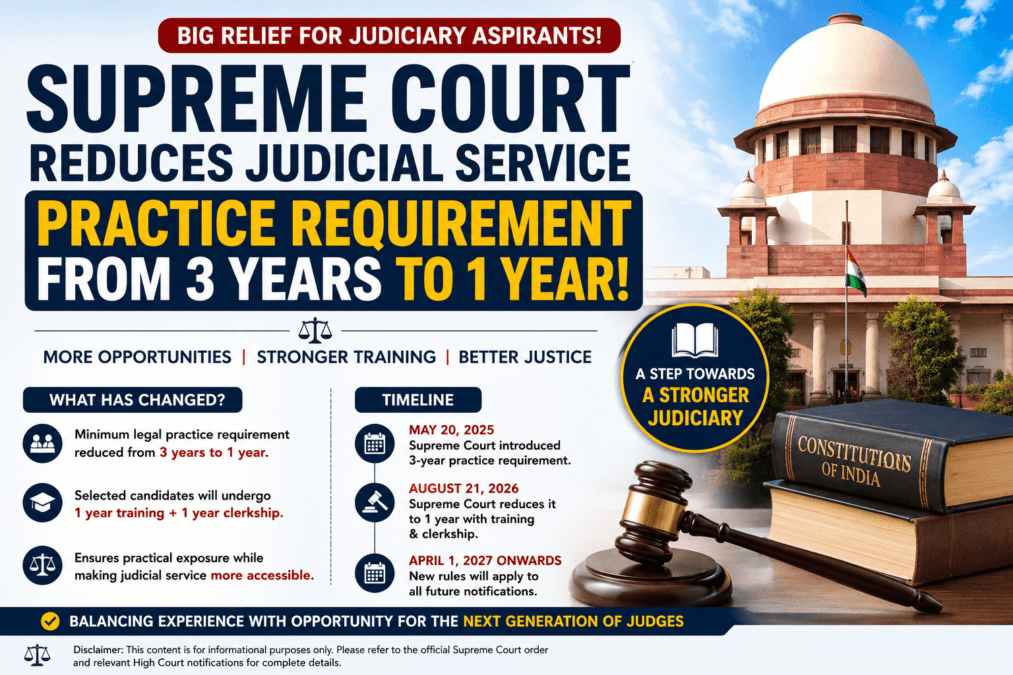
The Supreme Court of India has changed the rules governing direct recruitment to the post of Civil Judge (Junior Division). In its latest review decision, the Court has reduced the earlier three-year legal practice requirement to one year for judicial service examinations notified from April 1, 2027 onward.
The Court has not, however, removed the need for practical legal exposure. Instead, it has created a structured system of judicial academy training and law clerkship for selected candidates.
Supreme Court Judicial Service Rule 2026: What Changed?
The Supreme Court’s latest decision modifies its May 2025 ruling, which had restored a three-year practice requirement for candidates seeking direct entry as Civil Judges (Junior Division).
The Court has maintained its view that practical exposure to the legal profession is important before a person enters the judiciary. However, it found that the earlier three-year requirement needed modification, particularly because its sudden restoration had caused hardship to law graduates who had prepared for judicial examinations under the previous eligibility system.
The result is a new framework combining prior legal practice, judicial training and supervised clerkship.
New Civil Judge Eligibility Rule From April 1, 2027
For judicial service recruitment notifications issued on or after April 1, 2027, candidates appearing for the Civil Judge (Junior Division) examination must have at least one year of active legal practice.
The practice must be capable of verification through the prescribed certificate and record of the candidate’s participation in effective judicial proceedings.
In addition to the one-year practice requirement, selected candidates will have to undergo:
- One year of intensive training at the concerned State Judicial Academy.
- Six months of law clerkship under a District Judge or a member of the Higher Judicial Service.
- Another six months of law clerkship under a sitting Judge of the concerned High Court.
This means that the post-selection practical component will continue for two years.
What Is the Transitional Rule Up to March 31, 2027?
The Supreme Court has created a special transitional arrangement for recruitment notifications issued from May 20, 2025 to March 31, 2027.
During this period, law graduates will be permitted to apply without having to satisfy the earlier three-year practice requirement. For the purpose of applying, they will be treated as having completed one year of active practice and will not have to produce a practice certificate for that deemed period.
However, selected candidates will not immediately become regular judicial officers. They will first be designated as Trainee Judicial Officers.
They will then have to complete:
- One year of intensive training at the State Judicial Academy; and
- One year of structured law clerkship.
How Will the One-Year Law Clerkship Work?
The Supreme Court has prescribed a two-stage clerkship designed to give trainee judicial officers exposure to both the district judiciary and the High Court.
First Six Months: District Judiciary
The first six months will be spent working as a law clerk under the supervision of the Principal District Judge or members of the Higher Judicial Service.
Next Six Months: High Court
The remaining six months will be spent under the supervision of sitting judges of the concerned High Court.
During the clerkship, the trainee will receive emoluments as specified by the Court. At the end of the clerkship, the supervising High Court judge will submit a reasoned evaluation regarding the trainee’s progress and suitability.
Why Did the Supreme Court Reduce the 3-Year Practice Rule?
The Court has not abandoned the principle that a future judge should understand the practical working of courts.
Instead, it has attempted to find a middle path. The earlier three-year rule created a significant waiting period for young law graduates who wanted to enter judicial service. The Court considered that practical experience could also be developed through structured institutional training and supervised clerkship.
In simple terms, the new approach is:
1 year of practice before the examination + 2 years of structured practical training and clerkship after selection.
What Does This Mean for Judiciary Aspirants?
The decision is particularly important for LL.B. students, fresh law graduates and young advocates preparing for Judicial Service Examinations.
The biggest change is that future candidates will no longer need to complete three years of practice before becoming eligible for the Civil Judge examination. From April 1, 2027, the required prior practice will be one year.
At the same time, aspirants should not assume that clearing the examination will result in immediate regular judicial appointment. Practical training and clerkship will form an important part of the revised system.
What Should Law Students Prepare For?
Judiciary aspirants should focus not only on examination preparation but also on developing practical legal skills, including:
- Substantive and procedural law
- Legal research
- Case-law analysis
- Pleading and legal drafting
- Judgment writing
- Court procedure
- Evidence and appreciation of facts
- Advocacy and courtroom skills
The new framework makes practical exposure even more relevant to a candidate’s journey toward becoming a judicial officer.
Does the New Rule Apply to Every Judicial Service Examination?
The Supreme Court’s directions concern direct recruitment to the post of Civil Judge (Junior Division). Candidates must still check the recruitment rules and notification issued by the relevant High Court or State Judicial Service because the actual recruitment process and implementation will be governed by the applicable rules.
Therefore, an aspirant should always verify the latest official notification before applying.
Important Timeline for Judiciary Aspirants
| Recruitment notification | Practice requirement before examination | After selection |
|---|---|---|
| May 20, 2025 – March 31, 2027 | Transitional exemption from the earlier 3-year requirement | 1 year training + 1 year structured clerkship |
| On or after April 1, 2027 | At least 1 year active legal practice | 1 year training + 1 year structured clerkship |
The transitional arrangement is therefore especially important for candidates planning to appear in judicial recruitment examinations before April 2027.
Supreme Court Judgment: Bhumika Trust v. Union of India
The decision was delivered in Bhumika Trust v. Union of India and connected cases, arising from review petitions challenging the Supreme Court’s May 2025 decision on the three-year practice requirement.
The bench comprised Chief Justice of India Surya Kant, Justice Augustine George Masih and Justice K. Vinod Chandran. Justice K. Vinod Chandran dissented from the majority view.
Key Points of the Supreme Court Decision
- The earlier three-year practice requirement has been reduced to one year for future Civil Judge (Junior Division) recruitment.
- The new one-year practice requirement applies to notifications issued on or after April 1, 2027.
- Candidates covered by the transitional period up to March 31, 2027 can apply without satisfying the earlier three-year practice condition.
- Selected transitional candidates will be appointed as Trainee Judicial Officers initially.
- They must complete one year of intensive judicial academy training.
- This will be followed by one year of structured law clerkship.
- The clerkship consists of six months under the district judiciary and six months under a High Court judge.
- Future candidates will have to demonstrate their one year of actual legal practice through the prescribed verification mechanism.
What Is the Main Takeaway?
The Supreme Court has not simply removed the practice requirement. It has restructured the route to the lower judiciary.
For future recruitment, the basic model will be:
1 year legal practice → Judicial Service Examination → 1 year judicial academy training → 1 year structured clerkship → evaluation → regular judicial appointment, subject to the prescribed requirements.
For law students and judiciary aspirants, this is a major development because it reduces the pre-examination practice barrier while placing greater emphasis on supervised practical training after selection.
Frequently Asked Questions (FAQs)
1. Has the Supreme Court removed the practice requirement for Civil Judge recruitment?
No. For recruitment notifications issued on or after April 1, 2027, candidates will need at least one year of active legal practice.
2. Is three years of practice still required?
No. The earlier three-year requirement has been replaced by a one-year practice requirement for future recruitment covered by the Court’s directions.
3. Can fresh law graduates apply during the transition period?
Yes. For notifications issued during the specified transitional period up to March 31, 2027, law graduates can apply without satisfying the earlier three-year practice condition, subject to the Supreme Court’s directions and the applicable recruitment notification.
4. What happens after a candidate is selected?
The selected candidate will undergo one year of intensive training at the State Judicial Academy, followed by one year of structured law clerkship.
5. Where will the clerkship take place?
The first six months will be under the district judiciary, followed by six months under a sitting judge of the concerned High Court.
6. When does the one-year practice requirement become applicable?
It applies to judicial service recruitment notifications issued on or after April 1, 2027.
Final Takeaway for Law Students
The Supreme Court’s latest decision is a significant development in Judicial Service Examination eligibility in India. The Court has reduced the pre-examination practice requirement from three years to one year while introducing a structured two-year practical learning framework after selection.
For judiciary aspirants, the message is clear: the entry barrier has been reduced, but practical legal training has become more important.
Candidates should follow the latest notification issued by their respective High Court or State Judicial Service and should not rely solely on older information about the three-year practice rule.
Explore
- Latest Legal Opportunities
- Internships →
- Judiciary →
- Scholarships
- Fellowships →
- Call for Papers →
- Resume & Interview Preparation →
- Freelancing →
- Law Study Material →
- AI Hub →
Classmate Pulse Spiral Notebook ✏️ Need a Spiral Notebook for Everyday Writing? A spiral notebook…

Latest Scholarships & Fellowships 2026–27: Open Opportunities for Upcoming call
Latest Scholarships & Research Fellowships 2026–27 Last Verified: 30 September 2026 Students, researchers, PhD scholars…
Writing & Research Resources: Useful Books, Tools & Essentials for Writers and Researchers
Whether you are an author, content writer, law student, academic researcher, PhD scholar, teacher, or…
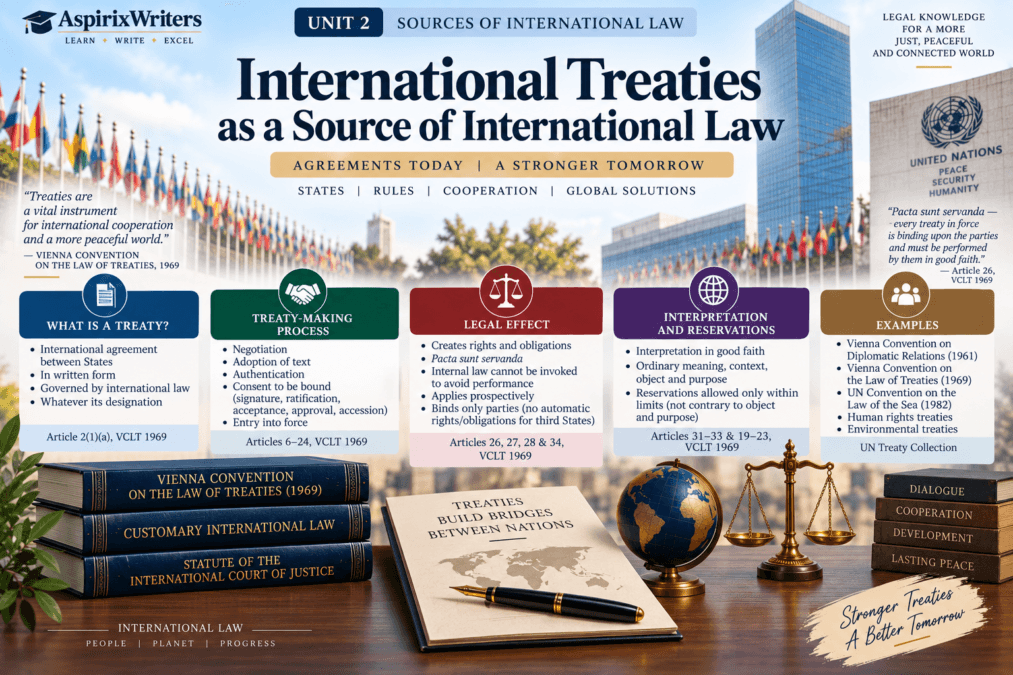
International Treaties as a Source of International Law | LL.B. Notes
International Treaties as a Source of International Law Introduction International treaties are one of the…

The Ultimate Guide to Organizing LLB Notes for Exam Success
LLB Notes for Exam Success Studying law is not simply about reading hundreds of pages….
What Is the Best AI Tool for Legal Research in 2026? A Practical Guide for Lawyers, Law Students and Researchers
What Is the Best AI Tool for Legal Research in 2026? Last updated: September 2026…