
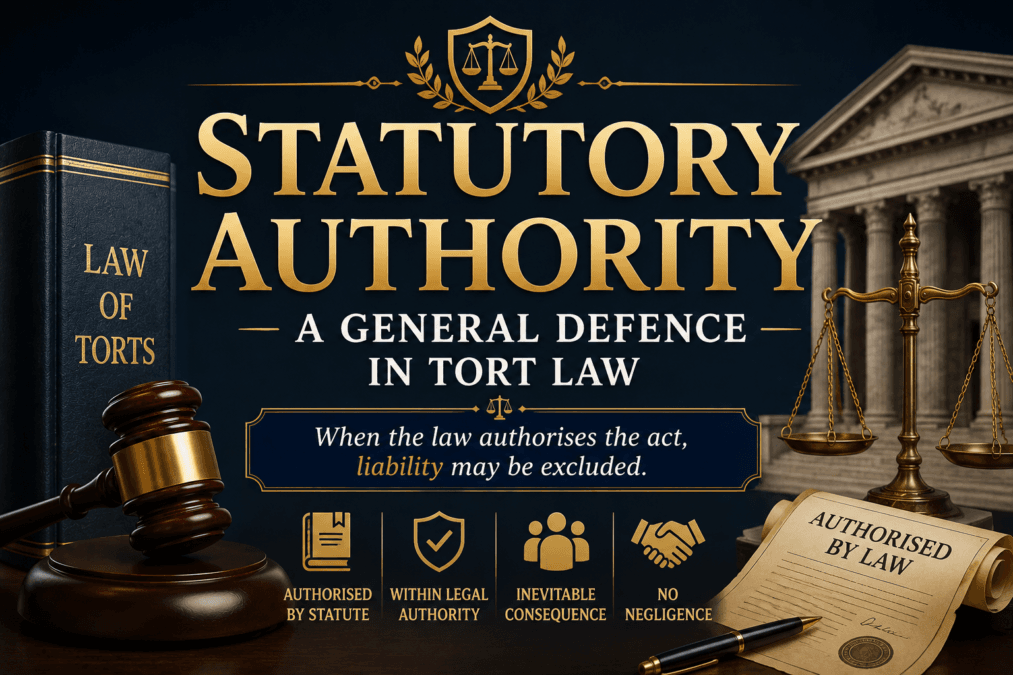
Statutory Authority in Tort Law
1. Meaning of Statutory Authority
Statutory Authority is a general defence in tort law where the defendant shows that the act causing the alleged harm was authorised by legislation, either expressly or by necessary implication.
In simple words:
If the law authorises a person or public authority to do a particular act, liability in tort may be excluded for harm that is an inevitable consequence of carrying out that authorised activity, provided the authority acts within the scope of the law and without negligence.
This defence is particularly important in cases involving railways, public utilities, highways, drainage systems, industries and other activities carried out under statutory powers.
2. The Basic Principle
The principle can be remembered as:
Statutory authority + authorised act + inevitable consequence + reasonable care = defence
However, merely having a licence or statutory power is not automatically a complete defence.
The court examines:
- What exactly does the statute authorise?
- Was the defendant acting within that authority?
- Was the harmful consequence inevitable?
- Could the harm reasonably have been avoided?
- Was there negligence in exercising the statutory power?
3. Essential Conditions of the Defence
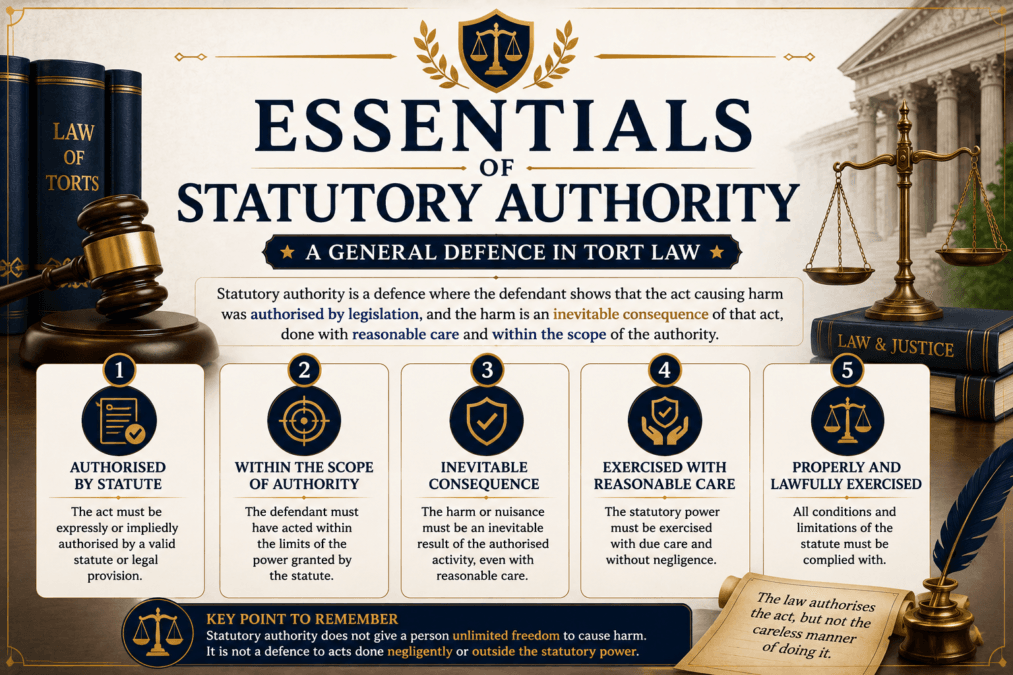
1. The act must be authorised by statute
The defendant must establish that the relevant activity is authorised by legislation.
The authority may be:
Express
The statute specifically authorises the particular activity.
Implied
The activity is not expressly stated but is necessarily implied from the statutory powers granted.
In Allen v Gulf Oil Refining Ltd (1980), the House of Lords recognised that statutory authority may arise through express direction or necessary implication.
2. The defendant must act within the scope of the statute
The defendant cannot rely on statutory authority for conduct that goes beyond the powers granted by legislation.
For example, if a statute authorises construction of a railway at a particular location, the railway operator cannot claim immunity for an unrelated activity simply because it operates under statutory authority.
3. The harm must be an inevitable consequence of the authorised activity
This is one of the most important requirements.
The defence generally applies where the nuisance or harm is an inevitable consequence of the authorised activity, despite reasonable care.
If the harm could reasonably have been avoided, statutory authority may not protect the defendant.
In Allen v Gulf Oil Refining Ltd, the House of Lords explained that immunity could extend to nuisance shown to be the inevitable result of the authorised undertaking.
4. The defendant must not be negligent
Statutory authority does not normally protect negligent execution of the authorised activity.
Thus:
The law may authorise the activity, but it does not generally authorise negligent performance of that activity.
This principle was emphasised in Geddis v Proprietors of Bann Reservoir (1878) and discussed by the House of Lords in Allen v Gulf Oil Refining Ltd.
5. The statutory power must be properly exercised
The defendant must comply with the conditions and limitations imposed by the statute.
If the defendant acts outside the statutory power, the defence will not normally be available.
4. Leading Case —
Vaughan v Taff Vale Railway Co. (1860)
This is one of the most important cases for LL.B. students.
Facts
The railway company was authorised by statute to operate its railway.
Sparks from a properly operated locomotive caused fire damage to the plaintiff’s adjoining property.
The plaintiff claimed compensation.
Decision
The railway company was not held liable because the operation of the railway was statutorily authorised and the damage was an inevitable consequence of properly carrying out the authorised activity, with no additional negligence established.
Principle
Where Parliament has authorised an activity and the harmful consequence is inevitable despite proper care, statutory authority may provide a defence.
Remember
Vaughan → Railway → Sparks → Fire → Statutory authority
Hammersmith & City Railway Co. v Brand (1869)
This is another leading case.
Facts
The construction and operation of a railway caused noise, vibration and other interference affecting neighbouring property.
The railway company relied upon statutory authority.
Principle
Where Parliament has authorised the construction and operation of an undertaking, the statutory authority may protect the defendant against nuisance that is the necessary or inevitable consequence of the authorised activity.
Importance
The case demonstrates that statutory authority can operate even where the authorised activity inevitably affects neighbouring property.
Geddis v Proprietors of Bann Reservoir (1878)
This case establishes an important limitation.
Principle
Statutory authority does not give an undertaking unlimited freedom to cause harm.
The statutory powers must be exercised with reasonable care and regard for the interests of others.
The principle from Geddis has been repeatedly recognised in later cases, including Allen v Gulf Oil Refining Ltd.
Exam point
Statutory authority is not a defence to negligent exercise of statutory powers.
Metropolitan Asylum District v Hill (1881)
This case is important for distinguishing between mandatory and merely permissive statutory powers.
Principle
Where legislation merely gives an authority a permission or discretion to carry out an activity, the authority may not automatically obtain immunity from nuisance.
The scope of the statutory power must be examined carefully.
Simple understanding
Permission to do something ≠ automatic immunity from tort liability.
Allen v Gulf Oil Refining Ltd (1980)
This is a particularly valuable case for advanced LL.B. notes.
Facts
Gulf Oil operated an oil refinery under statutory authority.
Nearby residents complained of alleged:
- unpleasant smells;
- noise;
- vibration;
- emissions; and
- other interference.
The company relied on the Gulf Oil Refining Act 1965 as a defence to nuisance.
Decision
The House of Lords held that the company could rely on statutory authority to the extent that the nuisance was shown to be the inevitable result of the authorised construction and operation of the refinery.
Important principle
The defence is not unlimited.
The defendant must establish that the nuisance was genuinely inevitable in the relevant sense and that the statutory authority covered the activity.
Exam memory
Allen → Oil refinery → Statutory authority → Inevitable nuisance
5. Mandatory vs Permissive Statutory Authority
This distinction is important.
A. Mandatory Statutory Authority
Where the statute effectively requires an authority to undertake a particular activity, and nuisance is an inevitable consequence of properly carrying it out, the defence is stronger.
Example
A statute requires a public authority to construct a particular facility at a specified location.
If some nuisance is unavoidable despite reasonable care, statutory authority may apply.
B. Permissive Statutory Authority
Where the statute merely permits an authority to carry out an activity, the authority generally has greater responsibility to avoid interference with private rights where reasonably possible.
This principle is illustrated by Metropolitan Asylum District v Hill.
6. Statutory Authority Does Not Mean “No Liability”
“The defendant has statutory authority, so the defendant cannot be sued.”
This is incorrect.
The defence is limited.
The defendant may still be liable where:
- the activity was outside the statute;
- the defendant acted negligently;
- the nuisance was avoidable;
- reasonable precautions were not taken; or
- the harm was not an inevitable consequence of the authorised activity.
7. Statutory Authority and Negligence
Suppose a railway is legally authorised.
Situation 1 — No negligence
A properly maintained train emits sparks and, despite all reasonable precautions, causes an unavoidable fire.
The defendant may potentially rely on statutory authority.
Situation 2 — Negligence
The railway company fails to maintain the locomotive properly, and the resulting defect causes sparks and fire.
The company cannot simply say:
“We are authorised by statute.”
The negligent manner of operation may defeat the defence.
8. Statutory Authority vs Act of God
These defences are different.
Act of God
The harm results from an extraordinary natural event.
Example: unprecedented flooding.
Statutory Authority
The defendant relies upon legal authority granted by legislation.
Example: unavoidable nuisance caused by a statutorily authorised railway.
Easy distinction
Act of God = extraordinary natural event
Statutory authority = authority granted by law
9. Statutory Authority vs Necessity
Necessity
The defendant acts to prevent a greater and more immediate harm.
Statutory Authority
The defendant acts under authority granted by legislation.
For example:
- Breaking a door to escape a fire → Necessity
- Operating a railway under a statute despite unavoidable nuisance → Statutory Authority
10. Important Cases — Quick Revision
| Case | Principle |
| **Vaughan v Taff Vale Railway Co. (1860) | Statutorily authorised railway; inevitable consequence may be protected |
| **Hammersmith & City Railway Co. v Brand (1869) | Statutory authority and inevitable consequences of authorised railway |
| **Geddis v Proprietors of Bann Reservoir (1878) | Statutory authority does not protect negligent exercise |
| **Metropolitan Asylum District v Hill (1881) | Permissive statutory power does not automatically create immunity |
| **Allen v Gulf Oil Refining Ltd (1980) | Defence available for nuisance that is the inevitable result of authorised activity |
11. Most Important Cases for LL.B. Students
Vaughan v Taff Vale Railway Co.
Railway + sparks + inevitable consequence
Hammersmith Railway Co. v Brand
Railway + nuisance + statutory authority
Geddis v Bann Reservoir
No immunity for negligent exercise
Metropolitan Asylum District v Hill
Permissive power ≠ automatic immunity
Allen v Gulf Oil Refining Ltd
Inevitable nuisance + statutory authority
12. Exam-Ready Formula
Remember:
Statutory Authority + Within Legal Power + Inevitable Consequence + No Negligence = Defence
And the most important limitation:
A statute may authorise an activity, but it does not generally authorise negligent performance of that activity.
Conclusion
Statutory authority is an important general defence in tort law, particularly in cases involving public utilities, railways, industrial undertakings and other activities carried out under legislative authority. The defence is not automatic merely because the defendant has a statutory power. The defendant must establish that the harmful activity was authorised by law, carried out within the scope of that authority, and that the relevant nuisance or harm was an inevitable consequence of properly exercising the statutory power.
FAQs — Statutory Authority in Tort Law
1. What is statutory authority as a defence in tort law?
Statutory authority is a defence where the defendant proves that the act causing the alleged harm was authorised by legislation and was carried out within the scope of that legal authority.
2. Is statutory authority a complete defence to tortious liability?
Not automatically. The defendant generally needs to show that the activity was authorised by statute and that the relevant harm was an inevitable consequence of properly carrying out the authorised activity.
3. Does statutory authority protect negligent acts?
Generally, no. A statutory power does not normally authorise negligent execution of the activity. Geddis v Proprietors of Bann Reservoir (1878) is an important authority on this limitation.
4. What is the leading case on statutory authority in tort law?
Vaughan v Taff Vale Railway Co. (1860) is a classic case. The railway was statutorily authorised, and the court recognised the defence where the damage resulted from an inevitable consequence of properly operating the authorised railway.
5. What is the difference between statutory authority and necessity?
Statutory authority is based on legal permission granted by legislation, whereas necessity is based on taking reasonable action to prevent a greater harm. Statutory authority concerns the defendant’s legal power to act, while necessity concerns the emergency requiring action.
Classmate Pulse Spiral Notebook ✏️ Need a Spiral Notebook for Everyday Writing? A spiral notebook…

Latest Scholarships & Fellowships 2026–27: Open Opportunities for Upcoming call
Latest Scholarships & Research Fellowships 2026–27 Last Verified: 30 September 2026 Students, researchers, PhD scholars…
Writing & Research Resources: Useful Books, Tools & Essentials for Writers and Researchers
Whether you are an author, content writer, law student, academic researcher, PhD scholar, teacher, or…